
REVIEW · NARA DAY TRIPS
Full Day Nara Deer, Temple, Shrine, Activities & Tea Ceremony
Nara’s famous deer are only the beginning here. This small-group walking tour pairs the big sights, especially Todaiji Temple and Kasuga Taisha, with quieter cultural stops such as Kikuichi’s historic knife shop, Gangoji Temple, calligraphy, origami, and a proper tea ceremony.
I like the useful mix of major sights and hands-on activities. I also like the way the day ends with a certified tea master serving fresh matcha and wagashi in a traditional cafe, rather than squeezing tea into a crowded attraction. The main drawback is the pace: seven hours on foot, with lunch on your own, can feel demanding.
In This Review
- Key points at a glance
- Why this Nara day works
- Meeting the deer in Nara Park
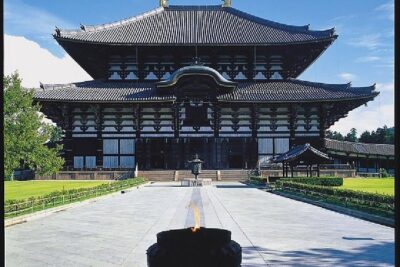
- Todaiji’s Great South Gate and Great Buddha
- Kikuichi and the story of Japanese knives
- Kasuga Taisha and Shinto ideas
- Lunch around Higashimuki Shopping Street
- Origami, calligraphy, and possible costume photos
- Gangoji and the demon story
- A proper matcha ceremony at Shofukutei
- The walking pace, group size, and practical details
- Who should book this experience
- Should you book the Nara day?
- FAQ
- Where does the tour start?
- Where does the tour end?
- How long does the tour last?
- Is this a walking tour?
- What is the maximum group size?
- Is a guide included?
- Is the Todaiji entrance fee included?
- Is lunch included?
- What is included in the tea ceremony?
Key points at a glance
- Todaiji’s Great Buddha: Enter one of Nara’s essential temples and see Japan’s largest bronze Buddha statue.
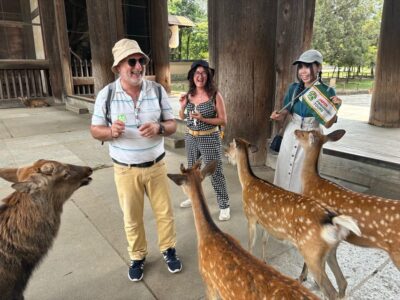
- Deer cookies included: Walk through Nara Park and share deer crackers with the animals, using sensible care around them.
- Kikuichi knife tradition: Visit the original shop of a former katana maker and learn about Japanese cutlery.
- Hands-on Japanese arts: Make deer origami, practice calligraphy, and possibly dress in a kimono or another outfit for photos if time allows.
- A quieter tea ceremony: Finish with matcha and handmade wagashi led by a certified tea master.
- Small group format: The tour accepts no more than 12 people, with a bilingual local guide and mobile ticketing.
Why this Nara day works
Nara is easy to visit independently, but it is also easy to reduce to a quick deer photo and a walk through Todaiji. This tour gives the day a clear shape and adds context at places you might skip on your own.
You begin at 9:00 am near Nara’s Higashimuki shopping area and finish back at the same meeting point. The day lasts about seven hours. That is long enough to see the main sights without making the tour feel like a rushed checklist, though you should expect plenty of walking.
The group size matters. With a maximum of 12 people, your guide can explain details without trying to address a large crowd. Past guides have included Harry and Remi. The available feedback especially praises friendly, clear explanations of Japanese religions, local stories, and traditions. One guide also led the experience in German, while another family outing with Remi included both the Nara sights and calligraphy.
The tour is listed at $110.55 per person. I see reasonable value here if you want admission to Todaiji and Gangoji, a bilingual guide, cultural activities, deer cookies, and a tea ceremony in one day. It is less attractive if you plan to visit the temples independently and mainly want time with the deer. Lunch, drinks, shopping, and souvenirs are extra.
More day trips to Nara:
- World Heritage Kyoto & Nara Uji Authentic Matcha Experience
★ 5.0 · 1,573 reviews - Nara Half Day Trip Walking Tour (Private Option Available)
★ 5.0 · 937 reviews - Nara Early Morning Tour (Kyoto or Osaka Departure Available)
★ 5.0 · 676 reviews
Meeting the deer in Nara Park
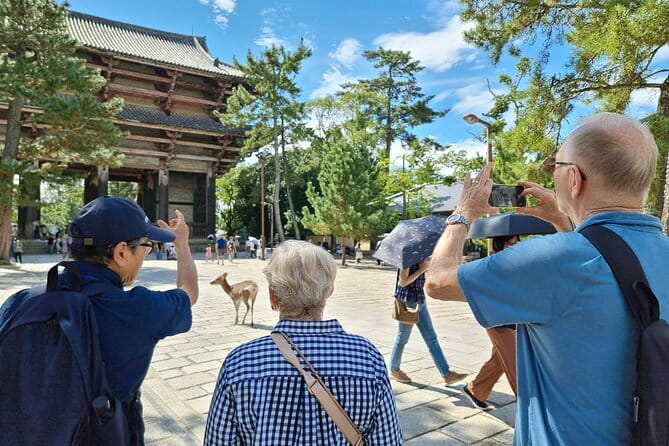
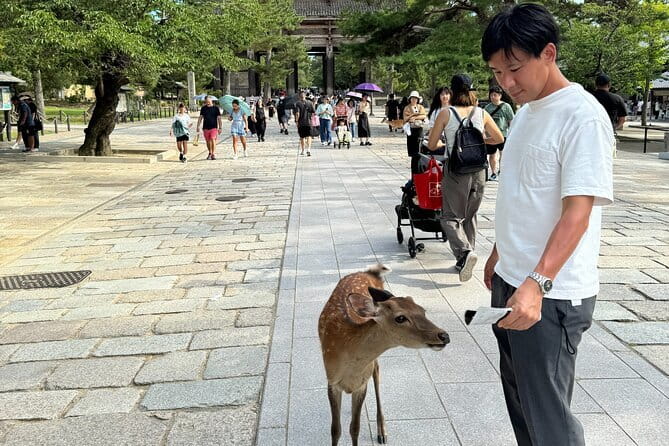
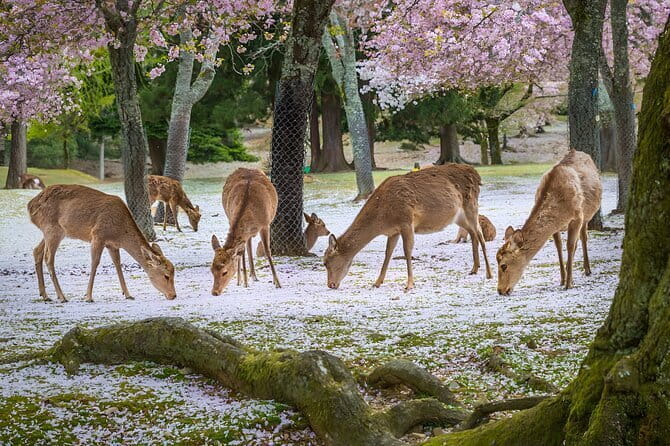
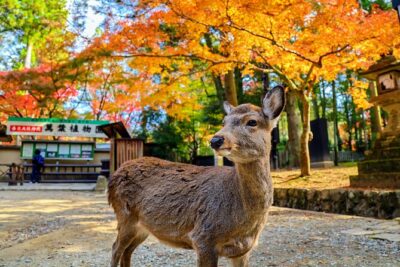
Nara Park is the visual heart of the day. The route takes you through the park between the temple and shrine stops, giving you time to see how closely the deer share space with the city.
Deer cookies are included for sharing. This sounds simple, but it is one of the most memorable parts of a Nara visit. You should follow your guide’s advice and keep the interaction controlled. The animals are accustomed to people, but feeding wildlife still calls for care, particularly when several deer gather around you.
The park is not just a photo stop. Your guide helps you follow a practical route between the major sites and explains the connection between Nara’s religious places and the deer. The deer are tied to the spiritual identity of the area, especially around Kasuga Taisha, so seeing them before and after the shrine visit gives the day more meaning.
One point to plan for: the deer portion is outdoors and comes during a walking-heavy day. Wear comfortable shoes and expect uneven stretches of walking. The tour information says most people can participate, but it does not promise a low-walking route.
Todaiji’s Great South Gate and Great Buddha
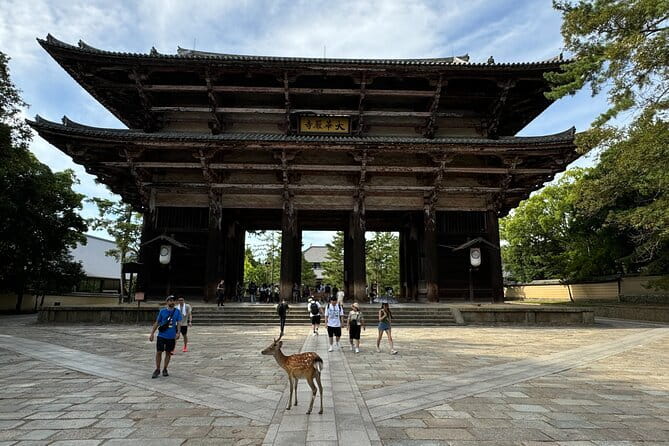
Your first formal sight is Todai-ji’s Namdaimon, or Great South Gate. It is a fitting entrance to the temple grounds, with large guardian figures that give the gate a serious, almost theatrical presence.
You have around 35 minutes here. That is enough to appreciate the gate, its architecture, and the two fierce guardians without lingering for a full architectural study. I like starting here because it lets you see the scale of Todaiji before entering the main temple.
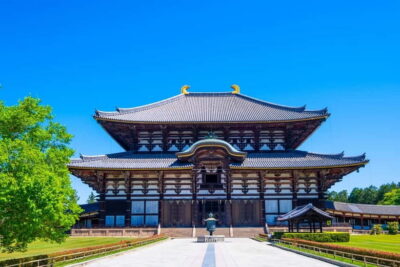
Next comes Todaiji Temple itself, with about 50 minutes inside. Entrance is included. The main draw is the enormous bronze Buddha, identified here as the largest bronze Buddha statue in Japan. Even if you are not deeply interested in Buddhist art, the size of the hall and statue makes this a powerful stop.
The free time inside is useful. Rather than having your guide narrate every step, you get room to look around at your own pace while still receiving historical background. Fifty minutes is not an entire morning, so you will need to keep moving if you want to see the hall carefully.
Todaiji is one of Nara’s essential visits, and this tour handles it sensibly. You receive the explanation and admission, but you also get personal time. If you want long periods for photography, detailed reading, or quiet reflection, you may find the schedule tight.
Kikuichi and the story of Japanese knives
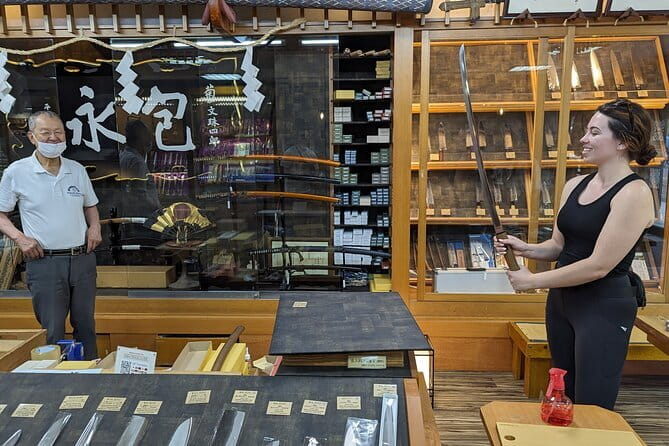
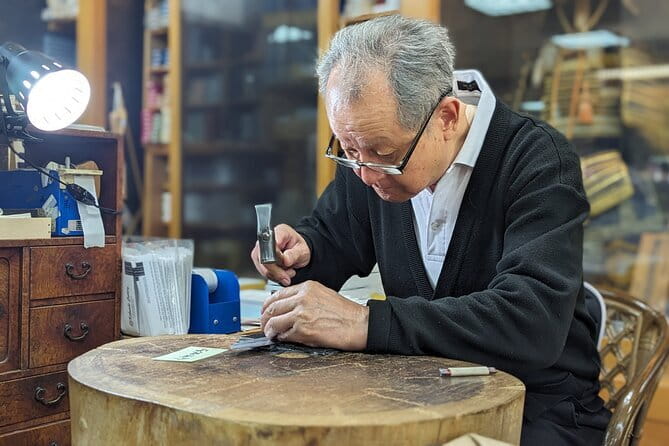
Kikuichi Monju Shiro Kanenaga offers a different view of Japanese tradition. The company is presented as a prestigious cutlery maker with an original shop in Nara and a background as a former katana maker.
You spend about 35 minutes here. The stop includes an introduction to Japanese cutlery and advice about Japanese knives if you need it. That makes it more useful than a generic shopping break. You can learn why knives matter in Japanese food culture and how the craft connects to older sword-making skills.
Shopping is optional and not included in the price. That distinction is important. You should not feel that the stop is simply a sales pitch, but anyone interested in kitchen tools may want time to ask questions and compare items. The tour information does not specify shipping services, prices, or luggage arrangements, so treat purchases as your own responsibility.
I like this stop because it gives the day a human craft element. Temples can begin to blur together on a long sightseeing day. A working knife tradition changes the rhythm and gives you something practical to remember after returning home.
More tea ceremonies in Nara:
- Nara:Authentic Tea Ceremony(Max 5 ppl) -Master Matcha Making
★ 5.0 · 119 reviews - Nara:5 Type of Tea Tasting & Mindful Tea Ceremony
★ 5.0 · 28 reviews - Nara:Tea Tasting&Private Tea Ceremony -Master Matcha Making-
★ 5.0 · 19 reviews - Nara:Private Tea Ceremony(Max 5 ppl) -Master Matcha Making-
★ 5.0 · 3 reviews
Kasuga Taisha and Shinto ideas
Kasuga Taisha is the day’s main shrine visit. You spend about 40 minutes learning about the shrine, Shinto, and the spirit of Kasuga, described through nature and the sacred character of the place.
The approach is known for its lantern path, which gives the visit a strong visual identity. Your guide can help explain how a shrine differs from a Buddhist temple, a useful distinction when you are visiting several religious sites in Nara.
The time here is enough for an introduction, a look at the lanterns, and a focused visit. It is not designed for an unhurried exploration of every corner. That is the tradeoff of fitting so many parts of Nara into one day.
The order of the park and shrine also works well. You first see the deer in their everyday setting, then learn about the spiritual connection between deer, nature, and Kasuga. I would pay attention to the explanations here, because they make the park feel like more than an attractive place to feed animals.
Lunch around Higashimuki Shopping Street
Around midday, you return toward Nara’s west side and receive about 45 minutes of free time for lunch near Higashimuki Shopping Street. Lunch is not included, and food and drinks are also excluded from the tour price.
This arrangement gives you choice. You can pick what suits your budget and appetite instead of accepting a fixed restaurant menu. The limit is time. Forty-five minutes is a practical lunch break, not an invitation to settle into a long meal.
You meet the guide again at a preset location for the afternoon section. Listen closely to those meeting instructions. A shopping street can be busy, and losing time here could cut into the craft activities or temple visit.
The location is convenient because the starting point is already at 7-Eleven, 30-1 Higashimuki Kitamachi, near public transportation. You do not need to arrange a separate transfer during the tour. Still, the experience is a walking tour, not a coach tour, so plan your energy accordingly.
Origami, calligraphy, and possible costume photos
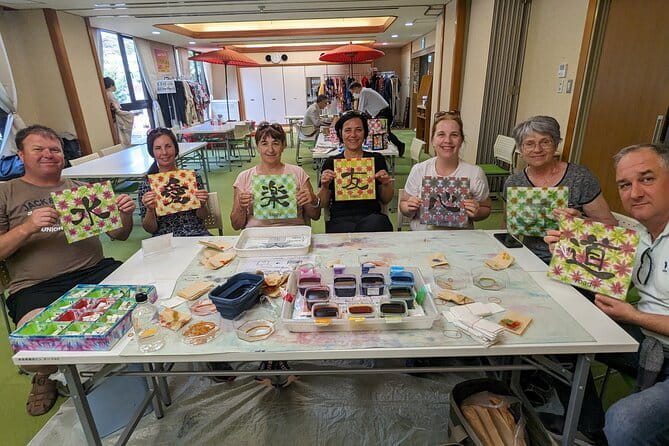
The cultural activity session at Nara Visitor Center & Inn lasts about one hour. You learn basic origami and calligraphy, create a deer origami figure, and write your name in Katakana or Kanji.
This is a smart addition for families and for anyone who wants to take home something made during the trip. A small paper deer and a written Japanese name are more personal than another souvenir bought in a shop. The activities also give you a short indoor break after the morning outside.
The session is described as an introduction, not a full art lesson. You should expect guided practice rather than advanced instruction. The value comes from trying the forms yourself and learning how Japanese writing and paper folding are used.
If time allows, you may be able to wear a kimono or other costumes and take photographs. This is not guaranteed, so do not book the tour solely for the costume photos. The calligraphy and origami are the dependable parts of this stop.
Gangoji and the demon story
Gangoji Temple brings you back to Nara’s older Buddhist tradition. It is one of Nara’s five World Heritage Sites and one of the city’s seven great temples. The tour presents it as technically the oldest temple in Japan still standing.
You have about 45 minutes here, with admission included. Gangoji is a useful counterpoint to the grandeur of Todaiji. Instead of focusing only on Japan’s biggest bronze Buddha and largest temple spaces, the tour introduces a site tied to the earliest period of Japanese Buddhism.
Your guide also tells the unusual origin story of the demon of Gangoji. That story gives the visit a stronger sense of place than a list of dates would. I like this kind of local tale because it helps you remember the temple and shows how religious sites often carry both formal teachings and old folklore.
The temple stop is another reason the tour is worth considering for first-time visitors. You receive a broad view of Nara’s sacred sites instead of spending the entire day at the two most famous locations.
A proper matcha ceremony at Shofukutei
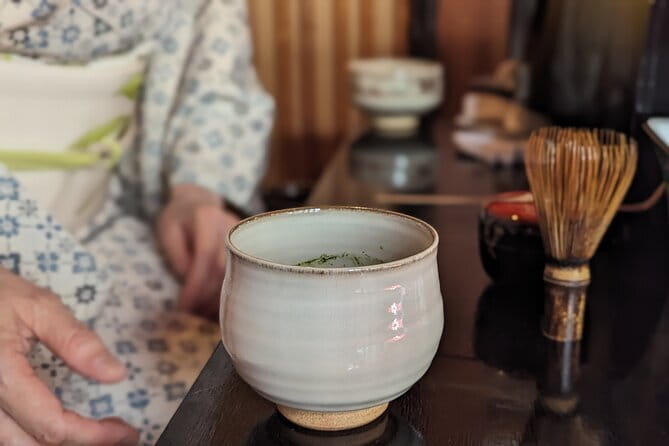
The final stop is Shofukutei, a traditional cafe where a tea master and her husband welcome the group. The tea ceremony lasts about one hour and includes matcha and a handmade wagashi sweet.
The tea master is certified, and the matcha is prepared fresh in front of you. That detail matters. You are not simply handed a cup of green tea in a tourist cafe. You see the tea prepared as part of a formal cultural practice, then enjoy it with a traditional sweet designed to pair with the tea.
The setting is described as away from crowded and overpriced tourist spots. That does not mean the ceremony is private, but the small-group size should make the experience more personal than a large staged demonstration.
I would save your questions for this part of the day. After seeing temples, shrines, deer, and crafts, the tea ceremony gives you a calm place to connect the pieces. You learn through the actions, the tools, the serving style, and the taste of the matcha.
Some people may find a formal tea ceremony too structured. If you prefer casual cafes and a quick drink, this hour may feel slow. If you want a clear introduction to one of Japan’s best-known traditions, it is one of the strongest parts of the program.
The walking pace, group size, and practical details
The tour starts at 9:00 am at the 7-Eleven at 30-1 Higashimuki Kitamachi in Nara. It ends at the same meeting point. The location is near public transportation, but the tour itself is on foot.
You should be comfortable walking for most of the day, standing in temple and shrine areas, and moving between stops. The schedule includes about 35 minutes at the Great South Gate, 50 minutes at Todaiji, 35 minutes at Kikuichi, 40 minutes at Kasuga Taisha, 45 minutes for lunch, one hour for crafts, 45 minutes at Gangoji, and one hour for tea. The park walking connects these stops and adds to the total.
The maximum group size is 12 people. A bilingual local guide is included. The available experiences show that guides may lead in different languages, including German, but you should confirm the language you need when booking rather than assume it.
Mobile ticketing keeps the entry process simple. Todaiji and Gangoji admission fees are included, as are the craft activities, deer cookies, and tea ceremony. Bring money for lunch, drinks, shopping, and souvenirs.
Free cancellation is available up to 24 hours before the start time for a full refund. Changes or cancellations inside that window are not refunded, and the experience requires a minimum number of participants. These rules are worth checking before you commit, especially if your Nara day depends on a tight train schedule.
Who should book this experience
I would choose this tour if you want one organized day covering Nara’s main sights and smaller cultural stops. It is especially useful for first-time visitors who want help understanding the difference between temples and shrines, the place of deer in Nara’s identity, and the basics of Japanese arts.
Families may like the deer cookies, origami, calligraphy, and possible costume photographs. Couples and solo visitors may prefer the tea ceremony and the smaller group. Anyone interested in Japanese food preparation or crafts should pay attention to the Kikuichi stop.
I would hesitate if you dislike scheduled walking tours, want a long independent visit inside Todaiji, or prefer to choose every meal and stop yourself. The day has several fixed times, and lunch is short. It also packs many different experiences into one route, so none receives a very long, leisurely visit.
Should you book the Nara day?
Book it if you want a well-shaped introduction to Nara that goes beyond the deer and Great Buddha. The combination of Todaiji, Kasuga Taisha, Gangoji, Kikuichi, calligraphy, origami, and a certified tea ceremony gives you a broad day for $110.55, especially with two temple admissions and tea included.
Skip it if your priority is freedom and slow sightseeing. You can visit the headline temples independently, spend longer in the park, and choose your own cafe. But for a first Nara visit, I like the balance here: famous places in the morning, hands-on culture in the afternoon, and matcha to finish.
FAQ
Where does the tour start?
The tour starts at 9:00 am at the 7-Eleven located at 30-1 Higashimuki Kitamachi, Nara, 630-8214, Japan.
Where does the tour end?
The activity ends back at the meeting point.
How long does the tour last?
The tour lasts approximately seven hours.
Is this a walking tour?
Yes. The experience is specifically described as a walking tour, with walking through Nara Park between the main stops.
What is the maximum group size?
The tour can have a maximum of 12 travelers.
Is a guide included?
Yes. A bilingual local guide is included.
Is the Todaiji entrance fee included?
Yes. The Todaiji Temple entrance fee is included in the tour price.
Is lunch included?
No. You have about 45 minutes of free time to buy lunch around Higashimuki Shopping Street. Food and drinks are not included.
What is included in the tea ceremony?
The tea ceremony fee is included, along with freshly made matcha green tea and a traditional handmade wagashi sweet.
More Shrines in Nara
- E-Bike Nara Highlights – Todaiji, Knives, Deer, Shrine
★ 4.8 · 186 reviews - Nara: Great Buddha, Kasuga Shrine & Deer Park Tour
★ 4.8 · 62 reviews - E-Bike Nara Highlights – Todaiji, Knives, Deer, Shrine, and Gems
★ 4.5 · 34 reviews - KYOTO Tea Ceremony with kimono near by Imamiya Jinjya Shrine
★ 5.0 · 343 reviews
More Temples in Nara
- Nara: Essential Private Tour with Deer Park and Temples
★ 5.0 · 24 reviews - Relax in Nara: Deer Park, Todai-ji Temple and Merchants’ Town
★ 5.0 · 6 reviews - Nara Heritage Walkabout from Nara Park to Todaji-ji temple
★ 5.0 · 5 reviews - Nara City Tour | Explore Temples, Park & Local Highlights
★ 4.8 · 5 reviews
Recently added around Nara
- Nara Private Customizable Half Day Tour★ 5.0 · 3 reviews
- Nara: Essential Private Tour with Deer Park and Temples★ 5.0 · 3 reviews
- Discover the Essence of Nara Ink Through Your Senses★ 5.0 · 3 reviews
- Private Journey in Nara’s Historical Wonder★ 5.0 · 3 reviews
- Nara:Private Tea Ceremony(Max 5 ppl) -Master Matcha Making-★ 5.0 · 3 reviews
- Nara Takayama Tea Whisk Craft and Tea Culture Experience★ 5.0 · 3 reviews
- Nara: Half-Day Private Tour of 4 Must-See Spots & Deer Park★ 5.0 · 3 reviews
- Udon and Tempura Cooking Class in Nara★ 5.0 · 3 reviews
Nara Day Trips, compared.
World Heritage Kyoto & Nara Uji Authentic Matcha Experience
Read our review →
Kyoto/Osaka: Nara, Fushimi Inari Taisha, Arashiyama Bus Tour
Read our review →
Nara Half Day Trip Walking Tour (Private Option Available)
Read our review →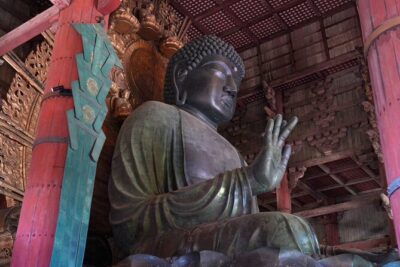
Nara Early Morning Tour (Kyoto or Osaka Departure Available)
Read our review →
Kyoto/Osaka: Kinkakuji, Bamboo Forest, and Nara Deer Park
Read our review →Browse the lists this tour appears in