
REVIEW · NARA DAY TRIPS
Kyoto and Nara Day Trip from Kyoto
Kyoto’s polished Golden Pavilion and Nara’s enormous bronze Buddha make a fine one-day pairing, especially if you want Japan’s old capitals explained rather than simply photographed. The tour also adds Nijo Castle, where shogun-era power feels surprisingly close at hand, and Kyoto Imperial Palace.
I like the efficient air-conditioned bus, which saves you from piecing together several train and local bus rides. I also like the guides’ personal touch: guides such as KC, Momo, Yuki, Yoshito, Tammy, and Etsuko have been praised for clear English, humor, history, and keeping groups moving. The drawback is the pace. You get a strong first look, but Nara in particular can feel short on free time.
In This Review
- Key points to know before booking
- Why this Kyoto and Nara day trip works
- Nijo Castle and the sound of shogun power
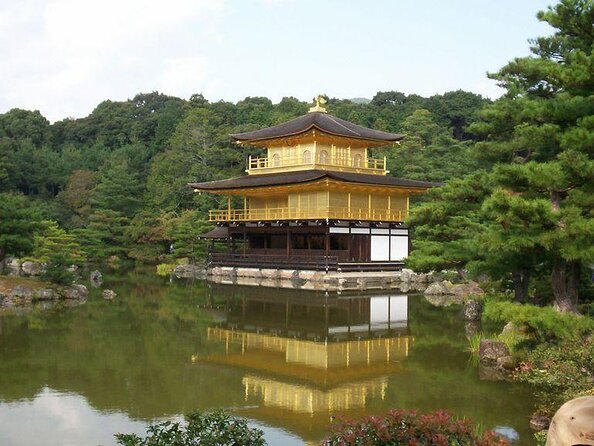
- Kinkaku-ji, Kyoto’s gold beside the pond
- Kyoto Imperial Palace and the backup plans
- The ride south to Nara
- Todai-ji and the Great Buddha
- Kasuga Shrine and lantern-lined paths
- Nara Park and the deer
- What the guides add
- Who should book this tour
- Practical details that matter
- Should you book it?
- FAQ
- How long does the Kyoto and Nara tour last?
- Where does the tour begin and finish?
- Which sights are included?
- Is lunch included?
- What happens if Kyoto Imperial Palace or Nijo Castle is closed?
- How large is the tour group?
- Can I cancel for a full refund?
Key points to know before booking
- Five major sights in one long day: Nijo Castle, Kinkaku-ji, Kyoto Imperial Palace, Todai-ji, and Kasuga Shrine.
- The Great Buddha is the day’s grand finale: Todai-ji’s wooden hall and vast bronze statue are genuinely hard to forget.
- A guide adds useful context: The best guides, including KC, Momo, Yuki, and others, mix historical facts with humor and practical help.
- Expect plenty of walking: Nijo Castle requires shoes to be removed, and the Nara stops involve long walks between the bus and sights.
- Lunch is optional: Select no lunch, a Western-style set menu, or an Indian thali when booking. Meal requests must be made in advance.
- The group can reach 40 people: This is organized sightseeing, not a private or slow-paced tour.
Why this Kyoto and Nara day trip works
At about 10 to 11 hours, this is a big day. You meet at the JTB Sunrise Tours Desk in the basement of Kyoto Avanti at 8:20 a.m., near Kyoto Station, and return to Kyoto Station around 6:30 p.m. There is no hotel drop-off, so plan to make your own way back after the tour.
That long stretch lets you cover two historic cities without changing trains or working out local transport at every stop. The bus is air-conditioned, and admission fees and transportation are included. For a first visit, that convenience has real value.
At $194.85 per person, the price is not bargain-basement. Still, the cost includes several paid entrances, an English-speaking national government licensed guide, and a full day of transport. If you tried to arrange all five stops alone, you might spend less on basic transportation, but you would give up the ease of a prepared route and the historical explanation.
The trade-off is control. You will follow the group’s departure times, and seats may not be assigned. A maximum of 40 people keeps the tour from becoming enormous, but this is still a standard group outing. You need to watch the clock and return to the bus promptly.
More day trips to Nara:
- World Heritage Kyoto & Nara Uji Authentic Matcha Experience
★ 5.0 · 1,573 reviews - Kyoto/Osaka: Nara, Fushimi Inari Taisha, Arashiyama Bus Tour
★ 4.7 · 1,275 reviews - Nara Half Day Trip Walking Tour (Private Option Available)
★ 5.0 · 937 reviews
Nijo Castle and the sound of shogun power
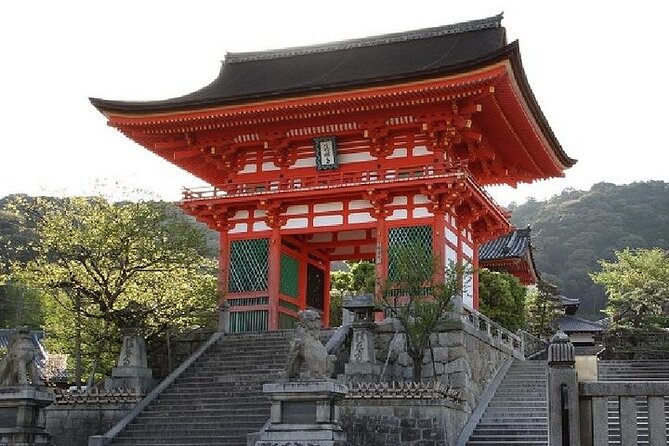
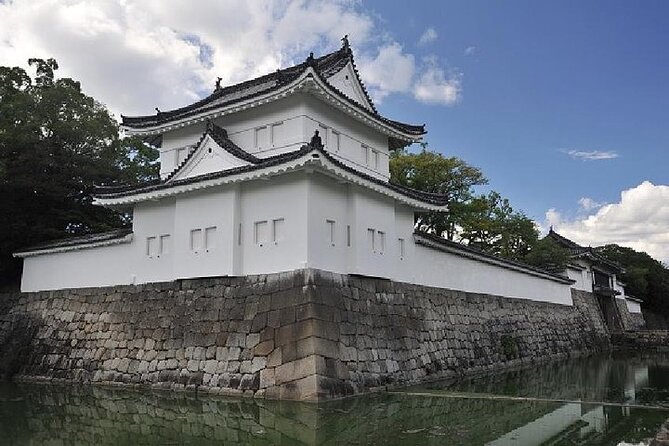
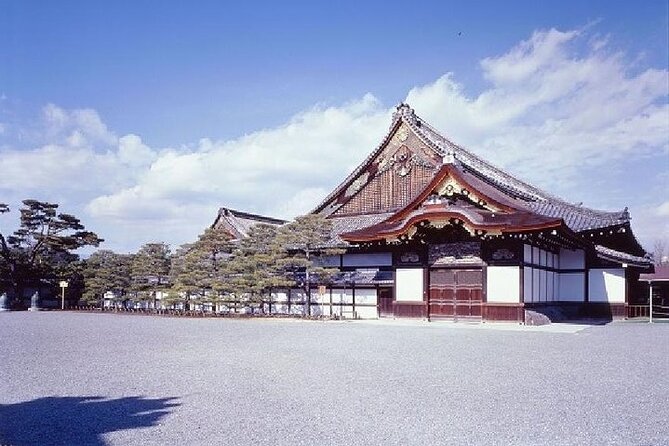
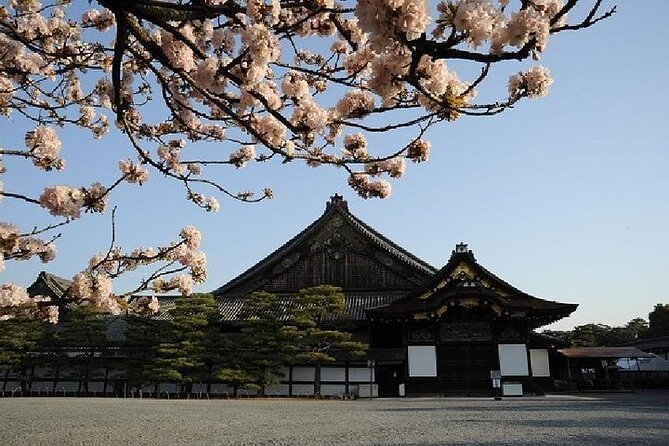
Your first stop is Nijo Castle, built in 1603 and completed in its present form in 1626. It served as lodging for the Tokugawa shogun in Kyoto and also protected the nearby Imperial Palace.
The castle is valuable because it shows a side of Japan that temples alone cannot. Its exterior has a formal, guarded look, while the interior is filled with elaborate carvings and decoration. The contrast helps you understand that this was both a residence and a political statement.
Allow about 50 minutes. That is enough to see the key areas with a guide, but not enough for a slow inspection of every detail. You will also remove your shoes inside, so wear footwear that is easy to take off and put back on.
This stop rewards attention. Look beyond the grand appearance and listen for the details about shogun rule, imperial authority, and the way architecture expressed rank. A good guide can turn rooms and carvings into a readable account of how power worked in old Japan.
Kinkaku-ji, Kyoto’s gold beside the pond
Kinkaku-ji, the Golden Pavilion, is the most instantly recognizable stop of the morning. The three-story wooden building is covered in thin layers of gold leaf and sits beside a pond in a carefully arranged garden.
You get about 45 minutes here. The famous view is compact, so your first photographs may come quickly. After that, use the remaining time to walk the garden path and take in the setting rather than treating the pavilion as a single photo stop.
Kinkaku-ji is popular for good reason, but popularity affects the experience. You may find the approach busy, and the fixed schedule does not allow for a long, quiet garden walk. Even so, it is one of those places that deserves its place on a first Kyoto visit.
The guide’s explanation also matters here. The building is not just a shiny landmark. It connects religious, artistic, and political ideas, and the setting shows how Japanese garden design frames a structure rather than merely surrounding it.
Kyoto Imperial Palace and the backup plans
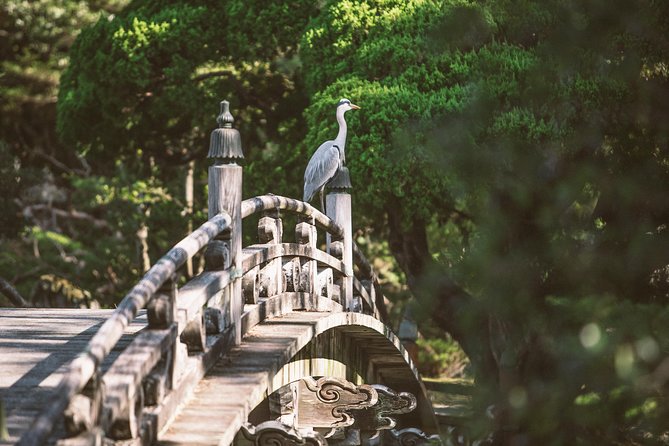
The Kyoto Imperial Palace was the Emperor’s residence until roughly 150 years ago. The tour spends about 40 minutes around the palace grounds and the Shishin-den, the hall associated with important state ceremonies.
This is a calmer counterpoint to Kinkaku-ji. Instead of focusing on one glittering building, you get a sense of imperial scale, ceremony, and open grounds. It helps round out the morning by showing the institution that existed alongside the shogunate.
The palace is closed to visitors on Mondays, on the following day when Monday is a holiday, and on dates affected by an Imperial Household Agency event. When that happens, the tour visits Kitano Tenmangu Shrine instead. If the closure falls on the 25th, the substitute is Nishi Hongan-ji Temple.
These changes are important to understand before you pay. The replacement site is included as part of the operating plan, but no refund is offered if an alternative is used. Nijo Castle also has closure dates, including certain Tuesdays in January, July, August, and December, plus December 26 through January 3. If it is closed, Ryoan-ji Temple replaces it.
A few more Kyoto experiences worth comparing
- PERFECT KYOTO 1-Day Bus Tour
★ 5.0 · 13,518 reviews - Kyoto: Fushimi Inari, Kinkakuji, Bamboo Grove 1 Day Bus Tour
★ 4.8 · 4,316 reviews - 10 Must-see Spots in Kyoto One Day Private Tour (up to 7 people)
★ 5.0 · 1,108 reviews - From Kyoto/Osaka: Kyoto Top Highlights 1-Day Guided Bus Tour
★ 4.5 · 714 reviews
The ride south to Nara
After the Kyoto sights, the bus heads south toward Nara. The ride gives the guide time to connect Kyoto’s political and religious story with Nara’s earlier role in Japanese history. This is one of the less tiring parts of the day because you can sit down, cool off, and reset before the afternoon walking.
If you select a lunch option, the meal is included. The Western-style choice is a set menu. The Indian thali includes three curries, vegetable pakora, yogurt, naan or roti, rice, salad, and one non-alcoholic drink, and is suitable for vegetarians.
You must choose the meal type when booking. Vegetarian requests for the Western meal also need to be provided in advance. Halal and gluten-free meals are not available, and you cannot switch between the Western and Indian dining areas on the day.
The no-lunch option gives you free time to eat independently in the Kyoto Station area, according to the provided details. If you want the simplest day, select a meal. If you have strict dietary needs, the no-lunch option may offer more control, but you should plan that choice carefully.
Todai-ji and the Great Buddha
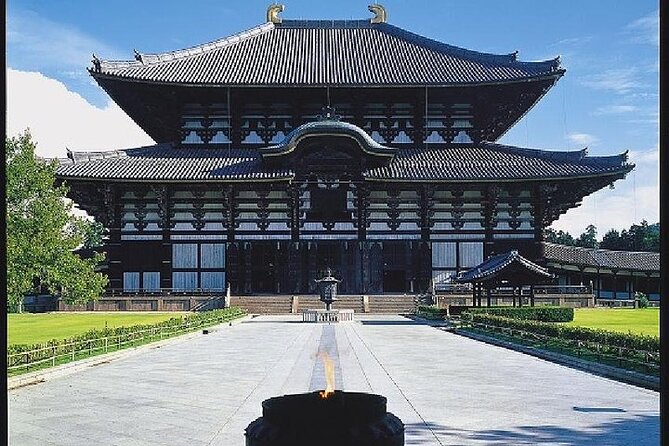
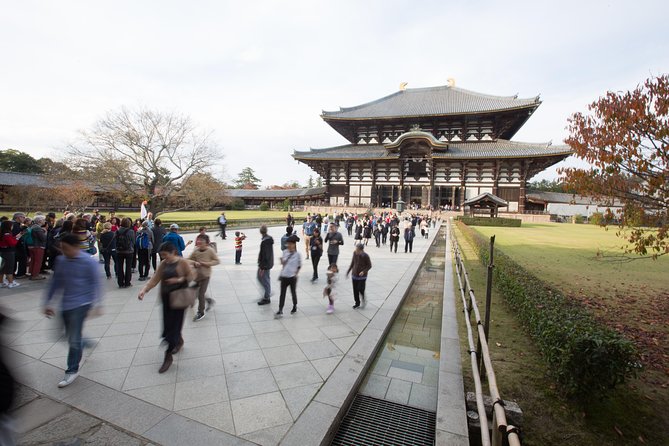
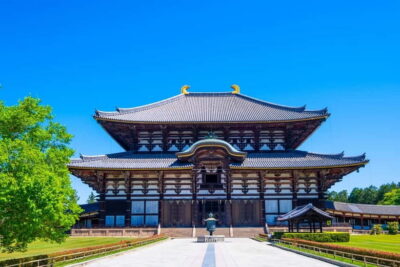
Todai-ji is the afternoon’s strongest sight. The temple complex is a World Heritage site and is known for one of the world’s largest bronze Buddha statues. Its Great Buddha Hall is also one of the world’s largest wooden structures.
You have about 1 hour and 10 minutes here. The scale does the work immediately. The hall feels immense, and the bronze Buddha gives the visit a sense of weight that smaller temple interiors cannot match.
This is where the tour’s broad historical theme comes together. Nijo Castle showed shogun authority. Kyoto Imperial Palace represented the imperial court. Todai-ji shows the reach of Buddhism and the resources devoted to religious projects in the Nara period.
The main limitation is time. Todai-ji includes more than one building and plenty of surrounding space, but the group schedule means you should stay aware of the meeting point. If you want to study every statue, hall, and museum, you will need a separate Nara visit.
Kasuga Shrine and lantern-lined paths
Kasuga Grand Shrine is a Nara-period shrine and a World Heritage site. It is associated with more than 3,000 lanterns, and Nara’s deer are traditionally regarded as messengers of the shrine.
The visit lasts about an hour. The approach through the wooded grounds gives the afternoon a different mood from the formal buildings of Kyoto. You will see a shrine tied closely to the religious traditions of Nara, not just another impressive structure to check off.
From January 2025, the schedule includes entry to the Main Sanctuary special visit area. That access can be affected by events or operating conditions. If it is unavailable, the Kasuga Taisha Museum or Todaiji Museum is substituted, with no refund for the change.
This stop can feel less immediately dramatic than Todai-ji, but it rewards a slower eye. Notice the lanterns, the approach, and the connection between shrine practice and the surrounding park. The guide’s explanation is especially useful because the symbols can otherwise pass by quickly.
Nara Park and the deer
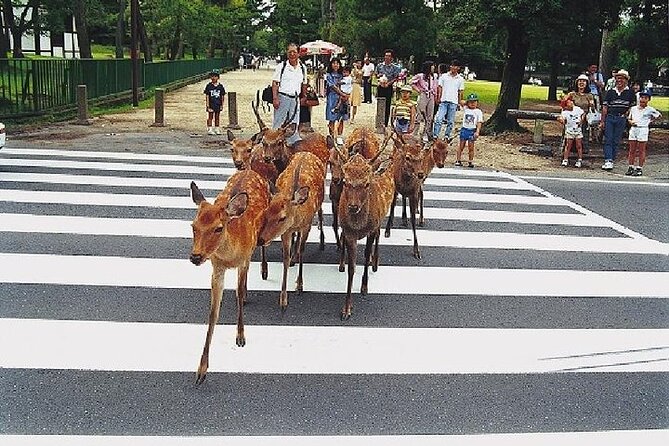
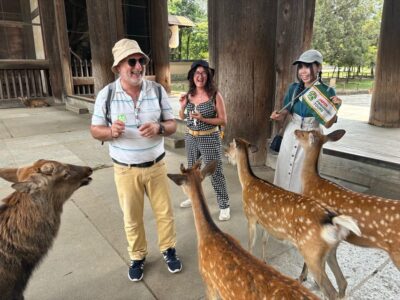
The day finishes around Nara Park’s famous free-roaming deer. This is the lighthearted part of the tour, but it still needs a little care. The deer are used to people and can approach closely, particularly if food is present.
Listen to the guide’s warnings and keep track of your belongings. One guide specifically warned that some deer can be more forceful than expected. They are charming, but they are not tame pets.
The park is also where the time pressure becomes most noticeable. The walk from the bus area to the sights and back can be long, and you may wish for more time to wander. If your main reason for visiting Nara is the deer, a dedicated Nara day will give you much more freedom.
Still, pairing the deer with Todai-ji and Kasuga Shrine is sensible for a first introduction. You get nature, religious history, and one of Japan’s most famous statues in a single afternoon.
What the guides add
The guide can make or break a full day like this. The strongest examples from this operation include KC, Momo, Yuki, Yoshito, Tammy, and Etsuko. Guide assignments can vary, so you should not book expecting one particular person, but the praised qualities are clear: strong English, humor, historical detail, and careful timing.
KC is described as answering questions before they were asked and keeping the group laughing. Momo is noted for a warm personality and a firm but polite approach to keeping people on schedule. Yuki is praised for explaining history and culture during the bus ride as well as at the sites.
That kind of guidance is useful in Kyoto and Nara because the buildings can blur together when you visit several in one day. A good explanation gives each stop a role in the larger story. It also helps with practical matters such as where to meet, when to return, and how to handle the deer.
There is one caution. A group tour depends on everyone following instructions. Arriving late at the bus can affect the whole schedule, so do not treat the meeting times as loose suggestions.
Who should book this tour
I would choose this tour if you are visiting Kyoto for the first time and want a structured introduction to both Kyoto and Nara. It suits you especially well if you prefer an English-speaking guide, want admission and transportation handled, and would rather not navigate several connections in one day.
Families can also find it useful. Children up to age five may join free, but they do not receive a bus seat or lunch unless you book the child rate. Anyone under 18 needs written parental permission, and participants under 15, or those not yet enrolled in middle school, must be accompanied by a parent or guardian.
You should think twice if you dislike early starts, long days, fixed departure times, or walking. The schedule is packed, and several stops could easily fill a half-day on their own. People with limited stamina may find the distances and pace tiring, even though most participants can take part.
The tour is also not ideal for a careful photographer or temple enthusiast who wants to linger. It gives you the outline, the major sights, and useful context. It does not give you hours at any one location.
Practical details that matter
Meet at the JTB Sunrise Tours Desk in the basement of Kyoto Avanti, at 31 Higashikujō Nishisannōchō, near Kyoto Station. The meeting point can be hard to find if you do not know Kyoto Station well, so arrive early and allow time to locate the desk.
The tour starts at 8:20 a.m. and ends at Kyoto Station around 6:30 p.m. Road conditions and congestion can change the order and arrival times. The group can include up to 40 people, and seats may not be designated.
Admission fees and transportation are included. Lunch is included only with the selected lunch option. Service animals are allowed, and the tour is near public transportation.
Free cancellation is available until 24 hours before the start time for a full refund. Changes or cancellations made less than 24 hours before departure are not accepted for a refund.
Should you book it?
Book this Kyoto and Nara day trip if you want to see the headline sights efficiently and learn what connects them. At $194.85, you are paying for convenience, entrances, a licensed English guide, and a full day on the road, not for a leisurely private tour.
My advice is to choose the lunch option that fits your needs, wear shoes that are easy to remove, arrive early at Kyoto Avanti, and accept the pace before you book. If that sounds workable, this is a strong first-day orientation to Kyoto and Nara. If you want quiet gardens, long temple visits, or plenty of free time with the deer, split the two cities across separate days instead.
FAQ
How long does the Kyoto and Nara tour last?
The tour lasts approximately 10 to 11 hours. It starts at 8:20 a.m. and ends at Kyoto Station around 6:30 p.m. for the Kyoto start and end option.
Where does the tour begin and finish?
The tour begins at the JTB Sunrise Tours Desk in the basement of Kyoto Avanti near Kyoto Station. It finishes at Kyoto Station, with no hotel drop-off service.
Which sights are included?
The scheduled sights are Nijo Castle, Kinkaku-ji, Kyoto Imperial Palace, Kasuga Grand Shrine, Todai-ji Temple, and Nara Park’s deer area.
Is lunch included?
Lunch is included only if you select a lunch option when booking. Choices include a Western-style set menu and an Indian thali. The no-lunch option does not include a meal.
What happens if Kyoto Imperial Palace or Nijo Castle is closed?
If Kyoto Imperial Palace is closed, the tour visits Kitano Tenmangu Shrine or, on a closure falling on the 25th, Nishi Hongan-ji Temple. If Nijo Castle is closed, Ryoan-ji Temple is visited instead. No refund is provided for these substitutions.
How large is the tour group?
The tour can have a maximum of 40 participants. Seats may not be assigned.
Can I cancel for a full refund?
Yes. You can cancel at least 24 hours before the local start time for a full refund. Cancellations or changes made less than 24 hours before the start time are not accepted for a refund.
Recently added around Kyoto
- Higashiyama | Kyoto: Sakura Season Private Rickshaw Tour★ 5.0 · 3 reviews
- Kyoto Kimono Rental CHAMATSU|Kimono/Yukata Rental FamilyPlan★ 5.0 · 3 reviews
- Kyoto: Half-Day Private Guided Tour to the Old Town of Gion★ 4.4 · 3 reviews
- Nara Private Customizable Half Day Tour★ 5.0 · 3 reviews
- Kansai Region Hiking Adventure in Nara Kobe Kyoto and More★ 5.0 · 3 reviews
- Full Day Nara Deer, Temple, Shrine, Activities & Tea Ceremony★ 5.0 · 3 reviews
- Nara: Essential Private Tour with Deer Park and Temples★ 5.0 · 3 reviews
- Hiking Tour for Sacred Sites in Kyoto with a Guide★ 5.0 · 3 reviews
Nara Day Trips, compared.
World Heritage Kyoto & Nara Uji Authentic Matcha Experience
Read our review →
Kyoto/Osaka: Nara, Fushimi Inari Taisha, Arashiyama Bus Tour
Read our review →
Nara Half Day Trip Walking Tour (Private Option Available)
Read our review →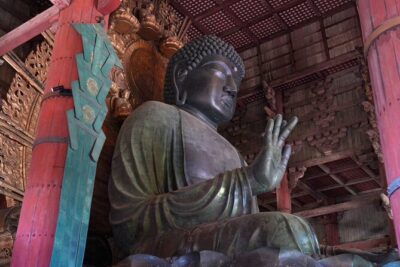
Nara Early Morning Tour (Kyoto or Osaka Departure Available)
Read our review →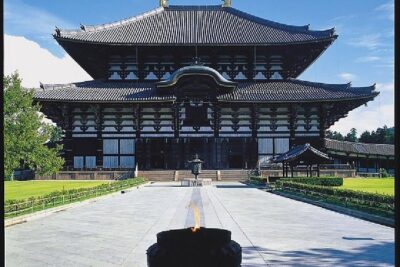
Kyoto/Osaka: Kinkakuji, Bamboo Forest, and Nara Deer Park
Read our review →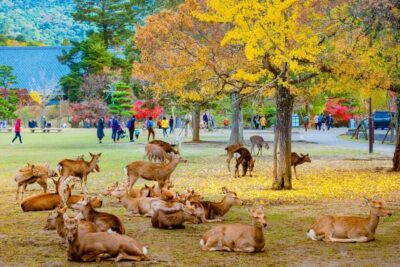
Kyoto/Osaka: Kyoto and Nara Customized Private Guided Tour
Read our review →Browse the lists this tour appears in