
REVIEW · NARA DAY TRIPS
From Kyoto: Nara Guided Morning Tour
Nara’s magic comes in a curious combination: a wooden temple hall big enough to house one of Japan’s largest bronze Buddhas, plus tame-looking deer wandering through the streets and temple grounds. This four-hour morning tour gives you both, along with Kasuga Taisha’s lantern-lined paths.
I like the efficient route and the calm early start. You get an English-speaking guide, admission to Todaiji Temple, air-conditioned transportation, and free Wi-Fi without spending a full day away from Kyoto. I also like the practical deer advice from guides such as Sakura, who reminds you to keep the crackers hidden until you are ready to feed the deer. The main drawback is important: the bus takes you from Kyoto to Nara but does not return you to Kyoto.
In This Review
- Key points to know before booking
- Why this short Nara tour works
- Meeting at Kyoto Avanti before 8 AM
- Kasuga Taisha and its lantern-lined approach
- Nara Park and the deer
- Nandaimon Gate and the approach to Todaiji
- Todaiji and the Great Buddha
- What the guides add to the morning
- Walking, weather, and practical comfort
- The return to Kyoto needs planning
- Who should book this half-day Nara tour?
- Should you book it?
- FAQ
- Where does the Nara tour meet in Kyoto?
- What time should I arrive?
- Does the tour return to Kyoto?
- Which languages are available?
- Are deer crackers included?
- Is the tour suitable for wheelchair users?
Key points to know before booking
- The Great Buddha is the visual centerpiece: Todaiji’s enormous wooden hall and bronze Buddha make this more than a deer-feeding outing.
- The deer are wild animals: They may bow for crackers, but they can also nip, tug at clothing, or crowd around you when food is visible.
- You visit three major Nara sights: Kasuga Taisha, Nara Park, and Todaiji fit into a compact morning.
- The early departure helps: Meet at Kyoto Avanti by 7:50 AM for an 8:00 AM departure and reach the sights before the day gets busier.
- You finish at Kintetsu-Nara Station: Plan your own train trip back to Kyoto and allow extra time if you have afternoon plans.
- Walking is moderate but real: Expect stairs, hills, and outdoor paths, so comfortable shoes matter.
Why this short Nara tour works
Nara is easy to reach from Kyoto by train, but the sights are spread across a broad area. You can certainly visit on your own, yet a guide removes some of the morning’s guesswork. You do not need to work out how Kasuga Taisha, Nara Park, and Todaiji fit together, and you receive background information as you walk.
This tour is especially useful if you have only one morning available. It covers the three places most first-time visitors want to see, then leaves you at a central rail station around noon. That timing lets you continue exploring Nara independently or return to Kyoto for the afternoon.
The cost is $77 per person. That is not the cheapest way to reach Nara, since regular trains cost less, but the price includes a guide, coach transportation from Kyoto, Todaiji admission, and the convenience of a planned route. The value is strongest if you want help with transport and cultural context. It is weaker if you are happy navigating trains and prefer to spend as long as you like at one temple.
The tour has a rating of 4.6 from 335 bookings, and the strongest pattern is clear: the guides make the morning work. Names such as Ciel, Tommy, Mai, Nagomi, Den, Harry, Aoi, Sakura, and Nanami appear in the feedback, with praise for clear explanations, good organization, humor, and help taking photographs. Guide quality can vary by departure, of course, but the company has a broad bench of well-liked English-speaking guides.
More day trips to Nara:
- World Heritage Kyoto & Nara Uji Authentic Matcha Experience
★ 5.0 · 1,573 reviews - Kyoto/Osaka: Nara, Fushimi Inari Taisha, Arashiyama Bus Tour
★ 4.7 · 1,275 reviews - Nara Half Day Trip Walking Tour (Private Option Available)
★ 5.0 · 937 reviews
Meeting at Kyoto Avanti before 8 AM
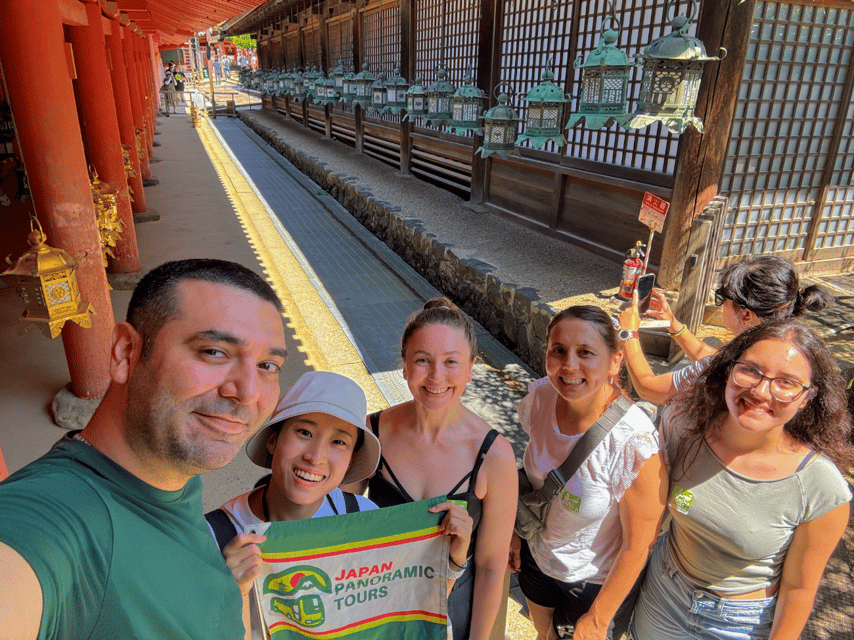
The meeting point is in front of the Kyoto Avanti building, on the Tully’s Coffee side, at 31 Higashikujo Nishiyamao-cho in Kyoto’s Minami Ward. You should arrive by 7:50 AM. Look for the green and white Japan Panoramic Tours flag.
The bus leaves at 8:00 AM sharp. This is not a flexible meeting time, and there is no refund for arriving late or missing the departure. The operator also warns that the bus may not wait for delays, and you may not join partway through the tour.
The first ride lasts about an hour. Along the way, you may see Fushimi Castle and the area around Heijokyo Palace from the coach. These glimpses help connect modern Kyoto with the older capitals and power centers of the region, though they are passing views rather than formal stops.
The air-conditioned coach is a welcome feature in warm or rainy weather. Free Wi-Fi is useful for checking train times later, though I would still save your return route in advance. Audio headsets are available for Spanish, French, German, Italian, Portuguese, and Ukrainian. The live guide speaks English.
Kasuga Taisha and its lantern-lined approach
Kasuga Taisha is usually given about 40 minutes with the guide. It is one of Nara’s most important Shinto shrines and part of the Historic Monuments of Ancient Nara UNESCO World Heritage listing.
The approach is one of the most memorable parts of the morning. Stone lanterns line the paths toward the shrine, and the setting becomes quiet and atmospheric, especially in the early light. The shrine is famous for roughly 3,000 stone and bronze lanterns, many of which are lit during special festivals.
Use this stop to pay attention to the details around the path rather than rushing straight to the main buildings. Your guide can explain the Shinto setting, the purpose of the lanterns, and how the shrine fits into Nara’s religious life.
Forty minutes is enough for an introduction, a guided walk, and photographs. It is not enough for a slow examination of every building or side path. If Kasuga Taisha is your main reason for visiting Nara, a private visit or longer independent stay would suit you better.
You will walk on outdoor paths and may encounter stairs or gentle hills. Bring water, sunscreen, and a hat in sunny weather. On rainy days, an umbrella or raincoat will make this stop much easier.
Nara Park and the deer
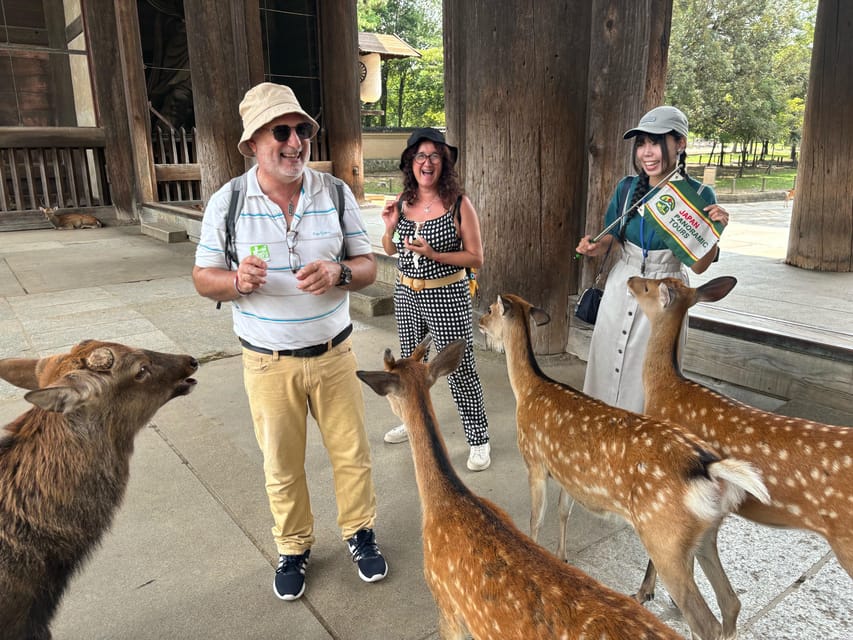
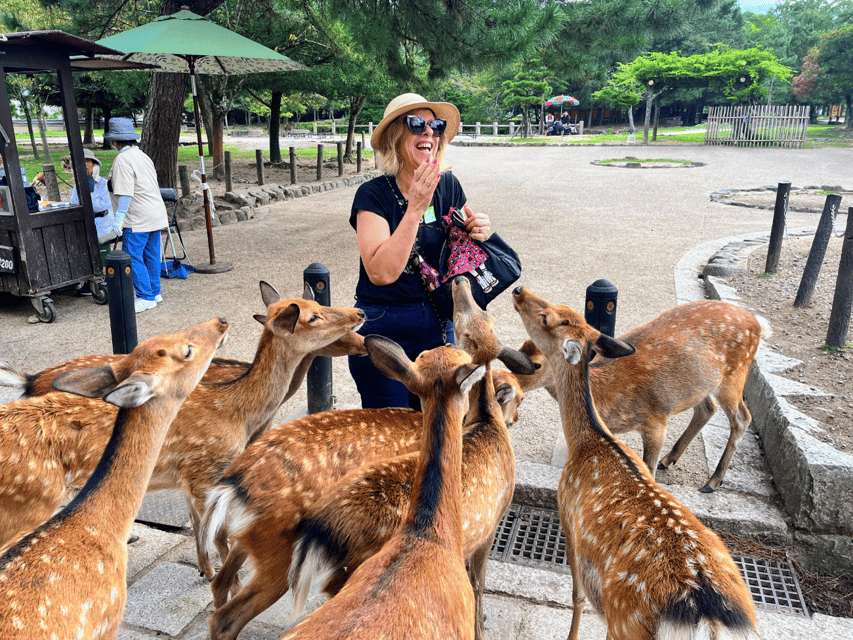
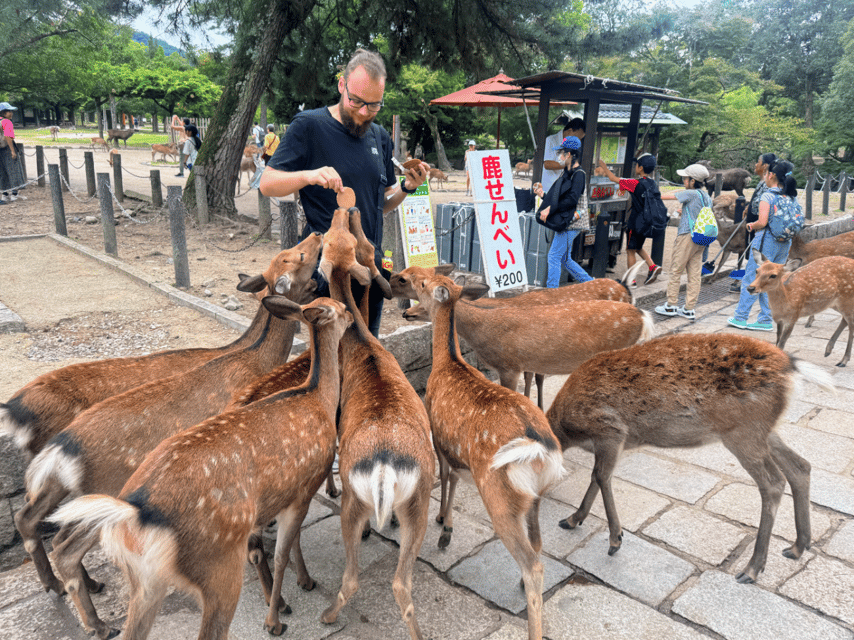
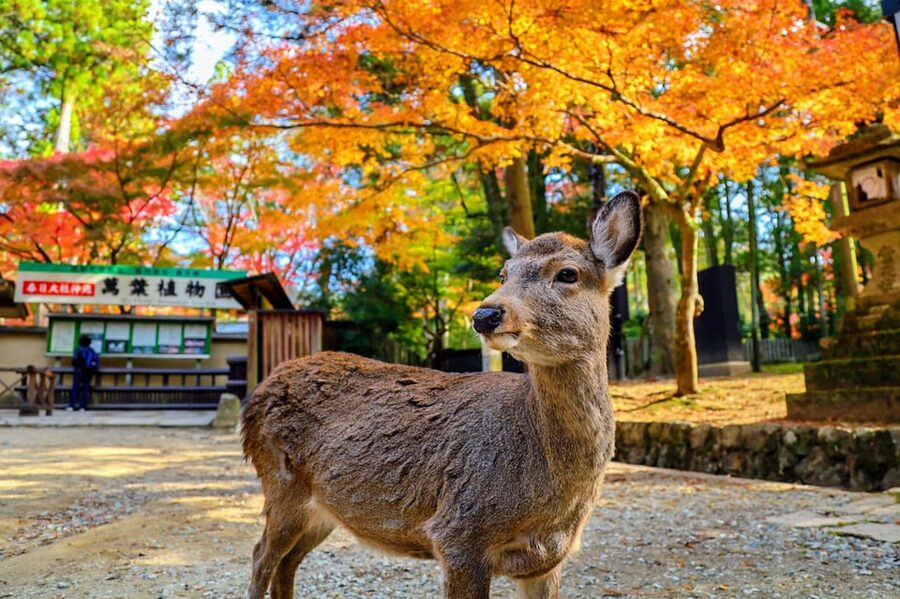
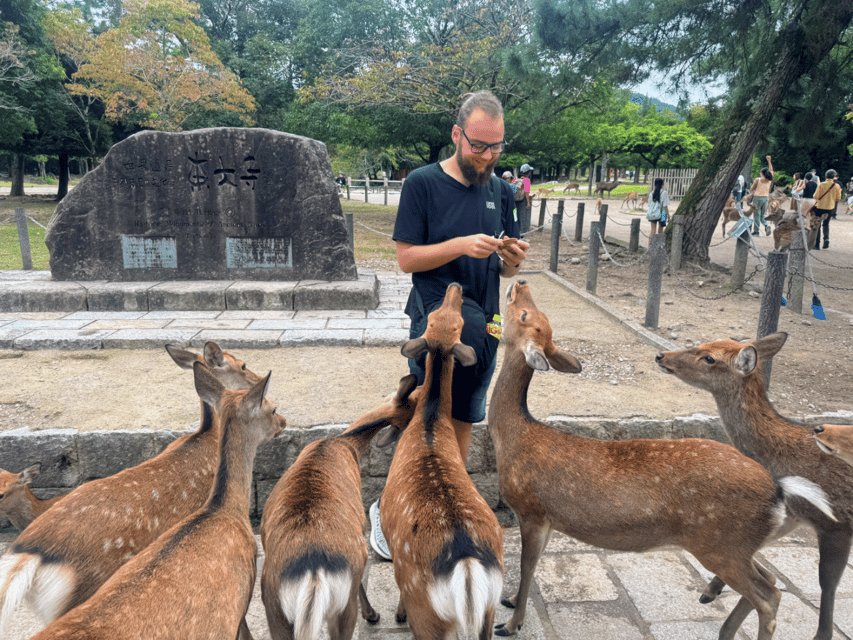
Nara Park is the tour’s most playful stop. You get about 30 minutes of free time to walk among deer that roam freely through the park. More than 1,400 deer live in the area, and their presence is tied to Nara’s long religious traditions. They are considered sacred messengers of the gods.
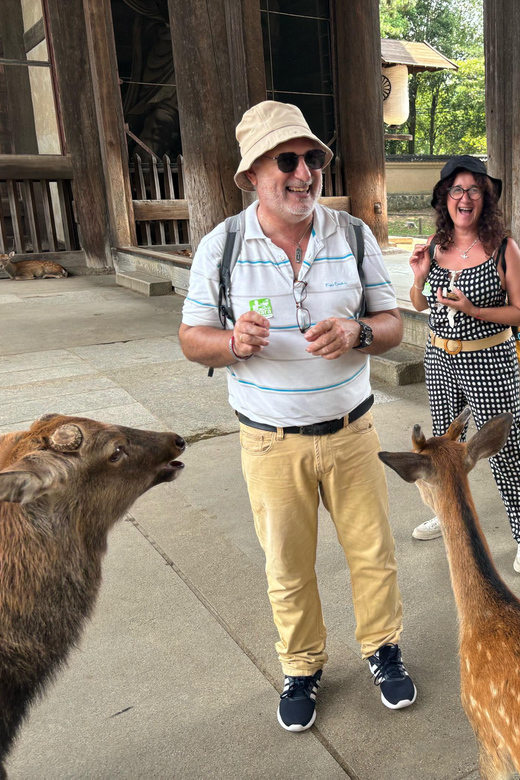
The deer are accustomed to people, but do not treat them like harmless pets. They are still wild animals, and several guides give the same useful warning: keep the special deer crackers concealed until you are ready to feed one. If the animals see food, they may gather around you, nip at clothing, or nudge you for more.
Feed responsibly with only the crackers sold in the park. Once the crackers are gone, show your empty hands. This simple gesture helps the deer understand that you have nothing left. Do not tease them with food or hold crackers above their heads.
Thirty minutes passes quickly. You have time to buy crackers, feed a few deer, and take photographs, but not to wander far across the park. Keep your belongings secure, especially in crowded areas, and watch where you step.
The deer are a highlight for children and animal lovers, but their behavior can surprise people. One guide’s advice is worth repeating in practical terms: keep the crackers in your pocket until you are ready, and be prepared for the deer to be more determined than their gentle appearance suggests.
A few more Kyoto experiences worth comparing
- Kyoto Early Morning Tour with English-Speaking Guide
★ 5.0 · 1,427 reviews - Kyoto: Early Morning Tour with English-Speaking Guide
★ 4.9 · 1,128 reviews - Nara Early Morning Tour (Kyoto or Osaka Departure Available)
★ 5.0 · 676 reviews - Kyoto Morning Tour from Kyoto or Osaka
★ 4.0 · 281 reviews
Nandaimon Gate and the approach to Todaiji
On the way to Todaiji, you pass through Nandaimon Gate, the grand entrance to the temple grounds. Two fierce guardian statues flank the gate, giving the approach a sense of power before you even reach the main hall.
This is a good place to pause and look up. The gate is not merely an entrance to pass through quickly. Its scale, roofline, and guardian figures set the tone for Todaiji, where architecture and religious sculpture are designed to overwhelm you with size.
The exact order of the morning can change because of traffic, weather, or operating conditions. Some departures may visit Todaiji before the park and Kasuga Taisha, while the stated route places Kasuga Taisha first, followed by Nara Park and Todaiji. The sights remain the same, but you should be ready for the sequence to shift.
Todaiji and the Great Buddha
Todaiji receives about 50 minutes with the guide, and this is the tour’s grandest stop. Admission is included, which saves you from handling another ticket while the group moves through the complex.
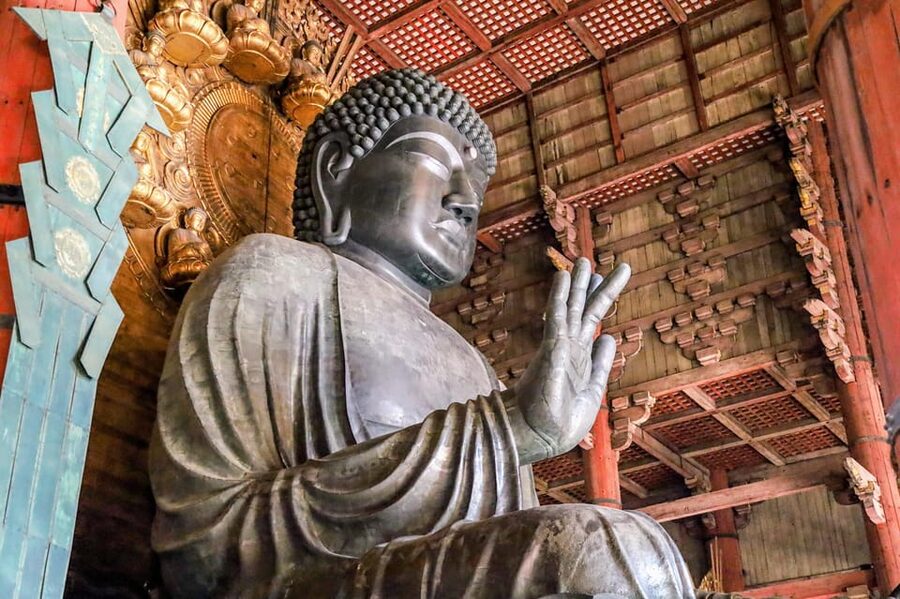
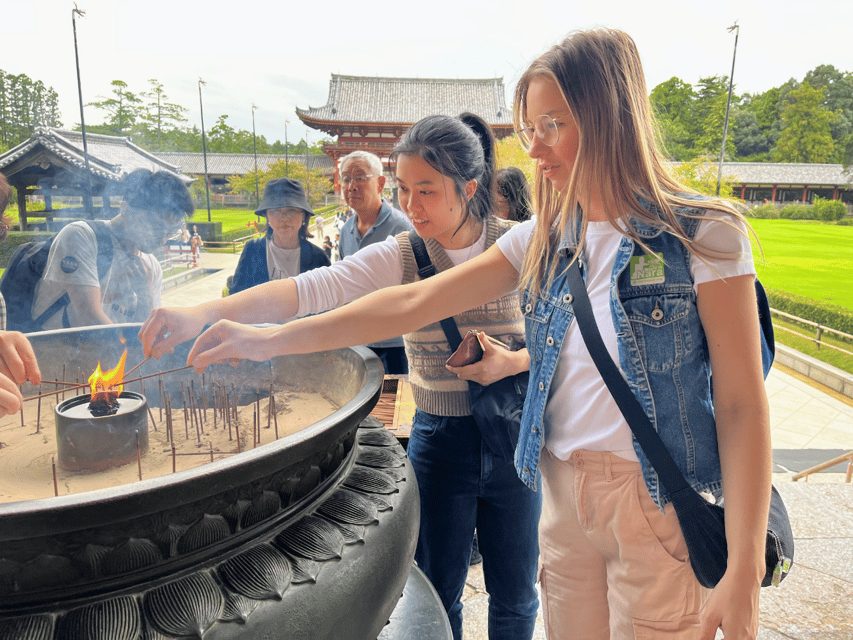
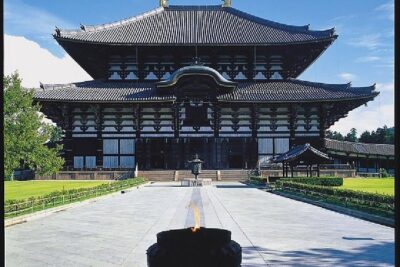
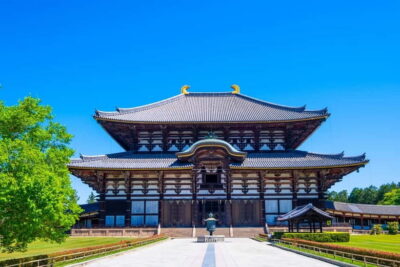
The Great Buddha Hall, or Daibutsuden, is an enormous wooden structure. Inside sits the Great Buddha of Nara, a monumental bronze image that has made Todaiji one of Japan’s best-known temple sights.
The hall’s size is the first thing you notice. Then the Buddha’s scale takes over. Even if you are not deeply interested in Buddhist art, the building and statue create a strong sense of place. This is one of those stops where a guide adds real value, since the symbolism and construction are easier to appreciate with a few clear explanations.
Fifty minutes gives you time to enter the hall, see the Buddha, hear the main points, and take photographs where permitted. Flash photography is not allowed. You will also have some freedom to look around, but this is a group visit rather than an unhurried temple study.
The combination of Kasuga Taisha and Todaiji is well judged. The shrine offers a quieter Shinto setting with lanterns and forest paths. Todaiji brings a much bigger architectural and artistic impact. Nara Park ties the two together with its deer and open green space.
What the guides add to the morning
A good guide matters on a compact tour because the schedule leaves little room for confusion. The strongest guides on this route are described as friendly, funny, patient, and clear, with names including Ciel, Tommy, Mai, Nagomi, Den, Harry, Aoi, Rina, Yuta, and Nanami.
Some guides add small touches that make the group easier to manage. Nagomi has used quizzes about Japanese customs and traditions. Several guides offer to take photographs for solo visitors and families. Others give food suggestions for after the tour, including lunch ideas and shaved ice.
You should expect a group experience, not a private lesson. The guide has to keep everyone moving, explain the main sights, and make sure nobody misses the bus. That structure is helpful for a first visit, though it means you cannot linger whenever you wish.
The audio guide option is useful if you prefer to hear information in your own language. English is handled by the live guide, while audio support is available in Spanish, French, German, Italian, Portuguese, and Ukrainian. Bring the provided headset into the relevant parts of the tour and follow the guide’s instructions.
Walking, weather, and practical comfort
The tour lasts four hours, but it is not four hours of sitting on a bus. You will walk through shrine grounds, park paths, temple approaches, and areas with stairs and hills. Comfortable shoes are essential.
Nara’s weather can change the feel of the morning. On hot days, the outdoor portions around Kasuga Taisha and Nara Park can be tiring, so carry water, wear a hat, and use sunscreen. On wet days, an umbrella or raincoat is more useful than hoping the coach will shelter you for most of the visit.
Meals and drinks are not included. The tour ends around noon, so you can choose lunch near Kintetsu-Nara Station or make your way back toward Kyoto. Carry some cash for deer crackers and personal expenses. The instructions also prohibit smoking, alcohol, drugs, intoxication, littering, bikes, flash photography, and alcoholic drinks inside the vehicle.
This experience is not suitable for wheelchair users or people with mobility impairments. The stairs, hills, and walking distance are part of the route, and the operator does not present the tour as step-free.
The return to Kyoto needs planning
The biggest practical issue is the ending point. The tour finishes at Kintetsu-Nara Station, not Kyoto Station, and return transportation is not included.
This arrangement is easy enough if you are comfortable using Japanese rail stations. It can be less comfortable if you booked a coach tour specifically to avoid navigating public transport. Several people have missed this detail when planning, so treat it as a central part of the decision rather than a footnote.
Before leaving Kyoto, check the route from Kintetsu-Nara Station to your next destination. Allow extra time if you have a reservation, airport connection, or fixed afternoon activity. Station staff can help, and some guides offer basic directions, but you are responsible for the journey and fare back.
The ending can also be an advantage. You are not forced back to Kyoto at noon. You can stay in Nara, visit another sight, eat lunch, or continue by train. The tour gives you a guided introduction, then leaves the rest of the day open.
Who should book this half-day Nara tour?
I would choose this tour if you are staying in Kyoto, want the main Nara sights in one morning, and prefer a guide to manage the route. It is also a strong choice for families, solo visitors who appreciate help with photographs, and first-time visitors who want context without committing to a full day.
It suits you particularly well if Todaiji and the deer are your priorities. You get the Great Buddha, Nandaimon Gate, Nara Park, and Kasuga Taisha without spending hours comparing train connections or deciding which sight to visit first.
You may want to skip it if you prefer a slow morning. Thirty minutes in Nara Park and 40 minutes at Kasuga Taisha are enough for a first look, but not enough for every path, hall, and photograph. Independent visitors can also save money by taking the train and paying only for the sights they enter.
If you enjoy the morning and want more time, the operator also offers a full-day option with lunch and additional stops. Some people changed to the full-day version during the day after finding they wanted to continue. That choice depends on availability, so do not count on changing plans.
Should you book it?
Book this tour if you want an organized, informative introduction to Nara and can accept arranging your own return to Kyoto. The best parts are substantial: Todaiji’s Great Buddha, Kasuga Taisha’s lantern approach, and close encounters with deer in Nara Park.
At $77, the tour earns its price through the guide, coach ride, admission, and time saved. Just arrive early, wear good shoes, bring cash and weather protection, and plan the train home before you leave Kyoto. If those conditions work for you, this is a smart half-day way to add Nara to a Kyoto visit.
FAQ
Where does the Nara tour meet in Kyoto?
Meet in front of the Kyoto Avanti building on the Tully’s Coffee side, at 31 Higashikujo Nishiyamao-cho in Kyoto’s Minami Ward. Look for the green and white Japan Panoramic Tours flag.
What time should I arrive?
The meeting time is 7:50 AM, with departure at 8:00 AM. The bus leaves on time, and there are no refunds for late arrival or no-shows.
Does the tour return to Kyoto?
No. The tour ends at Kintetsu-Nara Station around noon. Return transportation to Kyoto Station is not included, so you arrange and pay for your own journey back.
Which languages are available?
The live tour is conducted in English. Audio guides are available in Spanish, French, Italian, German, Portuguese, and Ukrainian.
Are deer crackers included?
No. Meals, drinks, and personal expenses are not included. You can buy special crackers in Nara Park and should feed the deer responsibly.
Is the tour suitable for wheelchair users?
No. The tour is not suitable for wheelchair users or people with mobility impairments. You should expect moderate walking, stairs, and hills.
Recently added around Kyoto
- Higashiyama | Kyoto: Sakura Season Private Rickshaw Tour★ 5.0 · 3 reviews
- Kyoto Kimono Rental CHAMATSU|Kimono/Yukata Rental FamilyPlan★ 5.0 · 3 reviews
- Kyoto: Half-Day Private Guided Tour to the Old Town of Gion★ 4.4 · 3 reviews
- Nara Private Customizable Half Day Tour★ 5.0 · 3 reviews
- Kansai Region Hiking Adventure in Nara Kobe Kyoto and More★ 5.0 · 3 reviews
- Full Day Nara Deer, Temple, Shrine, Activities & Tea Ceremony★ 5.0 · 3 reviews
- Nara: Essential Private Tour with Deer Park and Temples★ 5.0 · 3 reviews
- Photo Shoot with a Private Vacation Photographer in KYOTO, JAPAN★ 5.0 · 3 reviews
Nara Day Trips, compared.
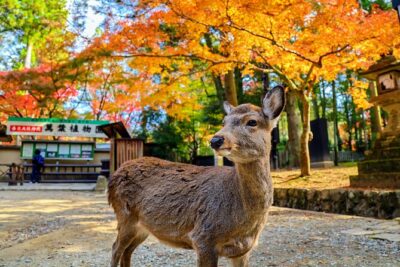
World Heritage Kyoto & Nara Uji Authentic Matcha Experience
Read our review →
Kyoto/Osaka: Nara, Fushimi Inari Taisha, Arashiyama Bus Tour
Read our review →
Nara Half Day Trip Walking Tour (Private Option Available)
Read our review →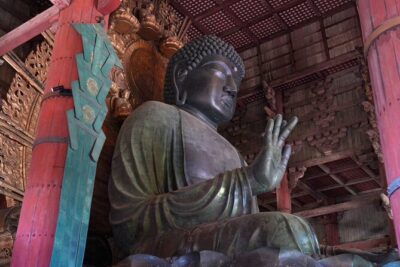
Nara Early Morning Tour (Kyoto or Osaka Departure Available)
Read our review →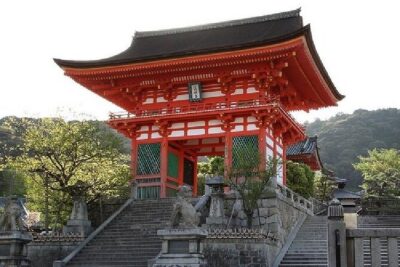
Kyoto/Osaka: Kinkakuji, Bamboo Forest, and Nara Deer Park
Read our review →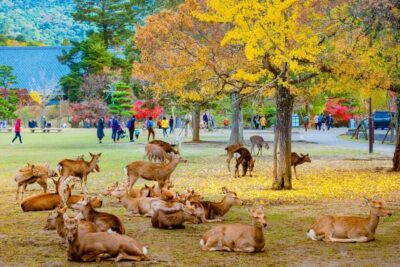
Kyoto/Osaka: Kyoto and Nara Customized Private Guided Tour
Read our review →Browse the lists this tour appears in