
REVIEW · KYOTO CALLIGRAPHY CLASSES
Kyoto: Calligraphy class at Buddhist temple in city center
This is a hands-on calligraphy class inside Seigan-ji Temple, right in Kyoto’s covered Shinkyogoku shopping street. You practice with brush, ink, and washi before creating a finished kanji on a decorative shikishi board. I like the setting, which gives a simple art lesson a genuine connection to Japanese temple life. I also like the small group, capped at six, because the teacher can offer personal corrections instead of giving a quick demonstration and sending you off.
The main drawback is the floor seating. You’ll usually sit on a zabuton cushion in a tatami room, and the few desks are limited. The class is listed as wheelchair accessible, but anyone who finds floor sitting difficult should check the arrangement before booking.
In This Review
- Five things to know before you book
- Calligraphy in the heart of Kyoto
- A 70-minute lesson with a sensible pace
- Why the practice sheets matter
- Creating the shikishi souvenir
- The temple room and floor seating
- A small group makes a real difference
- What the $55 price includes
- Who will enjoy this most
- Practical tips for a better class
- Should you book the Kyoto temple calligraphy class?
- FAQ
- Where does the calligraphy class meet?
- Should I enter the temple to find the workshop?
- How long does the experience last?
- What languages are available?
- What do I take home?
- Are materials included?
- Is food or drink provided?
- How many people can join the class?
- Can I cancel my booking?
Five things to know before you book
- You write a final kanji on a shikishi board: Your finished piece is designed to go home and be displayed.
- The class takes place inside a Buddhist temple: The tatami room and traditional tools add more atmosphere than a standard craft studio.
- The group is limited to six people: That leaves room for individual help with brush pressure, stroke order, and posture.
- Jose and Saskia may assist with translation: Instruction is available in English, Spanish, Japanese, and Dutch, with Imai Sensei leading the calligraphy.
- Bring a word in mind: You can choose from examples, but arriving with two or three possible kanji makes the final selection easier.
Calligraphy in the heart of Kyoto
Kyoto gives you no shortage of temples, but it is easy to see many of them from the outside, take a photograph, and move on. This class offers something different: you sit inside a traditional Japanese room and use an art form that remains part of everyday education in Japan.
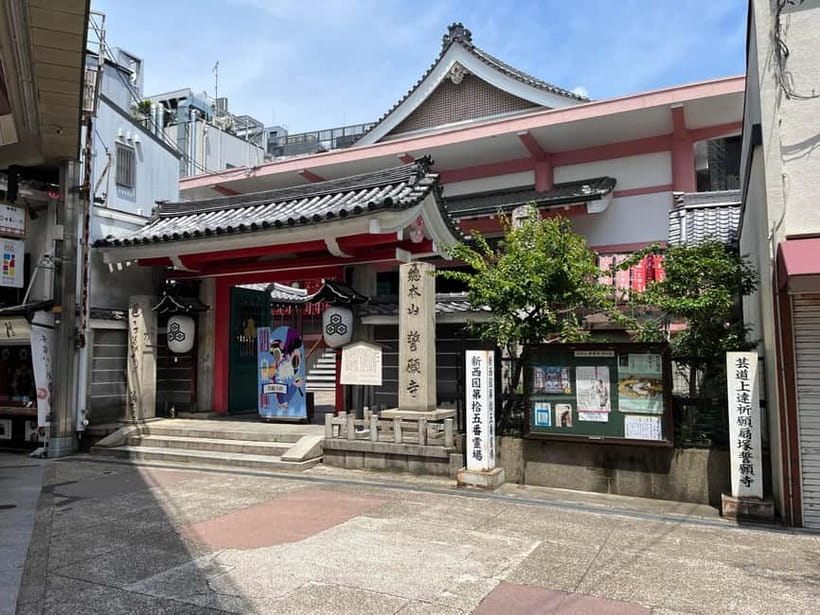
The meeting point is in front of Seigan-ji Temple, along the roofed Shinkyogoku shopping street. Look for the person holding a red lantern on a stick. This detail matters because the temple sits amid a busy shopping area, and the correct entrance may not be obvious at first glance.
Do not climb the temple stairs looking for the class. Wait outside for the person with the red lantern, and do not interrupt the monks or other temple workers to ask about the workshop. Read your voucher carefully after booking, since it contains the final meeting instructions.
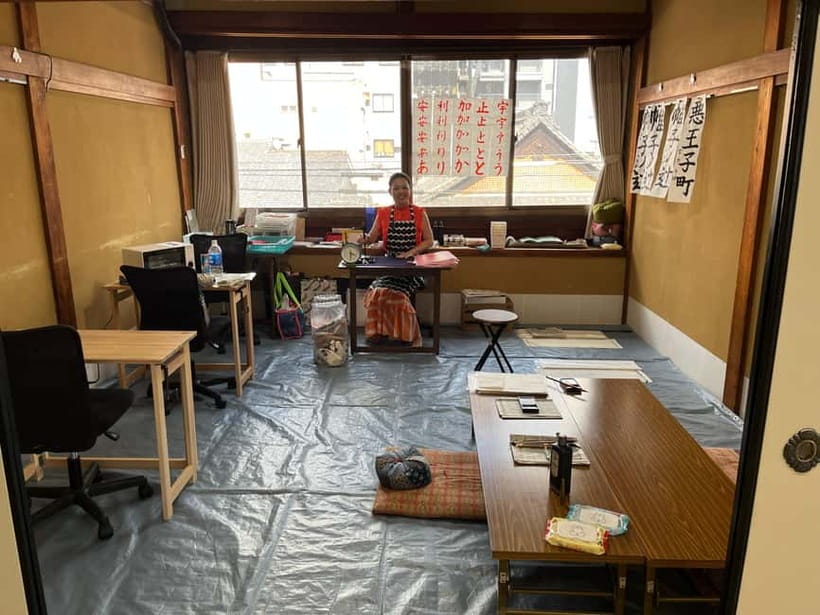
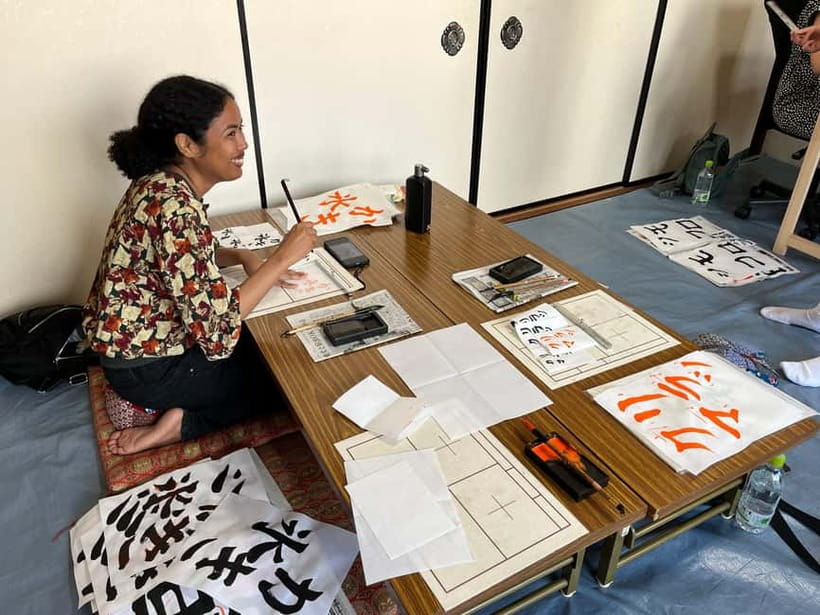
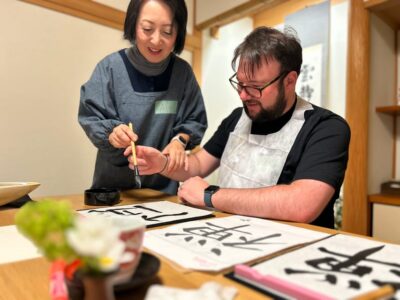
Once you are led inside, the surroundings change quickly. You leave the commercial street and enter a washitsu, a Japanese-style room with tatami flooring. Sliding doors, floor cushions, and the quiet concentration of the class make the setting feel far removed from the nearby shops.
The temple also has a Great Buddha at its center, adding a strong sense of place. You are not simply making a souvenir in a rented room. You are learning a traditional art within a religious building in central Kyoto.
More calligraphy classes:
- Kyoto: Japanese Calligraphy Class
★ 4.8 · 89 reviews - Kyoto: Japanese Calligraphy Workshop
★ 4.7 · 84 reviews - Kyoto: Local Home Visit and Japanese Calligraphy Class
★ 5.0 · 66 reviews
A 70-minute lesson with a sensible pace
The class lasts about 70 minutes. That is long enough to learn the basic method and make a finished piece, but short enough to fit between sightseeing plans.
The session begins with introductions to Imai Sensei, the calligraphy teacher, and the translator or guides. Imai Sensei has more than a decade of calligraphy experience, and some class sessions have included Jose and Saskia as English-speaking guides. The translator explains the instruction while the teacher demonstrates the movements.
The language arrangement is worth understanding. Imai Sensei teaches in Japanese, while translation makes the lesson accessible in English, Spanish, Japanese, or Dutch, depending on the session you book. This is not a problem for the activity, but it does mean you should select your preferred language carefully during reservation.
Next, you choose the word or kanji you want to write. Examples are available, so you do not need prior knowledge of Japanese. Still, I recommend preparing a short list before you arrive. A character connected to a personal value, name, place, or hope often makes a more meaningful souvenir than choosing hurriedly from the examples.
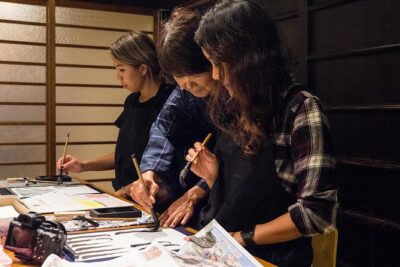
The teacher then introduces the tools. You use washi paper, a brush, ink, bunchi, and shitakami. Beginners may not recognize all these terms, but the important point is that you learn how the materials work rather than simply copying a finished character.
You practice basic lines first. This is where the class earns its keep. Japanese calligraphy is not just drawing a symbol with a large brush. Brush angle, speed, pressure, and the beginning and ending of each stroke all affect the result.
After the basic lines, you practice your chosen kanji. The teacher shows the stroke order and gives corrections as you work. This step-by-step approach suits complete beginners, and you do not need an artistic background to take part.
Why the practice sheets matter
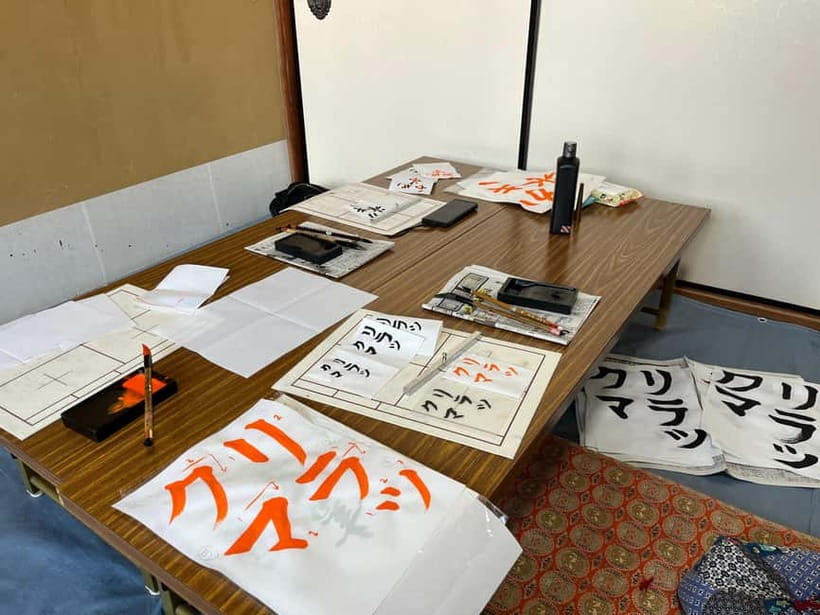
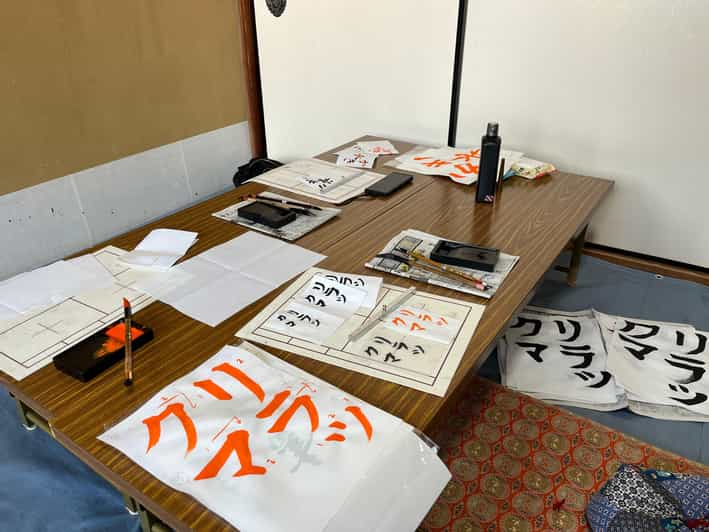
The practice stage can look modest, but it is the heart of the lesson. You learn how a brush behaves when you press harder, how a line changes when you move faster, and why a confident stroke often looks better than one made with too much hesitation.
The teacher encourages you to make mistakes. That is useful because your first attempt will probably not look like the graceful example on the paper. Calligraphy makes the difference between an expert and a beginner very clear, but the class is designed to let you improve within a short period.
Do not over-practice. The guidance specifically warns that too many attempts can tire your arm and make the final piece weaker. I would treat the practice as focused preparation rather than a contest to fill every sheet with ink.
You may also receive help with your name. Some participants practice writing their names before working on the final kanji. This gives you a chance to settle into the brush before making the piece you plan to take home.
Left-handed students should expect an extra challenge. Traditional brush technique is generally easier with the right hand, and one left-handed participant found it useful to try both hands. The atmosphere is relaxed, so left-handed beginners can still take part, but you should not expect the same ease as someone already used to brush lettering.
Creating the shikishi souvenir
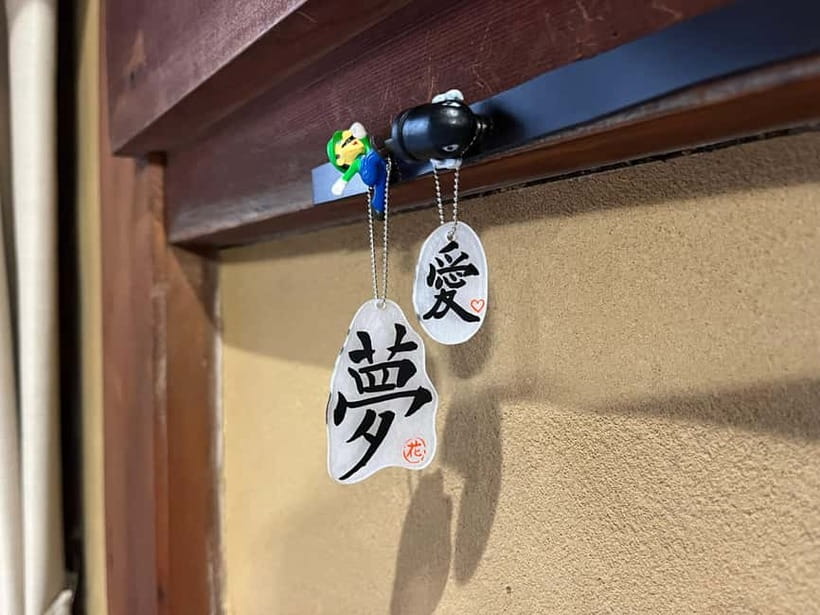
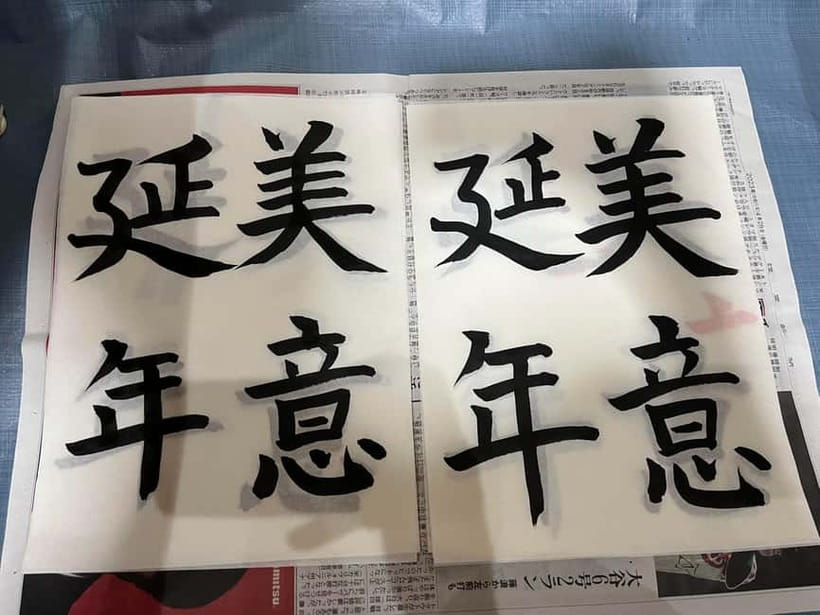
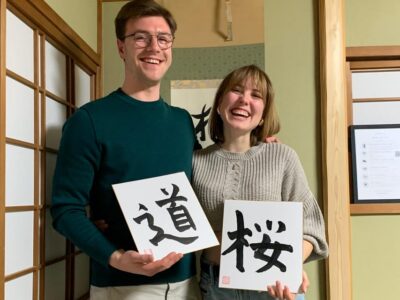
Once you have practiced enough, you move to the final artwork. You write your chosen character on a shikishi, a special square cardboard board often used for calligraphy and artistic inscriptions.
This is the point where restraint matters. You get one main chance to create the piece you will take home, so the earlier practice is important. The class does not promise that every beginner will produce museum-quality calligraphy. It gives you the tools and instruction to make a personal work with genuine evidence of your own hand.
That distinction is part of the appeal. A mass-produced charm from a souvenir shop may look neater, but it does not show the time you spent learning brush control in a Kyoto temple. Your finished shikishi will have character, including perhaps a slightly uneven line or a stroke that reveals you are still learning.
The artwork is easy to value because it is both decorative and personal. You can display it on a wall or mantelpiece, or keep it as a reminder of your time in Kyoto. Several people also received photographs taken during the class, which helps preserve the process rather than just the final result.
The teacher also makes a keychain with your chosen character as a special gift. It is a small extra, but a thoughtful one. If you choose a kanji with personal meaning, having it appear on both the artwork and keychain gives the experience a pleasing sense of completion.
More Kyoto temples worth a morning:
- Kyoto: Tea Ceremony Ju-An at Jotokuji Temple
★ 4.9 · 3,207 reviews - Arashiyama Bamboo, Temple, Monkeys, or Secret Sake Brewery
★ 4.8 · 886 reviews - Kyoto: Arashiyama Bamboo Forest, Monkeys, Matcha & Temple Tour
★ 5.0 · 759 reviews - Kyoto: Ninnaji Temple Entry Ticket
★ 4.2 · 650 reviews
The temple room and floor seating
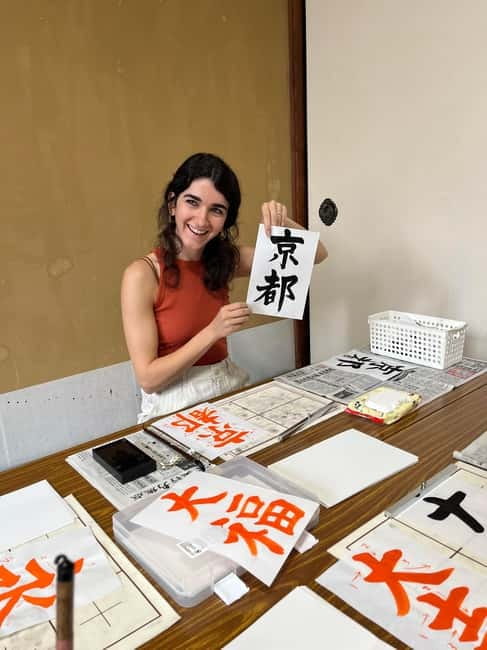
The washitsu is one of the strongest parts of this activity. Tatami flooring changes the physical feel of the class, and sitting low to the ground gives you a direct experience of a Japanese room that most short sightseeing visits do not provide.
The room tends to be quiet, but it is not a silent meditation session. People talk with the guides, ask questions, and concentrate on their writing. The mood is calm because everyone is focused, not because conversation is forbidden.
You will usually sit on a zabuton cushion on the floor. A limited number of desks are available, but they cannot be guaranteed for everyone. If you have knee, hip, back, or leg problems, consider this carefully before reserving.
The activity is marked wheelchair accessible, yet the floor-based format deserves a direct question before booking if you need a particular seating setup. The available information does not promise a desk for every participant.
Bare feet are not allowed. Wear socks or shoes that are easy to remove if the room requires it. Smoking, vaping, alcohol, and drugs are also prohibited.
A small group makes a real difference
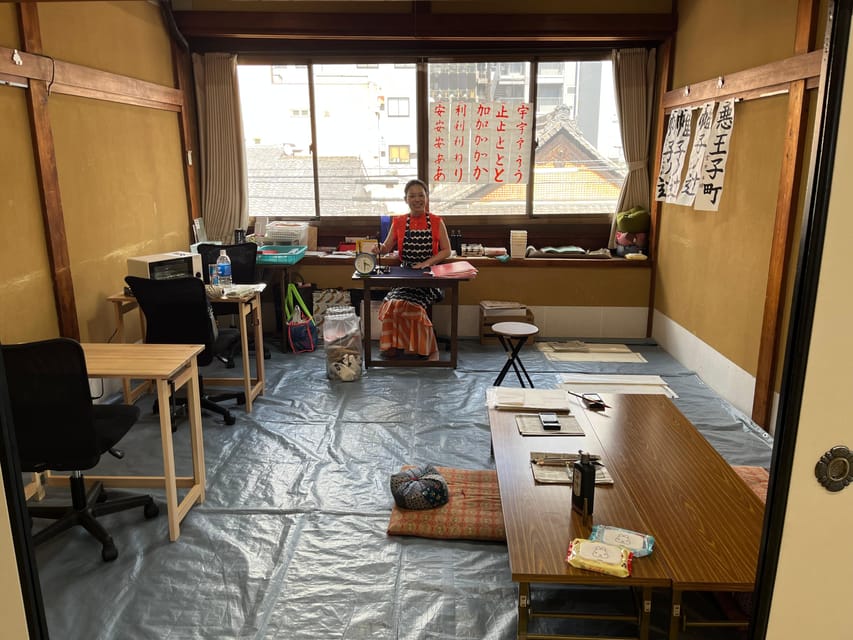
The maximum group size is six. That is a useful limit for calligraphy because your brush position and stroke pressure need to be seen at close range.
In a large workshop, you might spend most of the time watching a demonstration from a distance. Here, the teacher and translator can move around the room, offer practical suggestions, and encourage you through the difficult strokes.
The guides also add a social side to the class. Jose has been singled out for clear translation, friendly assistance, and taking photographs during the lesson. Saskia has also helped with translation and conversation. The guide and teacher work as a pair, with one explaining the Japanese instruction and the other showing the physical technique.
That arrangement helps the class feel welcoming without turning it into a loud group performance. You get help when needed, but you also have quiet time to concentrate.
The group format suits couples, solo visitors, families with older children, and friends looking for a change from temple walks and food stops. Very young children are not accepted, with the activity listed as unsuitable for children under five and under four, three, or two in separate age restrictions. Babies under one are also excluded. Since the age wording is inconsistent, check the booking conditions for your specific date if you are traveling with children.
What the $55 price includes
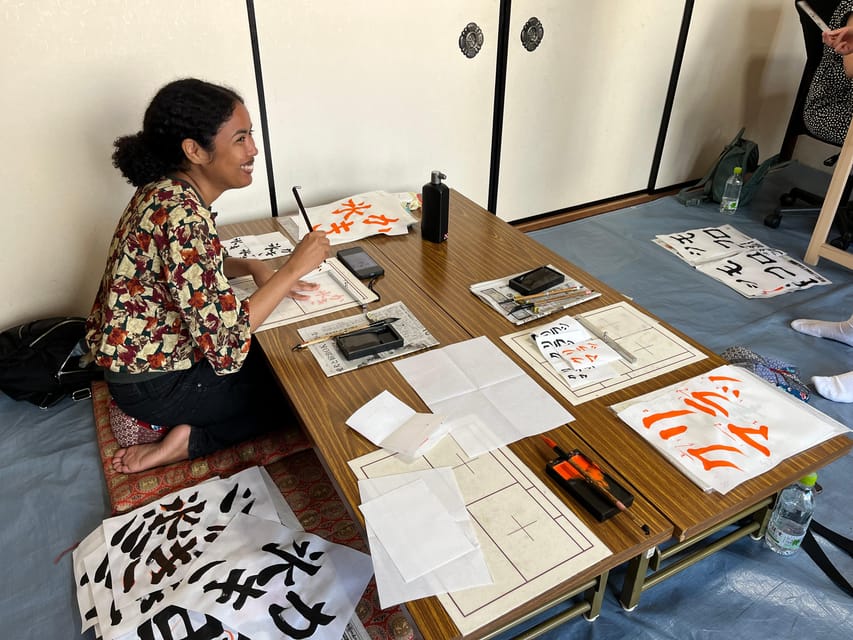
At $55 per person, this is not the cheapest craft activity in Kyoto. The value comes from what is bundled into the 70 minutes: a temple setting, an experienced teacher, translation, all the calligraphy equipment, guided practice, a final shikishi artwork, and a personalized keychain.
You are not paying only for materials. You are paying for access to instruction that would be difficult to arrange independently, especially if you do not speak Japanese or know how to choose and write a kanji.
The small group also strengthens the value. A six-person maximum gives the teacher time to correct individual technique, and the guides help bridge the language gap. If you are mainly looking for a cheap souvenir, a shop-bought item will cost less. If you want to understand how the souvenir is made and carry home something made by your own hand, the price is easier to justify.
Food and drinks are not included. This is a focused cultural class, not a half-day outing with refreshments. You can buy drinks from vending machines outside the temple, so plan to eat before or after rather than expecting a snack during the session.
The activity offers free cancellation up to 24 hours in advance and a reserve-now, pay-later option. Those policies help if your Kyoto plans are still shifting, though you should always check the terms attached to your booking.
Who will enjoy this most
I would recommend the class to anyone who wants a quieter, creative hour in Kyoto. It works particularly well after a morning of walking because the pace is slower and the main effort is concentration rather than sightseeing.
You do not need to know Japanese. You do not need to be artistic. You only need enough patience to repeat the same movement several times and accept that the first few strokes may look awkward.
It is also a good choice if you care about meaningful souvenirs. Your final work records a word you selected and the technique you learned. That gives it more personal weight than a generic object purchased on the way back to the hotel.
Families should consider the floor seating and the age limits. Adolescents who can sit quietly and follow instructions should find the class manageable, while very young children are not suitable.
This may not be the right pick if you want a fast photo stop, a polished professional artwork, or a completely silent temple visit. It also may not suit you if sitting on the floor is uncomfortable and no desk arrangement can be confirmed.
Practical tips for a better class
Think about your word before you arrive. Prepare two or three choices because some characters may prove too complicated for a first attempt, and the teacher can help you select an appropriate one.
Wear socks. Bare feet are not permitted, and socks are the simplest way to stay comfortable on tatami.
Leave room in your schedule for the meeting point. Seigan-ji Temple is in the Shinkyogoku shopping street, but the red lantern is the important landmark. Wait at the front rather than walking up the stairs or asking temple staff about the workshop.
Keep your final piece flat and protected on the way home. The shikishi is made for display, but it can still bend if packed carelessly.
If you want photographs, the guides may take pictures during the process. Still, concentrate on the brushwork first. The best part of the class is learning how the stroke feels, not documenting every second.
Should you book the Kyoto temple calligraphy class?
Book it if you want a personal souvenir, a small group, and a direct introduction to a traditional Japanese art. The temple setting and patient instruction give the class more substance than a basic tourist craft session, while the 70-minute length keeps it easy to fit into a Kyoto itinerary.
I would especially choose it for a first visit to Japan, for couples seeking an activity they can do together, or for anyone who has already seen enough temples for one day and wants to engage with Japanese culture in a different way.
Think twice if floor seating is a serious issue, if you need a completely private lesson, or if you are looking for food and drink as part of the booking. For most beginners who can sit comfortably and arrive with a little patience, $55 is a fair price for the instruction, setting, finished artwork, and small keepsake.
FAQ
Where does the calligraphy class meet?
Meet in front of Seigan-ji Temple in the covered Shinkyogoku shopping street. Look for the person holding a red lantern on a stick under the roofed street.
Should I enter the temple to find the workshop?
No. Do not climb the stairs to enter the temple while looking for the class. Wait at the front for the person with the red lantern, and do not ask the monks or other temple workers about the workshop.
How long does the experience last?
The calligraphy experience lasts about 70 minutes.
What languages are available?
The activity is available in English, Spanish, Japanese, and Dutch.
What do I take home?
You take home your calligraphy work on a shikishi, a special square cardboard board. You also receive a keychain made by the teacher with your chosen character.
Are materials included?
Yes. The class includes washi, a brush, ink, bunchi, shitakami, explanations, practice, and kanji examples to choose from.
Is food or drink provided?
No food or drinks are served. Drinks are available from vending machines outside the temple.
How many people can join the class?
The class is a small-group activity limited to six participants.
Can I cancel my booking?
You can cancel up to 24 hours in advance for a full refund. A reserve-now, pay-later option is also available.
More Workshops in Kyoto
- Kyoto: 45-Minute Tea Ceremony Lesson Experience
★ 4.3 · 2,378 reviews - Kyoto : Chopsticks Making Workshop in Gion with Engraving Option
★ 5.0 · 958 reviews - Kyoto: Samurai Sword Class by Experts in Traditional Arts
★ 4.9 · 657 reviews - Kyoto: Ramen Cooking Class at a Ramen Factory with Souvenir
★ 4.9 · 532 reviews
Recently added around Kyoto
- Higashiyama | Kyoto: Sakura Season Private Rickshaw Tour★ 5.0 · 3 reviews
- Kyoto Kimono Rental CHAMATSU|Kimono/Yukata Rental FamilyPlan★ 5.0 · 3 reviews
- Kyoto: Half-Day Private Guided Tour to the Old Town of Gion★ 4.4 · 3 reviews
- Nara Private Customizable Half Day Tour★ 5.0 · 3 reviews
- Kansai Region Hiking Adventure in Nara Kobe Kyoto and More★ 5.0 · 3 reviews
- Full Day Nara Deer, Temple, Shrine, Activities & Tea Ceremony★ 5.0 · 3 reviews
- Nara: Essential Private Tour with Deer Park and Temples★ 5.0 · 3 reviews
- Hiking Tour for Sacred Sites in Kyoto with a Guide★ 5.0 · 3 reviews
Kyoto Calligraphy Classes, compared.
Kyoto Ninenzaka : Japanese Calligraphy Class in Townhouse
Read our review →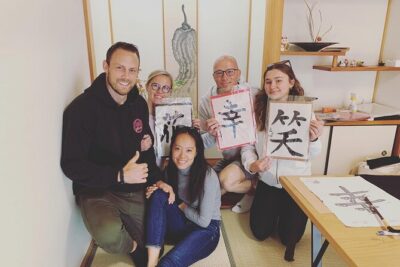
Private Japanese Calligraphy in Kyoto – Learn Shodō with a Master
Read our review →
Japanese Calligraphy – Shodo – Lesson (near Kyoto Station)
Read our review →
Browse the lists this tour appears in