
REVIEW · GION GEISHA DISTRICT TOURS
Kyoto: Lunch or Dinner with Maiko
Kyoto’s Maiko are not museum pieces. They are young women trained in dance, music, manners, and the demanding customs of the entertainment districts. This 90-minute program gives you a close look at that world through two traditional dances, a tea ceremony, questions, games, and a photo.
I like the direct contact most. You can ask about daily life, then take a picture beside the Maiko and receive a small Senjafuda lucky charm. I also like the simple games, which turn a formal performance into a cheerful shared moment. The main caution is the setting: this is a practical building venue, not a polished ochaya or historic Kyoto house, and the meal may not satisfy every palate.
In This Review
- Key points at a glance
- Meeting a Maiko near Gojo Station
- Tea ceremony first, with an optional hands-on version
- A Kyoto meal built around dashi
- Questions that open a door into Maiko life
- Two dances that show the Maiko’s precision
- Photos, Senjafuda, and a closer connection
- A simple game breaks the formal mood
- What the $63 price really buys
- Timing, language, and cancellation details
- Who should book this Kyoto cultural program?
- Should you book it?
- FAQ
- Where is the Maiko experience held?
- How long does the program last?
- Is dinner included?
- Can I make my own tea?
- Is English available?
- Can children attend for free?
Key points at a glance
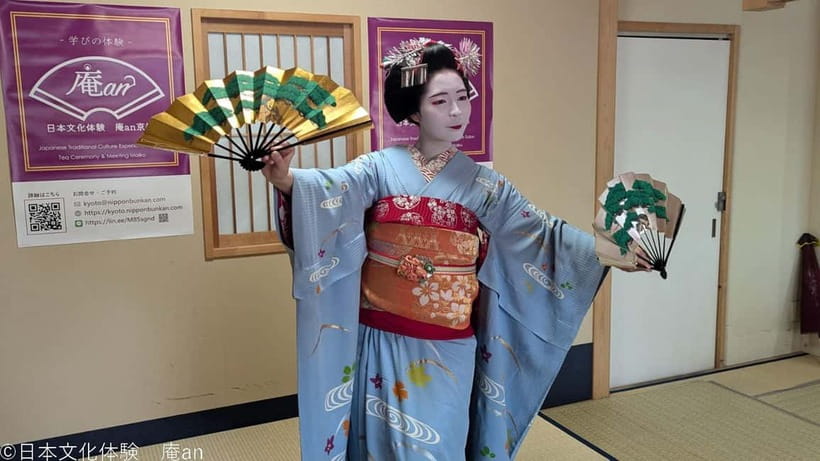
- Two live Maiko dances: Watch elegant movements linked to seasons, love stories, and daily life.
- A real question-and-answer session: Ask directly about the Maiko’s training and routine, with English support available as much as possible by request.
- Kyoto cuisine and dashi: Eat a traditional meal from a long-established local restaurant, with soup stock playing a central role.
- Photo and Senjafuda gift: Pose beside the Maiko and receive a paper charm as a keepsake.
- Tea, food, and entertainment may share one room: Different program options can run at the same time, so the atmosphere is friendly but not highly theatrical.
- Gojo Station is close: The venue is one minute from Exit 1 of the Subway Karasuma Line’s Gojo Station.
Meeting a Maiko near Gojo Station
You begin close to Gojo Station, one of the easiest parts of the plan. Exit 1 of the Subway Karasuma Line is about a one-minute walk from the entrance, which faces Gojo-dori, the main street.
That central location matters. You do not need to build a large block of sightseeing around the event, and the short walk is useful if you are arriving in the evening or carrying shopping bags. Check the exact starting time when you book, since several times may be available.
The activity takes place in a building rather than an ochaya, the traditional entertainment house associated with Kyoto’s geiko and Maiko culture. You may find the room plain and functional. Some sessions have been described as taking place in a basement-like space with simple furniture and little decoration, so set your expectations accordingly.
That is the tradeoff. You get access to a Maiko without paying for a private traditional house setting, but you do not get the atmosphere of old wood, screens, lanterns, and a formal tatami room. If the performance matters more to you than the backdrop, this arrangement is sensible.
There is no elevator, and you need to use stairs to reach the venue. Anyone with mobility concerns should contact the operator before booking. The event cannot be held for late arrivals, so allow time to find the entrance and get upstairs.
More evenings in Gion:
- Kyoto Geisha Walking Tour: Gion District & Hidden Gems
★ 4.7 · 3,273 reviews - Kyoto: Gion Magical Night Walking Tour with Geisha Trivia
★ 4.9 · 2,393 reviews - Kyoto: Gion Geisha District Walking Tour – Stories of Geisha
★ 4.7 · 2,187 reviews
Tea ceremony first, with an optional hands-on version
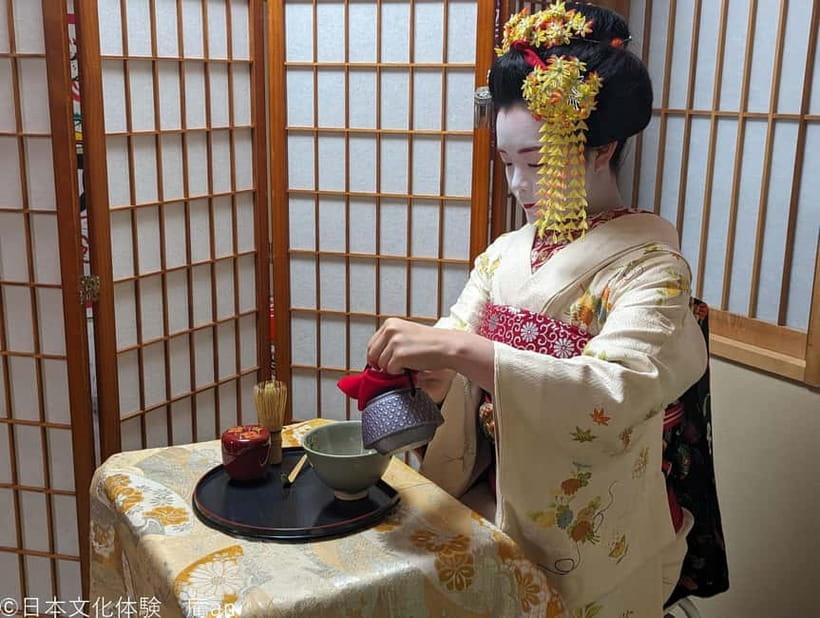
The program opens with a tea ceremony demonstration by the Maiko. Watch her measured movements, careful etiquette, and the quiet rhythm of preparing and serving tea.
This opening helps you notice details that can be easy to miss during a dance. A Maiko’s appeal is not only the costume and hairstyle. It is also the control of posture, hands, pace, and expression. The tea demonstration gives you a calm introduction before the food and more playful parts of the program begin.
You can add a tea-making option for 1,600 Japanese yen when you apply. The standard price includes the demonstration, not the hands-on activity, so select the option ahead of time if making your own tea is important to you. The available information does not promise that it can always be added on the day.
The demonstration is also a good moment to watch quietly. This is not a loud stage show from the first minute. The value comes from seeing how small gestures and formal manners carry meaning in Japanese culture.
A Kyoto meal built around dashi
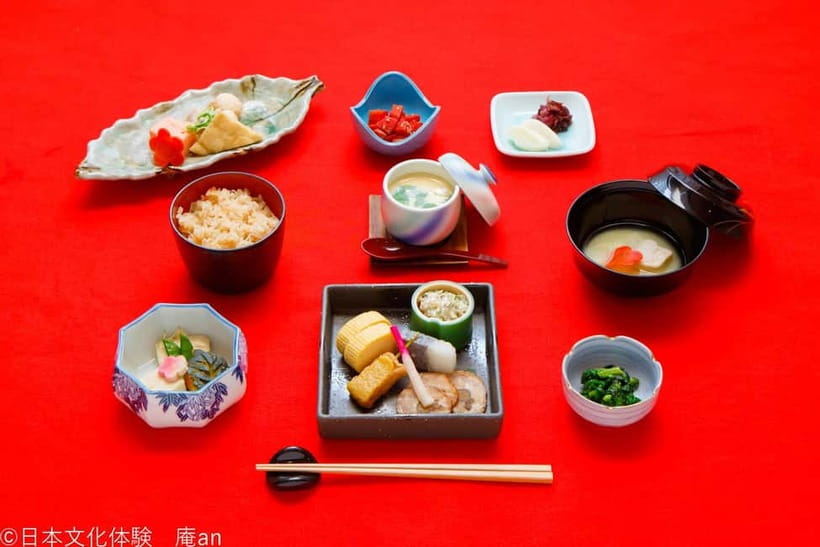
The meal is prepared by a long-established Kyoto restaurant. The food is described as traditional local cuisine, with dashi, or Japanese soup stock, used often in Kyoto cooking.
Dashi is a useful detail to understand before you sit down. It provides a light, savory base for soups and other dishes, and it is part of the flavor language of Kyoto cuisine. Do not expect a Western-style entrée with a large portion of meat. This is a chance to try a set of traditional dishes in a compact cultural program.
The meal may arrive through shidashi, a Kyoto tradition of ordering prepared food for delivery. That gives the event a local connection, but it also means the meal is not necessarily cooked and plated in front of you.
Food is the least predictable part of the experience. Some diners have found it typical but mild, while others have strongly disliked the texture and temperature, describing a tray that seemed barely thawed. I would not book this primarily as a food tour. Think of the meal as part of the evening’s cultural setting, with the Maiko program doing most of the heavy lifting.
If you enjoy subtle Japanese flavors, seasonal presentation, and dashi-based cooking, you may appreciate the meal. If you need bold seasoning or carefully prepared restaurant service, keep your expectations modest. The food is included in the $63 price, but the cultural program is the reason the price makes sense.
The event can also include people who selected different options. One group may be eating while another is taking part in the tea preparation. That shared setup keeps the cost down, but it can make the room feel less private and less staged.
Questions that open a door into Maiko life
The question-and-answer session is one of the strongest parts of the program. Instead of watching from a distance, you can ask the Maiko about her daily routine, training, clothing, hairstyle, and work.
The supplied details do not list individual Maiko or guide names, and the instructor language is Japanese. English translation is provided as much as possible if requested, so contact the operator before the event if you need interpretation.
This is the moment to prepare a few short questions. Ask about the hardest part of training, how long it takes to learn a dance, or what a normal working day involves. The format is more personal than a standard stage performance, but the quality of interpretation can depend on the session and the request.
The Maiko’s lifestyle is demanding and highly traditional. Her kimono, hairstyle, makeup, dance, and formal behavior are not simply costumes for a photo. They reflect years of instruction and a way of life that continues in modern Kyoto.
That context makes the encounter worthwhile. You are not only looking at an attractive performance. You are seeing how an old professional tradition is practiced by a living person today.
More Kyoto tours that include lunch:
- Bike Tour Exploring North Kyoto plus Lunch
★ 5.0 · 1,087 reviews - Kyoto Zen Meditation & Garden Tour at a Zen Temple with Lunch
★ 5.0 · 441 reviews - 4.5-Hour Kyoto Bike Tour with Lunch and UNESCO Zen Temples
★ 5.0 · 122 reviews - From Kyoto: Nara History Guided Half Day Bus Tour with Lunch
★ 4.8 · 114 reviews
Two dances that show the Maiko’s precision
After the meal and questions, the Maiko performs two traditional dances. The themes may express Japan’s seasons, love stories, or ordinary life.
Pay attention to the small movements. The charm is in a turn of the head, the position of a sleeve, the controlled steps, and the way the fan or kimono is handled. This is not a high-speed spectacle. Its power comes from restraint.
You should also remember that the room is not described as a formal theater. Seating position can affect how well you see the details, especially if your view is behind several rows. If this matters to you, you can pay for a preferred seat:
- SS seat, first row: 3,300 Japanese yen
- S2 seat, second row: 2,200 Japanese yen
- S3 seat, third row: 1,100 Japanese yen
The standard booking remains the least expensive choice, but the seat supplements are worth considering for anyone especially interested in dance, costume, or photography. A front-row position should give you a clearer view of facial expression and hand movements, though the event remains a shared group program.
In some sessions, a Geiko may appear instead of a Maiko. That is not a downgrade. A Geiko is a more senior performer in Kyoto’s traditional entertainment world, and the change can give you a different view of the same cultural tradition.
Photos, Senjafuda, and a closer connection
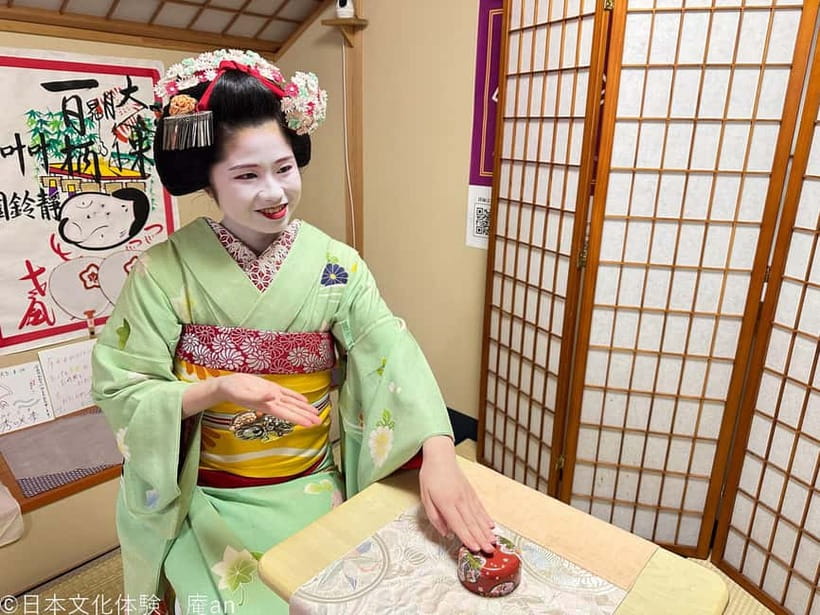
You receive a chance to take a commemorative photo beside the Maiko. This is one of the most appealing parts for many people because it changes the meeting from a performance watched at a distance into a personal memory.
Follow the staff’s instructions about where to stand and how the photographs are organized. The program is timed, so you should not expect a long private photo session. Still, standing beside the Maiko lets you see the kimono, hair, makeup, and accessories more closely than you can from your seat.
You also receive a Senjafuda as a special gift. Senjafuda are small paper name cards or charms traditionally associated with visits and good fortune. It is an easy-to-pack souvenir with a stronger connection to the event than a generic shop purchase.
Treat the photo opportunity with respect. The Maiko’s appearance and work involve formal customs, and the program is meant to introduce you to that world rather than turn her into a prop. A polite question and a quick, organized photograph fit the tone best.
A simple game breaks the formal mood
The final entertainment is an interactive game with the Maiko. Volunteers can take part, while everyone else can clap and cheer.
This section gives the program a welcome change of pace. After the quiet tea ceremony and graceful dances, a simple game lets the room become more social. You do not need to volunteer to enjoy it, but if you like joining group activities, this is your chance.
The games are described as simple but exciting, and the Maiko are professionals. That creates a friendly challenge: can anyone beat her? The answer matters less than the shared laughter and the chance to see a lighter side of the interaction.
At about 75 minutes, the Maiko leaves the room. You then have roughly 15 minutes for chatting before departing. The final informal time is useful if you have one last question or want to look over your Senjafuda and photographs.
What the $63 price really buys
At $63 per person, this is priced above a meal alone but below the cost of arranging a private cultural meeting. The fee includes the dinner, tea ceremony demonstration, Q&A, two dances, game, photograph opportunity, and Senjafuda gift.
I see the value in the access. Maiko culture is not something you can reliably encounter by walking through Kyoto streets, and a formal entertainment house is not normally open for casual drop-in visits. This program gives you a scheduled introduction with a meal attached.
The value is weaker if you expect a beautiful historic room or a standout dinner. The building has no elevator, the setting may be plain, and the meal has received mixed reactions. You are paying for the live cultural presentation and personal contact, not for luxury dining.
The extra costs can also change the total. Add 1,600 yen for hands-on tea, or up to 3,300 yen for the first-row seat. A standard seat and the included tea demonstration keep the outing at its simplest and most affordable.
The program may include people who are not eating, or people taking part in another option. That can make the event feel less exclusive, but it also creates a relaxed social setting. I would choose this for access and atmosphere, not privacy.
Timing, language, and cancellation details
The total duration is 90 minutes. The formal program ends at about 75 minutes, followed by chatting time, and the room departure is scheduled for the 90-minute mark.
The instructor language is Japanese. English translation is available as much as possible by request, so send that request before arrival rather than assuming it will happen automatically. The operator can also explain whether a Maiko or Geiko is expected for your session.
The venue cannot wait for late arrivals, regardless of the reason. Plan to reach Gojo Station early, find Exit 1, and locate the street-facing entrance without rushing.
The activity offers a full refund if you cancel at least eight days in advance. After that point, cancellation charges apply, and changing the date or time after a charge has been incurred can bring another specified fee. Travel costs to the venue are not covered if you cancel.
Children under two can attend free when sitting on a parent’s lap. If a child under two needs a separate seat or meal, the full one-person fee applies. Anyone who does not participate cannot enter the event, so do not book a spot only for someone who plans to wait inside.
Who should book this Kyoto cultural program?
I would recommend it to you if you want a clear, time-limited introduction to Maiko culture. It suits first-time visitors who want more than a distant glimpse, families with older children who can sit through a formal performance, and anyone interested in dance, Japanese etiquette, or traditional arts.
It is also a good choice if your Kyoto schedule is tight. The station access and 90-minute format make it easy to fit between other activities, and the package combines food, performance, conversation, and a small souvenir.
I would hesitate if your priority is an atmospheric old Kyoto room. The venue is in a building and may feel more like a plain event space than an ochaya. I would also hesitate if you are particular about dinner quality, since the meal can be mild and may not arrive at the standard you expect from a restaurant meal.
Choose the hands-on tea option if you want participation rather than observation. Choose a premium seat if the dance details and photos matter most. Otherwise, the regular booking gives you the core experience without adding much to the price.
Should you book it?
Book this experience if meeting a Maiko face to face is high on your Kyoto list and you value the conversation, dances, and photo more than the room or meal. The strongest elements are the two performances, the direct Q&A, the Senjafuda gift, and the playful game.
Skip it if you want a private dinner in a traditional house or a refined food-focused evening. For everyone else, $63 is a reasonable way to encounter a living Kyoto tradition in a compact package, as long as you arrive on time and accept a simple venue.
FAQ
Where is the Maiko experience held?
The meeting point is one minute from Exit 1 of Gojo Station on Kyoto’s Subway Karasuma Line. The entrance faces Gojo-dori, the main street.
How long does the program last?
The full activity lasts 90 minutes. The main program ends at about 75 minutes, followed by chatting time before you leave.
Is dinner included?
Yes. Dinner prepared by a long-established Kyoto restaurant is included in the listed price. The meal features traditional Kyoto cuisine, where dashi is commonly used.
Can I make my own tea?
Yes, but tea making is an optional add-on costing 1,600 Japanese yen. The regular program includes a tea ceremony demonstration.
Is English available?
The instructor language is Japanese. English translation will be provided as much as possible if you request it from the operator.
Can children attend for free?
Children under two are free if they sit on a parent’s lap. If a child under two needs a seat or meal, the same fee as one adult applies.
More Dining Experiences in Kyoto
- Private Dinner with a Geisha
★ 5.0 · 65 reviews - Kyoto Evening Gion Food Tour Including Kaiseki Dinner
★ 5.0 · 62 reviews - Kyoto: Maiko Dinner in Traditional Restaurant and Tour
★ 4.8 · 55 reviews - Private Dinner with Maiko and Geiko in Kyoto
★ 5.0 · 28 reviews
More Dinner Experiences in Kyoto
- Kyoto Gion Cultural Walk & Geisha Show with Dining Options
★ 5.0 · 518 reviews - Kyoto Gion Cultural Walk & Geisha Show with Dining Options
★ 5.0 · 483 reviews - Dinner with Maiko in a Traditional Kyoto Style Restaurant Tour
★ 5.0 · 175 reviews - Kyoto: Geisha Dinner & Gion Cultural Walk
★ 5.0 · 73 reviews
Recently added around Kyoto
- Kyoto Kimono Rental CHAMATSU|Kimono/Yukata Rental FamilyPlan★ 5.0 · 3 reviews
- Higashiyama | Kyoto: Sakura Season Private Rickshaw Tour★ 5.0 · 3 reviews
- Kyoto: Half-Day Private Guided Tour to the Old Town of Gion★ 4.4 · 3 reviews
- Nara Private Customizable Half Day Tour★ 5.0 · 3 reviews
- Kansai Region Hiking Adventure in Nara Kobe Kyoto and More★ 5.0 · 3 reviews
- Full Day Nara Deer, Temple, Shrine, Activities & Tea Ceremony★ 5.0 · 3 reviews
- Nara: Essential Private Tour with Deer Park and Temples★ 5.0 · 3 reviews
- Hiking Tour for Sacred Sites in Kyoto with a Guide★ 5.0 · 3 reviews
Gion Geisha District Tours, compared.

Kyoto Geisha Walking Tour: Gion District & Hidden Gems
Read our review →
Gion Magical Night Walking Tour with Geisha Trivia
Read our review →
Gion Geisha District Walking Tour – Stories of Geisha
Read our review →
Best of Kyoto: Gion, Geisha, Pagodas & Cobblestones
Read our review →

Kyoto Night Foodie Tour in Gion (9+ dishes + 6 Sake tastings)
Read our review →
Kyoto Gion Geisha District Walking Tour – The Stories of Geisha
Read our review →
Kyoto Gion: 2-Hour Geisha Culture & History Walking Tour
Read our review →Browse the lists this tour appears in