
REVIEW · GION GEISHA DISTRICT TOURS
Best of Kyoto: Gion, Geisha, Pagodas & Cobblestones
Kyoto’s Gion district takes on a different character after dark. Lanterns glow along wooden buildings, the lanes grow quieter, and the famous pagoda at Hōkan-ji becomes a fine nighttime photo subject. This two-hour walk gives you a gentle first look at Kyoto’s old center without the daytime crush.
I like the quiet evening timing, which makes Ninenzaka and Gion feel calmer and more atmospheric. I also like the respectful explanation of geiko and maiko life. Guides such as Karim, Kevin, Ben, and Janelle have been praised for clear stories, humor, and useful answers.
The main consideration is that nighttime beauty comes with darker stretches of pavement. You also need to arrive on time and contact the guide by phone, with WhatsApp recommended, if you cannot find the meeting point. Late arrivals or missed connections are not refunded.
In This Review
- Key points to know
- Why Gion works best after sunset
- Starting near Yasaka Shrine
- Yasaka Shrine and the basics of Kyoto religion
- Ninenzaka and Kyoto’s old street picture
- Hōkan-ji and the lit pagoda
- Yasui Kompira-Gu and a quieter pause
- Gion after dark and the world of geiko
- What the guides add to the walk
- The $24 price and what you receive
- Who should book this Kyoto walk
- Simple ways to enjoy it more
- Should you book Best of Kyoto at night?
- FAQ
- How long is the Best of Kyoto walking tour?
- What places are visited?
- Is the tour offered in English?
- Is food or drink included?
- Can I see geiko or maiko during the tour?
- Can I cancel the booking?
Key points to know
- Nighttime Gion feels calmer: Later hours help you see the historic lanes with fewer daytime crowds.
- Five distinct stops in two hours: The route covers Yasaka Shrine, Ninenzaka, Hōkan-ji, Yasui Kompira-Gu, and Gion.
- Geiko culture is treated with care: You learn about the training and customs of geiko and maiko, not just the chance of spotting them.
- The guide shapes the experience: Karim, Kevin, Ben, Janelle, Salomé, Diana, Hina, and other guides have received praise for warmth, humor, and strong local explanations.
- Good value at $24: The price covers a live guided walk, with private and small-group options available.
- Best on your first Kyoto evening: You get cultural context, photography ideas, and suggestions for food or drinks afterward.
Why Gion works best after sunset
Gion is Kyoto’s old entertainment quarter, known for wooden townhouses, narrow lanes, traditional restaurants, teahouses, and the world of geiko and maiko. During the day, popular streets can feel crowded and hurried. At night, the same buildings take on a softer look under their lanterns.
That timing is the heart of this experience. You are not simply ticking off temples. You are walking through a district built for evening life, when its architecture and customs make the most sense. The tour is especially useful if you have just arrived in Kyoto and want to understand what you are seeing during the rest of your stay.
I would book this for your first or second night, not because it covers every major sight, but because it gives you a useful framework. After two hours, terms such as geiko, maiko, shrine, temple, and traditional entertainment district will feel less abstract.
The pace is a walk with frequent stops rather than a long lecture while marching through town. Several guides have been praised for adjusting the amount of information, answering questions, and keeping the mood relaxed. That matters in Gion, where you want time to look up at the buildings and notice the details.
More evenings in Gion:
- Kyoto Geisha Walking Tour: Gion District & Hidden Gems
★ 4.7 · 3,273 reviews - Kyoto: Gion Magical Night Walking Tour with Geisha Trivia
★ 4.9 · 2,393 reviews - Kyoto: Gion Geisha District Walking Tour – Stories of Geisha
★ 4.7 · 2,187 reviews
Starting near Yasaka Shrine
You may begin at one of two meeting points: Tsuruha Drug Yasaka Shrine Store or a FamilyMart location in Kyoto Gion. The exact point depends on the option you book, so check your confirmation carefully before setting out.
This is one part of the tour where you should be practical. Give yourself extra time to locate the starting point, especially if you are navigating Gion for the first time. Your guide’s phone number is provided, and WhatsApp is recommended if you have trouble finding the group. You must contact the guide at least ten minutes before the start if there is a problem.
Do not treat the meeting point as a loose suggestion. The tour has a firm late-arrival policy, and missed connections are not refunded. In a district of small lanes and similar-looking storefronts, a little preparation saves a lot of stress.
Yasaka Shrine and the basics of Kyoto religion
The first guided stop is Yasaka Shrine, with about 20 minutes set aside for the visit. This is a useful opening because it introduces the difference between a Shinto shrine and the Buddhist temples you will see later.
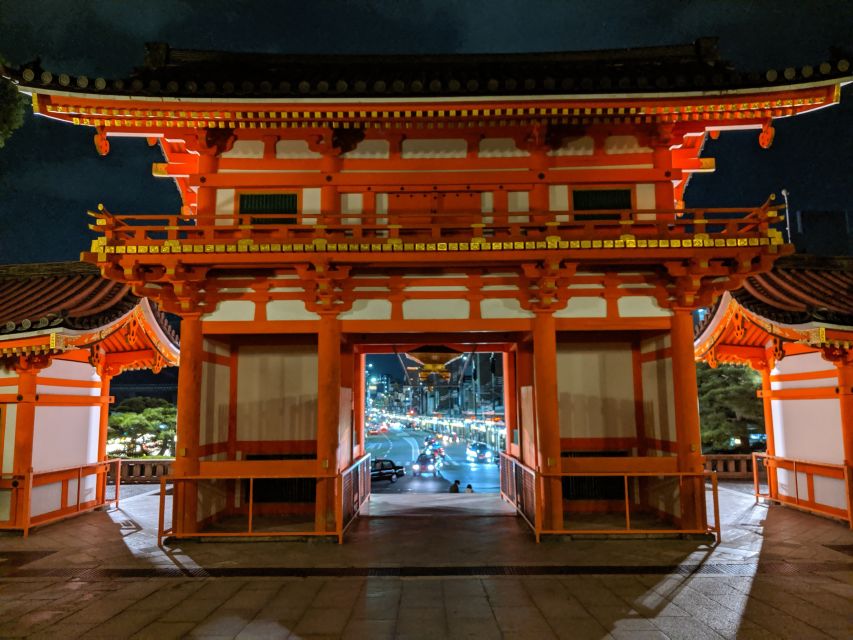
At night, the shrine grounds offer a change of mood from the commercial streets nearby. The lighting makes the entrance and buildings easier to appreciate, while the guide can explain local customs and the role of the shrine in Kyoto life.
You should expect interpretation rather than a long formal presentation. The value comes from having someone explain what you are looking at and how to behave respectfully. Several guides, including Karim, Kevin, and Salomé, have been praised for explaining religion, local customs, and Japanese culture in a clear way.
The 20-minute stop is enough for orientation, but not enough for a detailed study of every building. That is a fair trade on a route designed to cover several parts of Gion and Higashiyama in one evening.
Ninenzaka and Kyoto’s old street picture

From Yasaka Shrine, the walk continues to Ninenzaka for another 20-minute guided stop. This is one of the most recognizable streets in the Higashiyama area, with sloping lanes, traditional façades, and a strong sense of old Kyoto.
At night, Ninenzaka is often more enjoyable than during the busiest daytime hours. You can take in the lines of the street and the wooden buildings without constantly stopping to avoid crowds. The quiet also suits the guide’s stories about the district and its customs.
This is a good place to slow down for photographs, but remember that the streets are uneven and some sections are dark. Wear shoes you can walk in comfortably, and keep your attention on the pavement when looking around.
The route does not promise an empty Gion. You may still encounter other people, local activity, or groups heading toward restaurants. The advantage is simply that the evening atmosphere is generally less hectic than the daytime scene.
A completely different side of Kyoto:
- PERFECT KYOTO 1-Day Bus Tour
★ 5.0 · 13,518 reviews - Kyoto: Fushimi Inari, Kinkakuji, Bamboo Grove 1 Day Bus Tour
★ 4.8 · 4,316 reviews - Kyoto: Tea Ceremony in a Traditional Tea House in Kiyomizu
★ 4.9 · 3,519 reviews - Kyoto: Tea Ceremony Ju-An at Jotokuji Temple
★ 4.9 · 3,207 reviews
Hōkan-ji and the lit pagoda
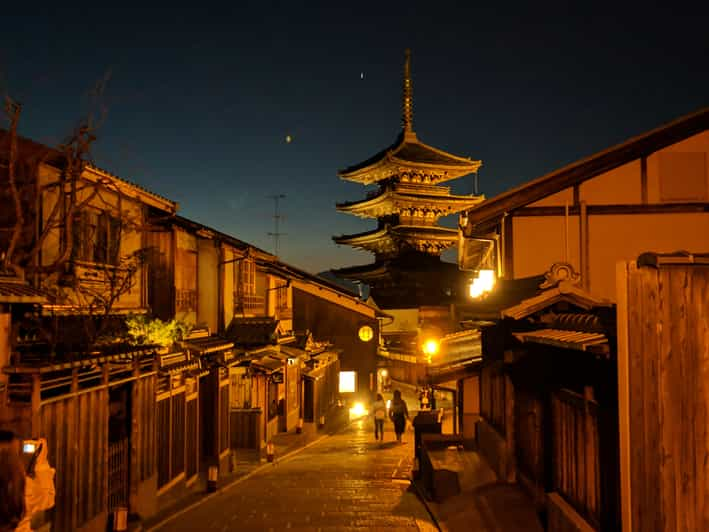
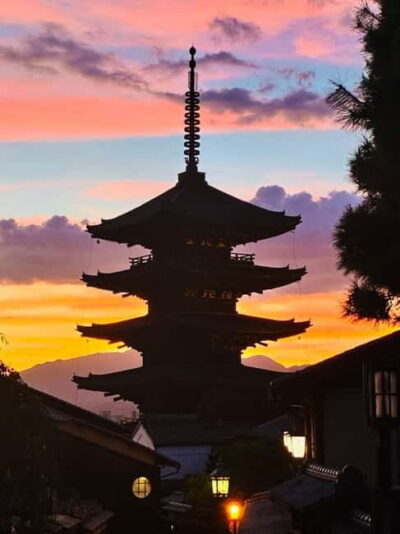
The Hōkan-ji Temple stop lasts about 20 minutes and is listed as a photo stop. Its five-story pagoda is one of the defining views of Higashiyama, and nighttime lighting gives it a particularly striking presence.
This is the most visual part of the walk. Your guide can point out good angles and explain the setting, while you have time to take pictures rather than rushing past. Ben has been praised for using visual material to help explain Kyoto’s past, and other guides have been noted for pointing out strong photography opportunities.
Keep your expectations measured. This is a photo stop, not a full temple tour, and the experience does not include a broad visit inside the temple complex. Its value is the combination of a famous Kyoto view and the guide’s context.
The pagoda also helps connect the different parts of the evening. You have moved from a Shinto shrine to an old Buddhist setting, then into the streets where traditional entertainment developed. That variety gives the walk more substance than a simple scenic stroll.
Yasui Kompira-Gu and a quieter pause
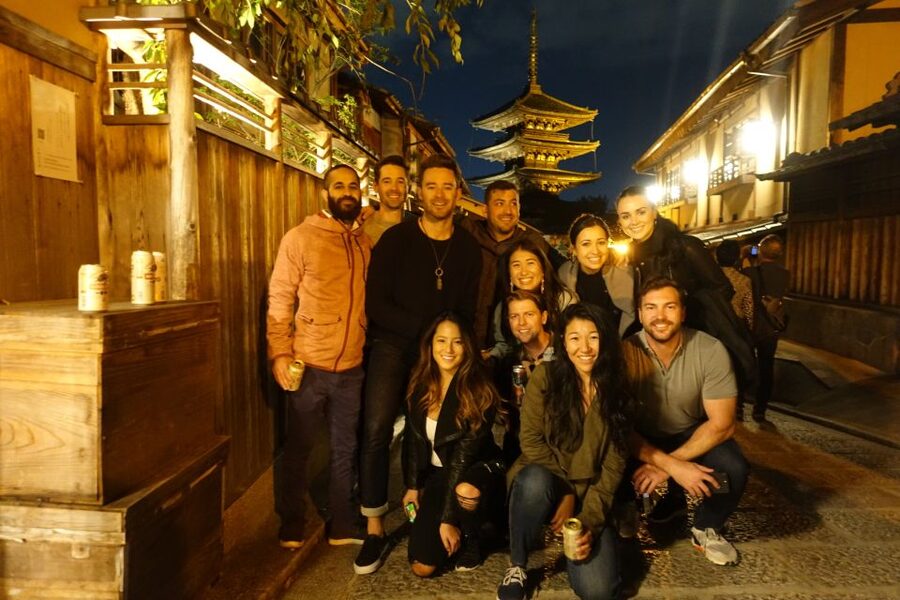
The next stop is Yasui Kompira-Gu Shrine, with about 15 minutes for a visit. It is shorter than the other stops, but it adds another religious site to the route and gives the tour a calmer pause before the longer Gion section.
The guide explains the shrine and its customs, helping you understand that Kyoto’s religious sites are not all the same. This kind of comparison is one of the better reasons to take a guided walk. You can see several places in a short time, while someone helps connect their rituals, architecture, and local meaning.
As with the other stops, this is an evening visit. Some areas may be dim, and you should stay close enough to hear the guide. The route is not built around dramatic entertainment at every corner. Its appeal is the steady change between streets, shrines, temples, and stories.
Gion after dark and the world of geiko
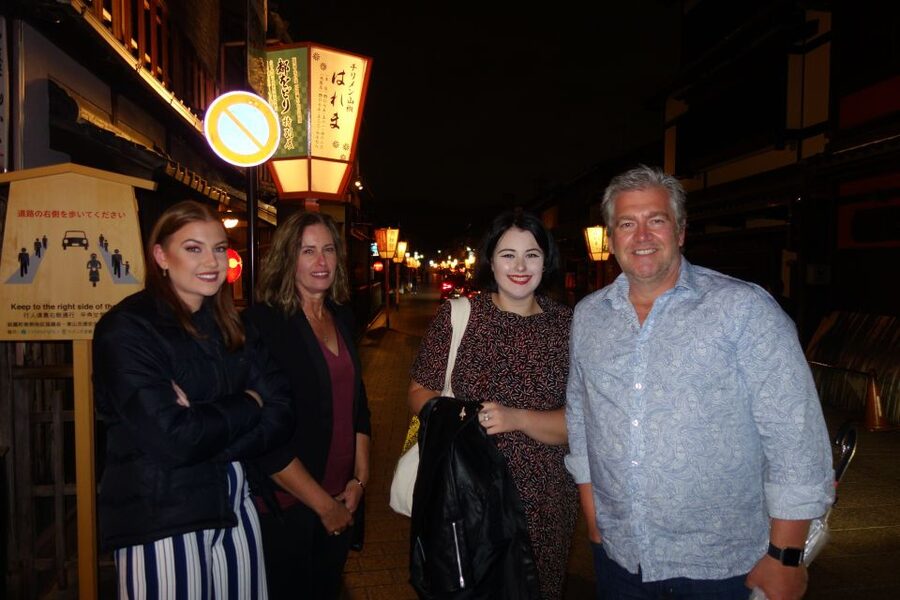
The final 45 minutes take place in Gion, the main cultural focus of the walk. Here, the guide explains the customs of geiko and apprentice maiko, along with the work and training behind their public appearance.
This is where a good guide makes a real difference. The subject can easily be reduced to costumes and photo opportunities, but the strongest guiding treats geiko and maiko as skilled professionals with demanding training. Kevin, Karim, and other guides have been praised for explaining their education, cultural role, and daily life with respect.
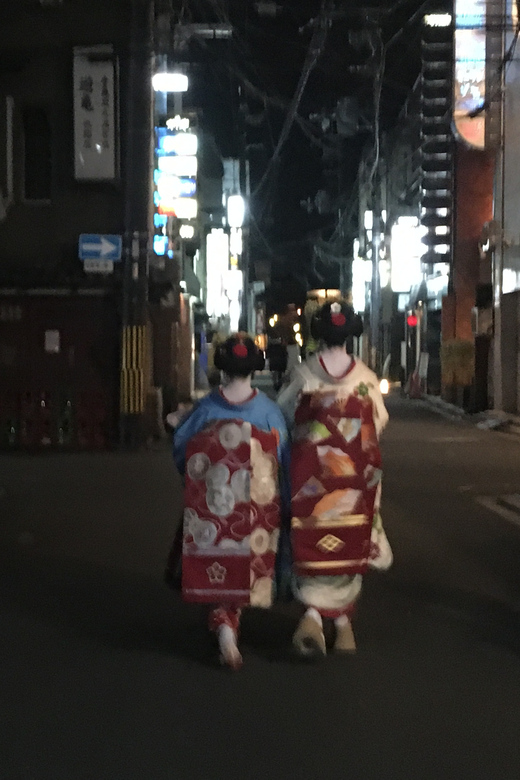
You might catch sight of women in full costume toward the end of the walk. Some people have seen several geiko or maiko, while others may see none. You should book this for the district and the cultural explanation, not as a guaranteed sighting.
That distinction matters. Chasing or photographing geiko without care can disturb residents and workers. The guides help you understand how to behave respectfully, which is more valuable than simply getting a quick picture.
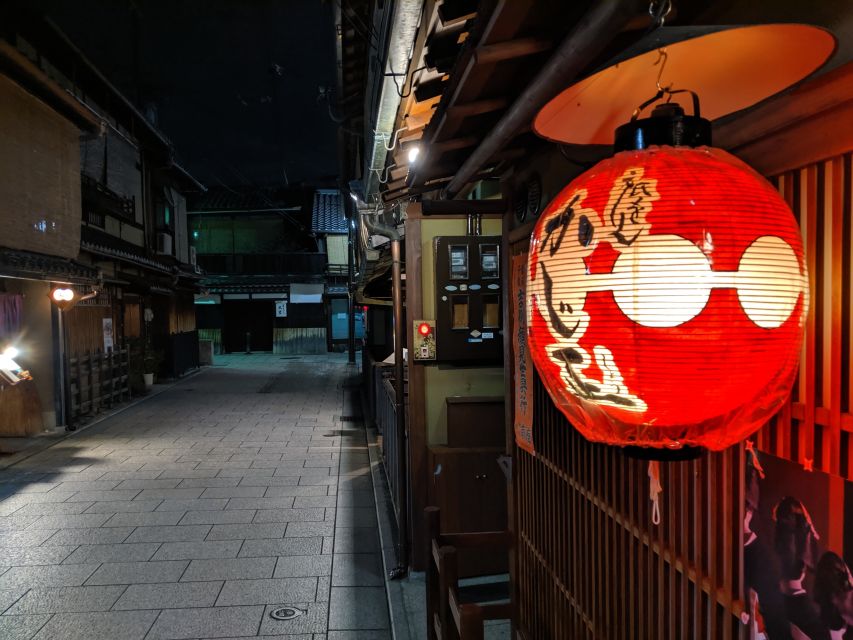
Gion itself is best appreciated in small details: a lantern outside a doorway, a narrow passage leading toward a traditional establishment, or the contrast between a quiet lane and a busier street. The guide’s job is to help you notice those details without turning the neighborhood into a stage set.
What the guides add to the walk
The strongest praise for this experience centers on the guides’ personal style. Karim is often described as friendly, funny, and especially good at answering questions. Kevin is praised for a relaxed pace, broad knowledge, and an ability to explain difficult subjects in simple terms.
Ben has used slides and visual aids on a tablet, which can help when discussing Kyoto’s past or geiko culture. Janelle, also spelled Janiel in some accounts, has been praised for lively conversation and strong explanations. Salomé, Diana, Hina, Amir, and Masu have also been singled out for warmth, humor, and engaging delivery.
You cannot choose a particular guide from the information provided, so do not book on the assumption that one specific person will lead your walk. Still, the repeated praise for different guides suggests that the operator has a solid range of presenters.
I particularly value the reports of guides offering restaurant and drink suggestions at the end. Food and drinks are not included, but practical advice about where to continue the evening can make the tour more useful. Ask questions as you walk, since the small-group and private options may allow more room for conversation.
The $24 price and what you receive
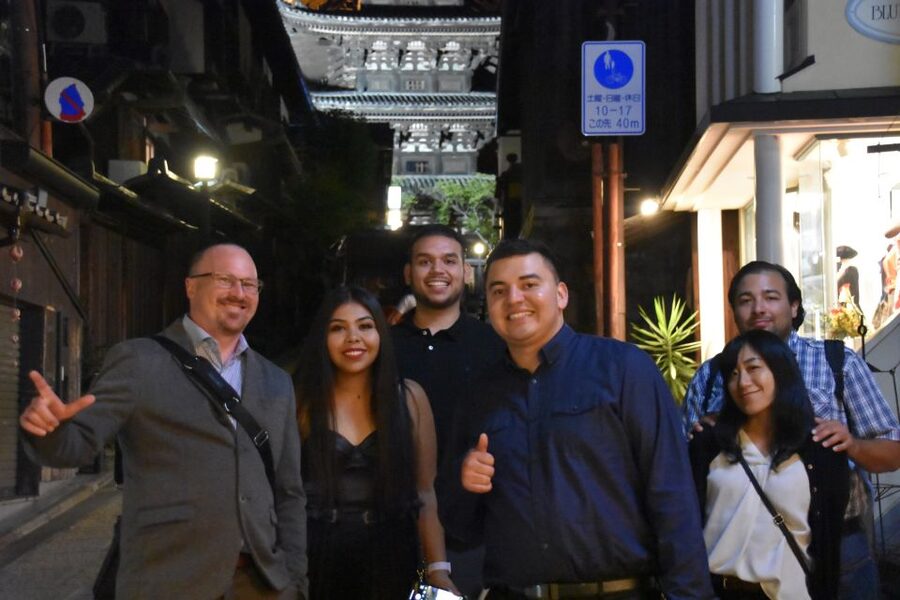
At $24 per person, this is a reasonably priced introduction to two of Kyoto’s most important historic districts. You are paying for a two-hour guided walk, not admissions, a meal, transport, or a special geiko performance.
That distinction makes the value easy to judge. If you only want to wander and take photos, you can explore Gion on your own. If you want someone to explain the religious sites, local customs, architecture, and geiko world while you walk, $24 is a modest cost for the context.
The tour becomes a better deal for first-time visitors, people with limited time, and anyone who finds Kyoto’s cultural rules difficult to read from signs alone. A private or small-group booking may also suit families or couples who want more opportunity to ask questions, though the exact group arrangement depends on the option selected.
The 4.9 rating from more than 2,000 reviews points to strong overall satisfaction, but the practical limitations remain. You pay separately for anything you eat or drink, nighttime streets can be dark, and the walk does not guarantee a geiko sighting.
Who should book this Kyoto walk
I would recommend it to:
- First-time visitors who want a useful introduction to Gion and Higashiyama.
- People arriving in Kyoto who want an easy first-evening activity.
- Anyone interested in geiko and maiko culture beyond costume photographs.
- Photographers who want to see Hōkan-ji’s pagoda and traditional streets under evening light.
- Visitors who prefer a relaxed walking tour to a large sightseeing bus.
- Couples, families, or small groups who value a guide’s local recommendations.
I would think twice if you want extensive interior access to temples, a formal geiko performance, or a guaranteed meeting with geiko or maiko. This is a neighborhood walk with cultural explanation, not a theater show or a full temple tour.
The tour also suits people comfortable walking for two hours on traditional streets. The supplied information does not give an accessibility assessment, so if you have mobility concerns, ask the operator before booking.
Simple ways to enjoy it more
Arrive early and confirm the correct meeting point. Carry a charged phone, since you may need to call the guide, and have WhatsApp ready if that is your preferred way to communicate.
Wear comfortable shoes and bring a light layer. Recent walks have taken place in cold weather, and one especially useful observation is that quieter nighttime lanes may also have darker spots.
Keep your camera ready at Hōkan-ji, but do not let photography distract from the guide’s explanations. In Gion, follow instructions about respectful behavior around people in traditional dress and avoid treating working neighborhoods as a photo backdrop.
Finally, save room in your evening. The tour ends with tips for a drink or bite to eat, and those recommendations may help you turn a two-hour introduction into a fuller night in Kyoto.
Should you book Best of Kyoto at night?
Yes, if you want a fairly priced, focused introduction to Gion and Higashiyama with a strong cultural angle. The quiet timing, range of historic stops, and careful explanation of geiko and maiko life give you more than a photo walk.
Book it early in your Kyoto stay so the stories and practical advice can guide the rest of your visit. Just arrive on time, expect some dark pavement, and treat a geiko sighting as a lucky extra rather than the purpose of the evening.
FAQ
How long is the Best of Kyoto walking tour?
The tour lasts two hours. The route includes guided stops at Yasaka Shrine, Ninenzaka, Hōkan-ji Temple, Yasui Kompira-Gu Shrine, and Gion.
What places are visited?
The walk visits Yasaka Shrine, Ninenzaka, Hōkan-ji Temple, Yasui Kompira-Gu Shrine, and the Gion district. Hōkan-ji is listed as a photo stop.
Is the tour offered in English?
Yes. Live guiding is available in English and French.
Is food or drink included?
No. Food and drinks are not included, although the guide can provide recommendations for a place to eat or have a drink afterward.
Can I see geiko or maiko during the tour?
You might catch a glimpse of women in full costume toward the end of the walk, but sightings are not guaranteed.
Can I cancel the booking?
You can cancel up to 24 hours in advance for a full refund. Reserve now and pay later is also available, depending on the booking option.
Recently added around Kyoto
- Higashiyama | Kyoto: Sakura Season Private Rickshaw Tour★ 5.0 · 3 reviews
- Kyoto Kimono Rental CHAMATSU|Kimono/Yukata Rental FamilyPlan★ 5.0 · 3 reviews
- Nara Private Customizable Half Day Tour★ 5.0 · 3 reviews
- Kyoto: Half-Day Private Guided Tour to the Old Town of Gion★ 4.4 · 3 reviews
- Kansai Region Hiking Adventure in Nara Kobe Kyoto and More★ 5.0 · 3 reviews
- Full Day Nara Deer, Temple, Shrine, Activities & Tea Ceremony★ 5.0 · 3 reviews
- Nara: Essential Private Tour with Deer Park and Temples★ 5.0 · 3 reviews
- Hiking Tour for Sacred Sites in Kyoto with a Guide★ 5.0 · 3 reviews
Gion Geisha District Tours, compared.
Kyoto Geisha Walking Tour: Gion District & Hidden Gems
Read our review →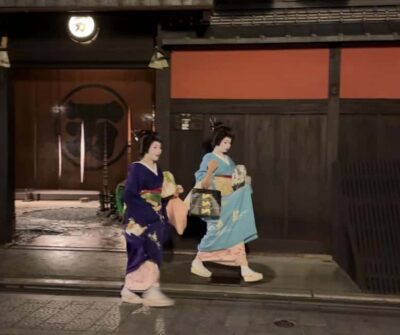
Gion Magical Night Walking Tour with Geisha Trivia
Read our review →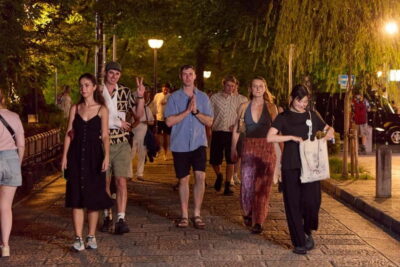
Gion Geisha District Walking Tour – Stories of Geisha
Read our review →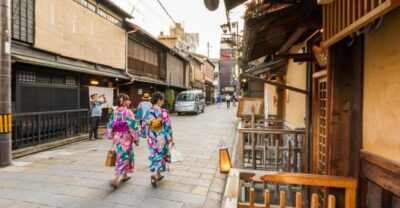

Kyoto Night Foodie Tour in Gion (9+ dishes + 6 Sake tastings)
Read our review →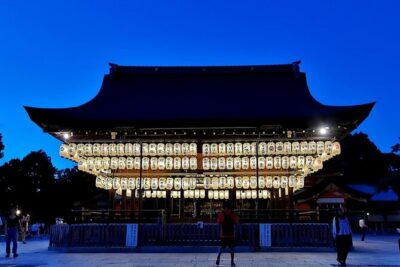
Kyoto Gion Geisha District Walking Tour – The Stories of Geisha
Read our review →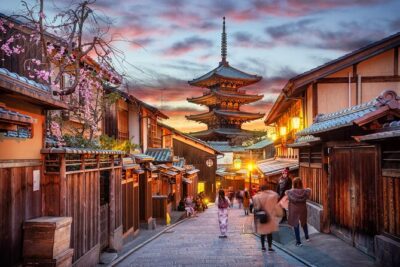
Kyoto Gion: 2-Hour Geisha Culture & History Walking Tour
Read our review →
Chopsticks Making Workshop in Gion with Engraving Option
Read our review →Browse the lists this tour appears in