
REVIEW · NARA DAY TRIPS
Nara: Enjoy Highlight Of Nara in 3 hours
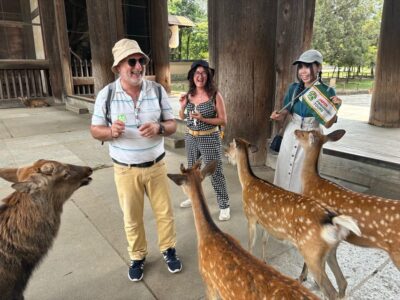
Nara’s deer are the opening act, but they are not the whole show. In Nara Park, you can buy special rice crackers and feed deer that roam freely among the trees and paths. The unusual part is the setting: Shinto tradition regards these animals as messengers of the gods, so a simple snack becomes a small link to Nara’s religious past.
I like the way this tour pairs close-up deer encounters with two major sacred sites. I also like the compact three-hour plan, which gives you an English-speaking guide and included admission to Kasuga Taisha and Todaiji Temple without taking an entire day.
The main consideration is pace. Forty-five minutes at Nara Park, forty-five minutes at Kasuga Taisha, and one hour at Todaiji leave little room for lingering, shopping, or a slow lunch. The listed meeting point is Himuro Shrine, while the listed end point is Kasuga Taisha, so confirm the exact route and final meeting instructions before you set out.
In This Review
- Key points to know before booking
- Why the deer are only the beginning
- Starting at Himuro Shrine and finding your group
- Walking through Nara Park with the deer
- Kasuga Taisha and its lantern-lit atmosphere
- Entering Todaiji Temple after the shrine
- What the English-speaking guide adds
- Is $71.54 a fair price?
- Who will enjoy this three-hour visit
- Practical details that affect the day
- Should you book this Nara tour?
- FAQ
- How long does the Nara tour last?
- What sights are included?
- Is admission included?
- Where does the tour start?
- Where does the tour end?
- How many people can join the tour?
- Can I cancel for a full refund?
Key points to know before booking
- Feed Nara’s free-roaming deer: Special rice crackers let you interact with the animals, though some may nip for a treat.
- See three major Nara sights in three hours: The route covers Nara Park, Kasuga Taisha, and Todaiji Temple.
- Learn why the deer matter: Shinto belief connects Nara’s deer with divine messengers, adding meaning to the encounter.
- Enter Kasuga Taisha and Todaiji Temple: Admission fees for both sites are included.
- Keep the group small: A maximum of eight people allows more direct contact with the English-speaking guide.
- Plan for steady walking: A moderate level of physical fitness is recommended.
Why the deer are only the beginning
Many people come to Nara expecting a quick photo with a deer. That is easy enough here, but the better experience is understanding why the animals are part of the place rather than just a roadside attraction.
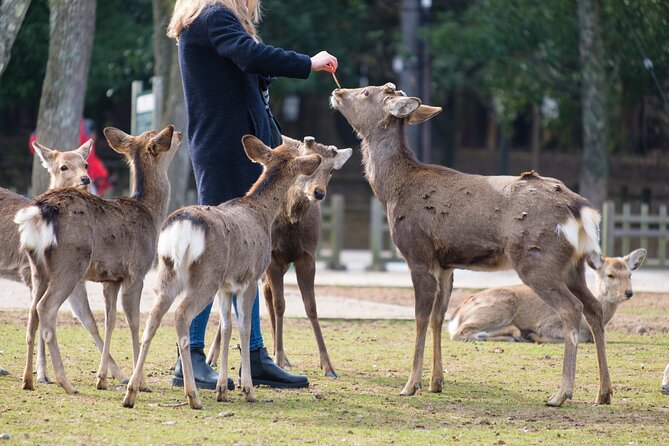
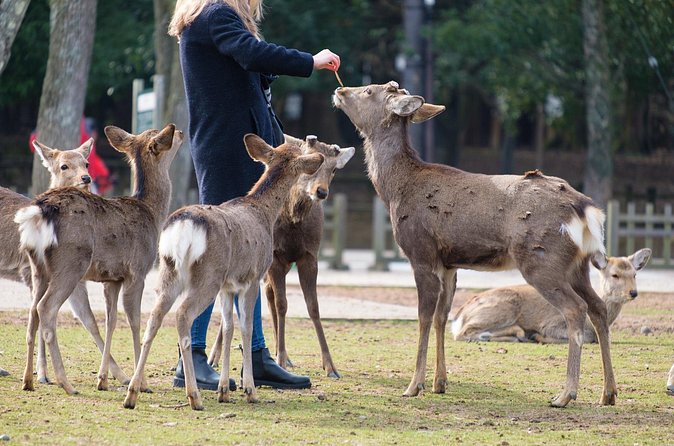
Hundreds of deer roam Nara Park freely. You can feed them special rice crackers, watch them wander at their own pace, and see how quickly they respond when food appears. Keep your hands raised and empty once the crackers are gone. One review notes that a deer may nip while asking for another snack, but raising your hands signals that the supply has ended.
That small tip matters. You will enjoy the deer more if you treat the exchange as brief and controlled. Feed slowly, keep the crackers visible, and do not expect the animals to pose politely for every photograph.
The religious connection gives the encounter more weight. In Shinto belief, deer are regarded as messengers of the gods. Your guide can help connect the animals with the shrines and temples you see later, so the park becomes an introduction to Nara’s spiritual character rather than a stand-alone animal stop.
The scheduled time here is 45 minutes. That is enough for feeding, photographs, and a first look around, but not enough for a leisurely exploration of every path. If deer are your main reason for coming to Nara, you may want extra free time before or after the tour.
More day trips to Nara:
- World Heritage Kyoto & Nara Uji Authentic Matcha Experience
★ 5.0 · 1,573 reviews - Nara Half Day Trip Walking Tour (Private Option Available)
★ 5.0 · 937 reviews - Nara Early Morning Tour (Kyoto or Osaka Departure Available)
★ 5.0 · 676 reviews
Starting at Himuro Shrine and finding your group
The tour begins at Himuro Shrine, at 1-4 Kasuganocho, Nara. This gives you a clear point in the historic shrine and temple district, close to Nara Park and the major sights on the route.
The experience uses a mobile ticket, and confirmation is provided when you book. It is still wise to arrive early enough to find the exact meeting spot without rushing. The tour is not built around a hotel pickup, so you need to make your own way to Himuro Shrine.
The activity is near public transportation, which helps if you are coming from another part of Nara. The group size is capped at eight people, a useful limit in a busy park where a large crowd can make it hard to hear explanations or stay together.
The listed end point is Kasuga Taisha Shrine, at 160 Kasuganocho. The sightseeing order places Todaiji Temple after Kasuga Taisha, so the published meeting and end details do not perfectly match the stop order. Ask the operator to confirm where the guided portion finishes on your date. One guide was kind enough to walk a participant back to the train station, but you should not treat that as a guaranteed part of the tour.
Walking through Nara Park with the deer
Nara Park is the most relaxed part of the experience. There is no entrance charge for the park, and the deer are the focus from the moment you begin looking along the paths.
You are not watching animals behind a fence. The deer move through the public space, which makes the encounter memorable, but it also means you need to pay attention to your food and belongings. A deer that sees crackers in your hand may come closer than expected.
The 45-minute stop works well for a first visit. Your guide can explain the cultural role of the deer, show you how to offer the crackers, and help put the park in context. This is especially useful if you want more than a series of animal photos.
The drawback is that the park can feel busy around the feeding areas. You may need patience for a clear picture, and the deer will not follow a planned schedule. The tour gives you a structured introduction, not unlimited time to sit and watch them.
If you have children in your group, the deer are likely to be the most immediately engaging part of the tour. Keep in mind that the animals can be eager around food. The practical rule is simple: give the treat, then show your empty hands.
Kasuga Taisha and its lantern-lit atmosphere
The route continues to Kasuga Taisha, one of Nara’s most important shrines. The shrine is surrounded by a forest associated with divine spirits, giving this stop a quieter and more mysterious feel than the open park.
The most striking details are the vermilion-lacquered shrine buildings and the many lanterns. Thousands of hanging lanterns are associated with Kasuga Taisha, and during festivals they are lit to create a soft glow along the shrine paths. Even outside festival periods, the lanterns help define the character of the site.
You also have access to the Manyo Botanical Garden as one of the shrine’s noted highlights. The garden adds a plant-filled pause to the visit and gives you a different view of the grounds beyond the main buildings.
Admission to Kasuga Taisha is included. That improves the value of the tour, since you are not simply being shown the outside of the shrine and then left to decide whether to enter.
The scheduled visit lasts 45 minutes. That is enough to see the main visual features and hear the essential background, but it is a short window for a shrine complex with several layers of interest. If you like taking your time with architecture, lanterns, or gardens, you may leave wanting another visit.
I would pay attention to the change in mood here. Nara Park is playful and unpredictable. Kasuga Taisha is more measured, with vermilion buildings, forest paths, and devotional objects creating a calmer rhythm. That contrast is one of the tour’s strongest qualities.
A few more Nara experiences worth comparing
- All must-sees in 3 hours – Nara Park Classic Tour! From JR Nara!
★ 5.0 · 108 reviews - 3-Hour Kyoto Insider Sake Brewery Tour with Tastings & Pairings
★ 5.0 · 917 reviews - Kyoto: 3-Hour Fushimi Inari Shrine Hidden Hiking Tour
★ 4.9 · 270 reviews - Kyoto Imperial Palace & Nijo Castle Guided Walking Tour – 3 Hours
★ 4.5 · 106 reviews
Entering Todaiji Temple after the shrine
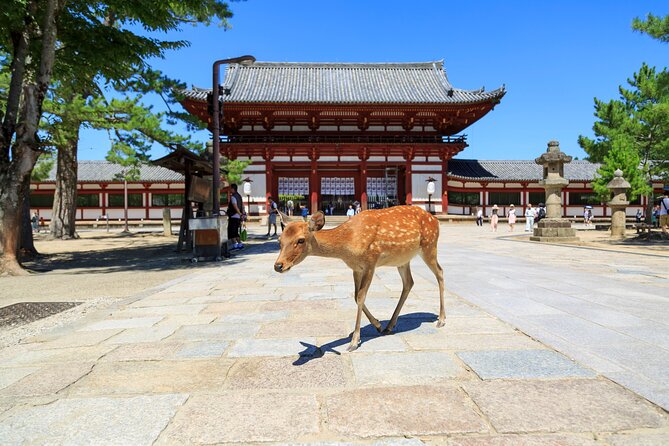
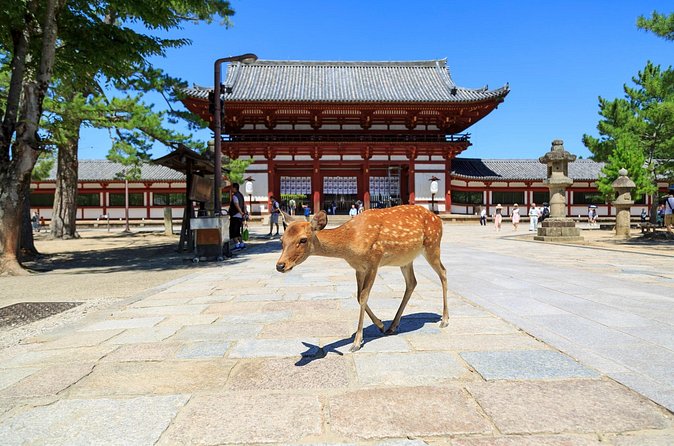
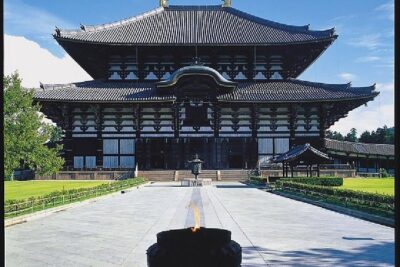
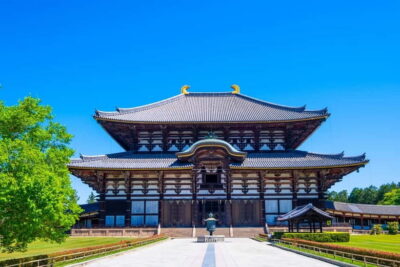
Todaiji Temple receives the longest stop, one hour, and for good reason. It is Nara’s most famous temple and is known for one of the world’s largest wooden structures. The building is designated a national treasure, and the site carries roughly 1,300 years of history.
The scale is the point. Even before you focus on individual details, the wooden construction gives the temple a powerful sense of size. A guide helps you read the building as more than a large photo opportunity by explaining its place in Nara’s religious and cultural story.
Admission to Todaiji is included, which is important here. The temple is one of the principal reasons many people come to Nara, so having entry handled within the tour keeps the three-hour plan straightforward.
One hour is a sensible introduction. You have time to enter, look around, hear the main explanations, and appreciate the structure without turning the tour into a full morning or afternoon. Still, this is not enough time for every detail or for a slow independent study of the entire temple grounds.
The order also gives the outing a good arc. You begin with living animals tied to religious belief, move into a forest shrine filled with lanterns, and finish with a huge wooden temple connected to 1,300 years of worship. That progression gives the stops a shared purpose.
What the English-speaking guide adds
The guide is the reason to choose this experience instead of walking the same route alone. You could visit Nara Park, Kasuga Taisha, and Todaiji independently, but you would have to supply the connections between them.
The supplied information identifies guides named Hiro and Ogawa in connection with this experience. Hiro is described as taking guests around Nara’s temples and historic areas while explaining why the deer are part of the area. Ogawa is praised for being helpful and kind, including walking someone back toward the train station after the tour.
That personal attention is particularly useful in Nara. The sights are famous, but the meaning behind them is less obvious at first glance. A guide can explain why deer appear in a religious setting, how Kasuga Taisha relates to the surrounding forest, and why Todaiji’s wooden scale matters.
The group limit of eight supports conversation. You should be able to ask questions without competing with a large crowd, though the exact experience will depend on the guide assigned and the day’s conditions.
There is a balance to keep in mind. A small guided tour is less flexible than exploring alone. The set schedule means you will move on when the group is ready, even if you want extra time with the deer or lanterns. In exchange, you get structure and context during a short visit.
Is $71.54 a fair price?
At $71.54 per person, this is not the cheapest way to see Nara’s sights. Nara Park itself is free, and independent visitors can reach the surrounding temples on their own.
The price becomes easier to justify if you value the guide and the included entries. You receive an English-speaking guide, admission to Kasuga Taisha, and admission to Todaiji Temple. The group is limited to eight, so you are paying for a more personal format rather than a large coach outing.
The three-hour length also has value if your schedule is tight. You can cover Nara’s main highlights without giving up an entire day. This works well for a short stay, a packed Kansai itinerary, or a first visit when you want help getting oriented.
It is less attractive if you already know the sites, prefer to set your own pace, or want long stretches for photography. Independent sightseeing will give you more control, but it will not automatically give you the explanations and local help that come with this tour.
I would judge the price by asking one question: do you want three famous sights explained efficiently, or do you want a full day to wander? For the first option, the cost is reasonable. For the second, use the tour as an introduction and leave time to return on your own.
Who will enjoy this three-hour visit
I would recommend this experience to a first-time Nara visitor who wants the main sights without working out the route alone. It suits anyone who enjoys cultural context but does not want a long lecture or a full-day commitment.
Families may appreciate the immediate appeal of the deer, followed by the more formal shrine and temple visits. The small group can also make it easier to keep the outing organized, though everyone should be comfortable walking for three hours.
It is a good fit for visitors staying in Kyoto or Osaka who have only a limited window for Nara. The schedule is compact, and the free-cancellation policy gives you some flexibility if plans change, provided you cancel at least 24 hours before the local start time.
You should think twice if you have limited mobility or dislike walking. A moderate level of physical fitness is recommended, and the tour does not promise a seated or vehicle-based visit. The exact walking distance is not specified, so ask the operator if you need that detail before booking.
Practical details that affect the day
The tour lasts approximately three hours. The planned time is 45 minutes at Nara Park, 45 minutes at Kasuga Taisha, and one hour at Todaiji Temple, with the remaining time used for moving between stops and guiding.
Your mobile ticket is confirmed at booking. Bring the ticket in a form you can access easily on your phone, and make sure your device has enough battery for the meeting details and contact information.
The tour begins at Himuro Shrine and is listed as ending at Kasuga Taisha. Since Todaiji is listed as the final sightseeing stop, confirm the final location before departure. That small check can prevent confusion when you are ready to continue to a train station, hotel, or another Nara sight.
Free cancellation is available until 24 hours before the experience starts. Cancellations made less than 24 hours ahead are not refunded, and changes inside that window are not accepted.
Should you book this Nara tour?
Book it if you want a short, guided introduction to Nara’s deer, shrine, and temple highlights. The strongest reasons are the eight-person maximum, the English-speaking guide, and the included admission to Kasuga Taisha and Todaiji Temple.
Skip it if you want to wander without a clock or spend much longer with any one stop. Nara rewards slow exploration, and this outing is a focused sampler rather than a complete day in the park.
For most first-time visitors with only three hours, I think the plan makes sense. You get the memorable deer encounter, the lantern-filled character of Kasuga Taisha, and the scale of Todaiji, along with explanations that tie the three places together. Just confirm the end point and arrive ready to walk.
FAQ
How long does the Nara tour last?
The experience lasts approximately three hours.
What sights are included?
The tour visits Nara Park, Kasuga Taisha Shrine, and Todaiji Temple.
Is admission included?
Admission to Kasuga Taisha and Todaiji Temple is included. Nara Park has free admission.
Where does the tour start?
The meeting point is Himuro Shrine, 1-4 Kasuganocho, Nara, 630-8212, Japan.
Where does the tour end?
The listed end point is Kasuga Taisha Shrine, 160 Kasuganocho, Nara, 630-8212, Japan. Since Todaiji is listed as the final sightseeing stop, confirm the exact end location before the tour.
How many people can join the tour?
The activity has a maximum group size of eight people.
Can I cancel for a full refund?
Yes. You can cancel for a full refund if you cancel at least 24 hours before the experience start time. Cancellations or changes made less than 24 hours before the start are not accepted or refunded.
Recently added around Nara
- Nara Private Customizable Half Day Tour★ 5.0 · 3 reviews
- Nara: Essential Private Tour with Deer Park and Temples★ 5.0 · 3 reviews
- Full Day Nara Deer, Temple, Shrine, Activities & Tea Ceremony★ 5.0 · 3 reviews
- Discover the Essence of Nara Ink Through Your Senses★ 5.0 · 3 reviews
- Private Journey in Nara’s Historical Wonder★ 5.0 · 3 reviews
- Nara:Private Tea Ceremony(Max 5 ppl) -Master Matcha Making-★ 5.0 · 3 reviews
- Nara Takayama Tea Whisk Craft and Tea Culture Experience★ 5.0 · 3 reviews
- Nara: Half-Day Private Tour of 4 Must-See Spots & Deer Park★ 5.0 · 3 reviews
Nara Day Trips, compared.
World Heritage Kyoto & Nara Uji Authentic Matcha Experience
Read our review →
Kyoto/Osaka: Nara, Fushimi Inari Taisha, Arashiyama Bus Tour
Read our review →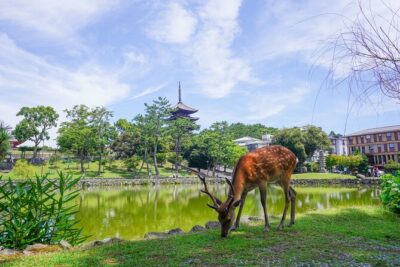
Nara Half Day Trip Walking Tour (Private Option Available)
Read our review →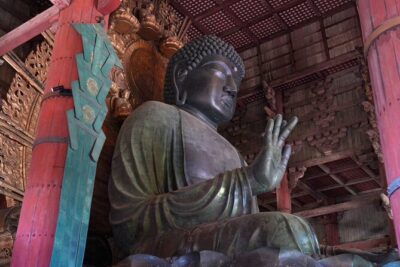
Nara Early Morning Tour (Kyoto or Osaka Departure Available)
Read our review →
Kyoto/Osaka: Kinkakuji, Bamboo Forest, and Nara Deer Park
Read our review →Browse the lists this tour appears in