
REVIEW · FUSHIMI INARI SHRINE TOURS
Kyoto Guided Walking Tour: Secret Zen Garden and Fushimi Inari
The clever part of this Kyoto tour is the route. You begin around Tofukuji’s temple grounds and quieter sub-temples, then approach Fushimi Inari through small shrines and wooded paths instead of rushing straight to the famous torii gates. By the time you reach the red gates, you have some context for the religious world you are seeing.
I like the small maximum of eight people, which gives the guide room to answer questions and adjust the walking pace. I also like the mix of major sights and less-visited places, especially Komyo-in’s Zen garden and the view from Yotsuji. The main caution is simple: this is a real walking and hiking tour, with uphill sections and stairs, not a gentle temple stroll.
In This Review
- Key points to know before booking
- Why this route works better than a simple Fushimi Inari visit
- Starting at Gaun-kyo Bridge and Tofukuji
- Komyo-in Temple and the secret Zen garden
- Araki Shrine and the meaning of personal prayer
- Hiking toward Yotsuji and the Kyoto view
- Kumataka Shrine and the quieter side of Fushimi Inari
- Okusha Worship Center and the shrine’s religious side
- Senbon Torii, the famous red gate passage
- Fushimi Inari’s Main Shrine and the end of the walk
- What the guides add to the morning
- Price, pace, and physical effort
- Who should book this Kyoto walking tour
- Should you book the Tofukuji and Fushimi Inari tour?
- FAQ
- How long does the Kyoto walking tour last?
- What time does the tour start?
- Where does the tour meet?
- Where does the tour end?
- How many people can join the tour?
- Is the tour suitable for people with limited fitness?
- Does the tour run in bad weather?
- Are admission tickets included?
- Can I cancel for a full refund?
Key points to know before booking
- A quieter approach to Fushimi Inari: You reach the shrine by way of lesser-known religious sites and paths before arriving at the busiest torii-gate area.
- Komyo-in is the peaceful centerpiece: This sub-temple offers a carefully arranged Zen garden and a chance to think about Japanese meditation traditions without a large crowd.
- The group is capped at eight: A small group makes it easier to hear explanations and request a slower or faster pace.
- Yotsuji rewards the uphill walk: The Four-Way Crossroad provides a scenic Kyoto view and a useful break during the ascent.
- Several guides are praised by name: Kenta, Mika, and Naomi are specifically associated with clear explanations, flexibility, and an easygoing approach.
- The tour runs in all weather: Wear proper walking shoes and plan for rain or shine.
Why this route works better than a simple Fushimi Inari visit
Fushimi Inari is easy to reach, but its famous lower gates can feel crowded. Many people walk through the first torii tunnels, take a few pictures, and leave without understanding the shrine’s place in Japanese religious life.
This tour gives you a broader morning. You see a major Zen temple area, a small garden temple, shrines tied to personal hopes, mountain paths, a viewpoint, and the main Fushimi Inari grounds. The sequence also helps break up the climb. You are not asked to hike continuously from the first minute.
The route begins at 9 a.m. near Tofukuji Station, at the FamilyMart at 12-chome-232 Honmachi in Kyoto’s Higashiyama Ward. The tour ends at the Outer Oratory of Fushimi Inari Shrine, so you finish at a useful sightseeing point rather than returning to your starting place.
That one-way design matters. You do not spend part of the morning retracing your steps, but you should plan your next stop from Fushimi Inari. The ending point is not the same as the meeting point.
More ways to walk Fushimi Inari:
- Kyoto: Fushimi Inari, Kinkakuji, Bamboo Grove 1 Day Bus Tour
★ 4.8 · 4,316 reviews - Fushimi Inari Hidden Hiking Tour (Private Option Available)
★ 5.0 · 1,750 reviews - Kyoto/Osaka: Nara, Fushimi Inari Taisha, Arashiyama Bus Tour
★ 4.7 · 1,275 reviews
Starting at Gaun-kyo Bridge and Tofukuji
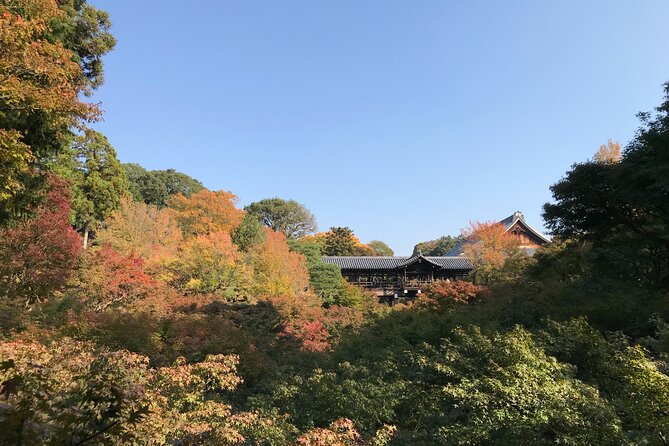
The first stop is Gaun-kyo Bridge, a wooden bridge crossing a leafy valley. From here, you can look toward Tsutenkyo Bridge and the maple trees below. The view changes with the season, and the setting gives you an immediate sense of why Tofukuji is one of Kyoto’s important temple areas.
The bridge stop is brief, about five minutes. Think of it as an introduction and photo pause, not a full sightseeing visit. If you are hoping for a long time at the viewpoint, you may find this part short, but the tour has many more stops ahead.
The route then moves into the Tofukuji temple area. Tofukuji was founded in the 13th century and is one of Kyoto’s major Zen temples. Its scale and setting help explain the role of large Buddhist temple compounds in Kyoto, while the side temples offer a quieter experience than the best-known central sights.
Your guide is especially useful here. The temple buildings and grounds can be hard to interpret on your own, and the tour is designed to connect the architecture, gardens, and religious purpose. Guides such as Mika have used notes and illustrations to make the explanations easier to follow, a useful touch if Japanese Buddhist terms are new to you.
Komyo-in Temple and the secret Zen garden
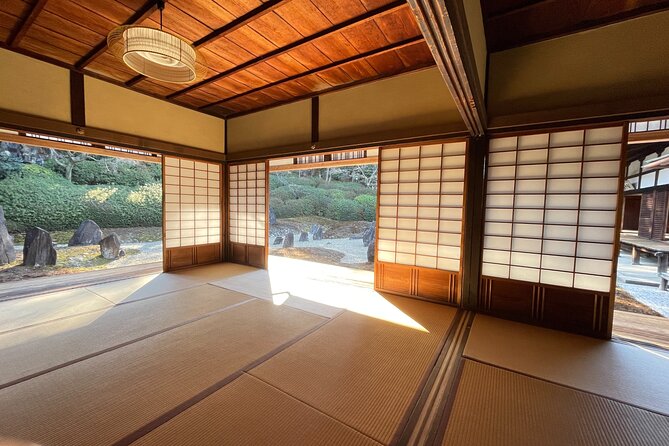
Komyo-in is the tour’s quiet pause. This lesser-known sub-temple is known for its Zen garden and calm atmosphere. You spend about 25 minutes here, enough time to look closely rather than simply snap a picture and move on.
A Zen garden does not need to be treated like a puzzle with one correct answer. Your guide can introduce the ideas behind Zen practice and meditation, then give you space to notice the arrangement of rocks, gravel, plants, and surrounding buildings. That balance is one of the best reasons to take this tour instead of visiting only the famous gates.
The garden may be the most valuable stop for people who want more than a checklist of Kyoto sights. It is also a good contrast to Fushimi Inari, where color, movement, and the repeated shape of the torii gates create a very different mood.
There is a practical limit. Twenty-five minutes is not a long meditation session, and the tour cannot guarantee complete silence. Still, the small group and lesser-known setting give you a better chance of enjoying the garden at an unhurried pace.
Araki Shrine and the meaning of personal prayer
Araki Shrine is a short stop of about ten minutes. It is associated with prayers for love, strong relationships, and general well-being. That makes it a more personal stop than a grand architectural sight.
I like this kind of inclusion because it shows how shrines function in daily life. Kyoto is not only a city of old buildings and scenic photographs. People come to these places with specific hopes, concerns, and family traditions.
The visit is free, and the stop is compact. You should not expect a long ceremony or a major complex. Its value comes from the guide’s explanation and the chance to see a different side of shrine worship before continuing toward Fushimi Inari.
More Zen sittings in Kyoto:
- Kyoto Zen Meditation & Garden Tour at a Zen Temple with Lunch
★ 5.0 · 441 reviews - Kyoto: Zen Experience in a Hidden Temple
★ 5.0 · 437 reviews - Kyoto: Tea Ceremony Meditation – Make Matcha with Tea Master
★ 4.8 · 406 reviews - Kyoto: Zen Meditation at a Private Temple with a Monk
★ 5.0 · 202 reviews
Hiking toward Yotsuji and the Kyoto view
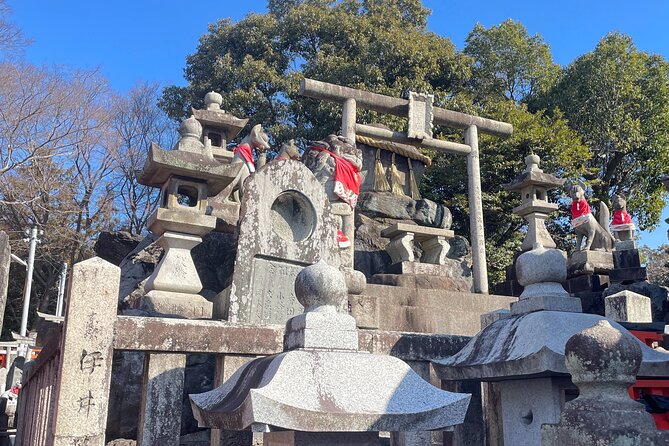
The path eventually joins the Fushimi Inari route and climbs toward Yotsuji, also known as the Four-Way Crossroad. This section is where the tour’s fitness warning becomes important. You will walk uphill, and the route includes hiking and stairs.
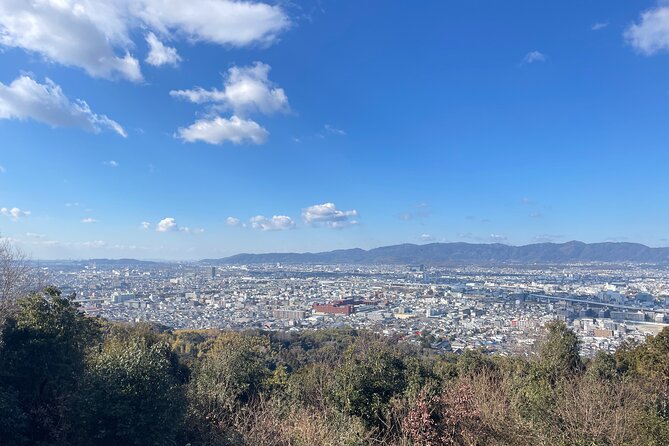
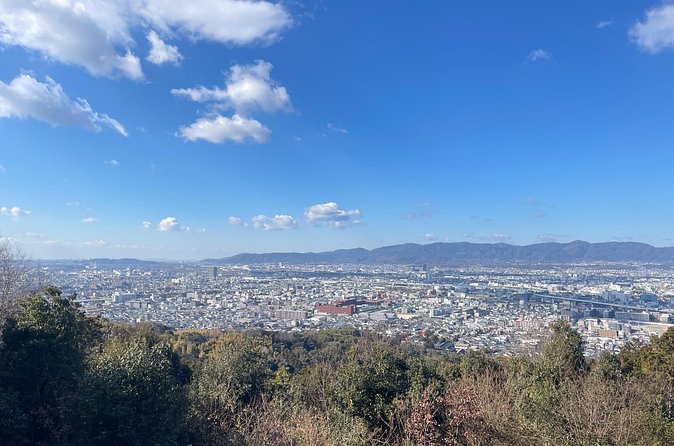
Yotsuji is a useful reward. From this point, you can pause and look out over Kyoto. The viewpoint gives the climb a clear purpose, and the break lets you catch your breath before continuing through the shrine grounds.
The tour spends about 20 minutes here. That is enough for photographs and a short rest, but it may feel brief if the view is especially clear or you want to linger. The guide can also help you judge the pace, and one of the most useful qualities praised in the tour’s feedback is the willingness to walk at the group’s speed.
Wear shoes with firm soles. Comfortable walking shoes are not a minor suggestion here. Sandals or smooth-soled shoes could make the uphill portions less pleasant, especially in wet weather.
Kumataka Shrine and the quieter side of Fushimi Inari
Kumataka Shrine is a secluded stop away from the most crowded torii-gate paths. You spend about 15 minutes here. It is described as a place with strong spiritual energy, and its quiet setting offers a sharp change from the more familiar parts of Fushimi Inari.
This is one of the tour’s more unusual choices. Many Fushimi Inari visits focus almost entirely on the Senbon Torii. By adding Kumataka Shrine, the route shows that the complex contains smaller sacred places as well as the famous photo stops.
The word secluded should not lead you to expect a completely untouched site. You are still within one of Kyoto’s major shrine areas. But compared with the main lower route, this stop can feel more removed and reflective.
Okusha Worship Center and the shrine’s religious side
The next stop is the Okusha Worship Center, also called Nosatsusho in the tour information. You spend about ten minutes here. This is where visitors can obtain sacred ofuda amulets, omamori charms, and goshuin shrine stamps.
If you collect goshuin, this stop may be especially useful. A goshuin is a calligraphic stamp and inscription connected with a temple or shrine, usually recorded in a dedicated book. Your guide can help explain the purpose of these items and the difference between a souvenir purchase and a religious offering.
The visit also gives you a better sense of Fushimi Inari as an active place of worship. The torii gates are striking, but they are only one part of the shrine’s meaning. The Okusha stop shifts attention from photography to practice.
Senbon Torii, the famous red gate passage
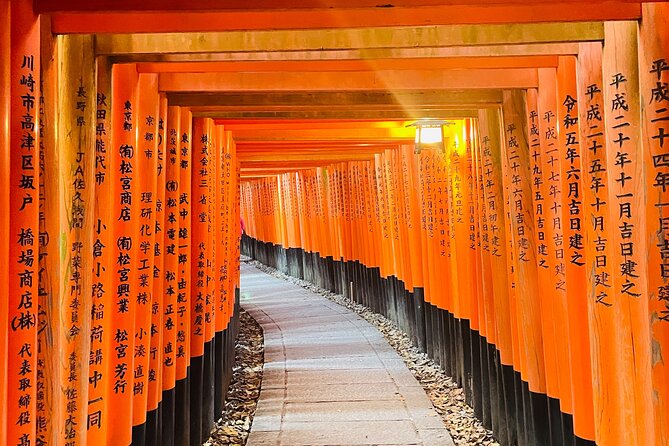
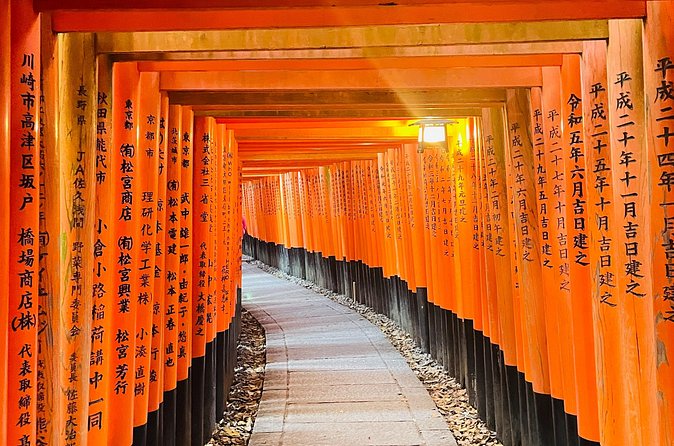
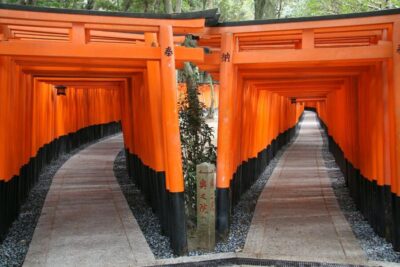
Senbon Torii is the sight most people associate with Fushimi Inari. Thousands of vermilion torii gates form long passages up the mountain, creating one of Kyoto’s most recognizable scenes.
The gates are striking because of their repetition. Each one has been donated by an individual or organization, and together they create a tunnel-like path. Your guide can help you understand why the gates matter rather than leaving you with only a photo opportunity.
The route’s timing is a real advantage. You encounter the quieter parts first, then arrive at the famous gates with some understanding of the surrounding worship sites. The lower sections can still be busy, especially at a popular time of day, so do not expect the entire passage to be empty.
The tour does not appear to cover the full mountain climb to the summit. It includes Yotsuji and several key areas before ending near the Outer Oratory. If reaching the top of Mount Inari is a personal goal, confirm the exact route with the operator before booking.
Fushimi Inari’s Main Shrine and the end of the walk
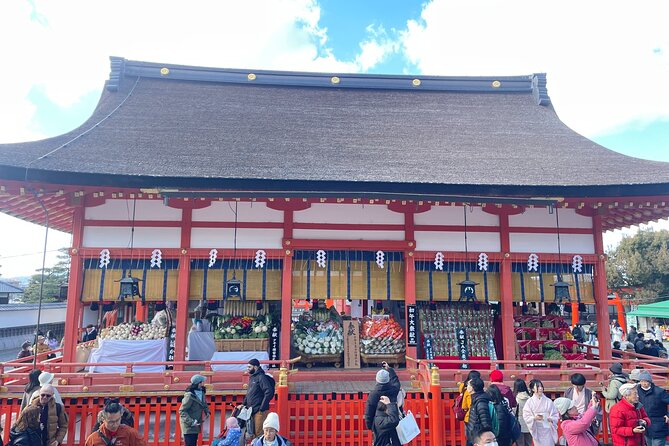
The final listed stop is the Fushimi Inari Taisha Honden, the Main Shrine. You spend about ten minutes here. The Main Shrine is the formal place of worship, while the torii gates and fox statues often draw most of the attention.
This is a good final lesson in looking beyond the famous image. The Honden gives you a quieter place to consider the shrine as a religious institution, not just a scenic path. Your guide can also explain the role of fox imagery, which is closely tied to Inari worship.
The tour ends at the Outer Oratory. From there, you can continue exploring Fushimi Inari on your own or make your way to your next destination. Since the tour ends in a different part of Kyoto from where it starts, allow a little time to orient yourself.
What the guides add to the morning
A walking tour like this rises or falls with its guide. The strongest feedback about this experience centers on clear explanations, flexible pacing, and guides who welcome questions.
Kenta is praised for adjusting the pace, which matters on the uphill sections. Mika is associated with strong English, helpful notes, historical explanations, and an ability to steer the group away from the thickest crowds. Naomi is noted for answering questions and explaining the sites clearly.
Those guides may not be assigned to every departure, so you should not book on the assumption that one particular person will lead your group. Still, the pattern is encouraging: this is not designed as a silent escort from one photo stop to the next.
The maximum group size of eight is another practical strength. In a large group, it is harder to hear a guide beside a busy shrine, and individual walking speeds can become a problem. With eight or fewer people, you have a better chance to ask about meditation, shrine customs, architecture, or the meaning of items sold at the worship center.
Price, pace, and physical effort
The price is $78.83 per person. That is not the cheapest way to see Fushimi Inari, since the shrine stops listed here do not require an admission fee. You are paying mainly for the guide, the planned route, the cultural explanation, and the time saved researching how to connect the sites.
For a first morning in Kyoto, I think the price can be reasonable if you value structure and interpretation. You see several places in about four hours, avoid figuring out the route yourself, and get access to a small group rather than a crowded excursion.
The value is weaker if you prefer to wander alone, already understand Zen and Shinto traditions, or want to spend a long time taking photographs at each stop. The listed visits are short, and the guide must keep the group moving.
The tour is best for someone with moderate fitness. You will walk and hike, with uphill stretches around Fushimi Inari. It runs rain or shine, so bring weather protection and dress for changing conditions. A mobile ticket is provided, and the starting point is near public transportation.
Who should book this Kyoto walking tour
I would choose this tour for a first visit to Kyoto if I wanted an easy introduction to both Zen Buddhism and Shinto shrine culture. It is also a good fit if you have one morning available and want a guide to connect Tofukuji with Fushimi Inari.
Couples may enjoy Araki Shrine’s focus on love and relationships. Photographers will appreciate Gaun-kyo Bridge, Yotsuji, and the Senbon Torii, though the short stop times mean you should keep your camera work efficient.
The tour suits people who want a quieter route before reaching a major sight. It is less suitable for anyone with limited mobility, anyone who dislikes hills, or anyone who wants a slow, solitary garden visit.
The free cancellation policy allows a full refund if you cancel at least 24 hours before the local start time. Changes or cancellations inside that window are not accepted for a refund.
Should you book the Tofukuji and Fushimi Inari tour?
Book it if you want context, a small group, and a carefully arranged route rather than a quick visit to the torii gates. The best parts are the calm garden at Komyo-in, the lesser-used shrine paths, and the guide’s help in making sense of places that can otherwise blur together.
Skip it if your priority is independence or a full-day climb through Fushimi Inari. You can visit the shrine on your own, and the admission-free sites make self-guiding inexpensive.
For most first-time visitors who have a free morning and can manage a moderate hike, this is a strong way to meet Kyoto’s spiritual side. Just wear good shoes, start ready for hills, and remember that the tour ends at Fushimi Inari rather than back at Tofukuji.
FAQ
How long does the Kyoto walking tour last?
The tour lasts approximately four hours.
What time does the tour start?
The tour starts at 9:00 a.m.
Where does the tour meet?
The meeting point is FamilyMart Nakai Tofukuji, at 12-chome-232 Honmachi, Higashiyama Ward, Kyoto, 605-0981, Japan.
Where does the tour end?
The tour ends at the Outer Oratory of Fushimi Inari Shrine at 58 Fukakusa Yabunouchicho, Fushimi Ward, Kyoto, 612-0882, Japan.
How many people can join the tour?
The tour has a maximum of eight travelers.
Is the tour suitable for people with limited fitness?
The tour requires a moderate fitness level. It includes a moderate amount of walking and hiking, including uphill sections, so comfortable walking shoes are recommended.
Does the tour run in bad weather?
Yes. The tour takes place rain or shine.
Are admission tickets included?
Admission is listed as free at Gaun-kyo Bridge, Araki Shrine, Yotsuji, Kumataka Shrine, the Okusha Worship Center, Senbon Torii, and Fushimi Inari’s Main Shrine. Admission to Komyo-in Temple is included.
Can I cancel for a full refund?
Yes. You can cancel at least 24 hours before the local start time for a full refund. Cancellations or changes made less than 24 hours before the start time are not accepted for a refund.
More Walking Tours in Kyoto
- Kyoto Geisha Walking Tour: Gion District & Hidden Gems
★ 4.7 · 3,273 reviews - Kyoto: Gion Magical Night Walking Tour with Geisha Trivia
★ 4.9 · 2,393 reviews - Kyoto: Gion Geisha District Walking Tour – Stories of Geisha
★ 4.7 · 2,187 reviews - Night Walk in Gion: Kyoto’s Geisha District
★ 4.5 · 2,003 reviews
More Gardens in Kyoto
- Kyoto Arashiyama Walking Tour: Bamboo, Monkeys, Gardens & Secrets
★ 5.0 · 1,216 reviews - Kyoto Arashiyama Bamboo forest & Garden Half-Day Walking Tour
★ 5.0 · 413 reviews - Kyoto: Zen Garden, Zen Mind (Private)
★ 5.0 · 126 reviews - Kyoto Kiyomizu Tea Ceremony with Scenic Garden Views
★ 5.0 · 101 reviews
Recently added around Kyoto
- Higashiyama | Kyoto: Sakura Season Private Rickshaw Tour★ 5.0 · 3 reviews
- Kyoto Kimono Rental CHAMATSU|Kimono/Yukata Rental FamilyPlan★ 5.0 · 3 reviews
- Kyoto: Half-Day Private Guided Tour to the Old Town of Gion★ 4.4 · 3 reviews
- Nara Private Customizable Half Day Tour★ 5.0 · 3 reviews
- Kansai Region Hiking Adventure in Nara Kobe Kyoto and More★ 5.0 · 3 reviews
- Full Day Nara Deer, Temple, Shrine, Activities & Tea Ceremony★ 5.0 · 3 reviews
- Nara: Essential Private Tour with Deer Park and Temples★ 5.0 · 3 reviews
- Hiking Tour for Sacred Sites in Kyoto with a Guide★ 5.0 · 3 reviews
Fushimi Inari Shrine Tours, compared.
Fushimi Inari, Kinkakuji, Bamboo Grove 1 Day Bus Tour
Read our review →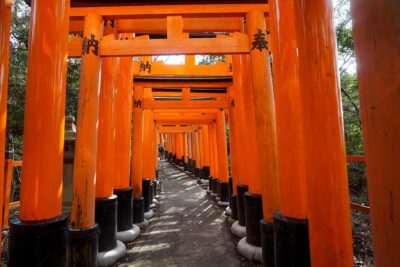
Fushimi Inari Hidden Hiking Tour (Private Option Available)
Read our review →
Kyoto/Osaka: Nara, Fushimi Inari Taisha, Arashiyama Bus Tour
Read our review →
Nijo, Kinkaku-ji, Arashiyama, Kiyomizu & Fushimi Inari
Read our review →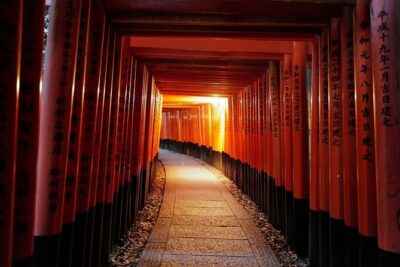
Kyoto Early Bird English Tour: Fushimi-Inari and Arashiyama
Read our review →
Fushimi, Arashiyama – Bamboo, Monkey, Torii & Secrets
Read our review →Browse the lists this tour appears in