
REVIEW · WORKSHOPS
Fukusa Shibori Class
Kyoto’s shibori class turns a traditional textile method into something you can actually do. You stitch patterns into silk, pull the thread tight, and wrap sections before dyeing. The final design only appears after the fabric is opened, which gives the class a small but satisfying surprise at the end.
I like two things right away: you make a useful silk wrapping cloth instead of a throwaway souvenir, and the class gives you both hands-on work and a look at finished museum pieces. The main consideration is time. At 60 to 90 minutes, this is a compact introduction, not a full course in every shibori method.
In This Review
- Key points to know before booking
- Why this short Kyoto craft class works
- Entering the Kyoto Shibori Museum
- Kasamaki: stitching, gathering, and wrapping
- Nuishime: making lines with pulled thread
- The dyeing moment and your finished silk cloth
- How the museum improves the hands-on lesson
- A good choice for families and first-time crafters
- Price, timing, and what you get for $71.67
- Who should book this shibori experience
- Practical details before you go
- Should you book the Kyoto Shibori Museum class?
- FAQ
- Where does the shibori class take place?
- How long does the activity last?
- Which shibori techniques will I learn?
- What will I make during the class?
- Are tools and fabric provided?
- Is the museum visit part of the experience?
- What is the minimum age?
- How many people can join the class?
- Is the class near public transportation?
- Can I cancel for a refund?
Key points to know before booking

- Two techniques in one class: Try kasamaki, which uses stitching and wrapping around gathered fabric, plus nuishime, which creates lines by stitching and pulling thread tight.
- A 38-by-38-centimeter silk cloth: Your finished piece is a practical memento that you can take home.
- Traditional tools and fabrics: The activity focuses on the real process rather than a quick decorative shortcut.
- Museum displays included: You can see carefully made examples of shibori before or around the practical lesson.
- Small group format: The class accepts a maximum of 15 people, with the exact group size depending on bookings.
- Easy short activity in central Kyoto: The class begins and ends at the Kyoto Shibori Museum and lasts about one to one and a half hours.
Why this short Kyoto craft class works
Shibori is often described as Japanese tie-dye, but that label misses the most interesting part. The patterns come from how you stitch, gather, bind, and protect the cloth before dye reaches it. You are not simply applying color to a blank square. You are shaping the cloth so the dye creates a pattern later.
That makes the class a good fit for you if you want a cultural activity with your hands busy. Kyoto has plenty of sights that ask you to look quietly. Here, you get to handle fabric, thread, and traditional tools while a local craft teacher guides the process.
The class concentrates on kasamaki and nuishime shibori. That focused approach is useful. You will not leave knowing every shibori style, but you should understand two distinct ways of controlling the fabric and have a finished piece that shows what you learned.
The pace is also easy to fit into a Kyoto day. The activity takes about 60 to 90 minutes, so it can work between other plans rather than taking over an entire afternoon. One participant found it especially suitable for a hot afternoon, when an indoor craft activity offered a welcome break from walking outside.
More workshops and classes in Kyoto:
- Kyoto: 45-Minute Tea Ceremony Lesson Experience
★ 4.3 · 2,378 reviews - Kyoto : Chopsticks Making Workshop in Gion with Engraving Option
★ 5.0 · 958 reviews - Kyoto: Samurai Sword Class by Experts in Traditional Arts
★ 4.9 · 657 reviews
Entering the Kyoto Shibori Museum
The meeting point is the Kyoto Shibori Museum at 135-5 Shikiamicho in Nakagyo Ward. The class ends at the same location, so you do not need to arrange a second pickup point or find your way across town afterward.
The museum setting adds useful context. Before you begin, you can see finished examples of shibori and get a clearer sense of what careful stitching and gathering can produce. These displays help you understand the goal without requiring a long lecture on textile design.
The museum shop is also part of the visit. It gives you a chance to see more examples and compare your beginner’s work with items made by skilled craftspeople. That comparison is not meant to make your piece look perfect. It shows how much pattern, control, and finish can change with practice.
The museum is near public transportation. Two car parking spaces and bicycle parking are available, but the limited car spaces mean you should not count on driving in and finding a spot. Public transportation is the safer choice for most people.
Kasamaki: stitching, gathering, and wrapping
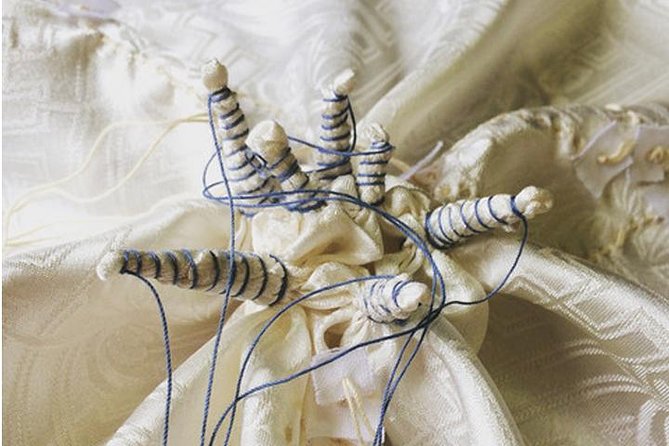
Kasamaki is the more sculptural of the two methods. You stitch around the shape you want to create, pull the thread tight, and then wrap the threads around a cone-like gathered section of fabric several times.
The important point is that your stitches do more than draw a line. They help isolate parts of the silk from the dye. Pulling the thread changes the shape of the fabric, and wrapping adds another layer of protection. The finished pattern depends on how carefully you carry out each step.
A teacher guides you through the process, which matters because the method can be hard to understand from a picture alone. You can watch how the fabric gathers and ask for help before the thread becomes too tight or the shape loses its form.
One instructor named in the class feedback is Roy, who was praised for explaining the process carefully and helping participants understand it rather than simply copying movements. The staff also includes experienced shibori makers who can offer assistance during the practical work.
That hands-on help is one of the strongest reasons to book a class instead of trying shibori from a written guide. You can see a technique, try it, and correct it while the fabric is still in your hands.
Nuishime: making lines with pulled thread
Nuishime uses a different idea. You stitch along a line and then pull the thread tight. The resulting folds and compressed sections affect how the dye reaches the silk.
This method is easier to describe than to predict. A line that looks simple before dyeing can create a more complex result once the thread is pulled and the cloth is colored. That element of uncertainty is part of the fun, but it also means your finished piece may not look exactly like the sample.
Using both kasamaki and nuishime makes the session more worthwhile. You are not repeating one movement for an hour. You get to see how two forms of stitching produce different effects, then combine them on one wrapping cloth.
The class also teaches tricks you can use at home. You will not receive a full textile studio in your luggage, but you gain a basic understanding of how stitch tension, gathering, and wrapping affect a dyed pattern. For a short class, that is a fair amount of practical knowledge.
A completely different side of Kyoto:
- PERFECT KYOTO 1-Day Bus Tour
★ 5.0 · 13,518 reviews - Kyoto: Fushimi Inari, Kinkakuji, Bamboo Grove 1 Day Bus Tour
★ 4.8 · 4,316 reviews - Kyoto: Tea Ceremony in a Traditional Tea House in Kiyomizu
★ 4.9 · 3,519 reviews - Kyoto Geisha Walking Tour: Gion District & Hidden Gems
★ 4.7 · 3,273 reviews
The dyeing moment and your finished silk cloth
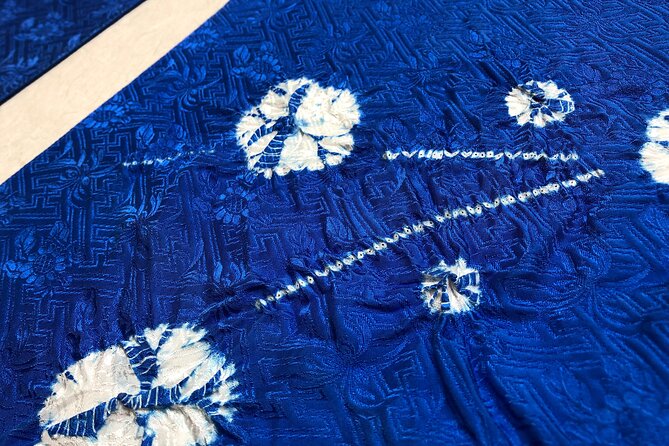
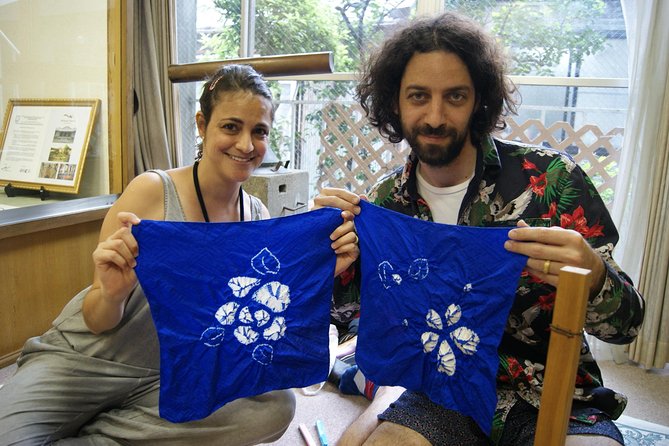
After the stitching and wrapping, you dye a silk wrapping cloth measuring 38 by 38 centimeters. The cloth is large enough to serve as a useful souvenir, not just a small sample tucked into a drawer.
The best part comes when the protected sections are opened. Until then, the design is hidden under thread and folds. Removing those restraints reveals how your choices shaped the color and pattern. You get a direct result from the work you just completed.
Do not expect every section to look precise. Shibori has a handmade quality, and small differences in stitching or thread tension affect the final result. That is an advantage if you want a personal object rather than a factory-perfect souvenir. It is a consideration if you are hoping to produce a flawless design on your first try.
You take the finished cloth home with you. It can serve as a reminder of Kyoto, and its size makes it easier to pack than a larger textile. Since the fabric is silk, you should protect it carefully in your luggage.
How the museum improves the hands-on lesson
The museum displays give you a useful before-and-after comparison. You first see what finished shibori can look like, then work through the basic actions that create it. This keeps the class from feeling like an isolated craft project.
It also gives you a better sense of the skill behind the finished pieces. The professional examples may have sharper patterns and more controlled detail than your own cloth. That contrast is helpful because it shows that shibori is a serious craft with room for years of practice.
An introductory class should not try to cover every technique. The value here comes from seeing a few examples, learning two methods, and producing a finished piece in one sitting. You get a clear introduction without needing to commit half a day.
The museum shop may also help if you are considering buying a finished shibori item. You can compare the handmade cloth you created with more advanced work and decide what sort of textile appeals to you.
A good choice for families and first-time crafters
The minimum age is eight, and the activity can work well for families with children who enjoy making things. The 60-to-90-minute length is long enough to feel substantial but short enough to hold a young person’s attention better than a long museum tour might.
Adults should keep expectations realistic for younger children. Stitching and pulling thread require some patience and hand control. The class has staff support, but the work is still a craft lesson rather than a quick paint-and-take activity.
The class also suits adults who want a break from temples, gardens, and city walking. One participant described it as a good way to spend a hot afternoon, and that makes practical sense. You get an indoor activity, a cultural connection, and a souvenir without adding a major time commitment.
Most people can participate, and the maximum group size is 15. That limit should help keep the lesson manageable, though a group of 15 will naturally feel less personal than a private class.
Price, timing, and what you get for $71.67
At $71.67 per person, this is not the cheapest short activity in Kyoto. Its value depends on what you want from an experience. You are paying for instruction, access to traditional tools and fabrics, the museum setting, and a silk cloth that you make and take home.
If you only want a souvenir, you can likely spend less on a ready-made item. If you want to understand how the pattern was formed and enjoy making it yourself, the price is more reasonable. The finished cloth gives the activity a lasting result, while the instruction gives it more substance than a simple shopping stop.
The compact schedule is part of the value. You do not have to give up an entire day, and the meeting point remains the end point. That makes it easier to combine with other Kyoto plans.
Classes are usually held during the day, though the exact start time should be checked when booking. Since the activity averages being booked 21 days ahead, I would reserve early if the class is important to your itinerary, especially during a busy Kyoto visit.
Who should book this shibori experience
I would choose this class for you if you meet one or more of these descriptions:
- You want a Kyoto souvenir that you made yourself.
- You enjoy craft activities more than passive demonstrations.
- You are curious about Japanese textile methods.
- You need a short indoor activity during a busy sightseeing day.
- You are visiting with children aged eight or older.
- You like the idea of a small finished object with an unpredictable handmade pattern.
I would think twice if you dislike precise handwork or want a polished result with no trial and error. The class involves stitching, pulling, and wrapping, so patience matters. You also need to accept that the final pattern is shaped partly by the process and may not match your expectations exactly.
The class is a better choice for curious beginners than for advanced textile artists. Experienced makers may find the introduction too short, although the museum displays and traditional methods could still make the visit worthwhile.
Practical details before you go
Confirmation is provided when you book, and the experience is available with a mobile ticket. You can cancel for a full refund if you do so at least 24 hours before the start time. Cancellations or changes made inside that period are not accepted for a refund.
The meeting point is the Kyoto Shibori Museum, and the activity returns there when finished. It is near public transportation, with only two car spaces and bicycle parking available.
Adult pricing applies to all ages, even though the minimum age is eight. Check the booking details for your exact class time and group size. The maximum is 15 people, so the class is not designed as a large workshop.
Should you book the Kyoto Shibori Museum class?
I would book it if you want a short, practical introduction to Kyoto’s textile arts and like bringing home something with a story. The combination of museum displays, two stitching methods, staff guidance, and a 38-by-38-centimeter silk cloth gives the session a clear purpose.
The biggest strength is the balance between explanation and making. You learn what kasamaki and nuishime do, then test those methods yourself. The main weakness is the limited time. You will gain a useful first lesson, not mastery.
For families, first-time crafters, and visitors needing an indoor break, the class is a sensible pick. For anyone hoping to explore many shibori techniques or create a highly refined piece, a longer workshop would be a better match. At $71.67, book it for the process and the personal souvenir, not simply for the museum entry.
FAQ
Where does the shibori class take place?
The class takes place at the Kyoto Shibori Museum, located at 135-5 Shikiamicho, Nakagyo Ward, Kyoto, 604-8261, Japan.
How long does the activity last?
The class lasts approximately 60 to 90 minutes.
Which shibori techniques will I learn?
You will try kasamaki and nuishime shibori. Kasamaki involves stitching around a shape, pulling the thread tight, and wrapping the thread around gathered fabric. Nuishime involves stitching along a line and pulling the thread tight.
What will I make during the class?
You will dye a silk wrapping cloth measuring 38 by 38 centimeters. You can take the finished cloth home with you.
Are tools and fabric provided?
Yes. The class uses traditional shibori tools and fabrics.
Is the museum visit part of the experience?
Yes. You can see shibori displays at the Kyoto Shibori Museum, and the museum shop also contains shibori examples.
What is the minimum age?
The minimum age is eight. Adult pricing applies to every age.
How many people can join the class?
The activity accepts a maximum of 15 participants.
Is the class near public transportation?
Yes. The meeting point is near public transportation. Two car parking spaces and bicycle parking spaces are also available.
Can I cancel for a refund?
You can receive a full refund if you cancel at least 24 hours before the experience start time. Cancellations or changes made less than 24 hours before the start time are not eligible for a refund.
Recently added around Kyoto
- Higashiyama | Kyoto: Sakura Season Private Rickshaw Tour★ 5.0 · 3 reviews
- Kyoto Kimono Rental CHAMATSU|Kimono/Yukata Rental FamilyPlan★ 5.0 · 3 reviews
- Kyoto: Half-Day Private Guided Tour to the Old Town of Gion★ 4.4 · 3 reviews
- Nara Private Customizable Half Day Tour★ 5.0 · 3 reviews
- Kansai Region Hiking Adventure in Nara Kobe Kyoto and More★ 5.0 · 3 reviews
- Full Day Nara Deer, Temple, Shrine, Activities & Tea Ceremony★ 5.0 · 3 reviews
- Nara: Essential Private Tour with Deer Park and Temples★ 5.0 · 3 reviews
- Hiking Tour for Sacred Sites in Kyoto with a Guide★ 5.0 · 3 reviews
Workshops, compared.
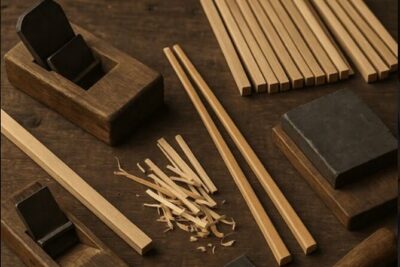
Chopsticks Making Workshop in Gion with Engraving Option
Read our review →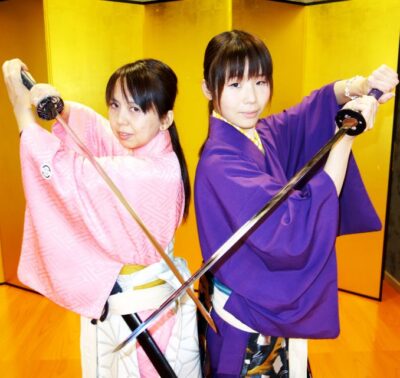
Samurai Sword Class by Experts in Traditional Arts
Read our review →
Ramen Cooking Class at a Ramen Factory with Souvenir
Read our review →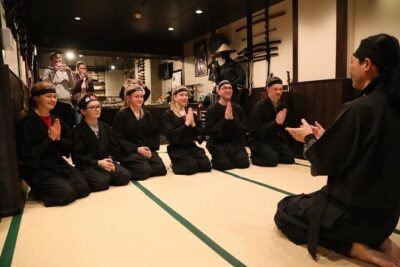
Ninja 1-hour Hands-on Lesson by Japanese master in Kyoto -Entry
Read our review →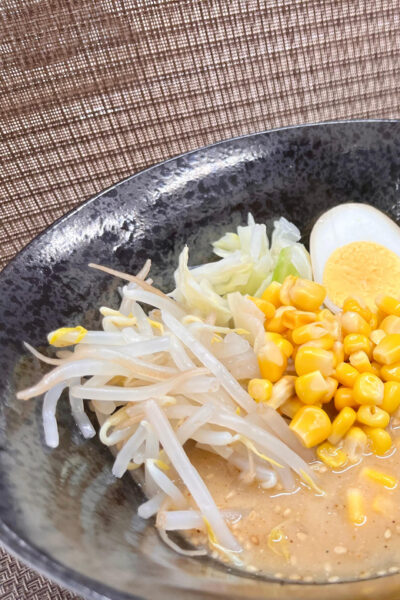
The Original Small-Group Sushi Making Class in Kyoto
Read our review →
Japanese Washoku Bento Small Group Cooking Class
Read our review →Browse the lists this tour appears in