
REVIEW · KYOTO CRAFT WORKSHOPS
Authentic knife making experience at a blacksmith in Kyoto
A red-hot bar of steel, a heavy hammer, and your own hands turn this Kyoto outing into something far more memorable than a standard souvenir hunt. At Studio NIN, you work under the close guidance of Mao, Taka, and other experienced instructors as you forge a practical Japanese-style knife from raw metal.
I like two things right away: you take home a real, usable knife, not a trinket, and the work feels genuinely hands-on. You do the hammering, shaping, sharpening, and polishing, while the instructors keep the process safe and help correct mistakes. The easy train access is another plus.
The main drawback is physical effort. Hammering hot steel takes more strength and stamina than many people expect, and the studio can feel very hot near the furnace. You should also confirm the studio location before leaving, since the activity uses two Kyoto spaces and old directions can cause confusion.
In This Review
- Key Points Before You Book
- Why This Kyoto Workshop Feels Different
- Arriving at Studio NIN in Sakyo-ku
- Changing Into a Japanese Blacksmith’s Uniform
- Learning the Tools and Safety Rules
- Heating Steel Until It Glows Red
- Hammering the Blade Into Shape
- Cooling, Grinding, and Refining the Edge
- Sharpening and Polishing Your Knife
- What You Take Home
- Is $154 a Fair Price?
- Who Will Enjoy This Most?
- Practical Tips for a Better Session
- Should You Book This Kyoto Knife-Making Class?
- FAQ
- How long does the knife-making experience last?
- How much does the experience cost?
- What size knife will I make?
- Can I take the knife home?
- Do I need previous blacksmithing experience?
- Who teaches the class?
- Which languages are available?
- Where is the workshop held?
- How do I reach the meeting point?
- What should I bring?
Key Points Before You Book
- Forge a 13 to 15 cm handmade knife: The finished blade is compact, practical, and suitable as a gift or everyday kitchen tool.
- Work beside experienced instructors: Mao has more than 10 years in knife making, while Taka and the other staff guide beginners through each stage.
- Expect real physical work: You will repeatedly hammer heated steel, hold tools, and spend time sharpening the blade.
- Wear traditional blacksmith clothing: The costume, tools, towel, water, materials, box, and bag are included.
- Reach the studio by train: The listed meeting point is about one minute from the Yase-Hieizan Exit of the Eizan Electric Railway, though you should follow the location message sent before your visit.
- Allow about three hours: The knife-making portion uses a shortened format, while larger knives require more than five hours and cost much more.
Why This Kyoto Workshop Feels Different
Kyoto is full of polished cultural activities, but blacksmithing is harder to find. This workshop gives you a direct role in a craft that normally stays behind the doors of a working forge.
You do not simply watch an artisan strike metal. You put on a craftsman’s uniform, learn how the tools work, and take your turn at the anvil. The instructors handle the parts that demand greater skill, but your finished knife still carries the marks of your own effort.
That balance matters. A complete beginner can finish with a useful blade, yet the process remains demanding enough to give the souvenir real meaning. You will remember the heat, the rhythm of the hammer, and the satisfaction of seeing a rough piece of steel become a knife.
The activity has earned a 4.8 rating from 350 reviews, with especially strong praise for the patient instruction, friendly team, clear safety guidance, and final knife. Those are the areas I would care about most in a hands-on craft class, since poor instruction can turn a physical activity into a frustrating one.
More Kyoto craft workshops:
- Roketsu dyeing experience: M course Roketsu Dyeing Experience
★ 5.0 · 163 reviews - Kyoto: Replica food making experience
★ 4.8 · 70 reviews - Kyoto: Traditional Yuzen Dyeing Experience
★ 4.8 · 61 reviews
Arriving at Studio NIN in Sakyo-ku
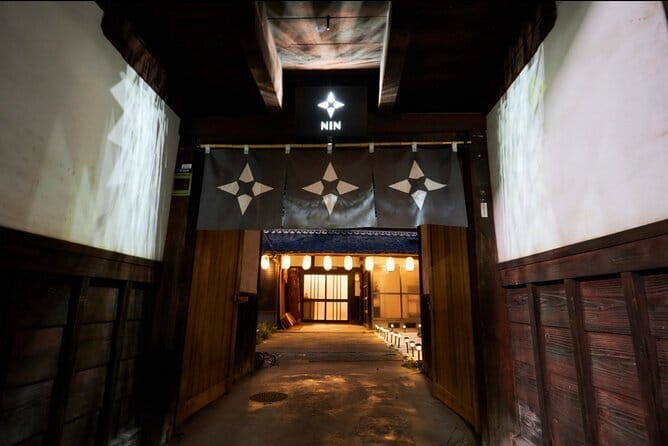
The listed meeting point is Studio Shinobi YASE, at 168-1 Yase-no-secho in Sakyo-ku. It is near the Yase-Hieizan Exit of the Eizan Electric Railway, and the activity information recommends coming by train. Taxis are also available.
There are two studios in Sakyo-ku: Studio NIN Yase and Studio NIN Kendo. The staff should message you before the appointment to confirm which one you will use. Read that message carefully and keep it handy on the day.
This is important because the directions have caused confusion for some people. One set of information places the studio a minute from the station, while one recent account described a longer walk from the train. The safest approach is simple: check the exact studio name and map pin before you set out, and allow extra time rather than arriving breathless for a safety briefing.
The setting is outside central Kyoto, but that is part of the appeal. You are not squeezing a forge into a crowded sightseeing district. The quieter location gives the outing a change-of-pace feel, and the train ride adds a little separation from the usual temple circuit.
Changing Into a Japanese Blacksmith’s Uniform
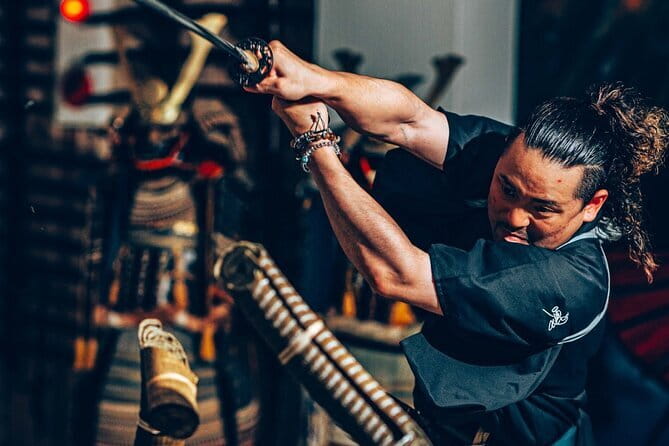
Once you arrive, you meet the instructor and change into traditional blacksmith attire. It is a small step, but it changes the mood of the class.
The costume is practical as well as theatrical. It signals that this is a workshop, not a demonstration staged for photographs. You will also receive a towel and water, useful items when you are working beside a furnace.
Wear socks. That is the one specific item you need to bring. Avoid alcohol and drugs, and do not treat the forge casually. You are working with heated metal and sharp tools, so the staff’s instructions need your full attention.
Learning the Tools and Safety Rules
Before the steel is heated, Mao or another instructor explains the main tools. These include hammers, tongs, grinders, and sharpening equipment.
The safety briefing is clear and direct. You learn how to hold the tools, where to place your hands, and how to move around the working area. The instructors stay close while you work, correcting your grip and technique when needed.
This is one of the strongest parts of the class. You are allowed to do real work, but you are not left to guess what to do next. That makes the activity suitable for people with no metalworking background, provided they can follow instructions and handle a physical task.
The workshop notes that anyone under 15 must have a guardian, and the activity is not suitable for children under 15 or people over 95. The safety information also makes clear that this work carries some risk, and you accept responsibility in the unlikely event of an injury or accident.
A completely different side of Kyoto:
- PERFECT KYOTO 1-Day Bus Tour
★ 5.0 · 13,518 reviews - Kyoto: Fushimi Inari, Kinkakuji, Bamboo Grove 1 Day Bus Tour
★ 4.8 · 4,316 reviews - Kyoto: Tea Ceremony in a Traditional Tea House in Kiyomizu
★ 4.9 · 3,519 reviews - Kyoto Geisha Walking Tour: Gion District & Hidden Gems
★ 4.7 · 3,273 reviews
Heating Steel Until It Glows Red
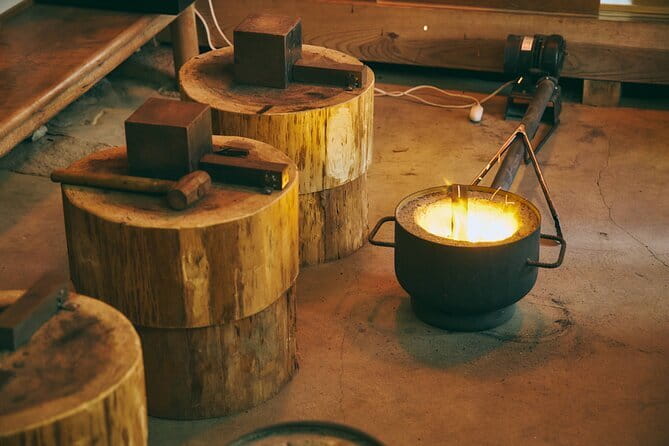
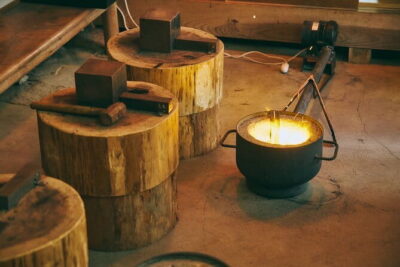
The raw iron goes into the furnace and heats until it becomes red-hot. This is the point where the process stops feeling like a craft demonstration and starts feeling like a working forge.
The heat is intense, especially in summer. The studio has air conditioning, and staff have provided frozen neck coolers or cooling wraps during hot sessions, but you should still expect to sweat. Bring the right mindset and avoid wearing your most delicate clothing.
You will see why temperature matters. Steel changes character as it heats, allowing the hammer to move and spread it. If it cools too much, the instructor reheats it. Timing, control, and repeated heating are part of the lesson.
The class does not turn you into a professional bladesmith in three hours. Instead, it gives you a clear look at the basic stages and lets you take part in the most important ones.
Hammering the Blade Into Shape
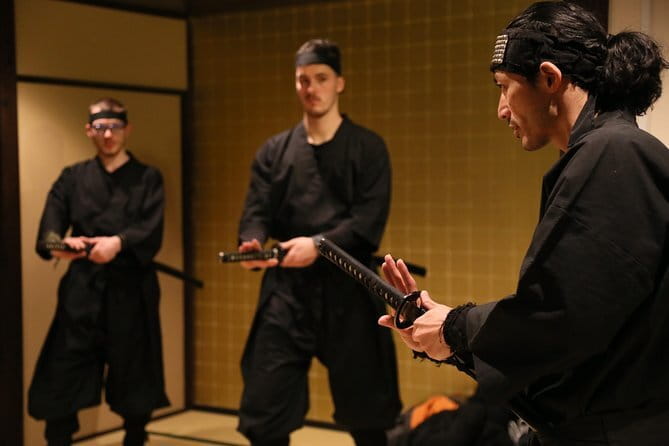
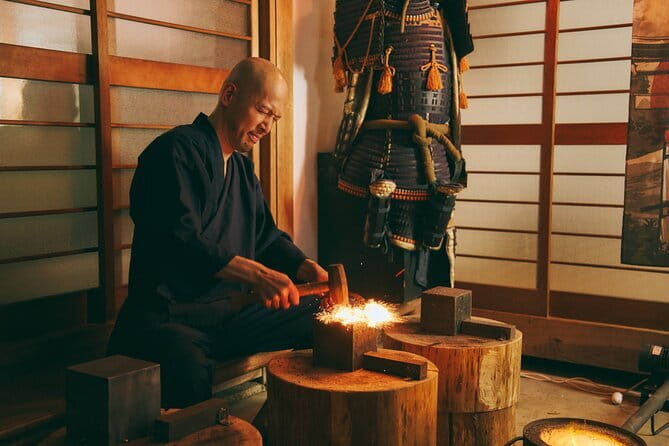
The centerpiece is the hammering. Guided by Mao or another instructor, you strike the glowing steel again and again, learning the proper angle, rhythm, and force.
This is fun, but it is not effortless. Several people found the hammering more tiring than expected, and one useful tip is to stretch before the class. You will be standing, gripping tools, and repeating the same motion. If you have limited strength, tell the instructor and follow the pace they set.
The instructors help keep the work moving. They may reheat the metal, adjust the shape, or repair a mistake so that you finish with a functional result. That assistance does not erase your contribution. You still experience the work of striking and shaping the steel, while the staff prevents a small error from ruining the blade.
I like this approach because the finished knife does not need to be perfect. A slightly rustic appearance is part of its character. The goal is to understand the process and leave with a blade you can be proud of, not to produce a museum piece in one afternoon.
Cooling, Grinding, and Refining the Edge
After the rough forging, the metal is cooled and checked. You then work on the rough edges and prepare the blade for sharpening.
Grinding gives the knife a cleaner outline. This stage requires care rather than brute strength, and the staff helps you keep the shape under control. It is also where you begin to see the proportions of your finished knife.
The workshop uses a shortened format, so the pacing is brisk. Some people would enjoy more time with the blade, especially if they want to study the craft in detail. That is the tradeoff for a three-hour activity and a manageable price.
A longer knife-making session is available in a different format, but larger knives require more than five hours and cost over $400. This class is designed as an introduction, not a full apprenticeship.
Sharpening and Polishing Your Knife
Sharpening is the step that turns shaped steel into a practical tool. Under instruction, you use sharpening stones and grinders to form the cutting edge.
Beginners should not worry about getting the angle exactly right on the first attempt. Mao and the other instructors watch closely and guide your movements. You will learn that sharpening is controlled, patient work rather than simply rubbing metal against a stone.
The last stage is polishing. You can bring the blade to a clean finish, but do not expect every knife to look factory-perfect. The handmade quality is part of the point.
The finished blade is around 13 to 15 centimeters long. One finish described for the workshop is kurouchi, a dark, rustic forged surface that keeps the marks of the process. If that is the finish offered during your session, do not assume a shiny silver blade is better. The rougher surface can be attractive and gives the knife a handmade identity.
Some sessions may offer a handle option for an added fee. One account noted an extra 5,000 yen for a handled version, payable by cash or card, including Apple Pay. Confirm the current price and options before you arrive, since the standard activity price does not specify that add-on.
What You Take Home
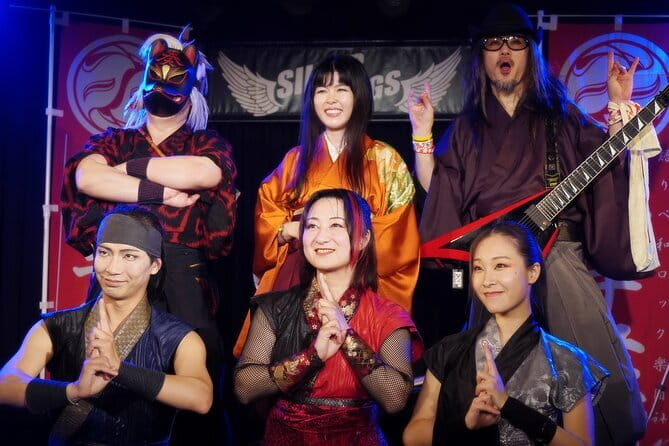
Your knife is placed in a box and bag, both included. The finished item works well as a gift because it is small, practical, and connected to something you did yourself.
You may give it to a parent, partner, friend, or cook in the family. You may also keep it as a daily reminder of Kyoto. The blade is more personal than a bought kitchen knife because its shape and finish reflect your time at the forge.
Photos and videos are welcome during the process. Staff may also help capture key moments, including the hammering. This is worth taking advantage of, since you will be too busy handling hot metal to document much yourself.
You should check current airline and customs rules before packing the knife for your journey home. The activity provides a box and bag, but it does not state that shipping is included.
Is $154 a Fair Price?
At $154 per person, this is not a cheap souvenir-making class. The value comes from the amount of equipment, supervision, material, safety preparation, and specialist instruction involved.
You receive the costume, towel, water, tools, materials, finished knife, box, and bag. More important, you get several hours of guided access to a forge, furnace, grinders, and sharpening equipment. Buying a comparable experience privately would be difficult, especially for a first-time visitor to Japan.
The price makes the most sense if you value participation. If you only want an inexpensive knife, buy one from a shop. If you want to understand how a Japanese-style blade begins as raw steel and becomes a working tool, the cost is easier to justify.
Small groups are available, and some sessions may be especially intimate when attendance is low. A smaller group means more direct help with hammering and sharpening, though group size can vary.
Who Will Enjoy This Most?
I would choose this for anyone who prefers making something to looking at another display case. It suits couples, families with teenagers, solo visitors, and anyone interested in Japanese craft.
It worked particularly well for families because everyone shares the same task. Parents and teenagers can compare their blades, help each other remember the steps, and take home a souvenir tied to a shared afternoon.
You do not need blacksmithing experience. You do need reasonable comfort with heat, noise, standing, and repeated hammering. If you want a quiet cultural activity, this is the wrong pick. If you like learning by doing, it is a strong choice.
The class is also a good option for a return visit to Kyoto. You may have already seen the major temples and gardens, but this introduces a working craft in a direct, physical way.
Practical Tips for a Better Session
- Stretch first: The hammering is tiring, even though the class is suitable for beginners.
- Wear socks and sensible clothing: The only required item listed is socks, but you should dress for heat and physical work.
- Read the location message: Confirm Yase or Kendo before traveling.
- Allow arrival time: The directions can be confusing, and a late arrival is poor preparation for a safety-focused activity.
- Ask about the finish: A rustic kurouchi blade may be intentional, not unfinished.
- Ask about a handle: A handled knife may cost extra, with one account citing 5,000 yen.
- Use the photo opportunity: Staff may take pictures and videos during the process.
- Plan your schedule carefully: The session lasts about three hours, but the work itself may feel brisk.
- Remember the age limits: Children under 15 need a guardian, and the activity is not suitable for anyone under 15 or over 95.
Should You Book This Kyoto Knife-Making Class?
Book it if you want an unusual Kyoto activity that leaves you with something useful. The instructors provide patient, clear help, and the class gives you real contact with hot steel rather than a passive display of craft.
Skip it if you dislike heat, physical work, or the chance of a slightly imperfect finish. The knife is handmade, and that means it may show the marks of a beginner’s effort.
For most people who enjoy hands-on activities, I think the $154 price is reasonable. Confirm the studio, ask about handle choices, stretch before you go, and expect to work. You will leave with a knife, but the better souvenir is knowing how much effort sits behind a simple kitchen blade.
FAQ
How long does the knife-making experience last?
The scheduled experience lasts three hours. The knife workshop itself uses a refined format of about two and a half hours, with the remaining time covering arrival, instruction, finishing, and questions.
How much does the experience cost?
The listed price is $154 per person.
What size knife will I make?
The finished handmade knife is about 13 to 15 centimeters long.
Can I take the knife home?
Yes. Your finished knife comes with a box and bag so you can take it home.
Do I need previous blacksmithing experience?
No. The instructors explain the tools, safety rules, forging process, sharpening, and polishing. Beginners can take part with close guidance.
Who teaches the class?
Mao is a knife professional with more than 10 years of experience. Other instructors include Taka and additional Studio NIN staff members who guide the forging and sharpening work.
Which languages are available?
Instruction is available in English and Japanese.
Where is the workshop held?
The activity operates from two studios in Sakyo-ku, Kyoto: Studio NIN Yase and Studio NIN Kendo. Staff will message you before the visit to confirm your location.
How do I reach the meeting point?
The listed meeting point is Studio Shinobi YASE, at 168-1 Yase-no-secho, Sakyo-ku, Kyoto City. It is near the Yase-Hieizan Exit of the Eizan Electric Railway, and taxis are also available.
What should I bring?
Bring socks. Tools, materials, costume, towel, water, box, and bag are included. Alcohol and drugs are not allowed.
Recently added around Kyoto
- Kyoto Kimono Rental CHAMATSU|Kimono/Yukata Rental FamilyPlan★ 5.0 · 3 reviews
- Higashiyama | Kyoto: Sakura Season Private Rickshaw Tour★ 5.0 · 3 reviews
- Kyoto: Half-Day Private Guided Tour to the Old Town of Gion★ 4.4 · 3 reviews
- Nara Private Customizable Half Day Tour★ 5.0 · 3 reviews
- Kansai Region Hiking Adventure in Nara Kobe Kyoto and More★ 5.0 · 3 reviews
- Full Day Nara Deer, Temple, Shrine, Activities & Tea Ceremony★ 5.0 · 3 reviews
- Nara: Essential Private Tour with Deer Park and Temples★ 5.0 · 3 reviews
- Hiking Tour for Sacred Sites in Kyoto with a Guide★ 5.0 · 3 reviews
Kyoto Craft Workshops, compared.
Roketsu dyeing experience: M course Roketsu Dyeing Experience
Read our review →
Authentic Knife Making Experience at a Blacksmith in Kyoto
Read our review →
Let’s make only one original onigawara in the world
Read our review →
Bamboo LED Lantern Making Experience in Kyoto Arashiyama
Read our review →Let’s make only one original onigawara in the world!!
Read our review →
Natural Indigo Dyeing with Local Masters (Private Atelier)
Read our review →Browse the lists this tour appears in