
REVIEW · FOOD & DRINK
Kyoto: Replica food making experience
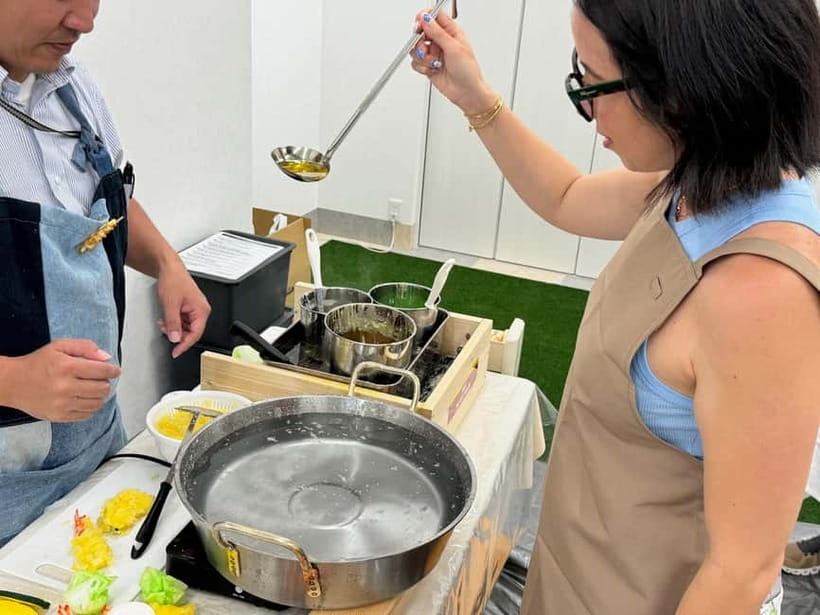
Kyoto’s restaurant windows are often filled with perfect-looking bowls of ramen, sushi, and tempura. They are not edible, of course. They are shokuhin sampuru, Japanese food replicas, and this small workshop lets you make your own from hot wax. You shape the wax in water, build the batter layer by layer, and leave with a tempura bowl that can fool your dinner guests at a glance.
I like two things here: you learn a real Japanese retail tradition, rather than simply buying a souvenir, and the finished piece travels home in packaging made to look like a supermarket item. The small group, limited to four people, also means the instructor can slow down and help when your shrimp starts looking more like a strange sea creature.
The main consideration is that hot wax requires care, especially with young children. The activity is not suitable for children under six, and parental help may be needed for older children. You should also arrive on time, since the making process is explained to everyone at once.
In This Review
- Key points at a glance
- Why Japanese food replicas are worth your time
- Finding the workshop near the giant crab sign
- The one-hour workshop, from wax to tempura
- The instructors make the difference
- A souvenir with a practical joke built in
- What to wear and how to handle the wax
- Is $22 a good value for one hour?
- Who will enjoy this most
- A better way to fit it into your Kyoto day
- The drawbacks to keep in mind
- Should you book the Kyoto replica food workshop?
- FAQ
- Where is the replica food workshop in Kyoto?
- How long does the activity last?
- How much does the experience cost?
- What food replicas will I make?
- Can I eat the food I make?
- Is instruction available in English?
- How many people are in each group?
- Are children allowed to participate?
- Can I cancel or pay later?
Key points at a glance
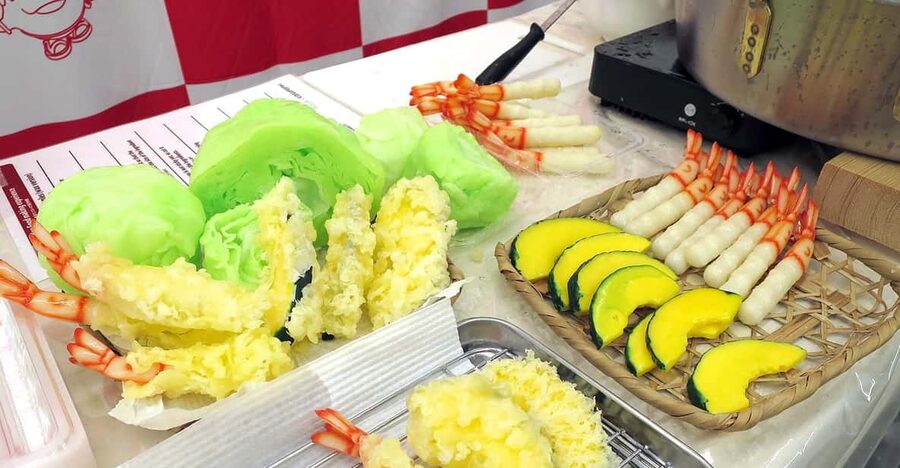
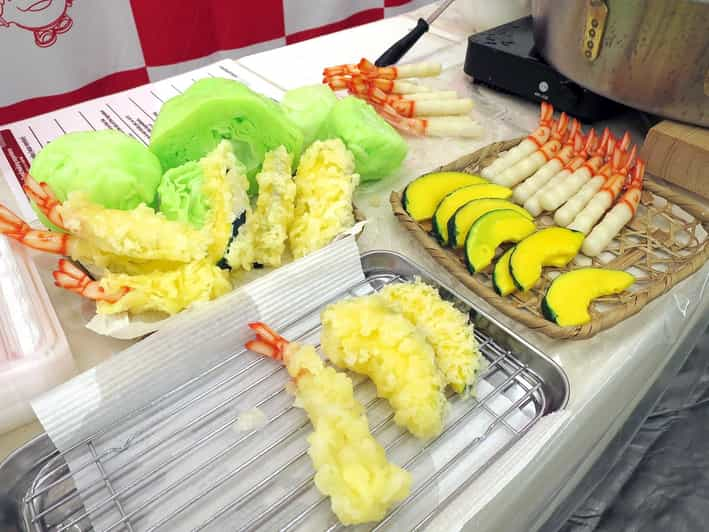
- Hot wax becomes shrimp and pumpkin tempura: Pour, shape, and texture the wax before adding the realistic batter.
- A small group of four: The limited size allows for patient, hands-on instruction.
- A useful cultural lesson: You learn why Japanese restaurants display replica dishes outside.
- A souvenir you make yourself: Your replica is packaged like a real supermarket food item.
- A handy central location: Find the meeting point diagonally across from Kani Douraku, marked by its giant crab sign.
- Good for families and couples: Children must be at least six, with parental assistance possibly needed.
Why Japanese food replicas are worth your time
Food replicas are more than a cute trick for tourists. In Japan, restaurant sample displays help you understand a menu before you sit down. The visual clues are especially useful when a menu is unfamiliar or written mainly in Japanese. A bowl of plastic ramen or a plate of tempura gives you an instant idea of size, ingredients, and presentation.
That makes this workshop a good match for a Kyoto itinerary heavy on temples and shrines. You are not just looking at another display case. You are learning how a distinctly Japanese form of everyday communication is made.
The experience also gives you a better eye for the replicas you will see around the city. After shaping wax yourself, you may notice the texture of batter, the curve of a shrimp, or the way lettuce is folded in a restaurant window. That small shift in attention is part of the value.
More Kyoto craft workshops:
- Authentic knife making experience at a blacksmith in Kyoto
★ 4.8 · 350 reviews - Roketsu dyeing experience: M course Roketsu Dyeing Experience
★ 5.0 · 163 reviews - Kyoto: Traditional Yuzen Dyeing Experience
★ 4.8 · 61 reviews
Finding the workshop near the giant crab sign
The meeting point is diagonally across from Kani Douraku, the restaurant recognizable by its large crab sign. This puts you in the Sanjo Meiten-gai shopping arcade, with Nishiki Market not far away. It is an easy area to combine with shopping, food, and an afternoon walk.
Do not treat the meeting point as a vague landmark. Look for the crab sign and check that you are on the correct diagonal side before your start time. The activity is only one hour, and late arrival can be awkward because the demonstration is given at the beginning.
The location works well before or after lunch. One especially amusing feature of this activity is that you will spend time making tempura look delicious, then find yourself surrounded by real places to eat. I would schedule this before a meal if you want the replicas to sharpen your appetite, or after eating if you prefer not to stare at fake food while hungry.
The one-hour workshop, from wax to tempura
The central task is making shrimp and pumpkin tempura. You begin with melted wax and hot water. The wax is poured into the water, where you shape it before it hardens. The instructor shows how the height and manner of pouring affect the final texture.
This is where the workshop becomes more interesting than a simple craft class. You are not assembling a ready-made kit. The batter texture comes from your handling of the wax, and small changes can make the surface look smooth, crisp, thick, or uneven.
Next, you wrap the shrimp and pumpkin in the wax batter. This step takes some control. The replica needs to look casually fried, not like a perfectly smooth sculpture. That is why the instruction matters. You get a chance to practise before making the pieces you will take home, and the instructors can offer tips when your first attempt needs help.
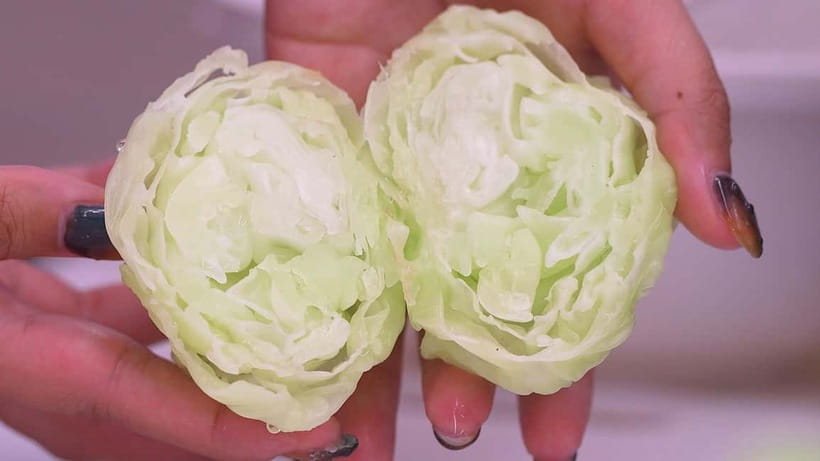
A lettuce replica may also be available as an option. It gives you a different challenge from tempura, since the shape and folds need to look fresh and natural rather than crisp and fried. If lettuce interests you, confirm the exact option when you book or arrive, since the core activity is the shrimp and pumpkin tempura.
The full session is listed as one hour, though one reported session lasted about 45 minutes. Plan for the full hour rather than trying to squeeze it between two tightly timed attractions. This is a hands-on class, not a quick photo stop.
The instructors make the difference
Instruction is available in English and Japanese. The teaching style described for this workshop is patient and practical, with demonstrations, simple directions, and time to practise. If a phrase is unclear, translation apps may help, but the work itself is visual. You can watch the motion, copy it, and adjust your result with guidance.
That matters because wax food making has a few techniques that are hard to understand from a written explanation. The way you drop the wax changes its texture. The timing before it hardens affects how you shape it. A calm instructor can show you the difference faster than a paragraph of directions ever could.
The workshop also seems well suited to people who are not confident in Japanese. Basic English instruction is offered, and communication can be supported by gestures or a phone translator. You should still arrive ready to watch closely and ask for help rather than assume every step will be explained in fluent English.
A small group of no more than four is a real advantage. In a larger class, you might wait while the instructor moves from table to table. Here, the format gives you a better chance to get help with details such as batter thickness and the final arrangement of your bowl.
More food tours in Kyoto:
- Kyoto Night Foodie Tour in Gion (9+ dishes + 6 Sake tastings)
★ 5.0 · 1,762 reviews - 3-Hour Kyoto Insider Sake Brewery Tour with Tastings & Pairings
★ 5.0 · 917 reviews - Arashiyama Bamboo, Temple, Monkeys, or Secret Sake Brewery
★ 4.8 · 886 reviews - Kyoto: Insider Sake Brewery Tour with Sake and Food Pairing
★ 5.0 · 704 reviews
A souvenir with a practical joke built in
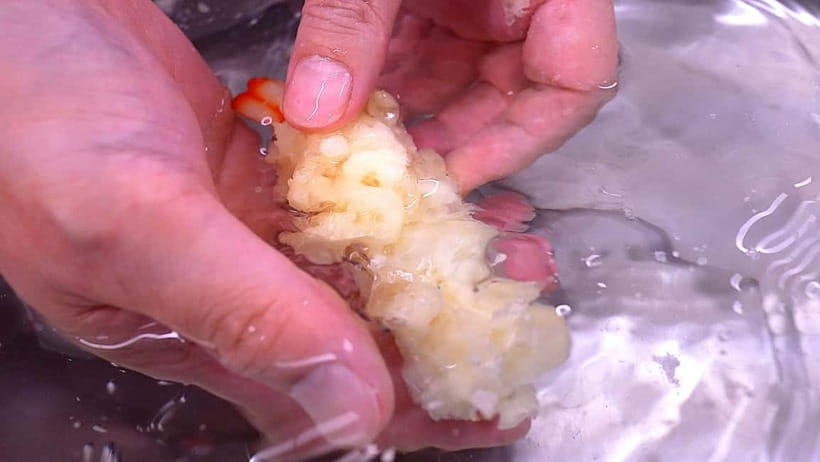
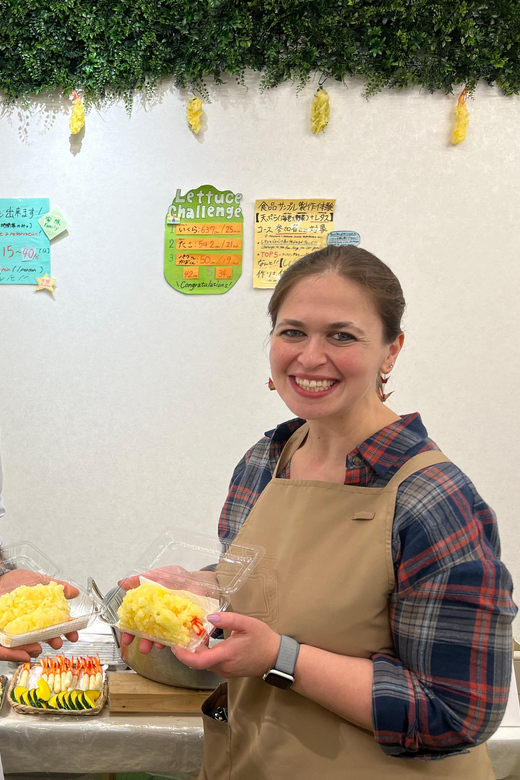
At the end, your replica food is packaged in a way that resembles a supermarket product or takeaway item. That packaging is part of the charm. It protects the piece and makes the souvenir more amusing when you unpack it later.
The tempura bowl is also more personal than a shop-bought magnet. You made the texture, shaped the pieces, and watched the food take form. It may not be perfect, and that is part of the appeal. A slightly irregular shrimp carries a story from your Kyoto trip.
The display-only warning deserves attention. The finished items can look remarkably edible, but they are not food and should never be served at the table by mistake. Keep them clearly separate from actual dishes at home, especially if you have children or visitors who enjoy a practical joke.
You should also think about luggage space. The souvenir is designed to go home, but it is still a physical object rather than a flat paper keepsake. Pack it with care and avoid placing heavy items on top of it. The exact size and packaging details are not specified, so leave some room rather than assuming it will fit in a small pocket.
What to wear and how to handle the wax
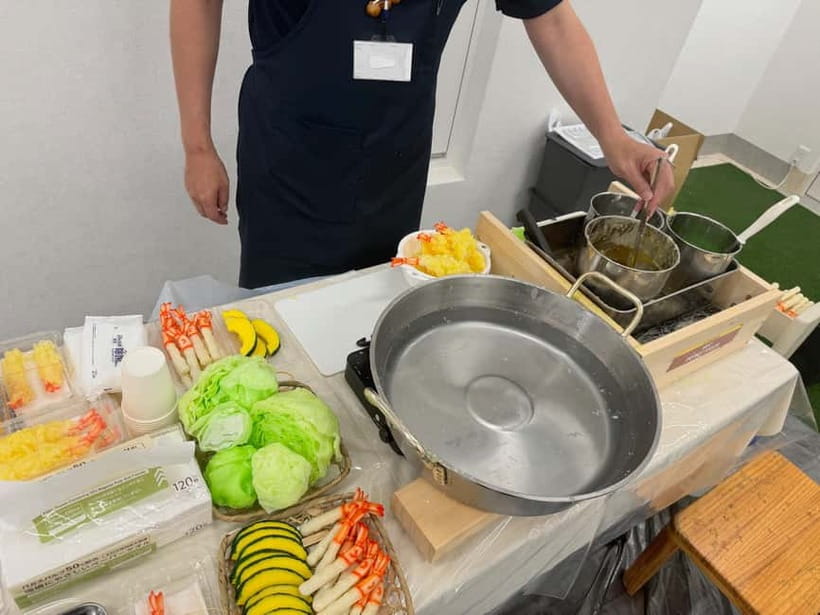
The workshop provides aprons and chef jackets, but wax can still be part of the process. One useful precaution is to wear clothing you do not mind getting marked. A review of the hands-on process specifically recommends considering a change of clothes, especially because you are working with melted wax and hot water.
This is not a reason to avoid the activity. It is simply a reminder that you are making the replica rather than watching someone else do it. Keep loose sleeves out of the work area, listen carefully during the hot-wax demonstration, and follow the instructor’s directions.
Children may need parental assistance. The official age limit is six and older, but age alone does not tell you how independently a child can manage hot materials. An adult should expect to take part, not sit back as a spectator.
For adults, the challenge is mild but real. You do not need artistic training, though your first batter coating may not look exactly like the sample. The workshop is forgiving because the aim is a fun, convincing souvenir, not a museum sculpture.
Is $22 a good value for one hour?
At $22 per person, this is a fairly modest add-on in Kyoto, especially when the price includes materials, instruction, and the replica you make. You are paying for a small activity rather than an admission ticket, and the souvenir has a direct connection to what you learned.
The value is strongest if you want an interactive break from sightseeing. A temple visit can be memorable, but it usually does not give you something you created with your own hands. This class fills that gap without taking half a day.
The value is less convincing if you only want to see how replica food is made or if your schedule is already packed with major sights. The workshop takes about an hour, plus time to reach the meeting point and continue onward. You should book it because you want to participate, not because you expect a long demonstration of Japanese food culture.
The small group helps justify the price. A four-person limit gives the session a personal feel and makes it easier to ask questions. For a family, couple, or solo visitor who likes crafts, that direct help is more useful than a cheaper, crowded demonstration.
Cancellation is flexible if your plans change: you can cancel up to 24 hours in advance for a full refund. You can also reserve now and pay later, which helps when you are still arranging a Kyoto schedule.
Who will enjoy this most
I would recommend the workshop to families with children aged six and up, couples looking for a lighthearted date activity, and solo visitors who want a souvenir with a story attached. It is also a good choice for anyone who has noticed Japanese food displays and wondered how they are made.
The activity works particularly well for people who enjoy trying something slightly unusual. It is not a formal cooking class, and you will not eat what you make. If you want to prepare real tempura, this is the wrong booking. If you want to understand a clever Japanese craft and produce a convincing fake meal, it fits nicely.
It can also suit a rainy afternoon. The workshop gives you a set activity in the shopping arcade, and its short length leaves room for Nishiki Market or nearby shops. Do not expect it to replace a full cultural tour. Think of it as a focused, playful hour that adds variety to your day.
Families should decide in advance who will handle the hotter or trickier parts. Younger children may love the visual result but need an adult beside them. Older children and teenagers can take more ownership of the shaping and decorating.
A better way to fit it into your Kyoto day
Use the location to build a compact neighborhood plan. Start at Nishiki Market, continue through the surrounding shopping arcades, and arrive at the workshop in time for your reservation. Afterward, you can look for a real tempura meal, browse nearby stores, or continue toward other central Kyoto sights.
I would not place this immediately before a temple reservation on the other side of the city. The class has a fixed start time, and the meeting point can take a little attention to find. Give yourself enough time to reach the crab sign and settle in.
The workshop is also a useful change of pace after several quiet temple visits. Kyoto sightseeing can involve a lot of walking and looking. Here, you handle materials, make decisions, and laugh at the gap between your first attempt and the finished bowl.
Bring a phone if you want photos or translation help. The finished replicas are naturally photogenic, and the process has several good moments to record. Be mindful of the work area and follow the staff’s instructions before taking pictures during the demonstration.
The drawbacks to keep in mind
The biggest limitation is the short format. In one hour, you learn the key method and make the featured pieces, but you should not expect a full course in the history or production of Japanese replica food.
Hot wax also means this is not a carefree toddler activity. Children under six cannot participate, and older children may still need close help. Adults who dislike messy, precise handwork may find the shaping more demanding than expected.
The activity is conducted in a small workshop, so it may not suit someone seeking a large cultural performance or a broad menu of crafts. The focus is narrow: learn the process, make tempura, and take it home.
Still, those limits are easy to understand before booking. The class promises a compact, hands-on craft, and that is exactly what you receive.
Should you book the Kyoto replica food workshop?
Book it if you want a short activity with a strong Japanese connection, a patient small-group format, and a souvenir you cannot get by simply walking into a gift shop. At $22, the combination of instruction, materials, and take-home replica makes good sense for families, couples, and curious solo visitors.
Skip it if you need every hour for major sights, want to cook something edible, or would rather avoid hot materials. For everyone else, this is a clever way to pause between Kyoto’s temples and markets. You will leave with a fake tempura bowl, a better understanding of restaurant sample culture, and a story that is much more fun than another keychain.
FAQ
Where is the replica food workshop in Kyoto?
The meeting point is diagonally across from Kani Douraku, the restaurant marked by its large crab sign. It is in the Sanjo Meiten-gai shopping arcade, not far from Nishiki Market.
How long does the activity last?
The scheduled duration is one hour. One session was reported to last around 45 minutes, so you should still allow the full hour when planning your day.
How much does the experience cost?
The listed price is $22 per person. Materials, instruction, and the replica food you make are included.
What food replicas will I make?
The main activity involves shrimp and pumpkin tempura made from melted wax. A lettuce replica may also be available as an option.
Can I eat the food I make?
No. The finished pieces are display replicas only and should not be served as food.
Is instruction available in English?
Yes. The instructors provide guidance in English and Japanese. Translation apps may also help if you need extra support.
How many people are in each group?
The activity is limited to four participants, making it a small-group workshop.
Are children allowed to participate?
Children under six are not permitted. Parental assistance may be requested for children, particularly when working with hot wax.
Can I cancel or pay later?
You can cancel up to 24 hours before the activity for a full refund. Reserve-now, pay-later booking is also available.
Recently added around Kyoto
- Higashiyama | Kyoto: Sakura Season Private Rickshaw Tour★ 5.0 · 3 reviews
- Kyoto Kimono Rental CHAMATSU|Kimono/Yukata Rental FamilyPlan★ 5.0 · 3 reviews
- Kyoto: Half-Day Private Guided Tour to the Old Town of Gion★ 4.4 · 3 reviews
- Nara Private Customizable Half Day Tour★ 5.0 · 3 reviews
- Kansai Region Hiking Adventure in Nara Kobe Kyoto and More★ 5.0 · 3 reviews
- Full Day Nara Deer, Temple, Shrine, Activities & Tea Ceremony★ 5.0 · 3 reviews
- Nara: Essential Private Tour with Deer Park and Temples★ 5.0 · 3 reviews
- Hiking Tour for Sacred Sites in Kyoto with a Guide★ 5.0 · 3 reviews
Food & Drink, compared.

Kyoto Night Foodie Tour in Gion (9+ dishes + 6 Sake tastings)
Read our review →
3-Hour Kyoto Insider Sake Brewery Tour with Tastings & Pairings
Read our review →
Arashiyama Bamboo, Temple, Monkeys, or Secret Sake Brewery
Read our review →
Insider Sake Brewery Tour with Sake and Food Pairing
Read our review →
Kyoto Nishiki Market Food and Culture Walking Tour
Read our review →
1.5-Hour Kyoto Insider Sake Experience with 7 Tastings & Pairings
Read our review →Browse the lists this tour appears in