
REVIEW · KYOTO SAMURAI EXPERIENCES
Samurai Training with Modern day Musashi in Kyoto
The most appealing part of this Kyoto activity is that you train inside a working dojo rather than watch a quick staged show. Yushin Sensei, assisted by Jordan and John, teaches basic sword etiquette, handling, and form before demonstrating his own skill, including a striking two-katana performance.
I like the small-class feel and the chance to wear proper training clothes, including hakama. I also like that the lesson explains samurai culture and sword parts instead of treating the katana as a movie prop. The main consideration is important: mat cutting with a sharpened katana is not currently offered, so book this for instruction and demonstration, not a cutting session.
In This Review
- Key points at a glance
- Entering a working dojo in central Kyoto
- Putting on dōgi, obi, and hakama
- Learning what the samurai sword meant
- Drawing, sheathing, and wielding the iaito
- Learning one complete kata
- Watching Yushin Sensei’s two-katana performance
- What the price means at $132.65
- Who will enjoy this most
- Practical details before you book
- Should you book Samurai Training in Kyoto?
- FAQ
- Where does the samurai training take place?
- How long does the experience last?
- Who teaches the class?
- What will I wear?
- Do I need previous martial arts experience?
- Is mat cutting with a real katana included?
- What is the cancellation policy?
Key points at a glance
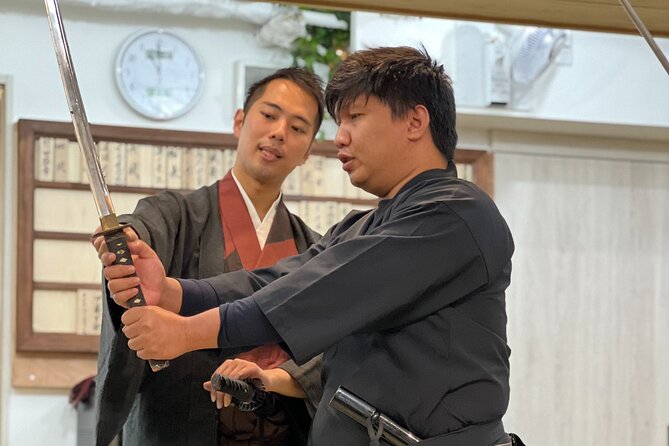
- A real central Kyoto dojo: The class takes place at Yushinkan International, a functioning martial arts training center with a traditional dojo setting and shrine.
- Personal instruction: Classes are planned for six participants, though the total can reach nine when smaller bookings are combined.
- Traditional dress included: You put on dōgi, obi, and hakama before training and photographs.
- Actual kata practice: You learn a short sword form, along with safe methods for drawing, wielding, and sheathing an iaito.
- Strong teaching team: Yushin Sensei leads the instruction, with Jordan and John helping explain techniques and answer questions in English and Japanese.
- A performance at the end: The master presents katana demonstrations, including a memorable two-sword routine.
Entering a working dojo in central Kyoto
This activity begins at 452-4 Matsugaechō in Nakagyo Ward, a central Kyoto location near public transportation. The dojo is on the basement level of a complex, so do not expect a grand temple entrance or a street-front museum. Follow the meeting instructions carefully and allow a little time to find the building.
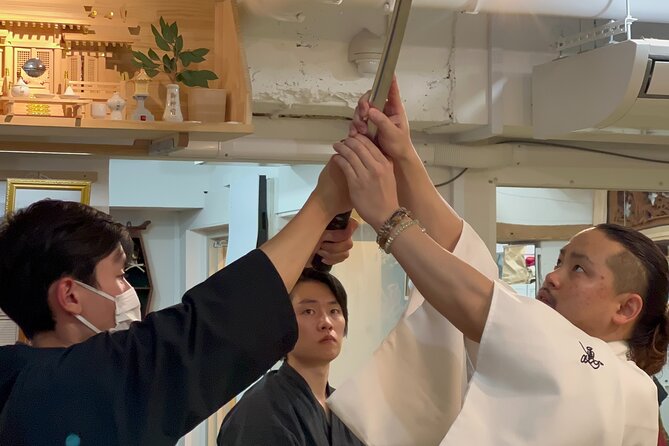
Once inside, the setting does much of the work. This is a martial arts training center, not a room dressed up for a single afternoon show. The dojo includes traditional touches such as a Shinto shrine and wooden name plaques connected with the school community. That matters because the lesson feels connected to an ongoing practice, not only to tourism.
I would arrive ready to show respect for the space. You will be learning etiquette as well as sword movements, and the atmosphere rewards attention. The setting is informal and friendly, but it is still a place where people train seriously.
The activity lasts about 1 hour 45 minutes, though the total time can run from 1.5 to 2 hours depending on class size. That extra time is useful when instructors need to correct several people, but it also means you should not schedule another activity immediately afterward.
More samurai and sword sessions:
- Kyoto Samurai Experience
★ 5.0 · 1,294 reviews - Kyoto: Kendo and Samurai Experience with Uniform and Gear
★ 4.9 · 815 reviews - Kyoto: Samurai Sword Class by Experts in Traditional Arts
★ 4.9 · 657 reviews
Putting on dōgi, obi, and hakama
The session starts with samurai training gear. You dress in a dōgi, obi, and hakama, giving you the proper appearance for practice and making the lesson feel more like a class than a costume photograph.
The clothing is not just decoration. The instructors use it to introduce the discipline and manners connected with Japanese sword arts. You will need to listen carefully as you move, stand, and handle the sword. Loose tourist clothing is replaced by practical training attire, so wear something comfortable underneath.
This part is especially useful for families and teenagers. It gives younger participants a clear role and creates good photographs without reducing the entire activity to dress-up. Parents can take pictures during suitable moments, but the main point is still training.
The age rule is firm: participants must be at least 12 years old. The activity requires moderate physical fitness, so you should be comfortable standing, moving through repeated positions, and following instructions with your arms and upper body.
Learning what the samurai sword meant
Before you begin the kata, the instructors explain samurai culture, swordsmanship, and the role of the katana. You learn why safe handling matters, how the sword was used, and who historically had access to samurai swords.
This background gives the physical lesson more meaning. Drawing a sword is not presented as a flashy trick. You learn that the movement has order, control, and purpose. The instructors also discuss the sword itself, including its parts and how traditional blades are made. Depending on the flow of the class, you may see historical swords during this explanation.
I like this balance. A short class cannot teach the full history of samurai life or the complete art of iaido, but it can give you a sound first picture. The teaching also helps separate real practice from the exaggerated swordplay you see in films.
English support is available through the teaching team. Yushin Sensei leads the martial arts instruction, while Jordan and John help with explanations and questions. Their combination makes the class easier to follow for English-speaking visitors while keeping the Japanese dojo setting intact.
Drawing, sheathing, and wielding the iaito
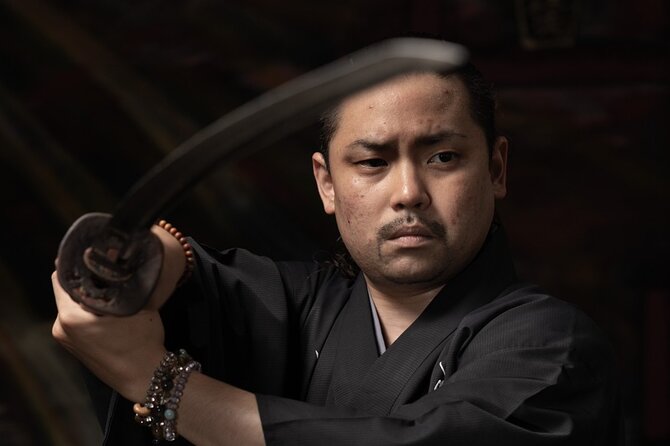
The practical work begins with basic sword handling. You learn how to draw, hold, move, and sheath the sword under instruction. Safety comes first, and the class is structured so that you practice one stage at a time.
The swords used for training are iaito, which allow you to work with the weight and shape of a real sword without using a sharpened blade for mat cutting. Some descriptions of the activity refer to real katanas, and past sessions may have included cutting demonstrations, but the current rule is clear: mat cutting with a real katana is not offered.
That change is worth understanding before you pay. If your main goal is to cut tatami mats, this is not the right booking. If you want to learn the basics of sword handling in a supervised dojo, the iaito are a sensible choice.
You should expect corrections. The instructors pay close attention to form, and that is one reason the class can run longer with a larger group. The planned group size is six, with a maximum of nine participants. A small group gives you a better chance to receive individual help, though the exact number depends on the day.
A completely different side of Kyoto:
- PERFECT KYOTO 1-Day Bus Tour
★ 5.0 · 13,518 reviews - Kyoto: Fushimi Inari, Kinkakuji, Bamboo Grove 1 Day Bus Tour
★ 4.8 · 4,316 reviews - Kyoto: Tea Ceremony in a Traditional Tea House in Kiyomizu
★ 4.9 · 3,519 reviews - Kyoto Geisha Walking Tour: Gion District & Hidden Gems
★ 4.7 · 3,273 reviews
Learning one complete kata
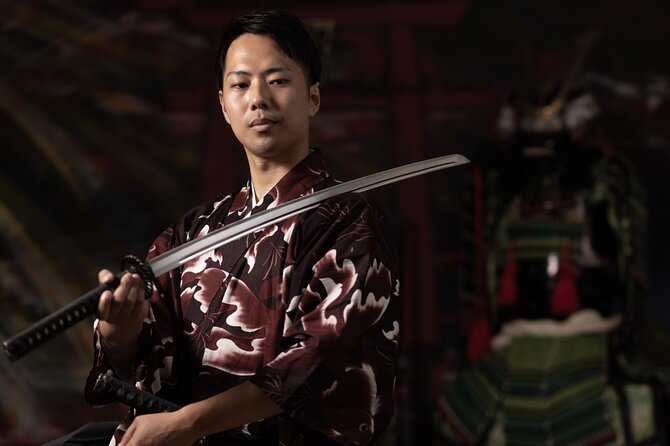
The central lesson is a short kata, or formal sequence. You do not simply swing a sword a few times and pose for pictures. You learn a routine with defined positions and movements, then repeat it under guidance.
For a first-time participant, the kata provides a clear goal. You can see how separate actions fit together: preparation, drawing, movement, handling, and sheathing. The sequence also shows why posture and timing matter more than force.
The class is not designed to turn you into a swordsman in one visit. Instead, it gives you a brief but genuine introduction to the structure of iaido practice. If you already train in karate, martial arts, or another discipline, you may appreciate the focus on detail. If you have no martial arts background, the instructors break the routine into manageable sections.
Take your time. Trying to perform quickly makes the movements less safe and less accurate. Listen for corrections, keep your feet controlled, and treat the sword as training equipment rather than a toy. The best part of the class is not looking dramatic. It is understanding how much precision sits behind a simple-looking movement.
Watching Yushin Sensei’s two-katana performance
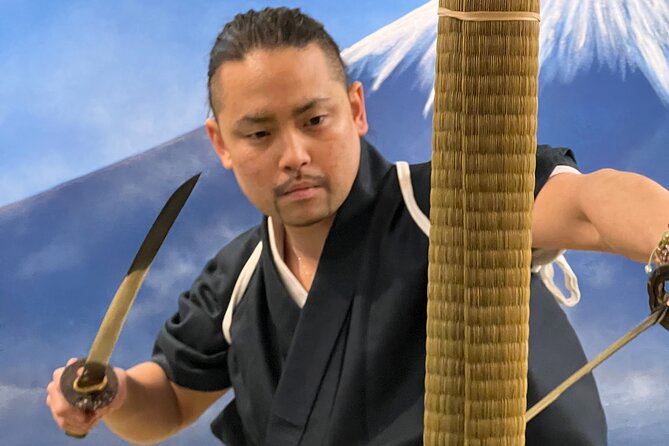
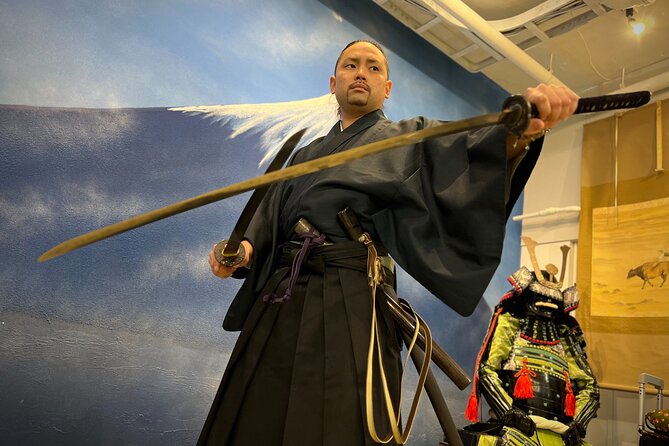
After your own practice, Yushin Sensei demonstrates his skill. The two-katana performance is the special visual moment of the session, and it gives you a sharper sense of the control required in the art.
The demonstration is different from your training. You work slowly through a beginner kata, while the master shows speed, precision, and command. This contrast helps you see that the basic movements are not watered-down entertainment. They are the first steps toward a demanding discipline.
You also have the chance to see sword demonstrations and learn more about historical katana construction and parts. The performance gives the class a strong finish, but it should not be confused with a live cutting show. Again, mat cutting is not currently part of the activity.
Photography and video are possible during parts of the lesson, according to the information provided by the operator. Ask before recording so you do not interrupt instruction or another participant’s turn. A photo in hakama with a training sword is a nice souvenir, but the better memory is the sequence you actually learned.
What the price means at $132.65
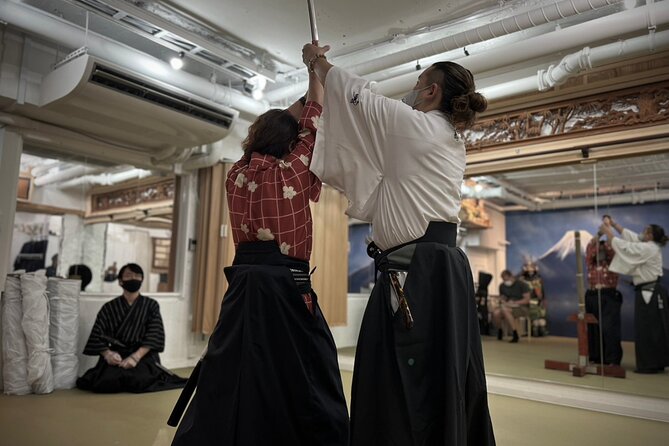
At $132.65 per person, this is not a low-cost sightseeing stop. You are paying for a guided, hands-on class with clothing, instruction, equipment, a small-group format, and a master demonstration.
The value depends on what you want. Compared with a simple costume photo session, this offers much more substance. You learn a kata, handle an iaito, hear about samurai culture, and train in an actual dojo. Compared with a full martial arts course, it is brief and introductory, so you should not expect advanced instruction.
I think the price makes the most sense for someone who values access and teaching over a long list of sights. It can be a strong choice for a family, a couple, or a solo visitor who wants an activity with more participation than a museum visit. It is also a good fit for people already interested in martial arts, Japanese swords, or traditional etiquette.
The activity had been booked more than 10 times in the previous week, and the stated rating is five out of five from 256 reviews, with 100 percent recommending it. Those figures suggest strong demand, so I would book ahead if the class fits your Kyoto schedule. Still, demand does not change the basic limitation: the lesson is short, and there is no current mat cutting.
Who will enjoy this most
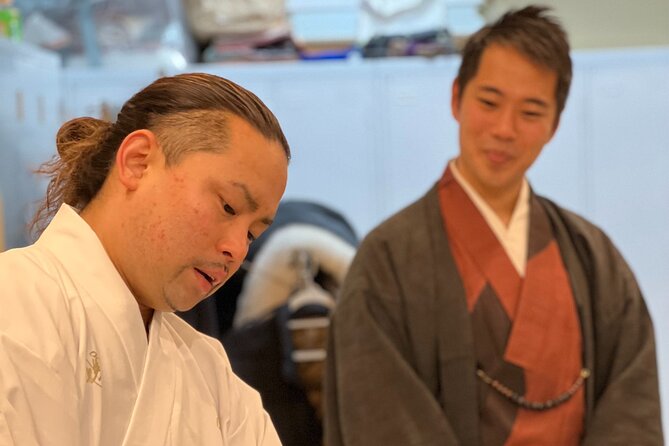
I would recommend this to adults and teenagers aged 12 and older who like learning by doing. Families with older children can train together, and the activity works well as a shared Kyoto memory because parents and teenagers can take part in the same class.
It also suits visitors who want a serious introduction without committing to a long martial arts program. You get enough explanation to understand the setting and enough practice to learn a real sequence, but you do not need prior sword or karate experience.
Martial arts practitioners may find the attention to form especially rewarding. The class has enough structure to feel genuine, though experienced iaido students should keep expectations modest. You are taking a short introduction, not attending a normal long-term dojo practice.
I would be more cautious about booking if you dislike standing activity, have limited physical fitness, or mainly want a theatrical samurai show. The class asks you to listen, repeat movements, and handle a sword under instruction. That is exactly what makes it worthwhile, but it is not passive entertainment.
Practical details before you book
The experience begins and ends at the same meeting point in Nakagyo Ward. It is near public transportation, which makes it easy to fit into a day exploring central Kyoto, though the basement location may not be obvious from the street.
Wear comfortable clothing under the training gear. You will be changing into dōgi, obi, and hakama, then moving through a series of standing positions and sword exercises. A moderate level of physical fitness is required.
The group is intended to be small, with six participants per class in normal conditions. The operator notes that more than six people may attend when only a few separate parties have booked, and the maximum is nine. If personal corrections matter to you, ask about the expected group size when confirming.
Confirmation is sent within 48 hours of booking, subject to availability. You can cancel for a full refund up to 24 hours before the local start time. Cancellations or changes made inside that 24-hour window are not refunded or accepted.
Should you book Samurai Training in Kyoto?
Book it if you want to learn something physical and specific in a genuine dojo. The clothing, etiquette, kata instruction, English support, and Yushin Sensei’s two-katana performance give the activity more depth than a standard samurai photo stop.
Skip it if your priority is cutting mats with a sharpened sword, or if you want a long technical course. The current program uses iaito for safe practice and focuses on a short introduction.
For most visitors aged 12 and older, I see this as a worthwhile Kyoto add-on, especially for families, martial arts fans, and anyone who wants a closer look at Japanese sword practice. Keep your expectations clear, listen carefully, and you will get a focused lesson rather than a tourist spectacle.
FAQ
Where does the samurai training take place?
The activity takes place at Yushinkan International in Kyoto, at 452-4 Matsugaechō, Nakagyo Ward, Kyoto 604-8034, Japan. The dojo is near public transportation and is located on the basement level of a complex.
How long does the experience last?
The listed duration is about 1 hour 45 minutes. The session may take between 1.5 and 2 hours depending on the number of participants.
Who teaches the class?
Yushin Sensei leads the training. Jordan and John assist with instruction and explanations, and English and Japanese are spoken during the activity.
What will I wear?
You will change into samurai training gear consisting of a dōgi, obi, and hakama.
Do I need previous martial arts experience?
Previous experience is not stated as a requirement. The activity teaches basic sword handling and a short kata, but participants should have a moderate level of physical fitness.
Is mat cutting with a real katana included?
No. Mat cutting with a real katana is not currently offered. Training focuses on safe practice with iaito, instruction, and demonstrations.
What is the cancellation policy?
You can cancel at least 24 hours before the local start time for a full refund. Cancellations or changes made less than 24 hours before the start are not refunded or accepted.
Recently added around Kyoto
- Higashiyama | Kyoto: Sakura Season Private Rickshaw Tour★ 5.0 · 3 reviews
- Kyoto Kimono Rental CHAMATSU|Kimono/Yukata Rental FamilyPlan★ 5.0 · 3 reviews
- Kyoto: Half-Day Private Guided Tour to the Old Town of Gion★ 4.4 · 3 reviews
- Nara Private Customizable Half Day Tour★ 5.0 · 3 reviews
- Kansai Region Hiking Adventure in Nara Kobe Kyoto and More★ 5.0 · 3 reviews
- Full Day Nara Deer, Temple, Shrine, Activities & Tea Ceremony★ 5.0 · 3 reviews
- Nara: Essential Private Tour with Deer Park and Temples★ 5.0 · 3 reviews
- Hiking Tour for Sacred Sites in Kyoto with a Guide★ 5.0 · 3 reviews
Kyoto Samurai Experiences, compared.
Kendo and Samurai Experience with Uniform and Gear
Read our review →
Samurai Sword Class by Experts in Traditional Arts
Read our review →
Skip the lines Basic Ticket at SAMURAI NINJA MUSEUM KYOTO
Read our review →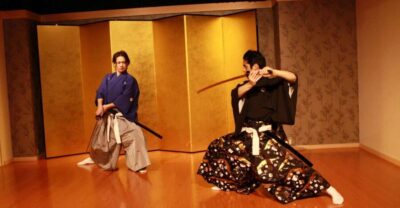
Private Tea Ceremony and Sake Tasting in Kyoto Samurai House
Read our review →
Kyoto Sword Experience – includes Museum Ticket/Ninja Experience
Read our review →Browse the lists this tour appears in