
REVIEW · GION GEISHA DISTRICT TOURS
Kyoto: Tea Ceremony with Maiko Premium
Kyoto’s Maiko Premium tea ceremony gives you something most sightseeing stops cannot: direct time with a young performer who is still training in one of Japan’s old entertainment traditions. You’ll learn to whisk matcha, ask about daily life, watch two elegant dances, play a simple game, and take a photo beside her. It is a cultural meeting, not just a stage show.
I especially like the Q&A session, where you can ask about training, clothing, routines, and the path from Maiko to Geiko. I also like the mix of quiet ceremony and cheerful play. The dances provide grace, while the game loosens up the room and works well for families.
The main point to understand is the setting. This takes place in a modern building near Gojo Station, not an ochaya or traditional tatami house. Large advertisements may appear behind the performer in photos, and the group room can feel more like an event venue than an old Kyoto teahouse.
In This Review
- Key points to know before booking
- Meeting a Maiko near Gojo Station
- What the Premium program adds
- Learning to make matcha
- The Q&A opens a door to Maiko life
- Two dances show the quiet skill of the performers
- A game brings the room back to earth
- Taking a photo and receiving a Senjafuda
- The room is useful, not traditional
- How the 90 minutes unfold
- Who will get the most from this experience
- Booking advice and final verdict
- FAQ
- Where is the Maiko Premium tea ceremony held?
- How long does the experience last?
- What is included in the Premium program?
- Will a Maiko definitely attend?
- Is the tea ceremony formal?
- Is English available?
- Are children allowed?
- Does the building have an elevator?
- Can I cancel for a full refund?
Key points to know before booking
- Meet a Maiko or Geiko up close: The performer may be a Maiko, but a Geiko may appear instead.
- Premium includes the full program: You get matcha-making, two dried Japanese sweets, two dances, a Q&A, photos, and a game.
- The conversation is the real prize: You can ask direct questions about training and daily life.
- Plan for a modern venue: The room has tables and chairs, and the building has no elevator.
- Arrive early: The event cannot wait for late arrivals, and arriving about 15 minutes early may give you time to settle in.
- Front-row seats cost extra: SS seats are 3,300 yen, S2 seats are 2,200 yen, and S3 seats are 1,100 yen.
Meeting a Maiko near Gojo Station
The experience begins about one minute from Exit 1 of Gojo Station on Kyoto’s Karasuma Subway Line. The entrance faces Gojo-dori, the main street, so the location is easy to reach once you come up from the station.
I like this location for a short Kyoto activity. You do not need to spend an hour reaching a remote neighborhood, and the 90-minute schedule fits neatly between sightseeing plans. You can place it before dinner, after visiting central Kyoto, or into an evening when you want something more focused than another temple visit.
Allow extra time to find the entrance and climb the stairs. There is no elevator in the building, and each venue is reached by stairs. The event will not be held for late arrivals, even if your train or taxi runs behind schedule.
The operation runs from 10:00 to 17:00, and reservations received after 17:00 are handled the next day. Check the available start times carefully when booking. If you cancel within the fee period or change the date after a fee applies, additional charges can result. The operator also does not cover your transport costs if you cancel.
More evenings in Gion:
- Kyoto Geisha Walking Tour: Gion District & Hidden Gems
★ 4.7 · 3,273 reviews - Kyoto: Gion Magical Night Walking Tour with Geisha Trivia
★ 4.9 · 2,393 reviews - Kyoto: Gion Geisha District Walking Tour – Stories of Geisha
★ 4.7 · 2,187 reviews
What the Premium program adds
The Premium option is designed as the full encounter rather than a short demonstration. At $50 per person, it costs more than a basic tea presentation, but it includes the pieces that give the visit its character: two dances, a game, a photo opportunity, and time for questions.
The extra cost makes sense if your main goal is to meet a Maiko and see her perform. It is less compelling if you only want to taste matcha or learn the mechanics of whisking it. The tea itself is simple. The value comes from the human contact and the range of activities packed into the session.
Front-row seating is available for an added fee. SS seats cost 3,300 yen, S2 seats cost 2,200 yen, and S3 seats cost 1,100 yen. You do not need to buy a premium seat to take part, but a closer position can help if photographs and a clear view of the dance matter to you.
The overall rating is 4.3 from 280 ratings, which fits the experience well. The program delivers a lot for its price, but its modern room and group format are not a perfect match for visitors expecting a private tea house setting.
Learning to make matcha
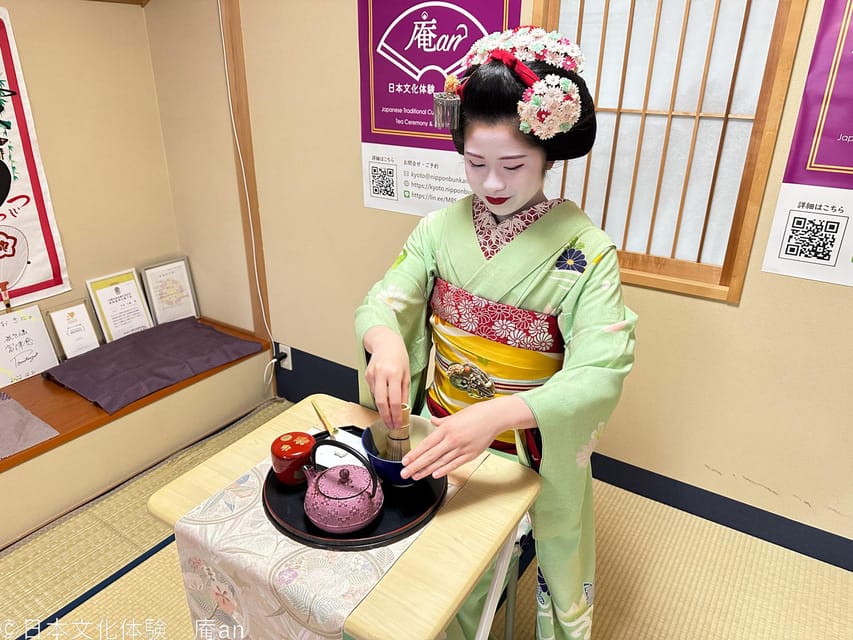
The tea portion begins with a greeting from the Maiko, followed by a demonstration of how to prepare matcha. You then make your own bowl of tea.
This is not presented as a formal, highly ceremonial tea gathering. Think of it as a friendly introduction to the basic actions and etiquette. You get to handle the whisk, prepare the matcha yourself, and drink the result with two dried Japanese sweets.
I like this hands-on approach because you do not simply watch someone else work. You take part, even if your bowl is less smooth than the Maiko’s. The activity gives children and first-time visitors something clear to do, while the explanation adds a little meaning to the sweets and tea.
The matcha is a standard serving, so do not book this expecting a specialized tasting menu. The included refreshments are modest. Free snacks and a drink are included, while other drinks may be available for purchase inside at a moderate price.
The tea section also sets the tone for the rest of the program. It begins quietly, then moves into conversation and performance. You get a useful introduction without needing special preparation, formal clothing, or previous knowledge of Japanese tea customs.
The Q&A opens a door to Maiko life
The question period is one of the strongest parts of the program. You can ask directly about the performer’s training, work, traditions, clothing, hairstyle, and daily routine.
Maiko are not simply people dressed for a photo. They follow a demanding traditional path, and the session helps explain how that way of life continues in modern Kyoto. One point discussed in the program is that training toward Geiko can take years, with five years cited in the experience’s explanations.
The conversation also helps clear up the difference between Maiko and Geiko. A Maiko is a younger apprentice, while a Geiko is an established professional. Depending on the schedule, a Geiko may appear instead of a Maiko. That change is not a downgrade. It gives you a chance to meet someone at a different stage of the same tradition.
The instructor is Japanese, and English translation is provided as much as possible when requested. You should contact the operator in advance if English assistance is important to you. Some sessions have had a host who helps bridge Japanese and English, but the level of translation may vary.
This is where I would prepare a few questions before arriving. Ask about the length of training, the weight of the kimono, the meaning of the dance, or what a normal working day involves. A few thoughtful questions can make the session feel personal instead of routine.
More tea ceremonies in Kyoto:
- Kyoto: Tea Ceremony in a Traditional Tea House in Kiyomizu
★ 4.9 · 3,519 reviews - Kyoto: Tea Ceremony Ju-An at Jotokuji Temple
★ 4.9 · 3,207 reviews - Kyoto: 45-Minute Tea Ceremony Lesson Experience
★ 4.3 · 2,378 reviews - Kyoto: Table-Style Tea Ceremony at a Kyo-Machiya
★ 4.9 · 1,211 reviews
Two dances show the quiet skill of the performers
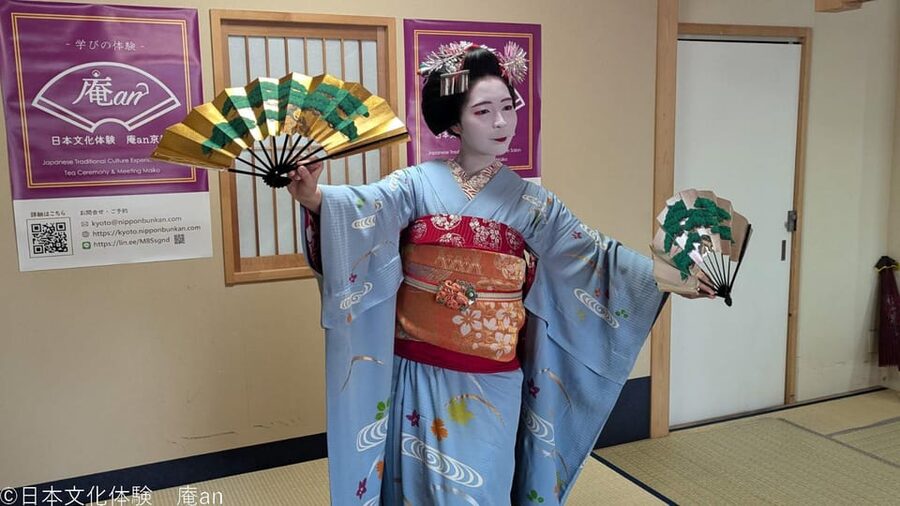
The Maiko performs two traditional dances. Their subjects may relate to the seasons, love stories, or daily life, and the movements are designed to express feeling through controlled gestures rather than large theatrical action.
You will notice the details: the turn of a sleeve, the tilt of the head, the way a fan or other small prop is handled, and the careful pace of each movement. The dances are short enough to hold your attention but substantial enough to show why Maiko performance is more than wearing an elaborate kimono.
This is often the most beautiful part of the visit. The room may not be atmospheric, but the performer’s concentration changes the mood. If you enjoy traditional arts, you will likely value the dance more than the tea preparation.
Photography is allowed during the presentation, according to the experience information. Still, be respectful and follow the host’s instructions. The opportunity to take photos is generous, but it is worth putting your phone down for part of the dance so you can actually watch it.
A game brings the room back to earth
After the formal beauty of the dance, the program shifts to a traditional game with the Maiko. Volunteers may join, while everyone else watches, claps, and cheers.
I like this part because it prevents the experience from becoming stiff. The Maiko’s role is highly disciplined, but the game shows a more playful side of Japanese hospitality. It also gives children a clear way to participate without needing to understand every detail of the tea ceremony.
The game is simple, though the Maiko has plenty of practice. You may find yourself cheering for a volunteer who has little chance of winning. That friendly imbalance is part of the fun.
Families have a good reason to consider the Premium program. Children as young as four have enjoyed the combination of questions, dancing, tea, and play. Children under two can attend free if they sit on a parent’s lap, but a regular fee applies if a separate seat or meal is required.
Taking a photo and receiving a Senjafuda
The photo opportunity places you beside the Maiko for a commemorative picture. This is a more direct encounter than seeing a performer across a theater or catching a fleeting glimpse in Gion.
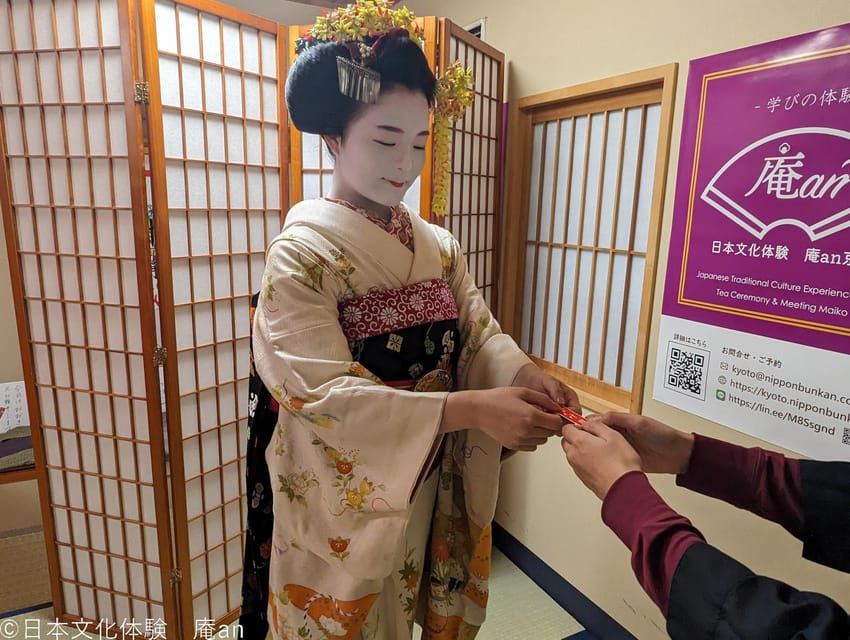
As a special gift, the Maiko presents a Senjafuda, a lucky charm associated with her name. It is a small item, but it gives the meeting a physical reminder beyond the photographs.
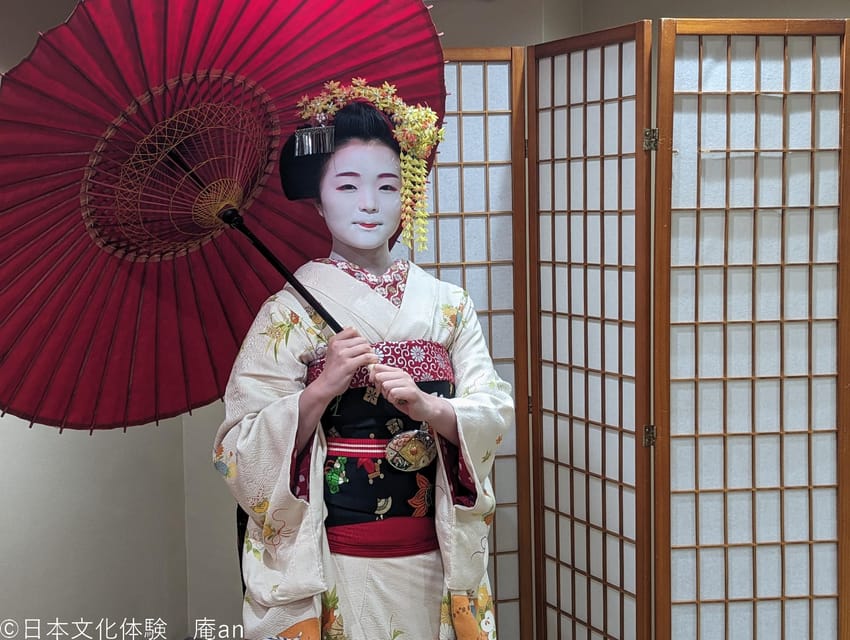
There is one practical photo warning. The backdrop includes large company advertisements, including a name and QR code, and these can appear in your pictures. The experience would look better with a more carefully designed Japanese backdrop, such as a screen, artwork, or quieter wall.
If the photo matters to you, choose your seat with care and ask the staff about the best position. The optional front-row seats may help, though the event does not promise a private photo session or a scenic old-Kyoto background.
The room is useful, not traditional
The venue is in a building, with tables and chairs rather than tatami mats. It is relaxed, and the staff are described as friendly, but it is not an ochaya or a traditional Japanese house.
This distinction matters. Some people will be happy to trade atmosphere for an accessible, organized way to meet a Maiko. Others may feel the plain wall and event-room layout weaken the sense of place. If you are comparing this with a formal tea ceremony in a preserved machiya, this is a different product.
The group format also shapes the experience. You are sharing the room with other people, and the program may take place alongside diners having lunch or dinner. The atmosphere can depend on the crowd. A noisy group can make it harder to hear, and the session is not intimate in the private sense.
Still, the program is organized around direct interaction rather than a distant stage. The Maiko answers questions, plays with the group, dances close enough for photos, and explains what she is doing. For a first introduction, that can matter more than an old wooden room.
How the 90 minutes unfold
The planned schedule is easy to follow:
- The program opens with a greeting from the Maiko.
- The tea demonstration and matcha preparation follow, with two dried Japanese sweets.
- You move into the Q&A session.
- You take a photo beside the Maiko.
- She presents the Senjafuda charm.
- She performs two dances.
- The group plays a traditional game.
- At about 75 minutes, the Maiko leaves.
- You have additional chatting time before departing at about 90 minutes.
Actual timing can vary. One account found the program closer to 70 minutes, while the stated duration is 90 minutes. I would keep your schedule flexible rather than booking a train or restaurant reservation immediately afterward.
Arriving 15 minutes early is a smart move. It gives you time to find the entrance, take your seat, and avoid losing part of the program. You might also see the Maiko arrive by taxi or leave after the presentation, but this is not a promised part of the activity.
Who will get the most from this experience
I would choose this for a first visit to Kyoto, especially if you want a clear introduction to Maiko culture without committing to an expensive private evening.
It suits couples, families, and solo visitors who enjoy cultural demonstrations with a social side. The game makes it less formal, the Q&A makes it more personal, and the photo provides a useful keepsake. You do not need to know the rules of tea ceremony or Japanese performance before arriving.
It also works well for a short Kyoto itinerary. Ninety minutes is long enough to feel substantial but short enough to fit around major sights. The central Gojo location makes the schedule easier than an activity far outside the city center.
I would hesitate if your priority is a silent, traditional tea ceremony in a historic house. The matcha preparation is basic, the room is modern, and you share the experience with a group. I would also be cautious if you need fully fluent English throughout, since the instructor is Japanese and translation is provided as much as possible rather than guaranteed at every moment.
Booking advice and final verdict
Book the Premium version if you want the complete program. The dances and game are repeatedly among the most enjoyable elements, and leaving them out would remove much of the experience’s personality.
At $50, I consider it good value for a 90-minute meeting that includes tea, sweets, two dances, questions, a photo, a charm, and a game. The value is strongest when you treat it as a cultural introduction with live performance, not as a luxury tea ceremony.
Choose a front-row seat only if close viewing and photography justify the extra 1,100 to 3,300 yen. Otherwise, the standard arrangement should still let you take part and see the program.
My advice is simple: book it if you want to meet a Maiko or Geiko directly and you can accept a modern group venue. Skip it if the room itself must feel historic. For most first-time Kyoto visitors, the honest conversation, graceful dances, and chance to prepare your own matcha make this a memorable and practical cultural stop.
FAQ
Where is the Maiko Premium tea ceremony held?
It is held about one minute from Exit 1 of Gojo Station on Kyoto’s Karasuma Subway Line. The entrance faces Gojo-dori.
How long does the experience last?
The scheduled duration is 90 minutes. The Maiko leaves at about the 75-minute mark, followed by chatting time before room departure.
What is included in the Premium program?
The program includes the tea ceremony with a Maiko, matcha, two dried Japanese sweets, a Q&A session, a photo opportunity, a Senjafuda charm, two dances, and an interactive game.
Will a Maiko definitely attend?
The program may feature a Maiko or, depending on the situation, a Geiko. Both are professional performers within Kyoto’s traditional entertainment culture, but they represent different stages of training and experience.
Is the tea ceremony formal?
No. The activity offers a relaxed introduction to preparing matcha rather than a formal ceremony in an ochaya or traditional Japanese house.
Is English available?
The instructor’s language is Japanese. English translation is provided as much as possible, and you should contact the operator if you would like to request English assistance.
Are children allowed?
Yes. Children under two are free when sitting on a parent’s lap. If a separate seat or meal is required, the regular per-person fee applies.
Does the building have an elevator?
No. You need to use stairs to reach the venue.
Can I cancel for a full refund?
You can cancel up to eight days in advance for a full refund. Cancellation fees apply after that point, and changing the date or time after a fee has been incurred may also result in a specified charge.
Recently added around Kyoto
- Higashiyama | Kyoto: Sakura Season Private Rickshaw Tour★ 5.0 · 3 reviews
- Kyoto Kimono Rental CHAMATSU|Kimono/Yukata Rental FamilyPlan★ 5.0 · 3 reviews
- Kyoto: Half-Day Private Guided Tour to the Old Town of Gion★ 4.4 · 3 reviews
- Nara Private Customizable Half Day Tour★ 5.0 · 3 reviews
- Nara: Essential Private Tour with Deer Park and Temples★ 5.0 · 3 reviews
- Kansai Region Hiking Adventure in Nara Kobe Kyoto and More★ 5.0 · 3 reviews
- Full Day Nara Deer, Temple, Shrine, Activities & Tea Ceremony★ 5.0 · 3 reviews
- Hiking Tour for Sacred Sites in Kyoto with a Guide★ 5.0 · 3 reviews
Gion Geisha District Tours, compared.

Kyoto Geisha Walking Tour: Gion District & Hidden Gems
Read our review →
Gion Magical Night Walking Tour with Geisha Trivia
Read our review →
Gion Geisha District Walking Tour – Stories of Geisha
Read our review →
Best of Kyoto: Gion, Geisha, Pagodas & Cobblestones
Read our review →
Kyoto Night Foodie Tour in Gion (9+ dishes + 6 Sake tastings)
Read our review →
Kyoto Gion Geisha District Walking Tour – The Stories of Geisha
Read our review →
Kyoto Gion: 2-Hour Geisha Culture & History Walking Tour
Read our review →Browse the lists this tour appears in