REVIEW · MORNING
Kyoto Morning Tour from Kyoto or Osaka
Kyoto packs centuries of power, religion, and refined design into a surprisingly small area. This morning tour gives you a brisk look at Nijo Castle, Kinkakuji, and Kyoto Imperial Palace, with an air-conditioned bus doing the hard work between them. It is a smart way to get your bearings fast, especially if Kyoto is a day trip from Osaka.
I like two things here: admission fees and transport are included, and a good guide can turn three fine sights into a useful lesson about shoguns, emperors, gardens, and Japanese design. The catch is time. Stops are short, groups can reach 40 people, and a closed palace or castle may be replaced without a refund.
In This Review
- Key points to know before booking
- Why this half-day Kyoto tour works
- Meeting at Kyoto Avanti near Kyoto Station
- Nijo Castle: shogun power in polished wood
- Kinkakuji: Kyoto’s famous Golden Pavilion
- Kyoto Imperial Palace: quiet formality after the gold
- A guide-led morning, not a private visit
- What $87.19 buys you
- Walking, weather, and family details
- Who should book this Kyoto morning?
- Should you book it?
- FAQ
- Where does the Kyoto morning tour begin?
- Where does the tour end?
- How long does the tour last?
- Which attractions are included?
- What happens if Kyoto Imperial Palace is closed?
- What happens if Nijo Castle is closed?
- Is transportation from Kyoto back to Osaka included?
- Are admission fees and a guide included?
- Can children join the tour?
Key points to know before booking
- Three major sights before lunch: Nijo Castle, Kinkakuji Temple, and Kyoto Imperial Palace are covered in roughly four hours and 40 minutes.
- A helpful choice from Osaka: The outbound trip from Hotel Granvia Osaka includes an English-speaking assistant to Kyoto, but your return from Kyoto to Osaka is not included.
- The Golden Pavilion requires care: Kinkakuji has a one-way path with uneven rocky steps and a climb, while Nijo Castle and the Imperial Palace are flatter.
- The guide can make or break the morning: Guides named in past bookings include KC, Casey, Jun, Jessie, Caisy, and Mr. Harada. The best guides are lively, clear, and full of useful context.
- Substitutions matter: The Imperial Palace may become Kitano Tenmangu Shrine, or Nishi Hongan-ji on the 25th, and Nijo Castle may become Ryoan-ji on certain closure dates.
- You finish near Kyoto Station: The tour ends in front of Kyoto Avanti, across from the station’s Hachijo Exit.
Why this half-day Kyoto tour works
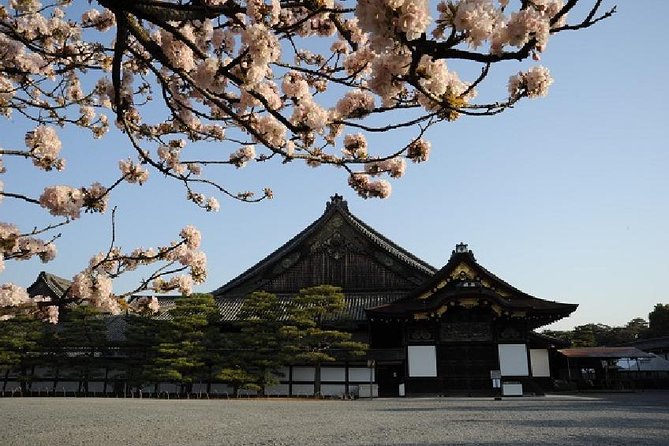
Kyoto rewards slow wandering, but not every schedule allows it. If you have one morning, or are using Kyoto as a day trip from Osaka, this outing covers three very different sides of the city: military authority at Nijo Castle, Buddhist beauty at Kinkakuji, and imperial ceremony at the palace.
I especially like the contrast. You are not spending four hours looking at similar temple halls. Instead, you move from painted castle rooms and nightingale floors to a gold-covered pavilion beside a pond, then to the restrained buildings and open grounds of the former imperial residence.
The bus is another practical advantage. Kyoto’s sights are spread across the city, and arranging three separate trips by local transport can eat up much of a short visit. The air-conditioned vehicle keeps the morning moving and gives you a place to rest between stops.
The tradeoff is depth. You will see the important parts, but you will not have much time to linger, sketch, sit in a garden, or explore beyond the marked route. I would treat this as an introduction, not as your complete Kyoto experience.
A few more Kyoto experiences worth comparing
- Kyoto Early Morning Tour with English-Speaking Guide
★ 5.0 · 1,427 reviews - Kyoto: Early Morning Tour with English-Speaking Guide
★ 4.9 · 1,128 reviews - Nara Early Morning Tour (Kyoto or Osaka Departure Available)
★ 5.0 · 676 reviews
Meeting at Kyoto Avanti near Kyoto Station
The meeting point is Kyoto Avanti31, at Higashikujō Nishisannōchō in Minami Ward. The tour also ends in front of Kyoto Avanti, across from Kyoto Station’s Hachijo Exit.
This is a useful location because Kyoto Station is easy to reach by train, and the area is near public transport. Still, allow extra time to find the exact entrance. The directions can be easy to misread, particularly if you rely only on a map link. Check the confirmation carefully and scroll through the full ticket details for the pickup instructions.
If you are coming from Osaka, pay close attention to the arrangement. The outbound journey from Hotel Granvia Osaka to the Sunrise Tours Desk in Kyoto Avanti’s basement includes an English-speaking assistant. That assistant is not the licensed guide for the Kyoto sightseeing portion.
The tour ends back at Kyoto Avanti. Your return transportation from Kyoto to Osaka is not included, and there is no assistant service for that journey. This is not a major problem, but you should allow time and budget for your own train ride after the tour.
Nijo Castle: shogun power in polished wood
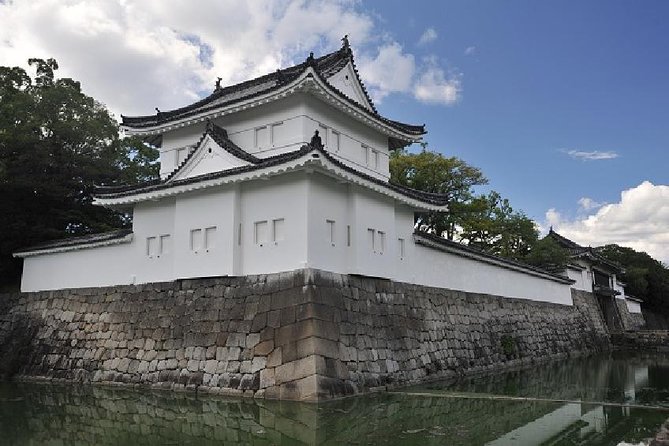
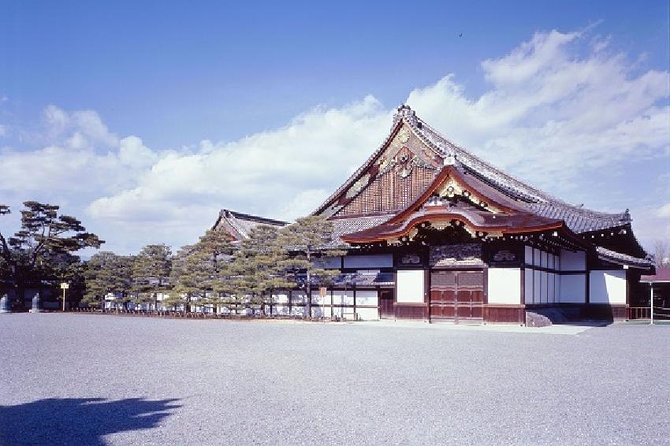
Nijo Castle is the first stop, with about 50 minutes allotted and admission included. Tokugawa Ieyasu ordered its construction in 1603, when the Tokugawa shogunate began its long rule of Japan.
The castle’s Ninomaru Palace is the main event. The connected buildings are made of cypress wood and contain elaborate carvings, painted decoration, and rooms covered in gold leaf. You also see areas connected with the daily running and protection of the complex, including kitchens, a guardhouse, and several gardens.
I find Nijo Castle valuable because it feels less like a defensive fortress and more like a carefully staged display of authority. The design tells you how the shogun wanted power to look: controlled, formal, expensive, and impossible to ignore.
The 50-minute visit is enough for a guided introduction and the central sights. It is not enough for a leisurely examination of every room or garden. Stay close to the guide at the start, since the group may need to move on promptly to keep the morning on schedule.
Nijo Castle is closed on Tuesdays in January, July, August, and December, as well as from December 26 through January 3. If a Tuesday closure falls on a public holiday, the closure moves to the following day. The replacement visit is Ryoan-ji Temple.
That substitution may suit you if you want another famous Kyoto religious site, but it is not the same experience. If Nijo Castle is the main reason you are booking, check the date before paying. The tour does not offer a refund simply because an advertised stop has been replaced.
Kinkakuji: Kyoto’s famous Golden Pavilion
Next comes Kinkakuji Temple, usually called the Golden Pavilion. The stop lasts about 45 minutes and includes admission.
The pavilion is a wooden structure covered in thin layers of pure gold, set beside a pond and framed by Japanese gardens. The first view is the one that matters most: the bright building, its reflection, the water, and the surrounding trees create the image that appears in nearly every Kyoto guidebook.
Kinkakuji is the most popular temple on this morning route, so expect a busy setting. The path follows a one-way system, and the route includes uneven rocky steps and a climb. Wear shoes with a firm sole, and do not assume this is a flat stroll just because the stop is short.
Forty-five minutes gives you time to see the pavilion, walk through the garden route, and take photographs. It does not give you the freedom to stop wherever you like for long. The route can feel quick, especially when the grounds are crowded.
There is also a practical guiding issue here. In a large group, with nearby tour groups speaking at the same time, it may be hard to hear every explanation. Some past departures did not use wireless headsets, and one review noted that a microphone was not transmitted to individual headphones.
I would stay near the guide whenever possible. Guides such as KC, Casey, Jun, Jessie, Caisy, and Mr. Harada have been praised for being warm, amusing, and well informed, but even a strong guide is difficult to hear if you are several people behind.
A completely different side of Kyoto:
- PERFECT KYOTO 1-Day Bus Tour
★ 5.0 · 13,518 reviews - Kyoto: Fushimi Inari, Kinkakuji, Bamboo Grove 1 Day Bus Tour
★ 4.8 · 4,316 reviews - Kyoto: Tea Ceremony in a Traditional Tea House in Kiyomizu
★ 4.9 · 3,519 reviews - Kyoto Geisha Walking Tour: Gion District & Hidden Gems
★ 4.7 · 3,273 reviews
Kyoto Imperial Palace: quiet formality after the gold
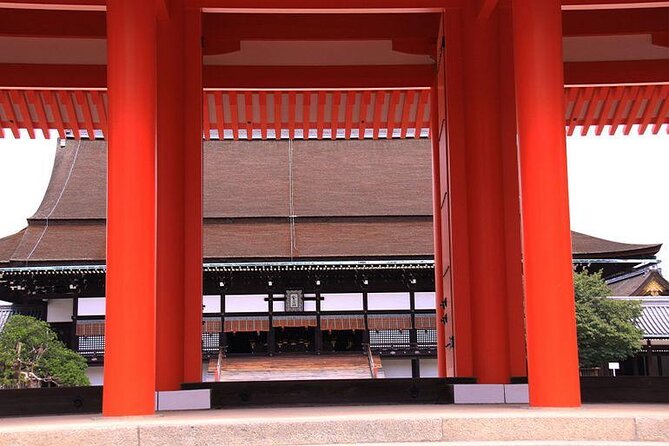
The final main stop is Kyoto Imperial Palace, with about 40 minutes allotted. The palace served as the Emperor’s residence until the capital moved to Tokyo in 1868.
After the bold color of Kinkakuji, the palace offers a different lesson in Japanese aesthetics. You see elegant buildings, restrained design, gardens, and the former setting for imperial enthronement ceremonies. The appeal is not simply the architecture. It is the chance to picture Kyoto as the seat of the imperial court before modern Japan shifted its political center east.
Forty minutes is enough to walk through the main visitor areas and hear the basic story. It is a short visit for anyone fascinated by palace design or ceremonial tradition, so you may want to return independently if this is your top interest.
The palace is closed on Mondays, or on the following day when Monday is a holiday. It may also close for an Imperial Household Agency event. In those cases, the tour visits Kitano Tenmangu Shrine instead. If the closure falls on the 25th, the replacement is Nishi Hongan-ji Temple.
This point deserves special attention. The tour continues even when the palace is unavailable, and no refund is provided for the replacement stop. That policy is stated in the conditions, but it is easy to miss when you are focused on the headline list of sights. If the palace is essential to your plans, confirm its opening status before booking.
After the sightseeing portion, the bus may stop at the lunch venue used by the one-day tour before dropping everyone at Kyoto Station. Food is not included, and the timing may vary with traffic and conditions at the sights.
A guide-led morning, not a private visit
The tour includes a National Government Licensed English Guide Interpreter fee for the main sightseeing service. The guide’s role is important because the stops are short and the historical context is dense.
A strong guide can connect the castle, temple, and palace into one clear story. You learn how the shogun and Emperor represented power in different ways, and why Japanese gardens and building design place such weight on movement, balance, and controlled views.
The guide names attached to particularly positive experiences include KC, Casey, Jun, Jessie, Caisy, and Mr. Harada. You should not expect a specific person unless the booking confirms one, but these examples show what a good morning can feel like: organized commentary, humor, help with photographs, and quick answers to questions.
The group size can reach 40 people. That keeps the price lower than a private guide, but it also creates limits. At crowded sites, you may hear another group’s guide speaking nearby. Some guides speak quickly, and one past experience found it hard to follow all the information.
My advice is simple: arrive early, keep within earshot, and ask for clarification if you miss a point. Do not spend the whole stop at the back taking photographs. You can often get better pictures after the guide has explained where to look.
What $87.19 buys you
At $87.19 per person, the tour is not the cheapest way to see Kyoto. You are paying for convenience, reserved group transport, entrance fees to Nijo Castle and Kinkakuji, and an English-language guide. The value rises sharply when you have only one morning or are making a short visit from Osaka.
I would compare the price with the cost of arranging three separate journeys, buying admissions, and keeping track of opening days yourself. The bus also saves you from figuring out the best order for distant sights. For a first visit, that organization has real value.
The price makes less sense if you have several days in Kyoto and enjoy moving slowly. You could spend longer at each place, return to a favorite temple, and avoid the clock by using local transport. You would give up the guide’s historical framing, but gain more freedom.
Since the tour averages booking about 31 days ahead, popular dates may fill early. That is particularly relevant during peak seasons and around major holidays, though the exact availability depends on the date.
Walking, weather, and family details
This is a sightseeing tour, not a seated bus ride. The walking is spread across three sites, and Kinkakuji includes uneven ground and a climb. Nijo Castle and the Imperial Palace are flatter, but you should still expect regular walking during each visit.
Most people can participate, and the tour is near public transportation. Children up to age five may join free, but they do not receive a bus seat under that arrangement. If you need a seat for a young child, book the child rate.
Anyone under 18 needs written parental permission. A participant under 15, or anyone not yet enrolled in middle school, must be accompanied by a parent or guardian.
The vehicle is air-conditioned, which matters during Kyoto’s hot months and gives your feet a break between stops. The order and arrival times can change because of road traffic and congestion at the attractions. Seats may not be assigned.
Who should book this Kyoto morning?
I would choose this tour if you want a structured first look at Kyoto and care more about seeing the major sights than setting your own pace. It suits a day trip from Osaka, a first morning in town, or a family group that wants transport handled for them.
It also works well if you enjoy learning as you go. The best guides add context that you might miss while walking through the rooms and gardens alone.
I would hesitate if you have limited mobility on uneven paths, need quiet time at temples, or are booking mainly for the Imperial Palace or Nijo Castle on a closure date. Check the calendar first. A replacement shrine may be worthwhile, but it will not match the stop you selected.
The tour is also not ideal for anyone who dislikes group schedules. Three stops in less than five hours means watches matter. You will get a clear sample of Kyoto, not an unhurried morning in each place.
Should you book it?
Book this tour if your Kyoto schedule is tight and you want the major cultural landmarks arranged in one efficient morning. The included transport, admissions, and English guide make $87.19 a fair convenience price, particularly for a first visit from Osaka.
Before booking, check three things: the opening days for Nijo Castle and the Imperial Palace, your route back to Osaka, and your comfort with walking and a group of up to 40 people. If those details suit you, this is a practical way to see a lot of Kyoto before lunch. If you have more time, use the tour as an introduction, then return to the places that deserve a slower look.
FAQ
Where does the Kyoto morning tour begin?
It begins at Kyoto Avanti31 in the Higashikujō Nishisannōchō area of Kyoto, near Kyoto Station.
Where does the tour end?
The tour ends in front of Kyoto Avanti, across from Kyoto Station’s Hachijo Exit.
How long does the tour last?
The tour lasts approximately 4 hours and 40 minutes.
Which attractions are included?
The planned stops are Nijo Castle, Kinkakuji Temple, also called the Golden Pavilion, and Kyoto Imperial Palace.
What happens if Kyoto Imperial Palace is closed?
The tour visits Kitano Tenmangu Shrine instead. If the closure falls on the 25th, the replacement is Nishi Hongan-ji Temple.
What happens if Nijo Castle is closed?
Ryoan-ji Temple is visited instead when Nijo Castle is closed.
Is transportation from Kyoto back to Osaka included?
No. The tour ends at Kyoto Avanti, and the return trip from Kyoto to Osaka is not included.
Are admission fees and a guide included?
Yes. The tour includes admission fees for the included paid attractions, transportation during the tour, and the fee for a National Government Licensed English Guide Interpreter.
Can children join the tour?
Children up to age five may join free of charge but will not receive a bus seat. If a seat is needed, book under the child rate. Participants under 18 also need written parental permission.
Recently added around Kyoto
- Higashiyama | Kyoto: Sakura Season Private Rickshaw Tour★ 5.0 · 3 reviews
- Kyoto Kimono Rental CHAMATSU|Kimono/Yukata Rental FamilyPlan★ 5.0 · 3 reviews
- Kyoto: Half-Day Private Guided Tour to the Old Town of Gion★ 4.4 · 3 reviews
- Nara Private Customizable Half Day Tour★ 5.0 · 3 reviews
- Full Day Nara Deer, Temple, Shrine, Activities & Tea Ceremony★ 5.0 · 3 reviews
- Nara: Essential Private Tour with Deer Park and Temples★ 5.0 · 3 reviews
- Kansai Region Hiking Adventure in Nara Kobe Kyoto and More★ 5.0 · 3 reviews
- Hiking Tour for Sacred Sites in Kyoto with a Guide★ 5.0 · 3 reviews
Morning, compared.
Kyoto Early Morning Tour with English-Speaking Guide
Read our review →Early Morning Tour with English-Speaking Guide
Read our review →
Nara Early Morning Tour (Kyoto or Osaka Departure Available)
Read our review →


Traditional Japanese Washi Papermaking- Kyoto morning
Read our review →