
REVIEW · GION GEISHA DISTRICT TOURS
Simple Plan with Maiko
Kyoto’s Maiko culture can feel distant behind painted faces, elaborate kimono, and tightly arranged ceremonies. This 90-minute program brings the tradition close enough for you to ask direct questions, watch a tea ceremony, see two dances, and take a photo beside a Maiko. The question-and-answer session and the informal game are the strongest parts for understanding daily life rather than simply watching a staged performance.
I like the modest $38 price and the chance to meet a Maiko without paying for a full tea ceremony. I also like the practical location, just one minute from Gojo Station. The main drawback is clear: you do not make your own matcha, and tea or snacks cost extra. Seating can also affect your view, especially during the dancing.
In This Review
- Key points to know before booking
- Meeting Maiko culture near Gojo Station
- What Maiko culture means in modern Kyoto
- The first 15 minutes: greeting and tea ceremony
- The Q&A is the heart of the experience
- Photos, Senjafuda, and a personal keepsake
- Two dances, with seating worth thinking about
- The game brings the room together
- The final 15 minutes after the Maiko leaves
- Is $38 good value?
- Who should book this Kyoto experience?
- Practical booking advice for Gojo
- Should you book Simple Plan with Maiko?
- FAQ
- Where is Simple Plan with Maiko held?
- How long does the experience last?
- Does the program include making matcha?
- Can I ask the Maiko questions?
- Can I take a photo with the Maiko?
- Is a Maiko guaranteed to appear?
- Are food and drinks included?
- Can I pay for a better seat?
- Is the venue wheelchair accessible?
Key points to know before booking
- Ask questions directly: The Q&A gives you a chance to learn about Maiko life, training, clothing, hairstyles, and daily routines.
- Watch, do not make, the tea: You see a tea ceremony demonstration, but preparing your own matcha requires the separate Premium program.
- Two traditional dances: The Maiko performs dances connected with seasons, love stories, or ordinary life.
- A photo and Senjafuda charm: You can pose beside the Maiko and receive a lucky paper charm as a keepsake.
- The game is part of the fun: Volunteers can play a simple traditional-style game, while everyone else claps and watches.
- Budget price, paid extras: The $38 base fare does not include drinks, snacks, or preferred front-row seating.
Meeting Maiko culture near Gojo Station
You find this experience in a building one minute from Exit 1 of Gojo Station on Kyoto’s Subway Karasuma Line. The entrance faces Gojo-dori, the main street, so you do not need to hunt through a quiet neighborhood or find a traditional townhouse.
That location matters. You can fit the program into a day of sightseeing around central Kyoto, and the short walk is useful after a long day on your feet. The venue is not an ochaya, or traditional teahouse, and it is not presented as one. It is a building with a relaxed room and friendly staff.
That may disappoint you if you picture sliding doors, tatami, and an intimate Kyoto teahouse. On the other hand, the ordinary building makes the experience easier to reach and less formal. You do not need special clothing, preparation, or knowledge of Japanese customs before arriving.
The program is conducted in Japanese. English translation is provided as much as possible, and you should contact the provider in advance if you want English support added. That is important for the Q&A, since the questions are one of the best reasons to choose this plan.
More evenings in Gion:
- Kyoto Geisha Walking Tour: Gion District & Hidden Gems
★ 4.7 · 3,273 reviews - Kyoto: Gion Magical Night Walking Tour with Geisha Trivia
★ 4.9 · 2,393 reviews - Kyoto: Gion Geisha District Walking Tour – Stories of Geisha
★ 4.7 · 2,187 reviews
What Maiko culture means in modern Kyoto
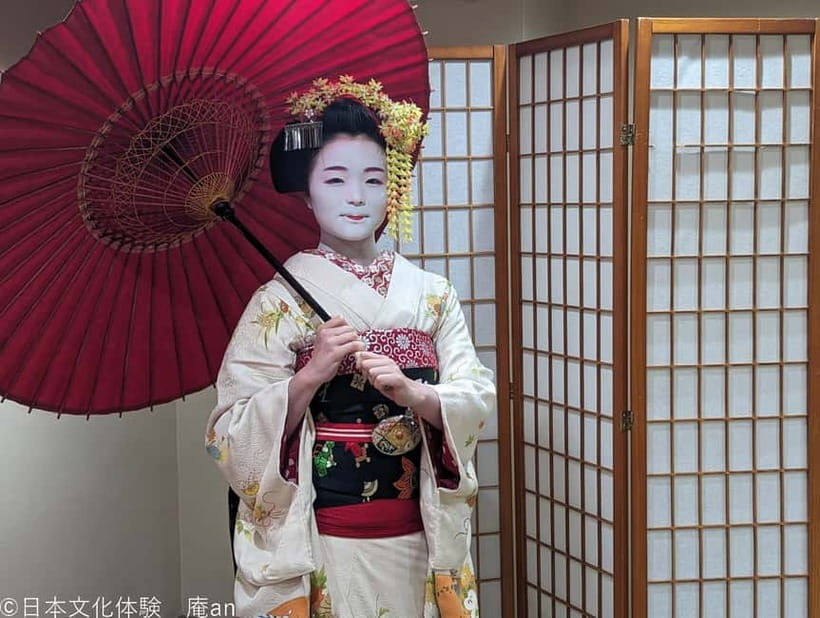
A Maiko is a young apprentice in Kyoto’s traditional entertainment world. Her appearance is carefully arranged, from the kimono and hairstyle to the makeup and accessories. The purpose of this program is not only to show you a costume. It gives you a chance to ask how this demanding traditional lifestyle works today.
The presentation also puts Maiko culture in a wider frame. Samurai culture is no longer part of daily Japanese life, but the Maiko tradition continues. You see how dance, hospitality, tea etiquette, clothing, and social customs remain connected.
I would not book this as a substitute for a history lecture. The value is personal contact. You can ask a question, hear an answer, and then see a custom performed in front of you. That direct exchange gives the details more meaning than a museum label or a short explanation in a guidebook.
Depending on the day, a Geiko may appear instead of a Maiko. Both are part of Kyoto’s traditional performance culture, but they represent different stages and roles within that world. If seeing a Maiko specifically is essential to your plans, check with the provider before booking.
The first 15 minutes: greeting and tea ceremony
The program begins with a greeting from the Maiko. This is a simple opening, but it helps set the tone. You are not expected to arrive with a special understanding of etiquette, and the staff aim to keep the atmosphere friendly rather than stiff.
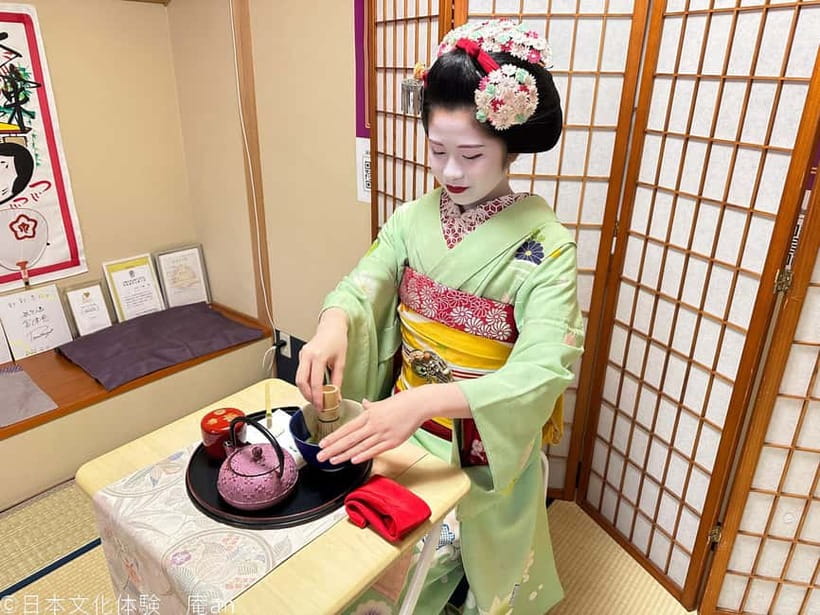
Next comes the tea ceremony demonstration. Watch the careful hand movements, the order of service, and the quiet attention given to each step. The ceremony is less about drinking a large amount of tea than about manners, timing, respect, and the beauty of ordinary actions done with care.
You should know exactly what is included here. The Maiko demonstrates the ceremony, but you do not prepare your own matcha. If making tea is your main goal, choose the Tea Ceremony with Maiko Premium program instead.
A snack and drink option costs 500 yen. The base ticket does not promise a cup of tea or a sweet, so you should add that option if having refreshments is part of your picture of a tea experience. This small detail has caused confusion for some people, and the program is better understood as a cultural presentation with a tea demonstration, not a standard hands-on tea ceremony.
The Q&A is the heart of the experience
After the tea demonstration, you get a question-and-answer session with the Maiko. This is where the program moves beyond watching. You can ask about her daily routine, her kimono, hairstyle, training, work, and the customs surrounding her role.
The answers will depend on the Maiko present and the translation available, but the format gives you something many performances do not: a chance to shape the conversation. If you are curious about how long dressing takes, how traditional dances are learned, or what a typical working day feels like, this is the moment to ask.
English assistance is offered as much as possible, but the instructor language is Japanese. I recommend preparing a few short questions in advance and contacting the provider if you want translation support. Short, focused questions are likely to work better than a long list of complicated cultural topics.
This part also suits people who have already attended a tea ceremony. If you have done a hands-on tea activity elsewhere, the Simple Plan lets you spend more of your time learning about Maiko and Geiko culture instead of repeating the same tea-making lesson.
A completely different side of Kyoto:
- PERFECT KYOTO 1-Day Bus Tour
★ 5.0 · 13,518 reviews - Kyoto: Fushimi Inari, Kinkakuji, Bamboo Grove 1 Day Bus Tour
★ 4.8 · 4,316 reviews - Kyoto: Tea Ceremony in a Traditional Tea House in Kiyomizu
★ 4.9 · 3,519 reviews - Kyoto: Tea Ceremony Ju-An at Jotokuji Temple
★ 4.9 · 3,207 reviews
Photos, Senjafuda, and a personal keepsake
The photo opportunity follows the Q&A. You can take a commemorative picture standing beside the Maiko, giving you a more personal memento than a photograph of a performance from across a room.
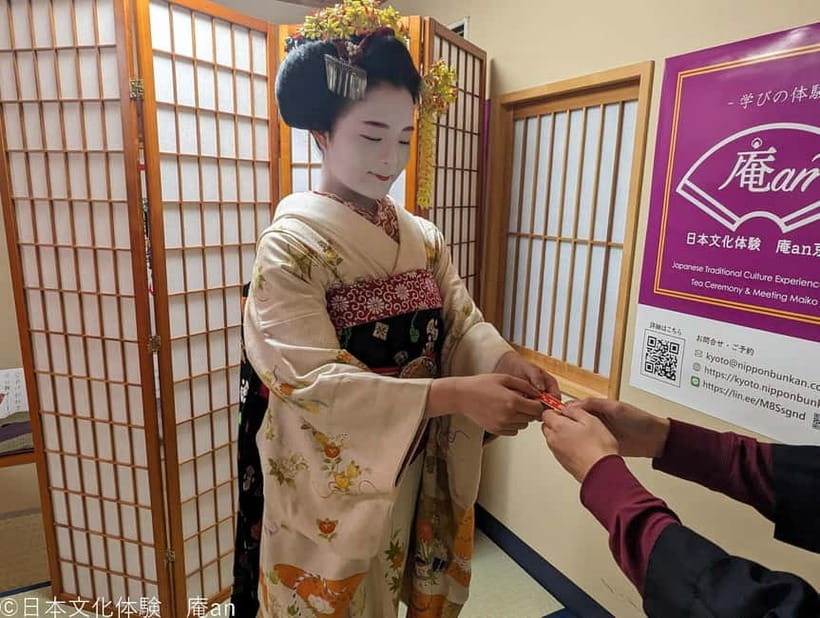
You also receive a Senjafuda. This is a small paper charm associated with good luck and traditional Japanese culture. It is a thoughtful keepsake because it connects the photo to the experience itself, rather than leaving you with only a phone picture.
The program does not specify the exact camera arrangement or how many photos you receive, so keep your expectations sensible. The key point is that you get a close photo opportunity beside the performer. Those who do not participate in the experience are not allowed to enter, so everyone in your party who wants to come inside needs to be included in the reservation.
Two dances, with seating worth thinking about
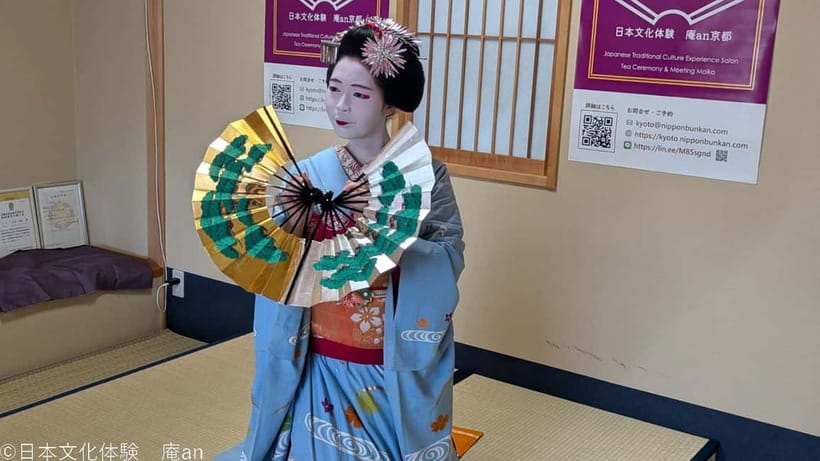
The Maiko then performs two traditional dances. The dances may express the seasons, a love story, or scenes from everyday life. Even without knowing every symbolic movement, you can appreciate the control, posture, fan work, and quiet precision.
This is the most visually striking part of the program, but the room layout matters. Tables covered with red cloth can interfere with the view, particularly for people seated farther back. The program offers paid seating upgrades:
- SS seat, first row: 3,300 yen
- S2 seat, second row: 2,200 yen
- S3 seat, third row: 1,100 yen
The $38 basic price is appealing, but a front-row upgrade can change the final cost sharply. If seeing the dance clearly is your top priority, consider the seating option when you book. If you mainly want the conversation and photo, the standard fare may be better value.
The room is not a theater built around a raised stage. That helps explain why table placement and distance can affect sightlines. I would arrive with realistic expectations: this is a close cultural gathering in a building, not a polished stage production with perfect visibility from every chair.
The game brings the room together
After the dance, the Maiko leads an interactive game. Volunteers can join, and the rest of the room claps and cheers. The activity is meant to be simple and lively, with the Maiko showing the skill that comes from professional hospitality.
You do not have to volunteer. Watching can be just as amusing, especially if you are shy or unsure about participating. Still, if you want the most interactive version of the experience, be ready to raise your hand early. The program may invite participants rather than having every person take a turn.
This game is a useful change of pace. The tea demonstration asks you to watch quietly, and the dances reward close attention. The game lets you laugh, cheer, and feel involved. It also gives the Maiko a chance to show a different side of her work: quick reactions, good humor, and the ability to make a room feel connected.
The final 15 minutes after the Maiko leaves
At about 75 minutes, the formal program ends and the Maiko leaves the room. You then have roughly 15 minutes of chatting time before leaving the venue at the 90-minute mark.
That closing period may be useful for clarifying something you heard earlier or asking staff about the performance. It is not another formal session with the Maiko, so do not book this expecting an additional private conversation after the main program.
The schedule is structured and compact:
- Greeting from the Maiko
- Tea ceremony demonstration
- Q&A session
- Photo opportunity
- Senjafuda presentation
- Two-dance performance
- Interactive game
- Chatting time after the Maiko leaves
The 90-minute length works well for a busy Kyoto itinerary. You receive several different elements without giving up half a day. It also means each part is fairly focused. If you want a long, slow tea ceremony or extended private conversation, a premium or more specialized program may suit you better.
Is $38 good value?
At $38 per person, the Simple Plan is a reasonably priced introduction to Maiko culture. You receive a live tea demonstration, direct questions, a photo, a Senjafuda charm, two dances, and a game. The Q&A is especially important because it turns the event into more than a performance.
The price is less attractive if you expect refreshments, hands-on tea preparation, or guaranteed front-row seating. Add the 500-yen snack and drink option, and perhaps a seating upgrade, and your total can rise quickly.
I would compare the cost with your main purpose. For an affordable first look at Maiko culture, the standard ticket makes sense. For the best dance view, budget for the S3, S2, or SS seat. For making matcha, skip this plan and select the Premium version instead.
The program can also be held while other people are having lunch or dinner. That may affect the atmosphere and is worth knowing before you book. You are not necessarily entering a private room devoted only to your group.
Who should book this Kyoto experience?
I would recommend it to you if you want a direct introduction to Maiko culture, especially if you value conversation over a long formal ceremony. It suits first-time visitors who want to see traditional dance, ask questions, and take a photo without committing to an expensive evening in a Kyoto entertainment district.
It is also a good fit if you have already attended a tea ceremony. The Simple Plan avoids repeating the hands-on tea-making portion and puts more attention on the Maiko’s life and performance.
Families can join, but children under two are free only when sitting on a parent’s lap. If a seat or meal is required, the adult fee applies. The event may be enjoyable for older children who can watch quietly and follow the game, but the supplied information does not specify a child-focused format.
The activity is listed as wheelchair accessible, yet the building has no elevator and you must use stairs to reach the venues. Contact the provider before booking if you use a wheelchair or have difficulty with stairs. That detail needs personal confirmation because the access information is not fully clear.
Practical booking advice for Gojo
The venue operates from 10:00 to 17:00. Reservations received after 17:00 are processed the next day, so do not expect an evening reply if you send a question late at night.
The meeting point is especially easy to reach: Exit 1 of Gojo Station, then about one minute on foot. The entrance faces Gojo-dori. Allow enough time to find the building and settle in, but you do not need a long transfer from the station.
Cancellation is free up to eight days in advance for a full refund. After that point, a cancellation fee applies regardless of the reason, and changing the date or time after a fee has been incurred can bring another specified charge. The provider does not cover your travel expenses if the booking is canceled, so check the policy carefully before committing.
English translation can be added as much as possible when requested. Since the instructor language is Japanese, I would make that request during booking rather than waiting until you arrive.
Should you book Simple Plan with Maiko?
Book it if you want close contact, questions, and a reasonable price more than a full tea ceremony setting. The strongest reasons are the direct Q&A, the two dances, the photo beside the Maiko, and the playful game. Together, they give you a broad 90-minute look at a living Kyoto tradition.
Skip it if you expect to make matcha, receive complimentary refreshments, or sit in a traditional ochaya. You should also think twice about the standard seating if clear views of the dancing are essential, since the room arrangement may make the back rows less comfortable.
For many visitors, this is a practical middle choice: more personal than a theater performance, less costly and less formal than a premium tea ceremony. Add the snack or a better seat only when those details matter to you. Otherwise, the basic $38 plan gives you a focused way to meet a Maiko and leave Kyoto with a better understanding of the culture behind the makeup, kimono, music, and dance.
FAQ
Where is Simple Plan with Maiko held?
It is held in Honshu, Japan, at a venue one minute from Exit 1 of Gojo Station on Kyoto’s Subway Karasuma Line. The entrance faces Gojo-dori.
How long does the experience last?
The full experience lasts 90 minutes. The formal program ends at about 75 minutes, followed by chatting time before room departure at 90 minutes.
Does the program include making matcha?
No. The Maiko demonstrates a tea ceremony, but you do not make your own matcha. Choose the Tea Ceremony with Maiko Premium program if you want to prepare tea yourself.
Can I ask the Maiko questions?
Yes. A question-and-answer session is included, and English translation is provided as much as possible. Contact the provider in advance if you would like English support added.
Can I take a photo with the Maiko?
Yes. The program includes a photo opportunity beside the Maiko. You also receive a Senjafuda lucky charm.
Is a Maiko guaranteed to appear?
Depending on the situation, a Geiko may be invited instead of a Maiko.
Are food and drinks included?
No. A snack and drink option is available for 500 yen, but it is not included in the basic price.
Can I pay for a better seat?
Yes. First-row SS seats cost 3,300 yen, second-row S2 seats cost 2,200 yen, and third-row S3 seats cost 1,100 yen.
Is the venue wheelchair accessible?
The activity is listed as wheelchair accessible, but the building has no elevator and stairs are required to reach each venue. Contact the provider before booking to discuss your needs.
Recently added around Kyoto
- Higashiyama | Kyoto: Sakura Season Private Rickshaw Tour★ 5.0 · 3 reviews
- Kyoto Kimono Rental CHAMATSU|Kimono/Yukata Rental FamilyPlan★ 5.0 · 3 reviews
- Kyoto: Half-Day Private Guided Tour to the Old Town of Gion★ 4.4 · 3 reviews
- Nara Private Customizable Half Day Tour★ 5.0 · 3 reviews
- Kansai Region Hiking Adventure in Nara Kobe Kyoto and More★ 5.0 · 3 reviews
- Full Day Nara Deer, Temple, Shrine, Activities & Tea Ceremony★ 5.0 · 3 reviews
- Nara: Essential Private Tour with Deer Park and Temples★ 5.0 · 3 reviews
- Hiking Tour for Sacred Sites in Kyoto with a Guide★ 5.0 · 3 reviews
Gion Geisha District Tours, compared.

Kyoto Geisha Walking Tour: Gion District & Hidden Gems
Read our review →
Gion Magical Night Walking Tour with Geisha Trivia
Read our review →
Gion Geisha District Walking Tour – Stories of Geisha
Read our review →
Best of Kyoto: Gion, Geisha, Pagodas & Cobblestones
Read our review →

Kyoto Night Foodie Tour in Gion (9+ dishes + 6 Sake tastings)
Read our review →
Kyoto Gion Geisha District Walking Tour – The Stories of Geisha
Read our review →
Kyoto Gion: 2-Hour Geisha Culture & History Walking Tour
Read our review →Browse the lists this tour appears in