
REVIEW · NARA DAY TRIPS
Nara 8hr Private Tour – Kyoto DEP. with Licensed Guide
Nara’s appeal is wonderfully simple: enormous Buddhist temples, forest shrines, old merchant streets, and deer wandering freely through the park. This private day trip lets you choose three or four sights instead of racing through every famous stop, and guides such as Taku, Junichi, Ken, Yuka, and Haru have shaped days around family interests, architecture, food, and history.
I like the personal itinerary and the fact that a licensed guide handles the route, trains, and cultural background. I also like the chance to go beyond Tōdaiji and the deer, perhaps to Horyu-ji, Yakushiji, Isuien Garden, or Naramachi. The catch is that transport, meals, admission, and your guide’s entry fees are not included, and eight hours of walking can feel long in Nara’s heat or rain.
In This Review
- Key points to know before booking
- Why Nara deserves a full day from Kyoto
- Tōdaiji and the Great Buddha
- Nara Park and the deer
- Kasuga Taisha and the forest approach
- Naramachi, where old Nara becomes everyday Nara
- Horyu-ji for serious early Buddhist history
- Wakakusayama Hill and broad views over Nara
- Kofuku-ji and the changing temple district
- Gardens and quieter choices
- How the private format changes the day
- Price, walking, and what you still pay
- Who should book this Nara day?
- Should you book it?
- FAQ
- How long does the tour last?
- How many places can I visit?
- Is transportation included?
- Are admission tickets included?
- Does the tour include lunch?
- Is this a private tour?
- Can I cancel for a full refund?
Key points to know before booking
- Three or four stops are chosen for your group, so you can build the day around temples, gardens, old streets, or family interests.
- Tōdaiji and Nara Park make a strong first visit, with the Great Buddha and free-roaming deer in the same broad area.
- Horyu-ji changes the pace, offering one of Japan’s oldest Buddhist temple complexes, but it takes you away from central Nara.
- The tour is private, so the guide can slow down, add local food stops, or adjust the day to your walking pace.
- You walk and pay transport costs separately, with no private vehicle included.
- The guide quality is central to the experience, and named guides praised for clear explanations include Taku, Junichi, Ken, Masaaki, Yuka, Haru, and Rie.
Why Nara deserves a full day from Kyoto
Kyoto gives you elegant gardens, wooden lanes, and famous temples. Nara offers a different kind of day. It was Japan’s capital during much of the Nara Period, from 710 to 794, and its major Buddhist sites are tied to the early development of Japanese religion, government, art, and architecture.
The city is close enough to Kyoto and Osaka for a day trip, yet its main sights feel spread out enough that planning matters. You can spend the morning around Tōdaiji and Nara Park, then walk through Naramachi in the afternoon. Or you can choose a history-heavy day with Horyu-ji, Yakushiji, and Tōshōdaiji.
That flexibility is the real reason to book a private tour. You are not simply following a fixed bus route. You can tell the agency or guide what interests you, then use local advice to decide how much ground you can sensibly cover.
The tour lasts about eight hours. That sounds generous, but three or four major sites, meals, transport, photos, deer encounters, and breaks quickly fill the day. I would arrive with two priorities and one backup rather than trying to see everything on the list.
More day trips to Nara:
- World Heritage Kyoto & Nara Uji Authentic Matcha Experience
★ 5.0 · 1,573 reviews - Kyoto/Osaka: Nara, Fushimi Inari Taisha, Arashiyama Bus Tour
★ 4.7 · 1,275 reviews - Nara Half Day Trip Walking Tour (Private Option Available)
★ 5.0 · 937 reviews
Tōdaiji and the Great Buddha
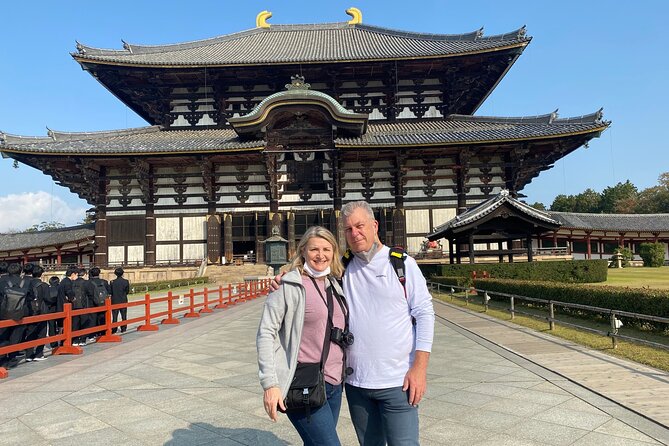
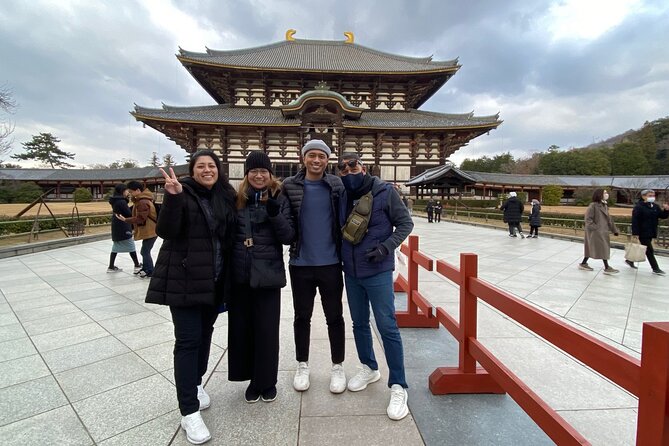
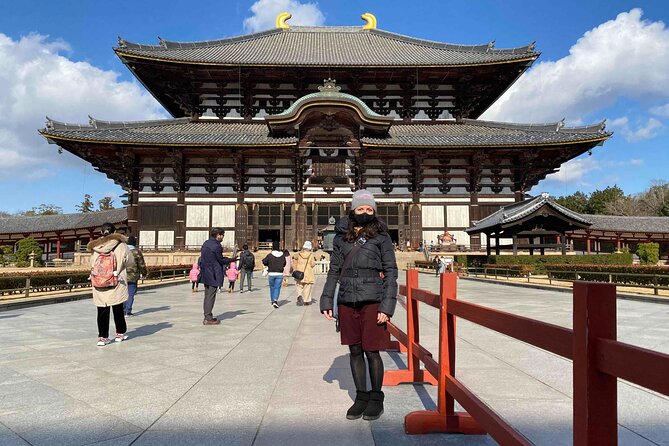
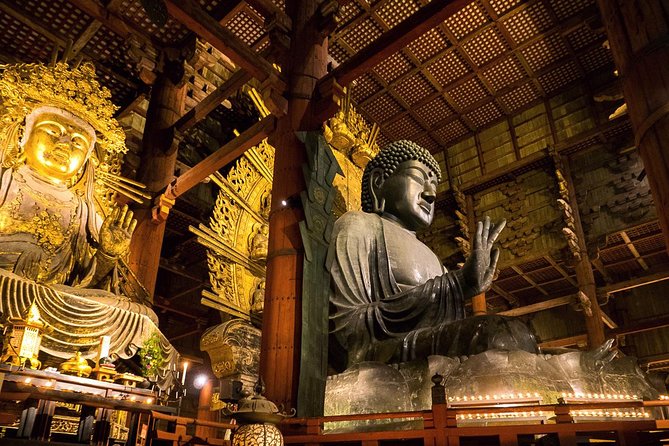
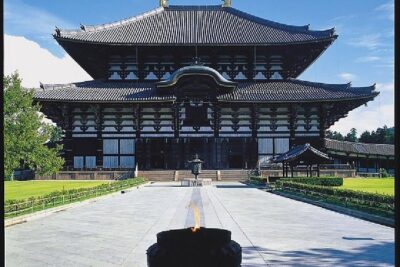
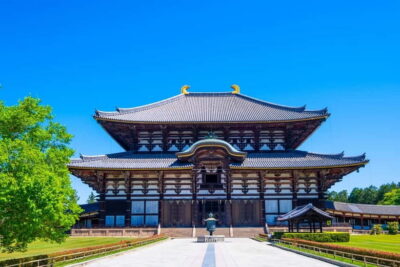
Tōdaiji, meaning Great Eastern Temple, is the natural centerpiece of a first Nara visit. The temple was built in 752 as the head temple for provincial Buddhist temples, and its Great Buddha Hall contains the enormous bronze Vairocana Buddha.
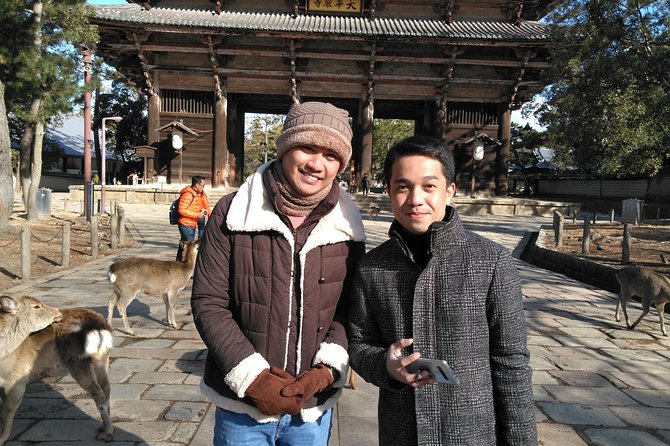
The scale is what you notice first. The approach through the Nandaimon Gate prepares you for the huge hall ahead, while the Buddha gives the visit its quiet center. A guide can explain why the temple mattered to the Nara capital and how Buddhism was linked to the early Japanese state.
Plan for crowds here, especially during school excursions, holidays, and Golden Week. One family found the school groups interesting but had less time to look closely at the Buddha. That is a useful warning: Tōdaiji is worth seeing, but you may need patience around the main hall.
Admission to Tōdaiji is not included for you, although the guide’s entry fees are covered for sights listed in the tour information. Confirm the current ticket cost and exact meeting arrangements before the day begins.
A small detail adds fun to the visit. Inside the Great Buddha Hall, a hole in one of the large pillars is said to match the size of the Buddha’s nostril. Children and adults line up to crawl through it, with the tradition linking the act to good fortune and academic success.
Nara Park and the deer
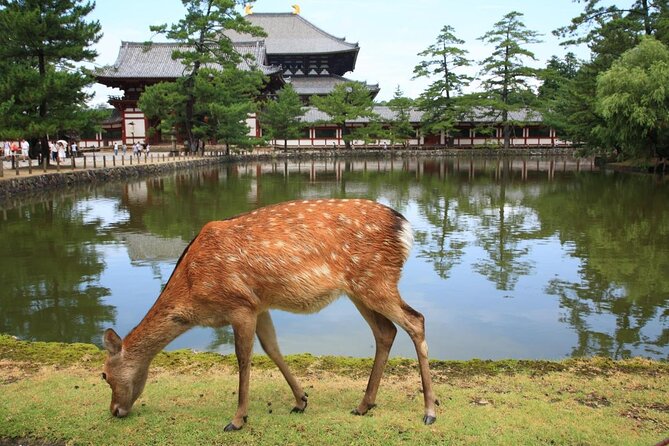
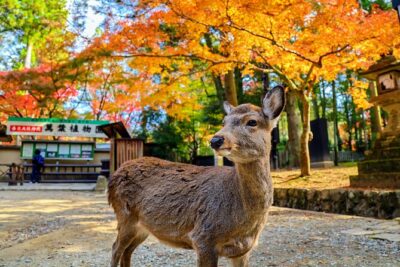
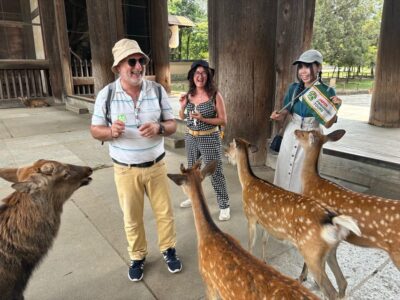
Nara Park was established in 1880 and contains several of the city’s best-known sights. Its deer wander freely between temple grounds, paths, trees, and open areas, making the park more than a quick photo stop.
The deer are a major reason families enjoy this outing. You may feed them special crackers, and they often bow in response. The encounters are memorable, but remember that these are still animals. Keep food visible only while you are feeding them and follow the guide’s advice.
Nara Park also gives the day breathing room after the enclosed spaces of temple halls. You can walk beneath trees, watch the deer, and move between Tōdaiji, Kasuga Taisha, and nearby gardens without needing a complicated plan.
The drawback is weather. Summer heat and humidity can make the walking tiring, and rain can continue for much of the day. Comfortable shoes, water, and a willingness to shorten the route are sensible. The private format helps here because your guide can adjust the pace instead of keeping to a large group schedule.
Kasuga Taisha and the forest approach
Kasuga Taisha is Nara’s best-known Shinto shrine. It was founded when the capital was established and is dedicated to the deity associated with protecting the city.
The approach is part of the experience. Stone lanterns line the way through wooded areas, creating a marked contrast with the open park and the massive geometry of Tōdaiji. At the shrine, you can see the continuing relationship between Shinto worship, sacred nature, and Nara’s old capital.
Some itineraries also include Wakamiya Shrine, a sub-shrine of Kasuga Taisha, or Tamukeyama Hachiman Shrine near Tōdaiji. These smaller stops can be a good choice if you prefer quiet spaces to another major hall.
Kasuga Taisha works well with Tōdaiji and Nara Park because all three can be combined in a central Nara day. Still, the walking is real. The route includes paths and gentle uphill sections, so tell your guide if anyone in your group has sore feet or limited stamina.
A few more Kyoto experiences worth comparing
- Fushimi Inari Hidden Hiking Tour (Private Option Available)
★ 5.0 · 1,750 reviews - Private Kyoto Tour with a Local, Highlights & Hidden Gems, Personalised
★ 5.0 · 1,543 reviews - Kyoto 6hr Private Tour with Government-Licensed Guide
★ 5.0 · 1,369 reviews - 10 Must-see Spots in Kyoto One Day Private Tour (up to 7 people)
★ 5.0 · 1,108 reviews
Naramachi, where old Nara becomes everyday Nara
Naramachi is the former merchant district, with preserved homes, warehouses, small shops, cafes, and traditional buildings. It offers a useful change after the grand religious sites.
Here you see how people lived and worked rather than only how emperors and religious institutions shaped Nara. Traditional homes may include tatami rooms, alcoves, and staggered shelves. Nigiwai-no-Ie is one example of a traditional house open for visitors.
This is also a good place to ask your guide about local food and modern Nara. Guides such as Taku have added sake tasting, shaved ice, cafes, and downtown stops to a temple-focused day. Junichi, who was born and raised in Nara, has also helped visitors find suitable tofu restaurants and explain the city through local connections.
Naramachi is especially useful for groups with mixed interests. One person can enjoy architecture, another can browse shops, and children can take a break from formal temple visits. The free entry listed for the district does not mean every shop, museum, or activity has no charge, so keep personal spending separate.
Horyu-ji for serious early Buddhist history
Horyu-ji is the strongest choice for visitors who care about ancient architecture and Buddhist art. Prince Shotoku founded it in 607, and it contains some of Japan’s oldest wooden structures, including what is described as the world’s oldest wooden building.
The temple lies outside the central cluster of Nara sights. That makes it harder to combine with a relaxed Tōdaiji, Kasuga Taisha, and Naramachi day, but it can be the highlight if early Japanese history is your main interest.
One carefully planned day placed Horyu-ji first, followed by Nara Park and Tōdaiji. The guide’s route planning made it possible to fit in a lot, but the schedule was tight. That is the tradeoff. Choose Horyu-ji if you would rather study an exceptional site than linger over deer, lunch, and old-town streets.
Admission is not included. Allow extra time for transport and walking, and discuss the order of stops with your guide before setting out.
Wakakusayama Hill and broad views over Nara
Mount Wakakusayama rises behind Nara Park between Tōdaiji and Kasuga Taisha. The grass-covered hill reaches about 350 meters and offers open views over Nara.
This is a scenic option when you want fresh air and a break from temple interiors. It also gives you a different sense of the city’s layout, with the park and historic center spread below.
The hill is not the automatic choice for every group. Its admission is not included, and an uphill walk may be a poor fit after several hours on foot. If views matter to you and the weather is clear, it can be worthwhile. If your group includes young children, older adults, or anyone tired from Kyoto sightseeing, use the customization to choose a gentler stop.
Kofuku-ji and the changing temple district
Kofuku-ji was the family temple of the Fujiwara clan, one of the most powerful aristocratic families during the Nara and Heian periods. Its five-story pagoda and Tōkondō Hall give you a strong look at Japanese temple architecture.
Kofuku-ji works well as part of a central Nara route. It is close to Nara Park and Naramachi, so it does not consume the same travel time as Horyu-ji or the temples farther west.
The site also helps explain that Nara is not only about one giant Buddha. The city developed through networks of temples, shrines, aristocratic families, court politics, and religious traditions. Admission to listed temple interiors is separate, so ask your guide which areas are included in your chosen plan.
Gardens and quieter choices
Isuien Garden is a refined choice for a slower afternoon. It uses Tōdaiji’s Nandaimon Gate and Mount Wakakusayama as borrowed scenery, a classic Japanese garden technique in which distant features become part of the composition.
Yoshikien is another pleasant garden near central Nara, named for the Yoshikigawa River beside it. These gardens suit you if you want carefully framed views, water, plants, and quiet paths instead of another large temple complex.
Yakushiji offers something more formal. Built in the late seventh century for the recovery of Emperor Tenmu’s sick wife, it has a strictly symmetrical layout and an East Pagoda first built more than 1,300 years ago. Tōshōdaiji, founded in 759 by the Chinese priest Ganjin, adds another important chapter in the development of Japanese Buddhism.
Shin-Yakushiji, founded during the Nara Period for an ailing emperor, is devoted to Yakushi Buddha, the Buddhist patron of medicine. These sites are less obvious choices for a first-time visitor, but they are excellent for repeat visitors or anyone who has already seen the central sights.
How the private format changes the day
A private guide is most useful when your group has a clear interest. You can request an architecture-focused route, a family-friendly day, gardens and old streets, or a broad introduction to Nara’s Buddhist and Shinto traditions.
Guides named in the feedback include Taku, Junichi, Ken, Masaaki, Yuka, Haru, Rie, Hiro, Naomi, Momoyo, Ichiro, and Lily. Their strengths vary. Taku is repeatedly associated with clear English, maps, flower identification sheets, jokes, sake tasting, and attention to tired feet. Junichi is a Nara local who has tailored routes around history, religion, tofu, and personal interests. Ken has designed days around teenagers and explained the links between temples, monuments, and Japanese culture.
Masaaki is a particularly good match for visitors focused on history and architecture. Yuka has adjusted routes to include Yakushiji, even though it is outside the most popular central route. Haru has been praised for careful communication before the tour and strong historical explanations.
The agency assigns your guide after booking, so you cannot assume you will receive a particular person. If guide fit matters to you, contact the provider and state your interests clearly. A guide’s licensed status does not guarantee a perfect accent or communication style, and one poor experience involved serious difficulty understanding English. That is not the typical pattern in the supplied feedback, but it is a fair point to keep in mind.
Price, walking, and what you still pay
At $201.51 per person, this is not the cheapest way to reach Nara. The value comes from private planning and interpretation rather than bundled transport or admission.
You pay separately for transportation, entrance fees, lunch, and personal expenses. There is no private vehicle. The tour is described as a walking tour, with an on-foot meeting within a designated Kyoto area, although some guide accounts describe hotel pickup and return arrangements. Confirm the exact pickup point and whether any hotel collection is available for your booking.
For a couple or small family, the price can make sense if you want a tailored day and would otherwise lose time navigating several temple districts. It is less attractive if you are comfortable using trains, choosing only Tōdaiji and Nara Park, and reading site information on your own.
Group discounts may improve the per-person cost. You cannot combine separate tour groups, and only your own party participates.
Who should book this Nara day?
I would choose this tour if you want historical context, help with public transport, and the freedom to shape the day. It suits families, first-time visitors, older couples who need a flexible pace, and repeat Japan visitors who want sites such as Yakushiji, Horyu-ji, Isuien, or Tōshōdaiji.
It is also a good fit if you want to understand the difference between Buddhist temples and Shinto shrines. Several guides have made that connection a major part of the day, rather than simply naming buildings and dates.
I would skip it if your budget is tight, you dislike walking, or you want a fixed all-inclusive vehicle tour. You should also avoid overloading the itinerary. Three well-chosen sites will usually give you more time to look, ask questions, eat, and enjoy Nara than four distant sites squeezed into one day.
Free cancellation is available up to 24 hours before the start time. Confirmation is sent within 48 hours, subject to availability, and most people can participate. Service animals are allowed, and the meeting area is near public transportation.
Should you book it?
Book this tour if you see Nara as more than a deer park and want a guide to connect temples, shrines, gardens, old homes, and the city’s role as Japan’s early capital. The strongest value is the customized route and the guide’s ability to explain what you are seeing in clear, human terms.
Before booking, send your top two priorities, mention anyone with limited walking stamina, and ask about the meeting point, transport costs, and entrance fees. For a first visit, Tōdaiji, Nara Park, Kasuga Taisha, and Naramachi make the most balanced plan. Choose Horyu-ji or the western temples instead if ancient architecture matters more than a relaxed central route.
FAQ
How long does the tour last?
The tour lasts approximately eight hours.
How many places can I visit?
You choose three to four sites from the available attractions, with the route customized to your interests.
Is transportation included?
No. Transportation fees are not included, and no private vehicle is provided. The experience is described as a walking tour with an on-foot meeting in a designated Kyoto area.
Are admission tickets included?
No. Your entrance fees are separate. The guide’s entry fees are covered only for sights listed under the tour’s expected attractions.
Does the tour include lunch?
No. Lunch and other personal expenses are not included.
Is this a private tour?
Yes. Only your group participates, and you cannot combine multiple tour groups.
Can I cancel for a full refund?
Yes, if you cancel at least 24 hours before the experience start time. Cancellations or changes made less than 24 hours in advance are not accepted for a refund.
Recently added around Kyoto
- Higashiyama | Kyoto: Sakura Season Private Rickshaw Tour★ 5.0 · 3 reviews
- Kyoto Kimono Rental CHAMATSU|Kimono/Yukata Rental FamilyPlan★ 5.0 · 3 reviews
- Kyoto: Half-Day Private Guided Tour to the Old Town of Gion★ 4.4 · 3 reviews
- Nara Private Customizable Half Day Tour★ 5.0 · 3 reviews
- Kansai Region Hiking Adventure in Nara Kobe Kyoto and More★ 5.0 · 3 reviews
- Full Day Nara Deer, Temple, Shrine, Activities & Tea Ceremony★ 5.0 · 3 reviews
- Nara: Essential Private Tour with Deer Park and Temples★ 5.0 · 3 reviews
- Hiking Tour for Sacred Sites in Kyoto with a Guide★ 5.0 · 3 reviews
Nara Day Trips, compared.
World Heritage Kyoto & Nara Uji Authentic Matcha Experience
Read our review →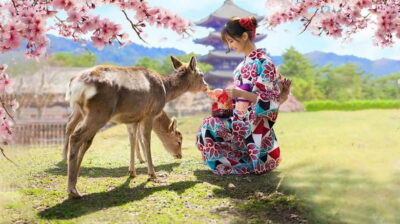
Kyoto/Osaka: Nara, Fushimi Inari Taisha, Arashiyama Bus Tour
Read our review →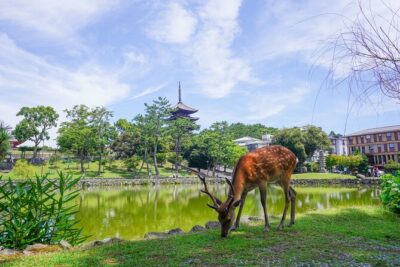
Nara Half Day Trip Walking Tour (Private Option Available)
Read our review →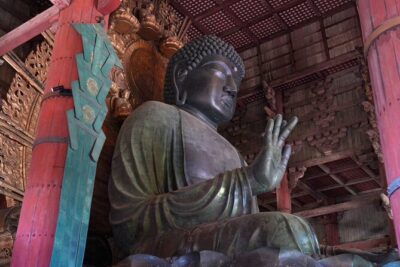
Nara Early Morning Tour (Kyoto or Osaka Departure Available)
Read our review →
Kyoto/Osaka: Kinkakuji, Bamboo Forest, and Nara Deer Park
Read our review →Browse the lists this tour appears in