
REVIEW · GION GEISHA DISTRICT TOURS
Kyoto: Gion Geisha District & Sake-in-Hand Walking Tour
Kyoto after dark is the star here. Lantern-lit lanes, wooden machiya houses, quiet shrine grounds, and the occasional glimpse of a geiko create a very different mood from daytime sightseeing. This tour gives you a simple way to enter Gion without fumbling over a map, while a guide explains what you are seeing and pours tastes of Japanese sake along the way.
I like the small group limit of 10, which should make it easier to ask questions and keep the walk personal. I also like the route itself: it links Gion with Yasaka Shrine, Yasaka Pagoda, Ninenzaka, Sannenzaka, and Nene-no-Michi rather than stopping after one famous street.
The main caution is that this is a walking tour first and a cultural talk second. One participant found the guide interaction too limited, and another felt the 70-minute finish was short of the advertised 90 minutes. If you want a highly structured lecture or a long sake session, this may feel light.
In This Review
- Key points to know before booking
- Why Gion works best after sunset
- Starting near the Kamo River
- Gion and Hanamikoji Street
- Yasui-Konpiragu and the meaning of the shrine
- Hokan-ji Temple and the Yasaka Pagoda view
- Ninenzaka and Sannenzaka: beautiful, steep, and busy
- Nene-no-Michi and the quieter side of Higashiyama
- Sake in hand, with sensible expectations
- Finishing at Yasaka Shrine
- Group size, timing, and physical effort
- Is $27.84 good value?
- Who should book this evening walk?
- FAQ
- How long does the Gion and sake walking tour last?
- Where does the tour start?
- Where does the tour finish?
- Is sake included in the tour price?
- How old must I be to join?
- How many people can join the group?
- How much walking is involved?
- What happens if the weather is poor?
Key points to know before booking

- Lantern-lit Gion is the main attraction: The evening setting gives Hanamikoji Street and the side lanes a quiet, cinematic feel.
- The route covers several major sights: You’ll see Gion, Yasui-Konpiragu, Hokan-ji Temple, the Ninenzaka and Sannenzaka slopes, Nene-no-Michi, and Yasaka Shrine.
- Sake is included: The experience includes a local sake tasting, and some departures have offered several styles from different parts of Japan.
- Guides shape the experience: Shumpei and Mune are among the guides associated with the tour, with the strongest praise going to friendly, conversational guiding.
- It is short but physically active: The tour lasts about one to one and a half hours, yet includes plenty of walking on stone streets and through residential areas.
- You must be at least 20: Alcohol is part of the experience, so responsible drinking is required.
Why Gion works best after sunset
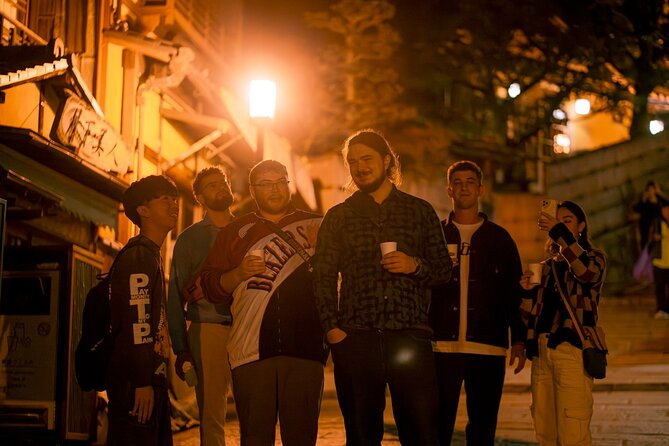
Gion can feel crowded in daylight, especially around its most photographed lanes. At night, the pace usually slows. The wooden facades take on a softer look, shrine lights replace the hard glare of the sun, and the narrow lanes feel more intimate.
That mood is a major reason to choose this tour at all. You are not simply checking off a district. You are seeing Gion at the hour when teahouse streets, lanterns, and dark timber make the area feel most distinct from modern Kyoto.
The guide also helps you understand the difference between what you see and what you may assume. Gion is linked with geisha culture, but it is not a theme park. It remains a lived-in district, with homes, businesses, and residents. The tour specifically asks you to keep your voice down in residential areas, which is sensible and important.
You may spot a geiko or maiko moving between appointments, but that should be treated as a possibility, not the promise of the tour. If you do see one, give her space, avoid blocking the lane, and follow local etiquette. The point is to learn about the culture, not turn people into street attractions.
More evenings in Gion:
- Kyoto Geisha Walking Tour: Gion District & Hidden Gems
★ 4.7 · 3,273 reviews - Kyoto: Gion Magical Night Walking Tour with Geisha Trivia
★ 4.9 · 2,393 reviews - Kyoto: Gion Geisha District Walking Tour – Stories of Geisha
★ 4.7 · 2,187 reviews
Starting near the Kamo River
The meeting point is at Kikunoi Roan in Saitocho, in Kyoto’s Shimogyo Ward. The area is near public transportation, and the route begins around the Kamo River before moving toward Gion.
The river is a fitting opening. It has long been part of Kyoto’s daily life, and its banks offer an easy contrast with the tight streets ahead. Depending on the season and light, you may see the river framed by trees and city lights. It is also a useful place to settle into the group before the walk narrows into back lanes.
Your exact starting instructions should be checked carefully after booking. The listed start and end points are not the same, and the tour finishes at Yasaka Shrine. That makes the route useful if you plan to continue around Higashiyama afterward, but less convenient if you need to return to the starting point immediately.
Gion and Hanamikoji Street
Gion is Kyoto’s best-known geisha district, with traditional wooden machiya houses, teahouses, and narrow passages. The guide’s role matters here because the visual details are easy to miss. A row of dark wooden buildings can look simple until you learn how the district functions and why these streets have been preserved.
The tour allows about 10 minutes in Gion, then another 10 minutes on Hanamikoji Street. That is not enough time for a full architectural study, but it is enough to get your bearings and hear the key stories.
Hanamikoji is one of the prettiest streets in the area. Traditional buildings line the route, and the evening light can make the street especially photogenic. The drawback is that this is a working district, not an open-air museum. Some doorways lead to private or reserved establishments, and respectful behavior is essential.
The commentary may also cover samurai culture, Zen meditation, and the place of geisha in Kyoto’s cultural life. The tour is strongest when you ask questions. Guides such as Shumpei have been praised for discussing everyday life in Japan as well as landmarks, while Mune has been noted for friendly and clear explanations. The quality of the evening will depend partly on how much conversation develops within your small group.
Yasui-Konpiragu and the meaning of the shrine

Yasui-Konpiragu Shrine receives about 15 minutes. It is known for the large Enkiri-ishi, a stone associated with cutting bad relationships and strengthening good ones.
This stop adds something beyond pretty streets. Japanese shrines often connect belief with everyday worries, and Yasui-Konpiragu gives you a direct example. People visit with hopes tied to relationships, habits, and difficult turning points. You do not need to share those beliefs to appreciate the atmosphere and symbolism.
The shrine is also a useful pause in the route. After walking through Gion’s lanes, you get a place where the guide can explain the customs behind what you are seeing. Keep in mind that shrine grounds are places of worship. Speak quietly, follow the guide’s instructions, and avoid treating the ritual space like a photo set.
More bars and sake stops in Kyoto:
- Kyoto Night Foodie Tour in Gion (9+ dishes + 6 Sake tastings)
★ 5.0 · 1,762 reviews - 3-Hour Kyoto Insider Sake Brewery Tour with Tastings & Pairings
★ 5.0 · 917 reviews - Arashiyama Bamboo, Temple, Monkeys, or Secret Sake Brewery
★ 4.8 · 886 reviews - Kyoto: Izakaya Bars Guided Walking Tour
★ 4.9 · 815 reviews
Hokan-ji Temple and the Yasaka Pagoda view
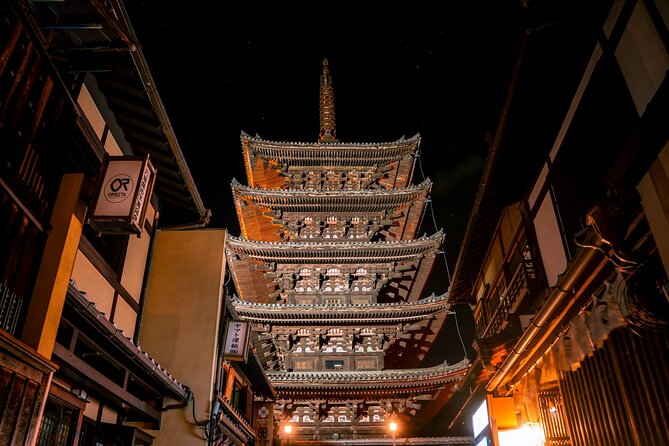
Hokan-ji Temple, better known as Yasaka Pagoda, receives about 15 minutes. Its five-story pagoda is one of Higashiyama’s most recognizable sights and dates back to the sixth century.
The pagoda is especially striking from the surrounding streets. Its height gives the tightly packed neighborhood a clear visual anchor, and the stone lanes leading toward it create some of the evening’s best photo opportunities. The tour does not promise entry into the temple, so think of this as an exterior visit and a chance to hear about the site.
This part of the walk can be busy at popular times. Stone pavement, slopes, and uneven surfaces also require steady footing. Wear shoes that you can comfortably walk in, rather than relying on fashion footwear for Kyoto’s historic streets.
Ninenzaka and Sannenzaka: beautiful, steep, and busy

The route spends about five minutes at Ninenzaka and five minutes at Sannenzaka. That sounds brief, but these lanes connect naturally with the nearby pagoda and Nene-no-Michi.
Ninenzaka and Sannenzaka are pedestrian streets lined with preserved wooden buildings, shops, and food outlets. Their gentle-to-moderate slopes are part of the charm, but they can be tiring if you have already spent the day visiting temples. The paving is not perfectly flat, so this is where the tour’s moderate fitness requirement becomes real.
Five minutes at each stop is enough for an introduction, not a shopping break. If you want time to browse every shop, return in daylight or plan another visit. The tour keeps moving so it can reach the wider route and finish at Yasaka Shrine.
The evening setting has one useful advantage: the streets may feel less crowded than during the busiest daytime hours. Still, do not expect an empty photo location. Walk carefully, keep the group together, and let residents and shop staff pass.
Nene-no-Michi and the quieter side of Higashiyama
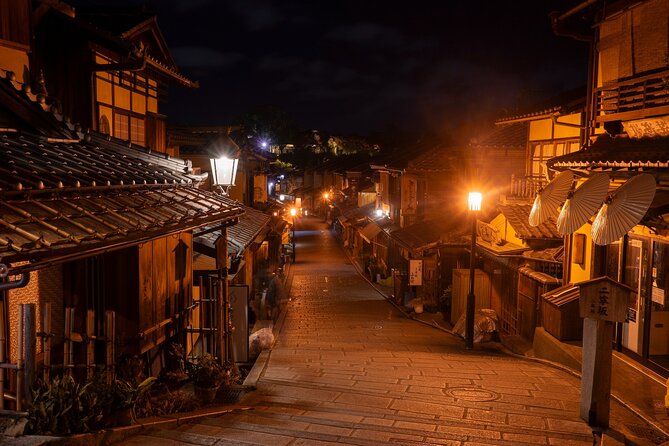
Nene-no-Michi receives about 10 minutes and offers a calmer stretch of stone-paved road. The path is named for Nene, the wife of Toyotomi Hideyoshi, and links the area around Kodaiji Temple with Maruyama Park.
This is the kind of segment that makes a guided walk worthwhile. You could find the road on a map, but a guide can explain its name and place it within Kyoto’s story. The route also gives you a break from the more photographed lanes.
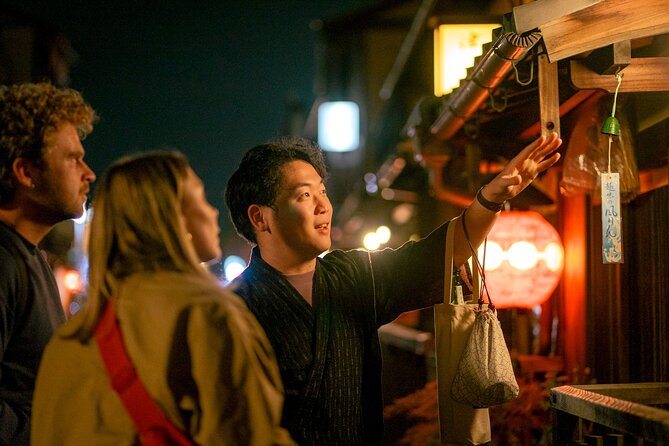
I would pay attention to the pace here. Some of the best moments may be the transitions between official stops, especially when the guide points out a small detail or answers a question about Japanese life. The experience has received strong praise when guides keep the conversation flowing. It has also disappointed people when the walk felt too quiet or under-explained.
That contrast is worth considering before you reserve. If you enjoy asking questions and noticing small details, you can help make the tour more engaging. If you prefer constant narration, ask at the start how the guide plans to handle commentary.
Sake in hand, with sensible expectations
The included sake tasting is the tour’s most unusual feature. Instead of visiting a formal brewery or sitting through a long tasting menu, you sample local sake during the evening walk.
That format is casual and social. It gives you a chance to compare flavors while seeing Kyoto’s historic streets, and it helps explain why the tour’s name emphasizes sake in hand. Some departures have featured sake from different Japanese regions, giving you more than one style to try.
You should also understand what this is not. The price is $27.84 per person, and the tour lasts about 60 to 90 minutes. At that rate, you are paying for a short guided walk with a tasting, not a full sake education or a restaurant experience. The tasting is a bonus that adds character to the route.
Alcohol and uneven streets are not the best combination if you drink too quickly. The operator requires participants to be at least 20 and asks you to drink responsibly. Keep your attention on the guide, the road, and the people around you.
Finishing at Yasaka Shrine
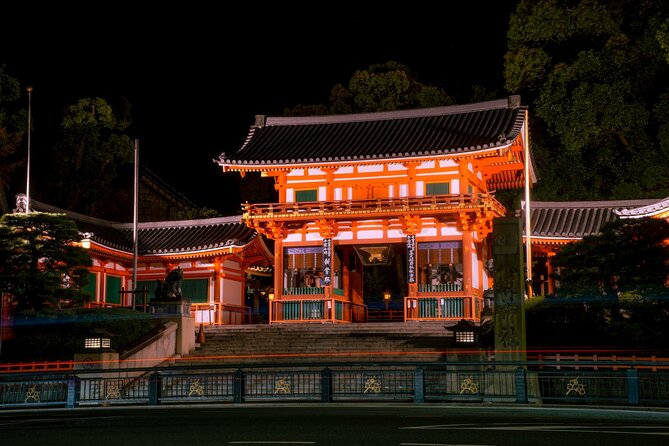
The walk ends at Yasaka Shrine, with about 20 minutes devoted to the site. Also called Gion Shrine, it dates to 656 and is closely tied to the district.
Yasaka Shrine is a strong finish because it brings together the themes of the evening: Gion, religious tradition, public life, and Kyoto after dark. Its grounds offer more room than the narrow lanes, and the illuminated structures can be lovely for photographs.
The end point is practical, too. From Yasaka Shrine, you can continue toward other Higashiyama sights or arrange a taxi. The operator notes that many buses may have stopped running by the time the tour ends, so do not assume public transportation will still be convenient. If needed, the guide can help you catch a taxi or return to the starting point.
Group size, timing, and physical effort
The maximum group size is 10 people. That is small enough for direct questions and easier movement through narrow streets. A very small departure can feel almost private, though it may also make the quality of the conversation depend heavily on the guide and the people in your group.
The advertised duration is approximately one hour to one and a half hours. Most of the route is on foot, with stone lanes, slopes, and the need to keep moving between stops. Comfortable shoes are essential, and you should avoid scheduling this immediately after an exhausting full day unless you still have energy.
The tour requires good weather. If poor weather causes cancellation, you can receive a full refund or choose another date. The same options apply if the minimum number of participants is not reached.
You can cancel for a full refund up to 24 hours before the start time. Changes or cancellations inside that 24-hour window are not accepted for a refund, so keep the local cut-off time in mind.
Is $27.84 good value?
For Kyoto, $27.84 is a reasonable price if you want orientation, local context, and a small sake tasting in one compact evening. The route includes several important Higashiyama sights, and the guide saves you the work of planning how Gion’s lanes connect.
The value is less clear if you only want to photograph Hanamikoji Street. You can walk through much of Gion without paying, and the short duration means the tour does not replace a full evening in Higashiyama.
I see the best value for a first night in Kyoto. The route helps you understand the shape of the area, then leaves you at Yasaka Shrine, where you can continue exploring on your own. It also suits anyone who likes a relaxed walk with conversation rather than a formal museum-style presentation.
Who should book this evening walk?
Book it if you are 20 or older, enjoy walking, want a gentle introduction to geisha culture, and like the idea of seeing Kyoto at night with a sake tasting included. It is also a good fit if you want a small group and prefer a guide who can answer questions about Japanese customs and daily life.
Think twice if you have limited mobility, dislike slopes or uneven paving, want a long tasting session, or expect a guaranteed geisha sighting. You should also choose another plan if you need a tightly timed 90-minute program, since the actual finish can be shorter.
My practical call is simple: choose this for atmosphere, orientation, and an informal introduction to Gion. Go in expecting a walking conversation rather than a full cultural course, and the price makes sense.
FAQ
How long does the Gion and sake walking tour last?
The tour lasts approximately one hour to one and a half hours. The actual length may vary, so allow some flexibility in your evening plans.
Where does the tour start?
The meeting point is Kikunoi Roan, 118 Saitocho, Shijo-sagaru, Shimogyo Ward, Kyoto, 600-8012, Japan.
Where does the tour finish?
The tour concludes at Yasaka Shrine, 625 Gionmachi Kitagawa, Higashiyama Ward, Kyoto, 605-0073, Japan.
Is sake included in the tour price?
Yes. A local sake tasting is included. Alcohol should be consumed responsibly.
How old must I be to join?
Participants must be at least 20 years old because the experience includes alcohol.
How many people can join the group?
The maximum group size is 10 people.
How much walking is involved?
The tour involves a lot of walking through narrow streets, stone-paved lanes, slopes, shrines, and temple areas. A moderate level of physical fitness is recommended, and comfortable shoes are important.
What happens if the weather is poor?
The experience requires good weather. If it is canceled because of poor weather, you can receive a full refund or choose a different date.
More Walking Tours in Kyoto
- Night Walk in Gion: Kyoto’s Geisha District
★ 4.5 · 2,003 reviews - Kyoto Gion Geisha District Walking Tour – The Stories of Geisha
★ 5.0 · 1,441 reviews - Nishiki Market Brunch Walking Tour (7 Tastings + Brunch)
★ 5.0 · 1,355 reviews - Kyoto Arashiyama Walking Tour: Bamboo, Monkeys, Gardens & Secrets
★ 5.0 · 1,216 reviews
More Food Tours in Kyoto
- Kyoto: Insider Sake Brewery Tour with Sake and Food Pairing
★ 5.0 · 704 reviews - Kyoto Sake Brewery & Tasting Walking Tour
★ 5.0 · 623 reviews - Kyoto Nishiki Market Food and Culture Walking Tour
★ 5.0 · 412 reviews - Kyoto: Gion Food Tour 13 Dishes at 4 Eateries
★ 5.0 · 408 reviews
Recently added around Kyoto
- Higashiyama | Kyoto: Sakura Season Private Rickshaw Tour★ 5.0 · 3 reviews
- Kyoto Kimono Rental CHAMATSU|Kimono/Yukata Rental FamilyPlan★ 5.0 · 3 reviews
- Kyoto: Half-Day Private Guided Tour to the Old Town of Gion★ 4.4 · 3 reviews
- Nara Private Customizable Half Day Tour★ 5.0 · 3 reviews
- Kansai Region Hiking Adventure in Nara Kobe Kyoto and More★ 5.0 · 3 reviews
- Full Day Nara Deer, Temple, Shrine, Activities & Tea Ceremony★ 5.0 · 3 reviews
- Nara: Essential Private Tour with Deer Park and Temples★ 5.0 · 3 reviews
- Hiking Tour for Sacred Sites in Kyoto with a Guide★ 5.0 · 3 reviews
Gion Geisha District Tours, compared.

Kyoto Geisha Walking Tour: Gion District & Hidden Gems
Read our review →
Gion Magical Night Walking Tour with Geisha Trivia
Read our review →
Gion Geisha District Walking Tour – Stories of Geisha
Read our review →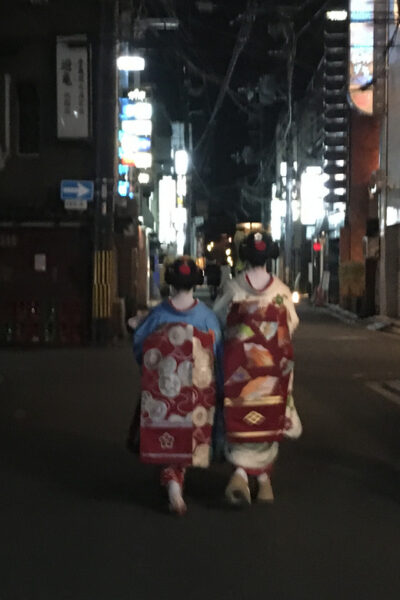
Best of Kyoto: Gion, Geisha, Pagodas & Cobblestones
Read our review →

Kyoto Night Foodie Tour in Gion (9+ dishes + 6 Sake tastings)
Read our review →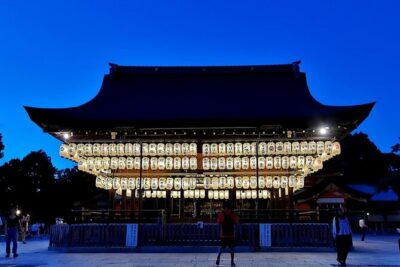
Kyoto Gion Geisha District Walking Tour – The Stories of Geisha
Read our review →
Kyoto Gion: 2-Hour Geisha Culture & History Walking Tour
Read our review →Browse the lists this tour appears in