
REVIEW · FUSHIMI INARI SHRINE TOURS
Discover the Secrets of Fushimi Inari and Gion with a Local Guide
Fushimi Inari’s long tunnel of red torii gates is the headline here, but the clever part is how this tour reaches it. You begin in Gion and work through Kyoto’s eastern temple district before finishing near the shrine, linking several major sights without wasting half a day finding your way between them.
I like the small group of no more than eight people, which gives the guide room to adjust the pace. I also like the mix of geisha-district streets, Shinto shrines, Buddhist temples, a famous pagoda, and Fushimi Inari. The main caution is simple: this is a four-hour walking tour with stairs and crowded sights, so it may feel rushed if you want long, quiet visits at every stop.
In This Review
- Key points at a glance
- Why this route makes sense in Kyoto
- Starting among Gion’s wooden streets
- Yasaka Shrine and the Shinto side of Kyoto
- Kōdaiji, a calmer temple pause
- Yasaka Pagoda and the Higashiyama photo stop
- Kiyomizu-dera and Kyoto’s famous wooden stage
- Riding toward Fushimi Inari
- Fushimi Inari’s torii gates
- Finishing at Fushimi Inari Station
- What $78.04 buys you
- The guide and group experience
- Who should book this Kyoto walk
- Practical details before you book
- Should you book it?
- FAQ
- How long is the tour?
- Where does the tour begin?
- Where does the tour end?
- How many people can join the tour?
- Is transportation included?
- Are meals and drinks included?
- Which admission fees are included?
- Is a guide included?
- Can most people participate?
- Can I cancel for a full refund?
Key points at a glance
- Six major Kyoto sights in four hours: The route covers Gion, Yasaka Shrine, Kōdaiji, Yasaka Pagoda, Kiyomizu-dera, and Fushimi Inari.
- A genuinely small group: The maximum is eight people, useful for questions and pace adjustments.
- A strong east Kyoto route: You move from Gion toward Fushimi Inari instead of doubling back across town.
- Two temple admissions are covered: Kōdaiji and Kiyomizu-dera entrance fees are included.
- A train ride costs extra: Allow ¥220 per person for transportation during the tour.
- The tour ends at Fushimi Inari Station: You finish on the Keihan Line, close to the shrine.
Why this route makes sense in Kyoto
Kyoto can be awkward to tour efficiently. Its famous sights are spread across several districts, and a first visit can easily turn into a day of checking train maps and walking in circles. This route gives you a clear east-side progression, beginning in central Gion and ending at one of Japan’s best-known shrines.
The order also gives the day a useful rhythm. Gion introduces old Kyoto streets and traditional culture. Yasaka Shrine and Kōdaiji bring you into religious sites. Yasaka Pagoda and Kiyomizu-dera place you in the busy Higashiyama district. Fushimi Inari then changes the mood with its long torii-gate paths.
You should think of this as an orientation tour, not a series of long museum-style visits. The listed time at most stops is about 20 to 30 minutes, with one hour at Fushimi Inari. That is enough to understand why each place matters and take in the main views, but not enough to inspect every corner.
More ways to walk Fushimi Inari:
- Kyoto: Fushimi Inari, Kinkakuji, Bamboo Grove 1 Day Bus Tour
★ 4.8 · 4,316 reviews - Fushimi Inari Hidden Hiking Tour (Private Option Available)
★ 5.0 · 1,750 reviews - Kyoto/Osaka: Nara, Fushimi Inari Taisha, Arashiyama Bus Tour
★ 4.7 · 1,275 reviews
Starting among Gion’s wooden streets
The meeting point is outside Minamiza Theater, beside the Shijo Bridge area in Gion. That is a practical place to begin because you are close to one of Kyoto’s best-known historic districts and near public transportation.
Gion is known for wooden machiya houses, teahouses, narrow streets, and its connection with geisha culture. Your guide can give the district a human scale instead of reducing it to a backdrop for photographs. The key value here is context: the streets look beautiful, but the guide helps explain how this part of Kyoto fits into the city’s traditional entertainment culture.
The planned visit lasts about 20 minutes and has no admission fee. That short time is sensible for a walking introduction, though you should not expect a lengthy exploration of every lane. Some streets in Gion can also be crowded, and respectful behavior matters. Keep your voice low, avoid blocking entrances, and do not treat people working in the district as photo props.
A guide-led start is especially useful if you arrive in Kyoto with little background. One person described the history and culture as coming across almost like a textbook absorbed directly into the mind. That points to the tour’s strongest role: giving you a framework for the rest of your time in Kyoto.
Yasaka Shrine and the Shinto side of Kyoto
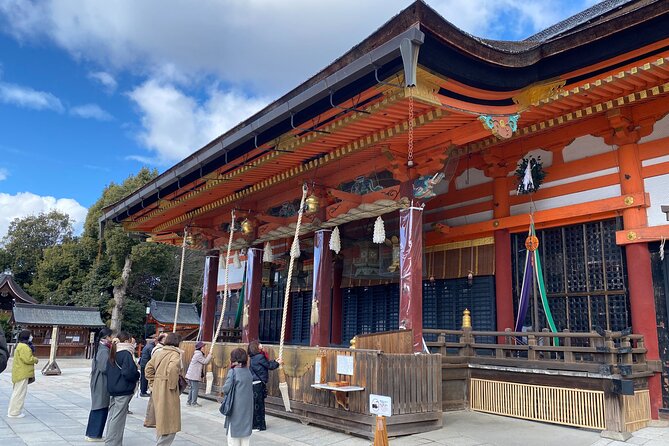
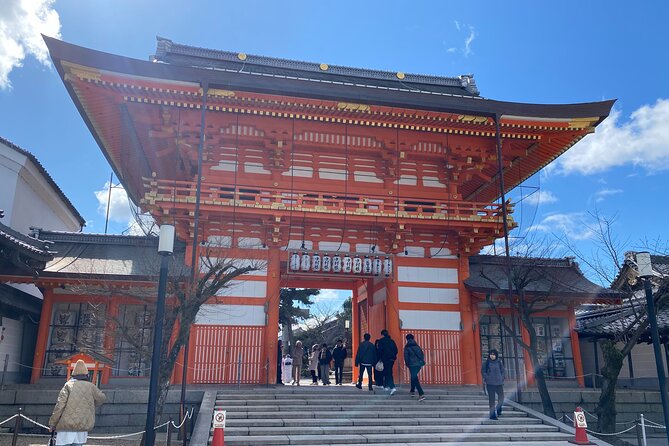
From Gion, the tour continues to Yasaka Shrine, located at the eastern end of the district. The shrine is more than 1,350 years old and is dedicated to Susanoo-no-Mikoto.
You have about 30 minutes here, with no separate admission charge. That should give you time to see the main shrine grounds and listen to an explanation of Shinto practice, local customs, and the shrine’s place in Kyoto life.
This stop works well after Gion because the two locations are closely linked. Gion grew around the religious and cultural activity of the area, and Yasaka Shrine helps explain why this corner of Kyoto has remained so important.
You will not be spending hours at the shrine, so keep your expectations realistic. The benefit is not a slow, solitary visit. It is a guided introduction that lets you recognize what you are seeing and understand the difference between a Shinto shrine and the Buddhist temples later in the route.
Kōdaiji, a calmer temple pause
Kōdaiji is a Zen Buddhist temple founded in 1606 by the wife of Toyotomi Hideyoshi, built in his memory. The temple is known for its gardens and traditional buildings, and admission is included in the tour price.
The planned visit is around 30 minutes. That is enough to appreciate the temple’s setting and hear the story behind its creation, though a garden lover may wish for more time. If you already know you want a slow visit, note the temple’s name and consider returning on your own.
I see Kōdaiji as an important change of pace. Gion and Yasaka Shrine can feel lively, while Kōdaiji offers a more reflective Buddhist setting. The route does not focus only on the most photographed places. It also gives you a place where the guide can connect architecture, memorial practice, gardens, and the political history of early seventeenth-century Japan.
The entrance fee is one reason the $78.04 price feels more reasonable than a simple walking orientation. You are not only paying for directions. You are also receiving guided access to two paid temple sites, with Kōdaiji providing one of the more thoughtful stops on the route.
More evenings in Gion:
- Kyoto Geisha Walking Tour: Gion District & Hidden Gems
★ 4.7 · 3,273 reviews - Kyoto: Gion Magical Night Walking Tour with Geisha Trivia
★ 4.9 · 2,393 reviews - Kyoto: Gion Geisha District Walking Tour – Stories of Geisha
★ 4.7 · 2,187 reviews - Best of Kyoto: Gion, Geisha, Pagodas & Cobblestones
★ 4.9 · 2,058 reviews
Yasaka Pagoda and the Higashiyama photo stop
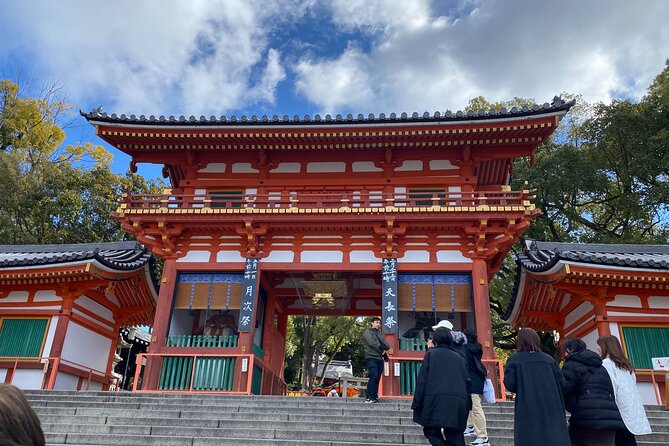
Yasaka Pagoda, officially Hōkan-ji Temple, is one of Kyoto’s most recognizable buildings. The five-story pagoda is associated with the historic Higashiyama district and is traditionally dated to the sixth century in its origins.
The scheduled visit lasts about 30 minutes, and no admission fee is listed for the tour. This is the kind of stop where your guide’s explanation matters because the pagoda itself can take only a few minutes to view from the street. The surrounding lanes and old buildings help create the classic Kyoto scene.
It is worth understanding the difference between seeing the pagoda and entering a pagoda. The tour includes a stop at Yasaka Pagoda, but the supplied details do not promise interior access. You should plan on an exterior-focused visit unless your guide tells you otherwise.
This part of Higashiyama can be crowded. The advantage of joining a small group is that you have someone helping you stay oriented. The disadvantage is that eight people still need to move together through narrow streets. If photography is your main goal, you may want to return later when you can work at your own speed.
Kiyomizu-dera and Kyoto’s famous wooden stage
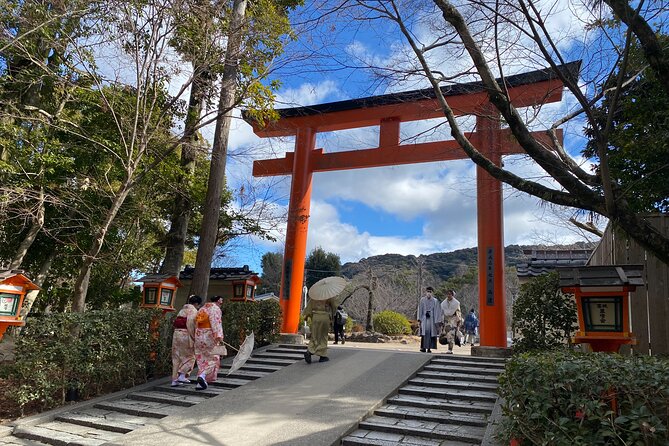
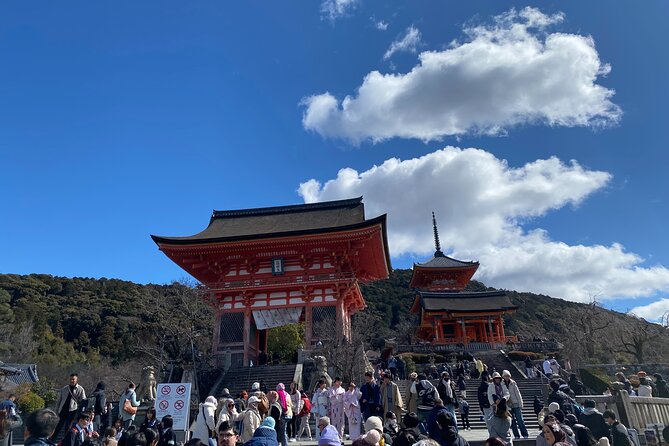
Kiyomizu-dera is one of Kyoto’s essential Buddhist temples. Founded in 778 and built on the slopes of Mount Otowa, it is famous for its large wooden stage and hillside setting. Admission is included.
The tour allows about 30 minutes here. That is a useful first look, especially if this is your first day in Kyoto, but it is not a full temple visit. Kiyomizu-dera has enough buildings, viewpoints, and religious details to fill much longer. You will need to stay with the group and focus on the main areas your guide selects.
This is another place where the guide adds value. Without background, it is easy to see the wooden stage, take a photograph, and move on. With an explanation, you can better understand why the temple has remained such a major pilgrimage and sightseeing site.
The walk up through Higashiyama can be demanding. The route includes historic streets and likely stairs, and the itinerary’s pace is fairly brisk. Comfortable shoes are more important here than stylish footwear. You should also carry water, since food and drinks are not included.
Riding toward Fushimi Inari
Transportation by train is not included, and the additional cost is ¥220 per person. That is a small charge, but you should bring cash or another accepted payment method and allow for the fact that the group must board and leave together.
The train connection is part of what makes the route efficient. Instead of ending in the Kiyomizu-dera area and asking you to find your own way to Fushimi Inari, the tour carries on to the final sight. This saves planning time and gives the day a clean finish.
The train ride also marks a change in setting. The earlier stops focus on old streets, temples, and central Kyoto. Fushimi Inari feels more open and more connected to the wooded slopes of Mount Inari, though the entrance area can be very busy.
Fushimi Inari’s torii gates
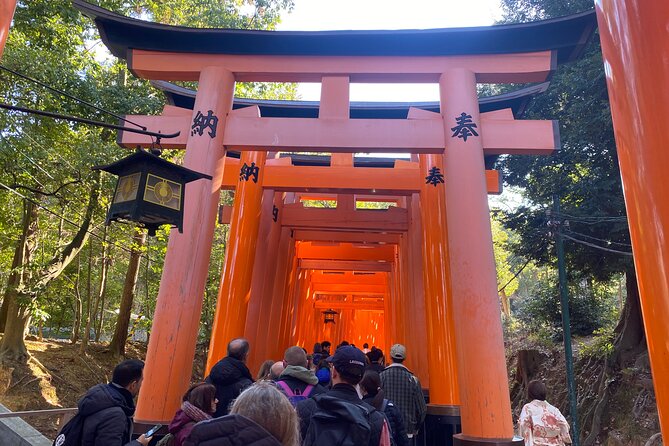
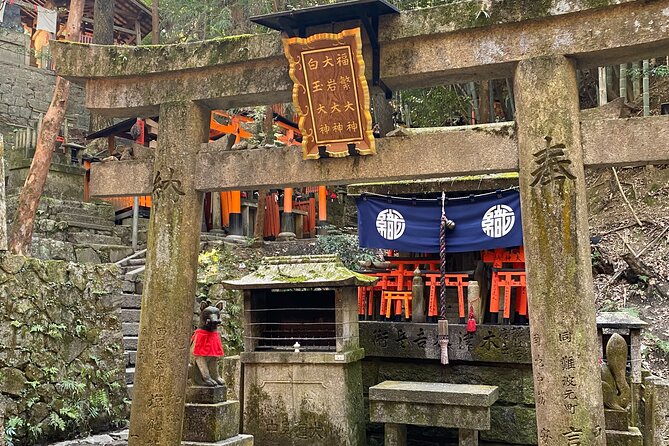
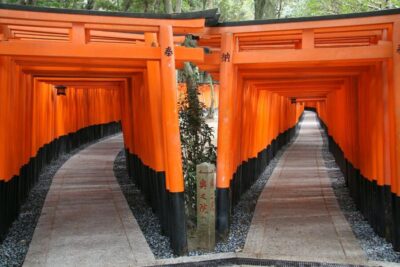
Fushimi Inari Taisha is famous for its thousands of red-orange torii gates, which form paths up Mount Inari. The shrine dates to the early eighth century and is dedicated to Inari, a Shinto deity connected with rice and prosperity.
The tour allows one hour here, the longest stop of the day. That is the right choice. Even a short walk through the gates gives you a strong sense of the site, while a longer climb changes the atmosphere as the crowds thin. The tour details do not specify how far up Mount Inari the group goes, so ask your guide about the planned turnaround point.
This is the place many people most want to see in Kyoto, and it is easy to understand why. The gates create a distinctive visual experience, but the shrine is not just a photo location. A local guide can explain the meaning of the gates and the role of Fushimi Inari in Japanese religious life.
The one-hour limit is also the tour’s clearest compromise. You may want to walk farther, pause at side paths, or spend time at the shrine buildings near the entrance. You can do that on another visit, since Fushimi Inari is close to the finishing station.
Finishing at Fushimi Inari Station
The tour ends at Fushimi-Inari Station on the Keihan Line, a short walk from Fushimi Inari Shrine. This is helpful if you are continuing your sightseeing, heading back toward central Kyoto, or simply want to return to the shrine later without retracing the whole route.
The finish is not at your hotel, and pickup is not included. Private tours or pickup may be possible if arranged by message, but the standard experience begins at Minamiza Theater and ends at the station.
That open-ended finish is useful. You are not pushed into a final group meal or a fixed return transfer. You can stay in the Fushimi Inari area, find a café, or use the Keihan Line for your next stop.
What $78.04 buys you
At $78.04 per person, this is not the cheapest way to walk through Kyoto. It can still offer fair value if you want a guide, a planned route, and access to two paid temples without spending time organizing the day yourself.
The price includes all guide costs, a personal guide, and admission to Kōdaiji and Kiyomizu-dera. The group limit of eight matters here. You are paying for a more focused experience than a large coach tour, with a better chance to ask questions and hear the explanation.
You should add ¥220 for the train and budget separately for food and drinks. No meal is provided. One tour group ended up stopping at a café together and chatting in a friendly, informal way, but that is not listed as a guaranteed part of the experience.
The strongest value comes if you have only half a day in Kyoto. You can see six major sites and receive historical and cultural background without arranging multiple tickets or transit steps. If you have several days in Kyoto and enjoy lingering at each temple, you may find the pace too quick.
The guide and group experience
The named guide Tomoki received especially warm praise for explaining not only temples and shrines but also modern architecture, traditional sweets, and matcha. That range is useful because Kyoto is not only an old city frozen in time. It is a living place where older customs sit beside modern buildings and daily life.
The company’s guide approach also appears flexible. The pace can be adjusted to suit the group, which matters on a route with stairs, crowds, and six stops. Still, flexibility has limits when the tour must reach Fushimi Inari within four hours.
A group of up to eight is small enough to feel personal but large enough that the pace may not match every person perfectly. If you walk slowly, tell the guide early. If you want extra time for photographs, ask which stops offer the best chance to pause.
Who should book this Kyoto walk
I would recommend this tour to a first-time Kyoto visitor who wants a clear introduction to the city’s eastern sights. It also suits anyone with a tight schedule, especially if Fushimi Inari is high on your list and you do not want to plan the connections yourself.
It is a good fit for people who enjoy learning as they walk. The strongest praise focuses on efficient sightseeing, detailed cultural explanations, a comfortable pace, and the friendly atmosphere created by the guide.
You may want a different plan if you dislike group schedules, need long visits at temples, or want to climb deeply into Mount Inari. A private tour could give you more control, and the operator invites inquiries about private arrangements and pickup.
Practical details before you book
Wear walking shoes and expect a route through historic streets, temple grounds, and shrine paths. Kiyomizu-dera and Fushimi Inari can involve slopes or stairs, so a light bag will make the day easier.
The standard meeting point is Minamiza Theater in Gion. The standard end point is Fushimi-Inari Station. Confirmation is provided at booking, the tour is near public transportation, and most people can participate.
The maximum group size is eight. Group discounts may be available, and the ticket is mobile. Free cancellation is allowed up to 24 hours before the local start time. Cancellation inside that window is not refunded, and late changes are not accepted.
Should you book it?
Book this tour if you want six major Kyoto sights in one tightly planned half-day, with a small group and a guide who can connect Shinto, Buddhism, geisha culture, food, architecture, and local customs. The inclusion of Kōdaiji and Kiyomizu-dera admissions helps justify the price, while the finish near Fushimi Inari gives you a useful route rather than a random collection of stops.
Skip it if your ideal Kyoto day means sitting quietly in one garden, climbing all the way up Mount Inari, or setting your own schedule. For most first visits, though, this is a sensible way to get your bearings, see the city’s eastern highlights, and leave yourself free to return to the places that deserve more time.
FAQ
How long is the tour?
The tour lasts approximately four hours.
Where does the tour begin?
It begins at Minamiza Theater, at the eastern end of Shijo Bridge in Kyoto’s Higashiyama Ward.
Where does the tour end?
It ends at Fushimi-Inari Station on the Keihan Line, a short walk from Fushimi Inari Shrine.
How many people can join the tour?
The group has a maximum of eight travelers.
Is transportation included?
Train transportation is not included. The listed cost is ¥220 per person.
Are meals and drinks included?
No. Food and drinks are not included.
Which admission fees are included?
Admission to Kōdaiji Temple and Kiyomizu-dera Temple is included.
Is a guide included?
Yes. The experience includes all guide costs and a personal guide. Tomoki is one of the guides associated with the tour.
Can most people participate?
The activity is near public transportation, and most travelers can participate.
Can I cancel for a full refund?
Yes, if you cancel at least 24 hours before the experience’s start time. Cancellations made less than 24 hours before the start time are not refunded.
Recently added around Kyoto
- Higashiyama | Kyoto: Sakura Season Private Rickshaw Tour★ 5.0 · 3 reviews
- Kyoto Kimono Rental CHAMATSU|Kimono/Yukata Rental FamilyPlan★ 5.0 · 3 reviews
- Nara Private Customizable Half Day Tour★ 5.0 · 3 reviews
- Kyoto: Half-Day Private Guided Tour to the Old Town of Gion★ 4.4 · 3 reviews
- Kansai Region Hiking Adventure in Nara Kobe Kyoto and More★ 5.0 · 3 reviews
- Full Day Nara Deer, Temple, Shrine, Activities & Tea Ceremony★ 5.0 · 3 reviews
- Nara: Essential Private Tour with Deer Park and Temples★ 5.0 · 3 reviews
- Hiking Tour for Sacred Sites in Kyoto with a Guide★ 5.0 · 3 reviews
Fushimi Inari Shrine Tours, compared.
Fushimi Inari, Kinkakuji, Bamboo Grove 1 Day Bus Tour
Read our review →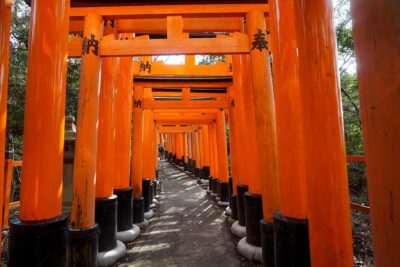
Fushimi Inari Hidden Hiking Tour (Private Option Available)
Read our review →
Kyoto/Osaka: Nara, Fushimi Inari Taisha, Arashiyama Bus Tour
Read our review →
Nijo, Kinkaku-ji, Arashiyama, Kiyomizu & Fushimi Inari
Read our review →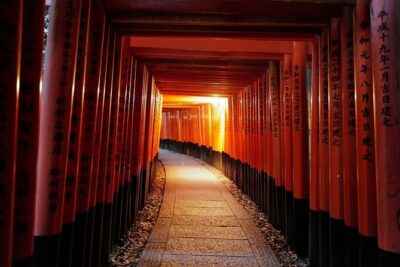
Kyoto Early Bird English Tour: Fushimi-Inari and Arashiyama
Read our review →
Fushimi, Arashiyama – Bamboo, Monkey, Torii & Secrets
Read our review →Browse the lists this tour appears in