
REVIEW · WALKING TOURS
Kyoto Late Bird Walking Tour
Kyoto’s most photogenic sights fit into one well-planned afternoon here: the thousand vermilion torii gates at Fushimi Inari, the old pagoda above Higashiyama, and the traditional lanes of Gion. It is a private tour, so your guide can keep the pace comfortable and explain what you are seeing instead of simply marching you from one photo stop to the next.
I like the efficient route and the chance to use Kyoto’s trains with local help. I also like the personal touch: guides including Kazu, Saori, Mitsue, Meg, and Key have been praised for patient meeting arrangements, clear English, easy conversation, and translation help. The main consideration is the cost of public transportation, about ¥850 per person, which is not included, and the four-hour schedule leaves little room for a long visit at each place.
In This Review
- Key points at a glance
- Why this afternoon route works
- Fushimi Inari and the first hour under the torii
- Yasaka Pagoda and the Higashiyama view
- Yasaka Shrine and the meaning of Gion
- Gion, old wooden houses, and the chance of seeing geisha
- Using Kyoto’s trains without losing your afternoon
- Pace, guide style, and the private advantage
- What the $86.49 price really buys
- Who should book this Kyoto walk
- Should you book the Kyoto Late Bird Walking Tour?
- FAQ
- Where does the Kyoto Late Bird Walking Tour start?
- How long does the tour last?
- What places are included?
- Is transportation included in the price?
- Is this a private tour?
- Can I cancel for a full refund?
Key points at a glance
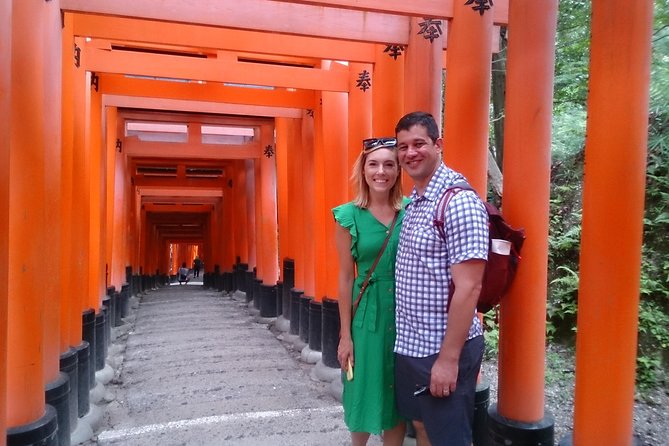
- Fushimi Inari first: Walk beneath the famous tunnel of thousands of orange-red torii gates.
- A private group setting: Only your party takes part, making it easier to ask questions or slow down.
- Kyoto by public train: Bring a loaded IC card, since the route uses several trains and the fare is separate.
- Gion at the right time: The afternoon finish gives you a chance to see old wooden streets and possibly a geisha or maiko.
- Guides with different strengths: Kazu, Saori, Mitsue, Meg, and Key have been noted for patience, English, local explanation, and warm conversation.
- A compact four-hour plan: You cover four major places, but this is a sampler rather than a long, unhurried temple walk.
Why this afternoon route works
Kyoto can feel scattered. Fushimi Inari is south of the central area, while Yasaka Pagoda, Yasaka Shrine, and Gion sit around Higashiyama. Put those places together without a plan and you can lose time finding platforms, exits, and the right lanes.
This tour handles that movement for you. You meet at Kyoto Station at 2 p.m., travel to the first shrine, then work back toward the historic streets near Gion. The route saves time and gives you a useful first look at several different sides of Kyoto: a major Shinto shrine, a classic pagoda view, a working shrine, and a preserved entertainment district.
The private format matters. You are not tied to the walking speed or interests of a large group. If you want more explanation at a shrine, you can ask. If your group has children, older family members, or different energy levels, the guide can keep the outing relaxed. The tour is listed as suitable for people with limited eyesight or limited mobility, though it is not stroller accessible.
At $86.49 per person, the value depends on your group size and how much you want help with transport and interpretation. A private guide costs more than joining a large group, but the fee covers the guide and gives your party exclusive use of the experience. You still pay about ¥850 per person for public transportation, plus any food or drinks you choose to buy.
More walking tours in Kyoto:
- Kyoto Geisha Walking Tour: Gion District & Hidden Gems
★ 4.7 · 3,273 reviews - Kyoto: Gion Magical Night Walking Tour with Geisha Trivia
★ 4.9 · 2,393 reviews - Kyoto: Gion Geisha District Walking Tour – Stories of Geisha
★ 4.7 · 2,187 reviews
Fushimi Inari and the first hour under the torii
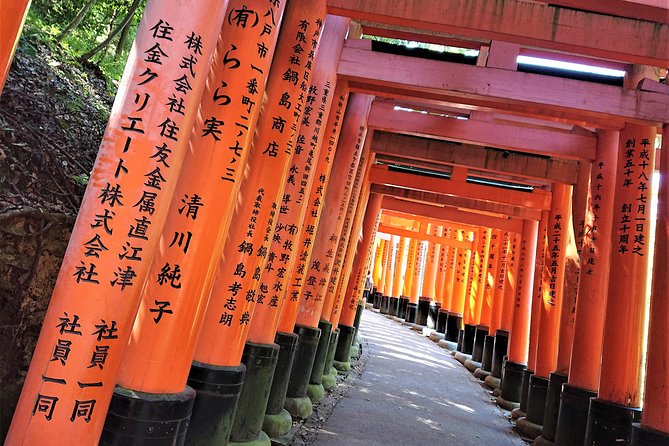
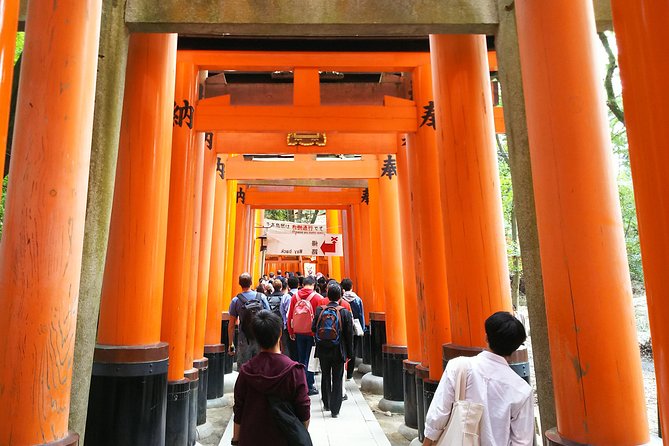
Fushimi Inari-taisha is the strongest opening stop. Its long rows of vermilion torii gates create one of Kyoto’s most recognizable scenes, and the gates are not simply decorative. Worshippers donated them as thanks for good fortune received from the deity honored here.
You have about an hour at the shrine. That is enough to see the famous gate-lined paths and get a feel for the place, but it is not enough to explore every trail on the mountain. Keep your expectations in check if you want a full climb. This tour gives you a focused introduction, not an all-day hike.
Your guide can add meaning to details that are easy to miss when you are taking pictures. The route also helps you avoid wasting time deciding how far to walk or where to turn. At a popular site such as Fushimi Inari, that practical help is worth something.
The shrine is free to enter, so there is no extra admission charge at this stop. You should wear comfortable shoes and expect walking, stairs, and uneven surfaces around the shrine paths. The supplied details do not promise a completely step-free route, so anyone with mobility concerns should discuss their needs with the operator before booking.
Yasaka Pagoda and the Higashiyama view
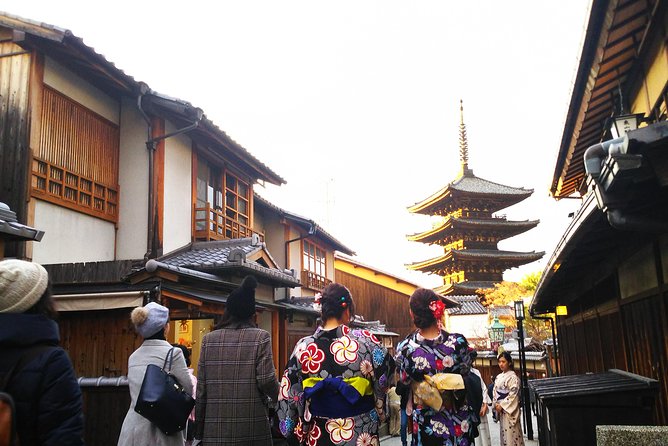
The next stop is Yasakanoto, usually called Yasaka Pagoda. Its origin reaches back to 592, and the present structure was rebuilt in 1440. The pagoda gives you one of those classic Kyoto scenes: a historic tower rising above old streets, with photographers gathering nearby in the evening light.
You have roughly 30 minutes here. That is a sensible amount of time for photographs and a short explanation, especially since the tour has several more stops. It will feel brief if you want to linger in every lane around the pagoda or wait for perfect lighting.
This is also where the tour’s timing helps and limits you at the same time. An afternoon visit can lead toward softer light, but the exact conditions depend on the season and weather. Since the experience requires good weather, poor conditions can lead to a new date or a full refund.
The pagoda is listed with free admission. The appeal is mainly the setting and the view from the surrounding streets, rather than a long indoor visit. Listen to your guide here, then use your free moments to take in the old-style architecture instead of rushing from one camera angle to another.
Yasaka Shrine and the meaning of Gion
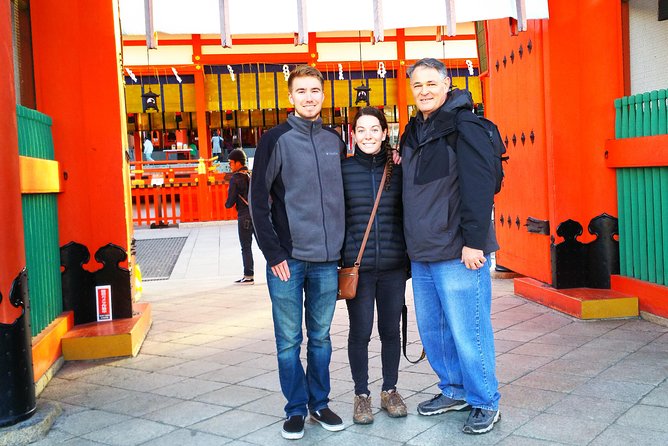
Yasaka Shrine receives about 20 minutes, making it the shortest scheduled stop. It was once known as Gion Shrine, and the name Gion came from this shrine. That connection gives the visit extra value, since you are not seeing the shrine and the Gion district as unrelated attractions.
The main deity is considered powerful, and a beauty deity is also enshrined here. That second association helps explain why the shrine attracts people interested in beauty and appearance. Your guide can point out the relevant details and explain the customs without leaving you to guess what each building or offering means.
Twenty minutes is enough for a compact visit, but not for a slow examination of every corner. If you are especially interested in Shinto practice, ask questions while you are there. The private format gives you a better chance to shape the conversation than a large scheduled group would.
Yasaka Shrine is also a useful transition point. You move from a major religious site into the traditional streets of Gion, where the focus shifts from shrine architecture to living cultural traditions.
A completely different side of Kyoto:
- PERFECT KYOTO 1-Day Bus Tour
★ 5.0 · 13,518 reviews - Kyoto: Fushimi Inari, Kinkakuji, Bamboo Grove 1 Day Bus Tour
★ 4.8 · 4,316 reviews - Kyoto: Tea Ceremony in a Traditional Tea House in Kiyomizu
★ 4.9 · 3,519 reviews - Kyoto: Tea Ceremony Ju-An at Jotokuji Temple
★ 4.9 · 3,207 reviews
Gion, old wooden houses, and the chance of seeing geisha
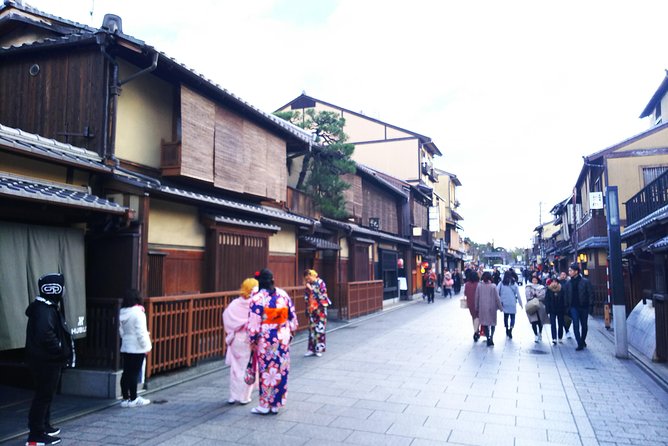
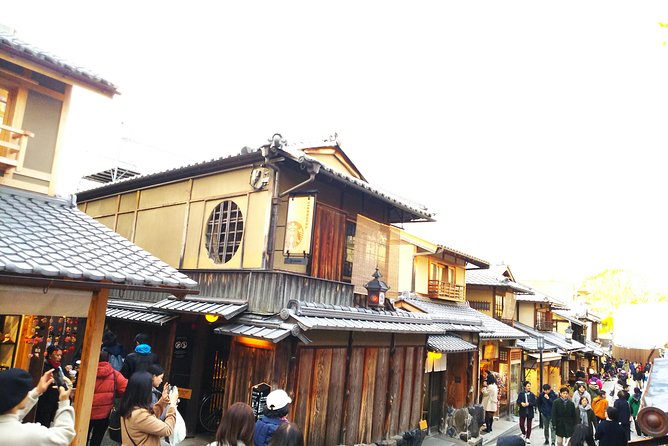
The tour gives Gion about 50 minutes. This is a walking visit through a district known for preserved old-style houses and its connection to geisha culture. You may see a geisha or maiko, a geisha apprentice, but no responsible tour can guarantee that encounter.
That uncertainty is part of the point. Gion is not a stage show arranged on demand. If you do see a performer moving between appointments, give her space and follow local etiquette. Your guide can help you understand what you are seeing without turning the moment into a chase.
One guide, Saori, is noted for strong English and Japanese, easy conversation, and an ability to relate to visitors from different backgrounds. An afternoon with her may include plenty of conversation and snacks, and a lucky group might see geisha and trainees. Other guides bring different strengths. Kazu waited patiently when a participant arrived late and helped translate a humorous paper wish at Yasui Konpira-gu, an extra stop described during one outing. Mitsue was praised for a welcoming, easy pace, while Meg was described as punctual, professional, and full of useful explanations. Key was also singled out for exceptional guiding.
The exact guide and any extra stop are not guaranteed in the tour details, so treat these as examples of the personal style you may encounter, not promises. The planned Gion visit itself is the reliable part.
Using Kyoto’s trains without losing your afternoon
Public transportation is part of the experience, not a minor footnote. The route involves trains between Kyoto Station, Fushimi Inari, and the eastern Kyoto sights. One useful practical tip is to arrive with a loaded IC card, which can make the train portions faster and simpler.
The public transportation fare is about ¥850 per person and is separate from the tour price. Carry enough balance before meeting your guide. If you need to stop and buy or load a card, that can eat into the four-hour schedule.
Meeting at Kyoto Station gives you a clear starting point, but the station is large. Read the meeting instructions carefully and arrive with time to spare. One participant who arrived late was helped by a patient guide, but you should not count on a delayed start. The tour ends back at the meeting point, which makes Kyoto Station convenient if you plan to continue by train afterward.
The route is designed to make transport less stressful, not to avoid all walking. You still need to move through shrines, streets, and station areas. For limited mobility, the operator states that the experience can accommodate participants with limited mobility, but it is not stroller accessible. Confirm the details for your specific group before paying.
Pace, guide style, and the private advantage
The strongest reason to choose this outing is the guide. The schedule is compact, and a guide turns four separate stops into a connected afternoon rather than a checklist of famous names.
You can ask why the torii gates are there, how Gion relates to Yasaka Shrine, or what the different roles of geisha and maiko mean. You also get help with small cultural moments, such as reading a wish written in Japanese or understanding a shrine custom. That kind of translation can be more memorable than another quick photograph.
The guides described for this experience tend to offer a relaxed, personal approach. Saori’s background studying in the United States made conversation easy for an international group. Mitsue kept the pace welcoming and unhurried. Kazu was patient with a late arrival. Meg was waiting at the agreed station location and explained the sights along the way. These details suggest that the human side of the tour is a major part of its appeal.
Still, your experience will depend on the guide assigned to your date. The names above are not a guarantee that you will receive a particular person. The private format gives you privacy and flexibility, but the tour is only about four hours, so you should tell the guide early if one stop matters most to you.
What the $86.49 price really buys
The price is easiest to justify for a small group that wants a private guide. If two people book, the per-person cost is higher in practical terms than if several relatives or friends share the experience. Group discounts may help larger parties, although the exact discount is not provided.
Your fee includes the guide. It does not include train fares, food, or drinks. The transportation cost of ¥850 per person is modest compared with the tour price, but it is important to budget for it. Shrine admission at the listed stops is free, so you do not face a string of entrance charges.
You are paying for route planning, local explanation, private attention, and a way to connect distant sights in one afternoon. If you already know Kyoto well and feel comfortable using trains, you may prefer to visit these places independently. If this is your first day in Kyoto, or if you want cultural context without arranging every transfer yourself, the price is more reasonable.
Who should book this Kyoto walk
I would choose this tour for a first Kyoto visit, a couple wanting a private afternoon, or a family that prefers a flexible pace. It also suits anyone who wants to see Fushimi Inari and Gion on the same day without working out the route alone.
It is a good fit if you care about explanation as much as photographs. The guides can help connect the religious sites with the streets and traditions around them, and the private setting makes questions easy.
I would hesitate if your main goal is a long Fushimi Inari hike. One hour at the shrine will not give you unlimited time on the mountain. I would also hesitate if you want an evening centered entirely on Gion, since the tour spends only about 50 minutes there and ends back at Kyoto Station.
Animals and pets are allowed, according to the activity details. The tour is not stroller accessible. Mobile tickets are available, confirmation arrives at booking, and most people can participate. Free cancellation is available up to 24 hours before the 2 p.m. start time. Cancellations or changes made inside that window are not refunded or accepted, and poor weather can lead to a new date or full refund.
Should you book the Kyoto Late Bird Walking Tour?
Book it if you want a private, guide-led introduction to four important Kyoto sights and like the idea of using public trains with someone who knows the way. The best parts are the efficient route, the guide’s personal explanations, and the chance of seeing Gion’s traditional culture in its own setting.
Skip it if you want extensive time at each shrine, a guaranteed geisha sighting, or a fully self-guided bargain. At $86.49 per person plus transport, it is not the cheapest way to see these places. For a small group that values calm logistics, local conversation, and a well-connected afternoon, it offers solid value.
FAQ
Where does the Kyoto Late Bird Walking Tour start?
The tour starts at Kyoto Station in Kyoto, Japan, at 2 p.m. It ends back at the meeting point.
How long does the tour last?
The experience lasts approximately four hours.
What places are included?
The planned stops are Fushimi Inari-taisha Shrine, Yasaka Pagoda, Yasaka Shrine, and the Gion district.
Is transportation included in the price?
No. Public transportation costs about ¥850 per person and are paid separately. Food and drinks are also not included.
Is this a private tour?
Yes. Only your group participates in the activity.
Can I cancel for a full refund?
Yes, if you cancel at least 24 hours before the local start time. Cancellations or changes made less than 24 hours before the start are not refunded or accepted. If poor weather causes the operator to cancel, you are offered another date or a full refund.
Recently added around Kyoto
- Higashiyama | Kyoto: Sakura Season Private Rickshaw Tour★ 5.0 · 3 reviews
- Kyoto Kimono Rental CHAMATSU|Kimono/Yukata Rental FamilyPlan★ 5.0 · 3 reviews
- Kyoto: Half-Day Private Guided Tour to the Old Town of Gion★ 4.4 · 3 reviews
- Nara Private Customizable Half Day Tour★ 5.0 · 3 reviews
- Full Day Nara Deer, Temple, Shrine, Activities & Tea Ceremony★ 5.0 · 3 reviews
- Nara: Essential Private Tour with Deer Park and Temples★ 5.0 · 3 reviews
- Kansai Region Hiking Adventure in Nara Kobe Kyoto and More★ 5.0 · 3 reviews
- Hiking Tour for Sacred Sites in Kyoto with a Guide★ 5.0 · 3 reviews
Walking Tours, compared.

Kyoto Geisha Walking Tour: Gion District & Hidden Gems
Read our review →
Gion Magical Night Walking Tour with Geisha Trivia
Read our review →
Gion Geisha District Walking Tour – Stories of Geisha
Read our review →

Kyoto Gion Geisha District Walking Tour – The Stories of Geisha
Read our review →
Kyoto Arashiyama Walking Tour: Bamboo, Monkeys, Gardens & Secrets
Read our review →
Kyoto Gion: 2-Hour Geisha Culture & History Walking Tour
Read our review →
Nara Half Day Trip Walking Tour (Private Option Available)
Read our review →Browse the lists this tour appears in