
REVIEW · KYOTO IKEBANA CLASSES
Kyoto: Ikebana (Japanese Flower Arrangement)
Kyoto’s ikebana tradition began with a flower arrangement made here in 1462, created not simply as a religious offering but as a way to bring harmony between nature and human space. This experience lets you try that idea yourself, then places your finished arrangement before a garden at Tondaya, a 140-year-old machiya in Nishijin.
I like two things right away: the historic setting gives the lesson more meaning than a modern classroom, and the flowers, tools, entrance, and private-group format are included. The main caution is value. At $122 per person, the 90-minute schedule needs to feel like a real lesson, yet some bookings have reportedly felt closer to 15 minutes and light on explanation.
In This Review
- Key points
- What the ikebana lesson is really about
- Entering Tondaya, a 140-year-old Kyoto townhouse
- How the 90 minutes are arranged
- What the strongest parts of the experience offer
- Where the value becomes uncertain
- The role of the instructor and interpreter
- The garden photographs and the optional kimono
- Who should book this Kyoto activity
- Practical details before you arrive
- Should you book the Tondaya ikebana experience?
- FAQ
- Where does the ikebana experience take place?
- How long does the activity last?
- What is included in the price?
- Is the experience suitable for beginners?
- How many people are required to book?
- Is the group private?
- What languages are available?
- Do I need to bring anything?
- Can I attend barefoot?
- Can I cancel for a refund?
Key points
- Create your own arrangement: Seasonal flowers and all required ikebana tools are supplied.
- Learn in a 140-year-old machiya: Tondaya is a culturally significant Kyoto townhouse and museum.
- See the arrangement in a garden setting: Your completed work is displayed outside for photographs.
- Expect a beginner-level lesson: The activity is designed for first-time participants, not advanced ikebana students.
- Plan for language support: Instruction is offered in English and Japanese, with an interpreter or translation device when needed.
- Bring socks: Bare feet are not allowed, and stockings or tights are discouraged.
What the ikebana lesson is really about
Ikebana is more than placing pretty flowers in a vase. Its purpose is to express a relationship between natural forms and the space around them. That is why the 1462 origin story matters: the arrangement was admired because it created harmony between nature and a human interior, rather than serving only as a religious offering.
You will get a beginner-friendly introduction to this tradition at Tondaya. Seasonal flowers and the required equipment are supplied, so you do not need to buy materials or arrive with any prior skill. The lesson is intended to let you make an arrangement yourself under the direction of an ikebana master.
That sounds simple, but it is an important distinction. You are not only watching a demonstration or touring a museum. You are expected to work with the flowers and tools. For many people, this hands-on part will be the reason to book.
At the same time, you should set your expectations carefully. The published length is 90 minutes, but some past participants felt their practical session lasted only about 15 minutes. One person also wanted a demonstration by an experienced practitioner and more discussion of ikebana theory. If you want a formal lesson with detailed rules, a long demonstration, and extensive correction of your technique, this may feel too light.
More flower-arranging classes:
- Ikebana Traditional Japanese Art of Flower Arranging
★ 4.5 · 19 reviews - Kyoto Cultural IKEBANA Experience@SEKKA FLOWERS
★ 5.0 · 11 reviews - Traditional Japanese Flower Styling Workshop – Ikebana in Kyoto
★ 5.0 · 10 reviews
Entering Tondaya, a 140-year-old Kyoto townhouse
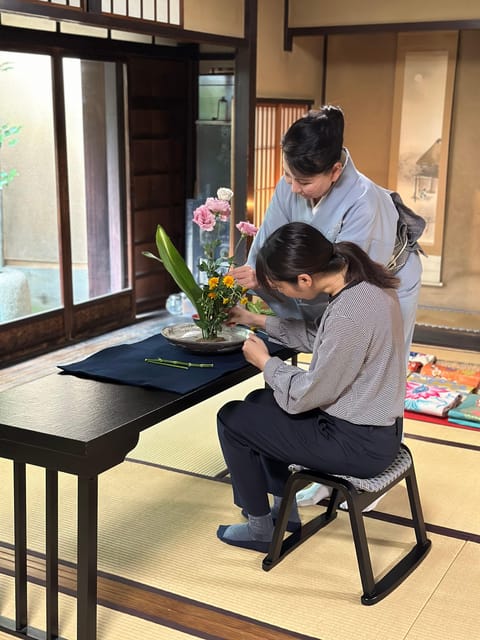
The meeting point is Tondaya, Nishijin Japanese Cultural Experience Museum, at 697 Ishiyakushichō in Kyoto’s Kamigyo Ward. The venue is a machiya, the traditional townhouse style associated with Kyoto. Here, the building itself is part of the experience.
Tondaya is described as a 140-year-old machiya and a culturally significant landmark designated by the Kyoto City Government. That gives the flower lesson a useful sense of place. You are not simply learning a Japanese art in an anonymous room. You are working inside a building connected to Kyoto’s domestic and cultural life.
The follow-up visit through the Nishijin Lifestyle Museum gives you a chance to see historically valuable objects and hear stories about the building. Staff explain the site and its place in Kyoto’s living heritage. I like this combination because it links a small creative activity with the kind of older architecture that can be easy to miss during a busy city visit.
The trade-off is that the museum portion may matter more to some people than the flower lesson, while others will want the opposite. The experience is best for you if both parts sound worthwhile. If you only want to arrange flowers, the $122 price may feel high. If you are interested in traditional arts, historic homes, and a quieter cultural stop, the setting adds real value.
How the 90 minutes are arranged
The experience begins with an introduction to ikebana and its origins. The 1462 Kyoto reference gives the lesson a clear starting point, showing how the art developed from earlier religious flower offerings into a form concerned with beauty, balance, and space.
You then work with seasonal flowers and the provided tools. The instructor guides you through the arrangement process. English and Japanese are listed as the activity languages. Since not every staff member speaks English, an interpreter may be arranged, or a translation device may be used when needed.
That language note is worth taking seriously. The support plan is helpful, but it also means the amount of detailed explanation may vary. If you are eager to discuss the finer points of ikebana, ask at the start how instruction will be handled. A short request for a step-by-step explanation can help you get more from the time.
The private-group format is another plus. You are not placed in a large public class, so the session can feel more personal and less hurried than a group demonstration. Still, private does not automatically mean lengthy. The main question is how much time the instructor gives to history, demonstration, hands-on work, and feedback.
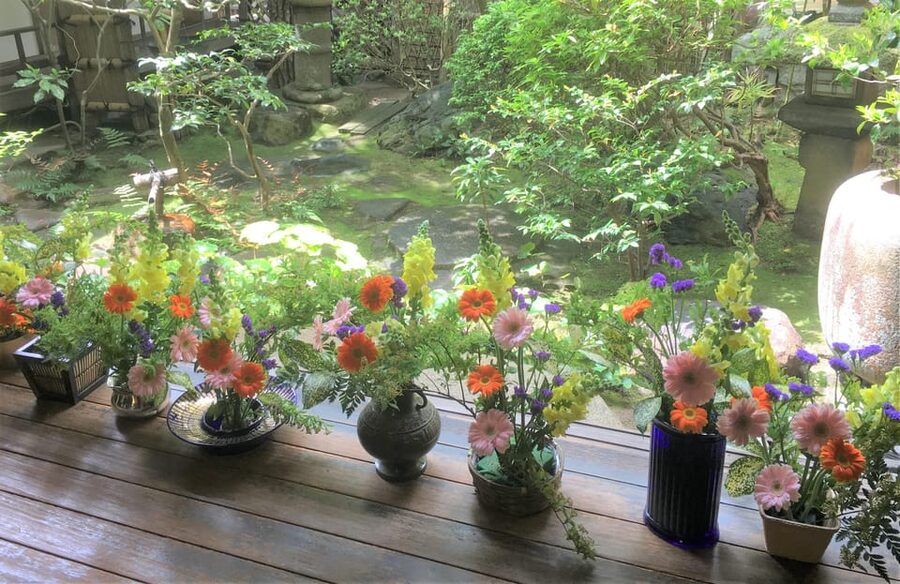
After you finish, the arrangement is displayed in front of the garden. This creates a natural photo stop and gives your work a proper setting. It also helps you see the arrangement as part of a larger space, which fits the basic idea of ikebana better than carrying it away immediately.
What the strongest parts of the experience offer
The best feature is the mix of doing and seeing. You make something with your own hands, then look around a historic Kyoto house. That is more memorable than a quick craft activity with no connection to its surroundings.
The venue also received some of the warmest praise. Jean-Louis described the building as extraordinary and appreciated the history given before the arrangement. The same account notes that the instructor and interpreter explained each step and allowed plenty of time for photographs. That is the experience at its best: clear guidance, a meaningful setting, and a finished arrangement that looks good in pictures.
Ioana, visiting with her mother, found the activity informative and enjoyable. That points to another strength. The format can suit two generations traveling together because it is calm, creative, and does not require physical exertion or previous knowledge.
The option to wear a traditional kimono and take a small tour of the historic venue is also mentioned as an extra-cost add-on. It is not part of the $122 price, so treat it as a separate choice rather than an included benefit. For some people, the kimono option may make the visit feel more complete. For others, it will push the total cost beyond what they want to spend.
A completely different side of Kyoto Prefecture:
- Kyoto: Zen Meditation and Garden Tour at a Temple with Lunch
★ 4.9 · 86 reviews - Kyoto: Hike and Hot Springs in Kurama
★ 5.0 · 49 reviews - Kyoto Satoyama Cycling with Lunch and English Guide
★ 5.0 · 19 reviews - Kyoto 1 Day Suntory Yamazaki Distillery Tour and Asahi Art Museum
★ 5.0 · 13 reviews
Where the value becomes uncertain
At $122 per person, this is not a casual drop-in flower class. The price includes the flowers, tools, and entrance fee, and the group is private. Those details help, especially if you value a quiet setting and a cultural site.
Still, the cost is high enough that you should want more than a finished arrangement. You are paying for access to Tondaya, the flower materials, instruction, the museum visit, and the setting for photographs. If the lesson is fully explained and uses much of the 90-minute period, the package can make sense as a special Kyoto activity.
The concern is that the practical teaching may be brief. Catherine considered the price excessive for what felt like a 15-minute experience. Another participant wanted more theory and said the teacher rearranged the flowers without being able to explain much. A separate comment also called the session very short and questioned its value.
These are not small complaints for this price. They point to the need for clear expectations. You should not book this assuming a full professional training session. Think of it as an introductory cultural activity with a flower arrangement, a historic-house visit, and photographs.
If you are comparing it with a basic craft workshop, the venue and private format may justify the difference. If you are comparing it with a serious ikebana class, the lesson may not provide enough depth.
The role of the instructor and interpreter
The instructor is described as an ikebana master, and the staff work across several traditional arts, including kimono, tea ceremony, calligraphy, and flower arrangement. That range can be useful because Tondaya presents traditional culture as a connected part of Kyoto life rather than as one isolated skill.
The available languages are English and Japanese. However, English support is not guaranteed from every staff member. The organizers may arrange an interpreter, and a translation device may be used if needed.
This is not necessarily a problem, but it affects the kind of conversation you can expect. A translation device may handle basic instructions well while making a detailed discussion of symbolism, history, or technique slower. If the theory of ikebana matters to you, make that clear early.
The strongest account of the experience praised the instructor and interpreter for explaining each step. The weaker accounts describe little explanation and a teacher who changed the arrangement without explaining the rules. That difference suggests that communication is central to your experience.
I would ask three simple questions at the beginning:
- What is the main principle we are practicing today?
- Can you demonstrate the arrangement before I begin?
- Will you explain why each stem is placed where it is?
Those questions are especially useful for a beginner. They can turn a quick craft exercise into a more useful lesson.
The garden photographs and the optional kimono
Once your arrangement is complete, it is displayed in front of the garden. This is one of the most appealing details for anyone who enjoys taking photographs of their travel experiences. The flowers are not just packed away at the end. They become part of the visual setting.
The garden backdrop also reinforces the connection between a flower arrangement and its surrounding space. You can photograph the finished work, and the setting gives the activity a clear ending.
The optional kimono experience costs extra. It includes wearing traditional clothing and taking a small tour of the historic venue, according to the information provided. Since it is not included, check the additional cost before deciding.
I would consider the kimono add-on only if you already care about traditional dress or want a more photograph-focused visit. If your main goal is ikebana, the basic activity should be enough. Do not let the attractive photos make you assume the clothing experience is part of the standard booking.
Who should book this Kyoto activity
This experience is a good match for you if you want a gentle introduction to a Japanese art and prefer a small private setting. It also suits families, couples, and parent-child pairs who want an activity that encourages conversation rather than rushing from one sight to another.
It is particularly appealing if you have already seen Kyoto’s major temples and want something connected to daily cultural life. The machiya setting and Nishijin museum visit add context that a stand-alone flower class would not provide.
You may also like it if photographs matter to you. The garden display and optional kimono add-on create several planned photo moments without requiring you to arrange the setting yourself.
I would hesitate if you are booking mainly for an advanced ikebana lesson. The activity is for beginners, and the amount of theory or detailed correction may be limited. I would also hesitate if $122 feels expensive for a short hands-on session. The cost only works if you value the whole package, not just the flowers.
Practical details before you arrive
The experience lasts 90 minutes, and you should arrive on time. A late arrival could reduce the already limited time available for instruction and the museum visit.
Reservations require at least two participants. This is not a solo booking option, so plan to attend with a companion or another member of your party.
Wear socks. Bare feet are not allowed, and the instructions specifically ask you not to wear stockings or tights. The simplest choice is ordinary socks with comfortable clothing.
Flowers, tools, and the entrance fee are included. You do not need to bring arranging materials. The meeting point is Tondaya, at 697 Ishiyakushichō, Kamigyo Ward, Kyoto.
You can cancel up to 24 hours before the scheduled experience for a full refund. You can also reserve now and pay later, which gives you some flexibility while finalizing your Kyoto plans.
Should you book the Tondaya ikebana experience?
Book it if you want a private beginner activity in an important Kyoto townhouse, and if the museum visit, garden photographs, and seasonal flowers matter as much as the lesson itself. The venue is the main reason this experience feels special, and the strongest sessions combine clear instruction with the building’s history.
Think twice if you want a long demonstration or a serious study of ikebana theory. The mixed feedback on lesson length and explanation is the key warning. At $122 per person, you should ask for step-by-step instruction at the start and confirm how English support will work.
My call: a worthwhile cultural visit for the right expectations, especially for two people who value traditional Kyoto settings and a small creative activity. It is not the safest choice for a dedicated ikebana student seeking technical depth.
FAQ
Where does the ikebana experience take place?
It takes place at Tondaya, Nishijin Japanese Cultural Experience Museum, at 697 Ishiyakushichō, Kamigyo Ward, Kyoto, Japan.
How long does the activity last?
The scheduled duration is 90 minutes.
What is included in the price?
Seasonal flowers, all necessary ikebana tools, and the entrance fee are included.
Is the experience suitable for beginners?
Yes. The activity is presented as an ikebana experience for beginners.
How many people are required to book?
Reservations must be made for at least two participants.
Is the group private?
Yes. The activity is offered as a private group experience.
What languages are available?
Instruction is available in English and Japanese. An interpreter may be arranged, and a translation device may be used when needed.
Do I need to bring anything?
You should bring and wear socks. The flowers and tools are supplied.
Can I attend barefoot?
No. Bare feet are not allowed. You should also avoid stockings or tights.
Can I cancel for a refund?
You can cancel up to 24 hours in advance for a full refund. A reserve-now, pay-later option is also available.
Recently added around Kyoto Prefecture
- 7hr Private Wazuka True Hidden Kyoto Matcha Farm Experience★ 5.0 · 3 reviews
- Shibori Fukusa Course at Kyoto Shibori Museum★ 5.0 · 3 reviews
- Kyoto Satoyama Cycling with Lunch and English guide★ 5.0 · 4 reviews
- Arashiyama Walking Tour with Optional Sagano Romantic Train Ride★ 5.0 · 6 reviews
- Kyo-arashi Shibori Scarf Class at Kyoto Shibori Museum★ 5.0 · 6 reviews
- Amanohashidate Sand bar & culture e-bike tour★ 5.0 · 7 reviews
- kyoto:Experience creating one-of-a-kind special fragrances★ 4.8 · 8 reviews
- Kyoto’s ONLY COUNTRYSIDE E-Bike Tour with a Japanese Local!★ 5.0 · 9 reviews
Kyoto Ikebana Classes, compared.

Ikebana Traditional Japanese Art of Flower Arranging
Read our review →
Traditional Japanese Flower Styling Workshop – Ikebana in Kyoto
Read our review →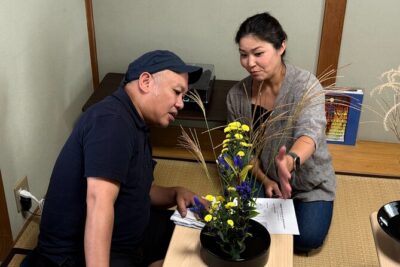
Browse the lists this tour appears in