
REVIEW · KYOTO IKEBANA CLASSES
Kyoto Cultural IKEBANA Experience@SEKKA FLOWERS
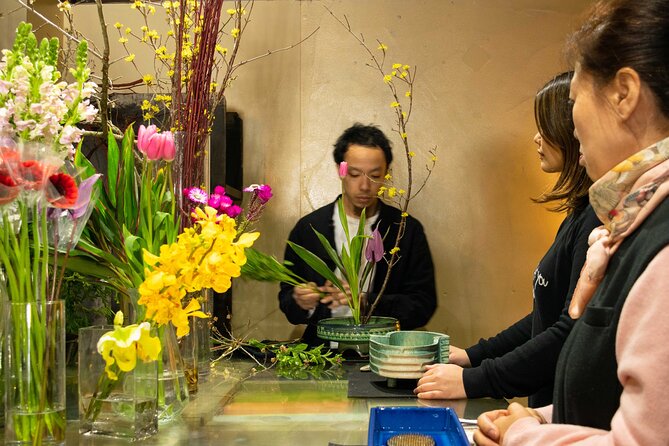
The most appealing part of this Kyoto activity is its quiet setting: you create an ikebana arrangement inside a roughly 100-year-old traditional townhouse, not in a large tourist venue. Taro-san and Chiaki-san guide you through classical forms, then let you make choices of your own.
I like two things especially. First, the workshop treats flowers and branches as natural objects, rather than forcing them into a stiff design. Second, your finished arrangement can be delivered to your accommodation afterward, giving you more than a quick classroom souvenir. The main consideration is the short 40-minute duration, which leaves little room for a slow, elaborate arrangement.
In This Review
- Key points to know before booking
- A quiet flower lesson near Kyoto’s major temples
- What happens during the 40-minute ikebana class
- Why the townhouse setting changes the experience
- The seasonal flowers and the idea of natural beauty
- A useful pause after Kinkaku-ji or Daitoku-ji
- Is the $65.15 price fair?
- A good choice for families, couples, and first-time makers
- What the strongest praise tells you
- Booking details and small practical points
- Should you book the SEKKA FLOWERS ikebana experience?
- FAQ
- Where does the ikebana experience take place?
- Is the activity near Kinkaku-ji?
- How long does the ikebana class last?
- Are beginners welcome?
- How many people can participate?
- Who teaches the class?
- Where does the activity end?
- Is public transportation available nearby?
- What is the cancellation policy?
Key points to know before booking
- A small-group class: The maximum is six people, so instruction should feel personal rather than rushed.
- A historic Kyoto setting: The flower shop occupies a renovated traditional townhouse close to Kinkaku-ji and Daitoku-ji.
- Classical ikebana principles: You will learn how to respect the natural shape of flowers and branches while working with seasonal materials.
- A calm break from sightseeing: The session offers a peaceful change of pace after Kyoto’s crowded temple routes.
- Friendly creative guidance: Taro-san and Chiaki-san explain the ideas clearly while leaving room for your own choices.
- Possible flower delivery: Arrangements have been delivered to accommodations afterward, allowing you to enjoy them beyond the class.
A quiet flower lesson near Kyoto’s major temples
SEKKA FLOWERS is at 44-4 Murasakino Kamimonzencho in Kyoto’s Kita Ward. The location is near Kinkaku-ji, the famous Golden Pavilion, and Daitoku-ji, a large temple complex known for its Zen atmosphere.
That location makes the class easy to pair with temple sightseeing. You can visit one of the area’s major religious sites, then trade the crowds and camera stops for a focused hour with flowers and branches. I like this kind of pairing because it gives your day two different views of Japanese culture: grand public architecture and a small hands-on art lesson.
The setting matters. A renovated townhouse gives the activity a more local feel than a modern hotel classroom. You are working in a flower shop with traditional Japanese character, which helps the lesson feel connected to Kyoto rather than simply portable to any city.
The meeting point is also the ending point. You do not need to arrange a separate return transfer, and the activity stays centered on the shop and its traditional room.
More flower-arranging classes:
- Ikebana Traditional Japanese Art of Flower Arranging
★ 4.5 · 19 reviews - Traditional Japanese Flower Styling Workshop – Ikebana in Kyoto
★ 5.0 · 10 reviews - Kyoto: Ikebana (Japanese Flower Arrangement)
★ 3.7 · 9 reviews
What happens during the 40-minute ikebana class
The class begins with an introduction to ikebana, the Japanese art of flower arrangement. You learn about its background and the way seasonal flowers have long been part of Japanese life and aesthetics.
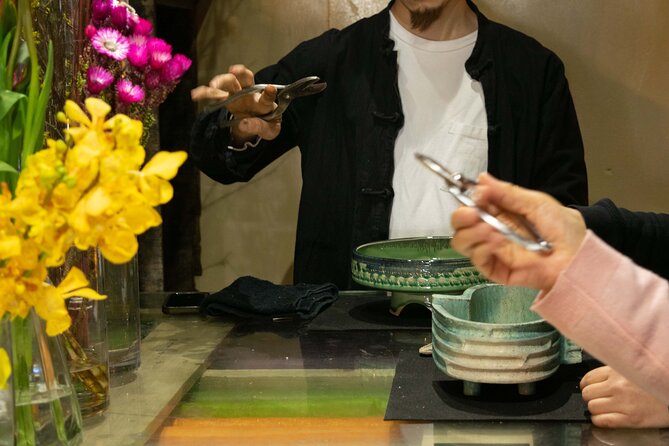
The lesson is not simply about making a pretty bouquet. Classical ikebana pays attention to line, space, balance, and the natural direction of each stem. A branch may curve, split, or point in an unexpected way. Instead of hiding that character, you use it as part of the design.
That approach is important for beginners. You do not need to arrive with an artistic background or previous flower-arranging experience. The instructors show you how to look at the material first, then decide how to use it.
The class also introduces wabi-sabi, a Japanese aesthetic that values simplicity, imperfection, and the marks of natural change. In practical terms, this means your arrangement does not need to look perfectly symmetrical or polished. A bent branch or a flower at a slightly different height can give the arrangement its character.
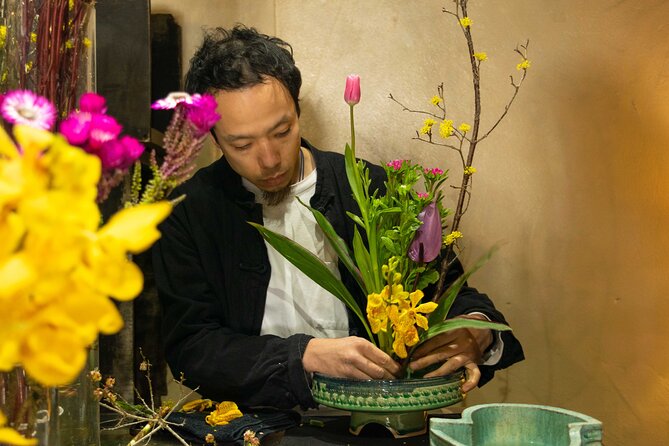
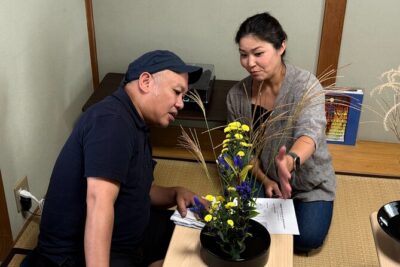
After the explanation, you create your own piece with guidance from the instructors. Taro-san and Chiaki-san offer direction, but the teaching style leaves room for personal choices. That balance is one of the strongest reasons to book this activity. Too much instruction can make a class feel like copying a model. Too little can leave you wondering what to do. Here, you are shown the principles, then encouraged to work with your own eye.
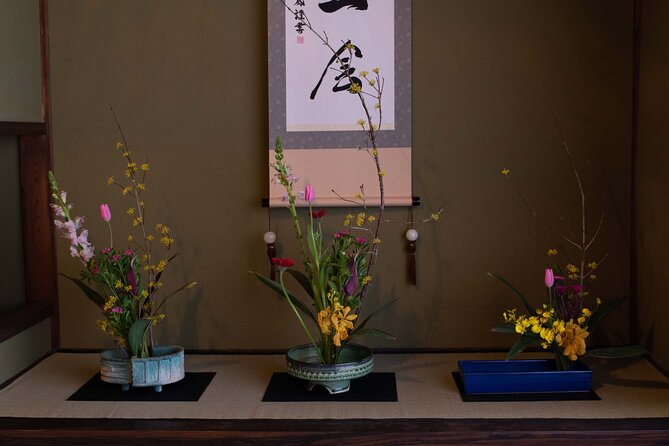
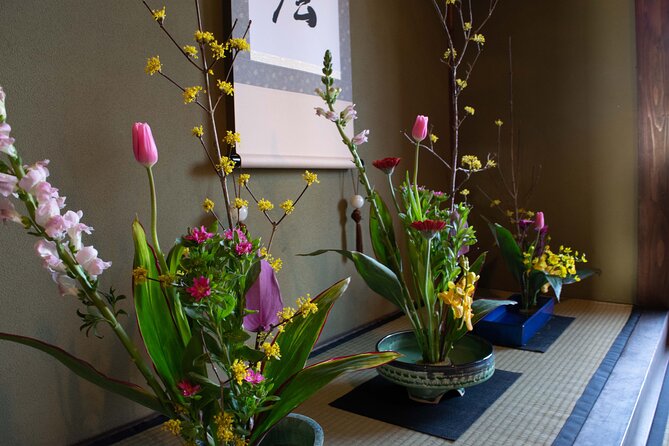
Your finished arrangement is displayed in a tokonoma, the recessed alcove found in a traditional Japanese room. This is not just a convenient place to set the flowers. The tokonoma has a special role in Japanese interiors, where a carefully chosen object, flower arrangement, or scroll becomes the focus of the room.
For a short session, the structure is sensible. You receive cultural context, practical instruction, time to make your own piece, and a chance to see it presented in a traditional setting. Still, you should not expect a full professional ikebana course. Forty minutes is enough for a memorable introduction, not a detailed study of every school or formal technique.
Why the townhouse setting changes the experience
Kyoto has no shortage of cultural activities, but the setting can make a big difference. A workshop held in a renovated townhouse gives you a look at a type of building that is easy to pass without entering. The flower shop’s age and traditional design add atmosphere without turning the activity into a staged performance.
You are not only hearing about Japanese aesthetics. You are practicing one inside a room designed to frame a carefully placed object. The arrangement in the tokonoma helps you see how ikebana fits into daily interiors, rather than treating it as an isolated craft.
I also like the scale of the experience. With no more than six participants, the class has a better chance of feeling calm and attentive. A tiny group does not guarantee a private lesson, but it should make it easier to follow the demonstration and ask questions.
The small group may not suit someone who wants a lively social activity with lots of participants. This is better for people who enjoy concentration, quiet conversation, and a little creative breathing room.
The seasonal flowers and the idea of natural beauty
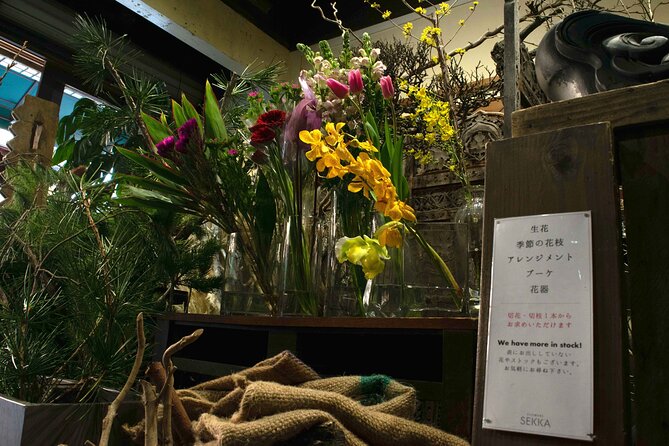
The flowers reflect Japan’s changing seasons. The exact materials are not specified in advance, and that is part of the appeal. You work with what is available and learn to notice the character of each stem, branch, and bloom.
This seasonal focus gives the class a stronger connection to Kyoto than a standard craft project using fixed materials. Your arrangement belongs to the time of year when you visit. It may look different from one created in another season, even if the basic principles remain the same.
The instructors’ classical approach focuses on bringing out the beauty of the flowers and branches while respecting their natural state. That means the class is not about packing a container with as many flowers as possible. Empty space and the angle of a branch matter too.
If you prefer bold color combinations and large bouquets, you may find the result more restrained than expected. If you enjoy simple design and natural forms, the method offers plenty to think about. The lesson may also change how you look at flowers in shops and gardens after you leave.
A completely different side of Kyoto:
- PERFECT KYOTO 1-Day Bus Tour
★ 5.0 · 13,518 reviews - Kyoto: Fushimi Inari, Kinkakuji, Bamboo Grove 1 Day Bus Tour
★ 4.8 · 4,316 reviews - Kyoto: Tea Ceremony in a Traditional Tea House in Kiyomizu
★ 4.9 · 3,519 reviews - Kyoto Geisha Walking Tour: Gion District & Hidden Gems
★ 4.7 · 3,273 reviews
A useful pause after Kinkaku-ji or Daitoku-ji
The location makes this a practical addition to a Kita Ward day. Kinkaku-ji is one of Kyoto’s most famous sights, and Daitoku-ji offers a different mood through its temple grounds and Zen connections. Both can be part of a busy sightseeing schedule.
The ikebana class gives you a slower activity to place between major stops. You are seated, focused, and working with your hands. That makes it a good choice if your trip includes many temples and you want one experience that does not involve another long walk or large crowd.
Timing still deserves attention. The class lasts about 40 minutes, but you should allow extra time to reach the address and find the shop. The activity is close to public transportation, which helps, though the supplied details do not specify a particular station, bus, or travel time. Check your route on the day and avoid scheduling a temple admission immediately afterward.
The meeting point and return point are the same, so the activity is easy to fit into a larger plan. If your accommodation is nearby, ask about the flower delivery arrangement. Several participants have been able to enjoy their flowers at their lodging later, which is especially useful if you do not want to carry an arrangement through the rest of the day.
Is the $65.15 price fair?
At $65.15 per person, this is not the cheapest short activity in Kyoto. The class lasts only about 40 minutes, so you are paying for setting, instruction, materials, and the chance to create a personal arrangement, not for a half-day lesson.
The value improves if you care about authentic cultural context. You are not simply buying flowers and placing them in a container. You are learning why line, space, season, and natural form matter in ikebana, then seeing your work displayed in a tokonoma.
The small maximum of six also helps justify the price. A large class could offer the same basic craft at a lower cost, but it would likely feel less personal. Here, the teaching team can keep an eye on each arrangement and provide guidance without taking over.
The possible accommodation delivery adds value when available. It means you may enjoy your flowers after the class instead of leaving them at the shop or carrying them around Kyoto. Since delivery details are not fully specified, you should confirm how this works when arranging your visit.
I would consider the price reasonable for a special-occasion activity, a couple’s outing, or a family experience. It may feel high if your main goal is a long technical lesson or a large take-home bouquet.
A good choice for families, couples, and first-time makers
Beginners are welcome, and the gentle teaching style makes this a strong choice for people who are curious about ikebana but unsure of their artistic ability. You do not have to produce a perfect arrangement. The point is to notice the materials and make thoughtful decisions.
Couples may enjoy the contrast between working side by side and making separate creative choices. The peaceful setting also gives you a break from the constant movement of a Kyoto sightseeing day.
Families can join as well. The activity has worked for adults and children together, with the whole family able to take part in the arrangement process. Keep in mind that the session is short and focused, so very young children may need help staying involved.
This experience also suits solo visitors. A small class and instructor guidance make it easier to participate without needing a companion. The creative freedom means you can produce something personal rather than simply following a group project.
It is less suitable if you want a broad survey of Japanese arts, a long temple ceremony, or a formal certification course. This is a compact introduction to one art form in a traditional setting.
What the strongest praise tells you
The highest marks center on three practical strengths: the peaceful mood, the quality of instruction, and the ability to enjoy the arrangement afterward.
The calm atmosphere is especially useful in Kyoto, where major sights can be crowded and noisy. You get a chance to slow down without giving up cultural content.
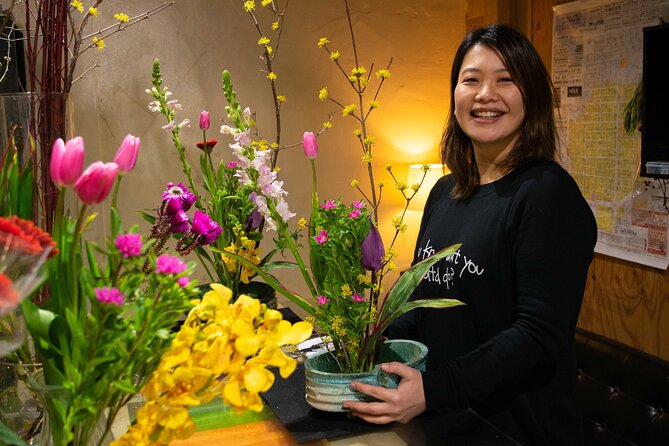
The instructors are repeatedly praised for being welcoming and well informed. Their method combines explanation with restraint. They teach the principles, answer questions, and let you make your own choices. That is the right approach for an art built around personal observation.
The flower delivery is another unusual benefit. Having your arrangement brought to your accommodation means the class can continue to be part of your trip after you leave the townhouse. It also reduces the problem of carrying fresh flowers through buses, temple grounds, and restaurants.
The experience has a 5 out of 5 rating from 11 published ratings, with 100 percent recommending it. That is a small sample, so I would not treat it as a guarantee. Still, the praise is consistent and focuses on specific parts of the activity rather than vague enthusiasm.
Booking details and small practical points
Confirmation is provided when you book, and the ticket is mobile, so you can keep the booking on your phone. The experience is near public transportation, but exact route details are not provided, so plan your journey before setting out.
Most people can participate, and service animals are allowed. The group maximum is six people. If you are traveling with a larger party, you should not assume everyone can join the same session.
You can cancel for a full refund up to 24 hours before the local start time. Cancellations or changes made less than 24 hours in advance are not refunded or accepted, so leave some room in your Kyoto schedule before booking.
This activity is often booked about 35 days ahead. That advance pattern suggests you should reserve early if your dates are fixed, especially if you want to place it near visits to Kinkaku-ji or Daitoku-ji.
Should you book the SEKKA FLOWERS ikebana experience?
Book it if you want a small, calm, hands-on introduction to Japanese culture, especially if you are already planning to visit Kyoto’s northern temples. The traditional townhouse, seasonal materials, tokonoma display, and personal instruction make the $65.15 worthwhile for the right kind of visitor.
I would choose it for couples, families, solo visitors, and anyone who wants something more thoughtful than a quick souvenir purchase. The short length is useful for a crowded itinerary, but it also limits how much technique you can learn.
Skip it if you want a long class, a large finished arrangement, or a detailed course in ikebana schools. For everyone else, this is a compact and meaningful way to bring a little of Kyoto’s seasonal beauty back to your room.
FAQ
Where does the ikebana experience take place?
The activity takes place at SEKKA FLOWERS, located at 44-4 Murasakino Kamimonzencho, Kita Ward, Kyoto, 603-8217, Japan.
Is the activity near Kinkaku-ji?
Yes. The flower shop is near Kinkaku-ji Temple and Daitoku-ji Temple, making it practical to combine with sightseeing in the area.
How long does the ikebana class last?
The experience lasts approximately 40 minutes.
Are beginners welcome?
Yes. Beginners are welcome to join the class.
How many people can participate?
The activity has a maximum of six participants.
Who teaches the class?
The instructors are Taro-san and Chiaki-san.
Where does the activity end?
The experience ends back at the meeting point at SEKKA FLOWERS.
Is public transportation available nearby?
Yes. The activity location is near public transportation, though specific station and route details are not provided.
What is the cancellation policy?
You can cancel up to 24 hours before the local start time for a full refund. Cancellations or changes made less than 24 hours before the start time are not accepted for a refund.
Recently added around Kyoto
- Higashiyama | Kyoto: Sakura Season Private Rickshaw Tour★ 5.0 · 3 reviews
- Kyoto Kimono Rental CHAMATSU|Kimono/Yukata Rental FamilyPlan★ 5.0 · 3 reviews
- Nara Private Customizable Half Day Tour★ 5.0 · 3 reviews
- Kyoto: Half-Day Private Guided Tour to the Old Town of Gion★ 4.4 · 3 reviews
- Kansai Region Hiking Adventure in Nara Kobe Kyoto and More★ 5.0 · 3 reviews
- Full Day Nara Deer, Temple, Shrine, Activities & Tea Ceremony★ 5.0 · 3 reviews
- Nara: Essential Private Tour with Deer Park and Temples★ 5.0 · 3 reviews
- Hiking Tour for Sacred Sites in Kyoto with a Guide★ 5.0 · 3 reviews
Kyoto Ikebana Classes, compared.

Ikebana Traditional Japanese Art of Flower Arranging
Read our review →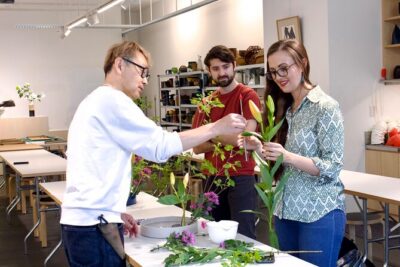
Traditional Japanese Flower Styling Workshop – Ikebana in Kyoto
Read our review →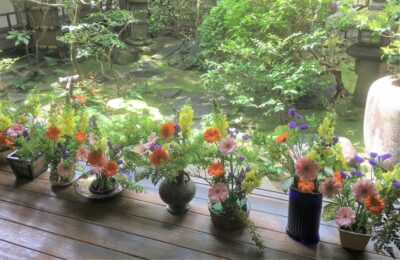
Browse the lists this tour appears in