REVIEW · TOURS
Kyoto Half Day Highlights Tour
Kyoto packs a remarkable amount into this three-and-a-half-hour walking tour. You move from geisha streets and old stone lanes to Kiyomizu-dera and the orange torii tunnels of Fushimi Inari, two of the city’s essential sights, without spending your limited time sorting out trains and routes.
I like the small maximum group of 12, which keeps the walk personal, and I like the clear progression from Gion to southern Higashiyama and then Fushimi. Guides such as Mari add useful background on geisha, Shinto, Buddhism, and local customs. The tradeoff is simple: this is a brisk walk with hills, steps, and Kyoto humidity, so comfortable shoes and moderate fitness are important.
In This Review
- Key points to know before you book
- Why this short Kyoto route works
- Starting in Gion at 3 p.m.
- Yasui-Konpiragu and the meaning of the power stone
- Yasaka Pagoda and the old Higashiyama lanes
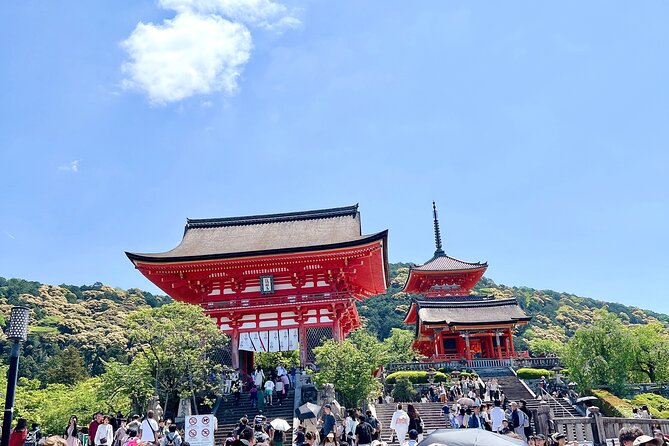
- Kiyomizu-dera and its famous wooden terrace
- Fushimi Inari and the orange torii tunnels
- What the guide adds to the experience
- How strenuous is the walk?
- Who will get the most from this tour?
- Should you book the Kyoto Half Day Highlights Tour?
- FAQ
- How long does the Kyoto Half Day Highlights Tour last?
- Where does the tour start?
- Where does the tour end?
- Is admission included?
- How large is the group?
- Can I cancel for a refund?
Key points to know before you book
- Three major Kyoto areas in one afternoon: Gion, Kiyomizu-dera, and Fushimi Inari are linked in a well-planned route.
- A small group of up to 12: You get more room to ask questions than on a large coach tour.
- A 3 p.m. start: The afternoon timing works well after a morning arrival or an earlier temple visit.
- One admission fee included: Entry to Kiyomizu-dera is covered, while the shrines and outdoor lanes are free.
- A walking tour with real exercise: Expect slopes, stairs, and roughly three hours of movement.
- Easy public transport at the end: The tour finishes in front of Fushimi Inari Shrine, close to JR and Keihan stations.
Why this short Kyoto route works
Kyoto can be confusing on a first visit. Its famous sights are spread across different neighborhoods, and a short stay makes every transfer matter. This tour solves part of that problem by joining several high-value stops into one continuous afternoon.
The route begins in Gion, where narrow streets and traditional buildings give you a first look at old Kyoto. It then heads through Higashiyama, passing shrines, a pagoda, and the famous Ninenzaka and Sannenzaka slopes before reaching Kiyomizu-dera.
The final leg takes you to Fushimi Inari, where the setting changes from historic lanes to wooded mountain paths lined with thousands of orange gates. You finish near a railway station rather than having to retrace your steps. That is a practical touch, especially after a full afternoon on foot.
At $50 per person, the price is reasonable if you want context and direction rather than simply checking off sights. You are paying for a guide, a planned route, and admission to Kiyomizu-dera. The shrines and neighborhood walks do not require admission, and public transportation costs an additional ¥220 per person.
This is not the cheapest way to visit Kyoto’s temples. You can walk parts of the route alone for little money. But the value improves if you are in Kyoto for only a day or two, want help understanding what you see, or tend to lose time navigating unfamiliar streets.
Other Kyoto mornings people book alongside this one:
- PERFECT KYOTO 1-Day Bus Tour
★ 5.0 · 13,518 reviews - Kyoto: Fushimi Inari, Kinkakuji, Bamboo Grove 1 Day Bus Tour
★ 4.8 · 4,316 reviews - Kyoto: Tea Ceremony in a Traditional Tea House in Kiyomizu
★ 4.9 · 3,519 reviews
Starting in Gion at 3 p.m.
The meeting point is Gion-Shijo Station, at 1 Chome Miyagawasuji in Kyoto’s Higashiyama Ward. The 3 p.m. start leaves your morning open for another sight, a meal, or a slower beginning after arriving in Kyoto.
Gion is best appreciated on foot. The district is famous for geisha culture, but it is not a stage set. You will see lanes, old facades, small entrances, and a neighborhood that still functions as part of modern Kyoto. Your guide can explain the difference between geisha and maiko, along with the customs that are easy to miss when you walk through alone.
The first section lasts about 30 minutes and requires no admission fee. It is a gentle introduction to the city, though the streets can be crowded and the group needs to stay together. Keep your expectations respectful. You are looking at a working neighborhood, not attending a public performance.
Guides named Mari and Marie have been praised for making this part both informative and lighthearted. Mari is also noted for taking photos for participants, a useful bonus if you are traveling alone or want a group picture without handing your phone to a stranger.
Yasui-Konpiragu and the meaning of the power stone
The next stop is Yasui-Konpiragu Shrine, reached during the walk through historic Higashiyama. The visit lasts about 10 minutes and is free.
The shrine is known for its unusual power stone and the passageway through it. The act has symbolic meaning connected with breaking unwanted ties and forming better ones. Your guide can give the ritual some context, which helps you understand why people approach the stone and pass through it rather than treating it as just another photo stop.
This is a short visit, so do not expect a long shrine tour. Its value comes from the contrast with the larger sights nearby. Kyoto’s famous temples draw most of the attention, while smaller religious sites can offer a clearer look at everyday beliefs and local practice.
Yasaka Pagoda and the old Higashiyama lanes
Hokan-ji Temple, commonly called Yasaka Pagoda, is the next stop. The five-story pagoda rises 46 meters and is the last remaining structure of a temple complex dating to the sixth century.
The visit lasts about 10 minutes and admission is free. The pagoda is especially striking from the surrounding lanes, where its height gives the neighborhood a strong sense of place. You get a quick look rather than an extended temple visit, but that suits the pace of this half-day tour.
From here, the walk continues along Ninenzaka and Sannenzaka. These stone-paved slopes lead toward Kiyomizu-dera and are lined with traditional buildings, shops, and places to pause for a snack.
This is one of the most pleasant sections of the route, but it is also one of the least forgiving for anyone with mobility concerns. The slopes are uneven, and the walk includes steady movement between stops. You will want shoes with a firm grip. Bring water, particularly during Kyoto’s humid months.
The lanes can also be busy. A guide helps the group keep moving and points out details you might pass without noticing, but this is not a quiet stroll at every moment. The charm comes from the architecture, the changing views, and the sense that you are moving through an old part of the city rather than arriving at a single isolated monument.
A completely different side of Kyoto:
- Kyoto Geisha Walking Tour: Gion District & Hidden Gems
★ 4.7 · 3,273 reviews - Kyoto: Tea Ceremony Ju-An at Jotokuji Temple
★ 4.9 · 3,207 reviews - Kyoto: Gion Magical Night Walking Tour with Geisha Trivia
★ 4.9 · 2,393 reviews - Kyoto: 45-Minute Tea Ceremony Lesson Experience
★ 4.3 · 2,378 reviews
Kiyomizu-dera and its famous wooden terrace
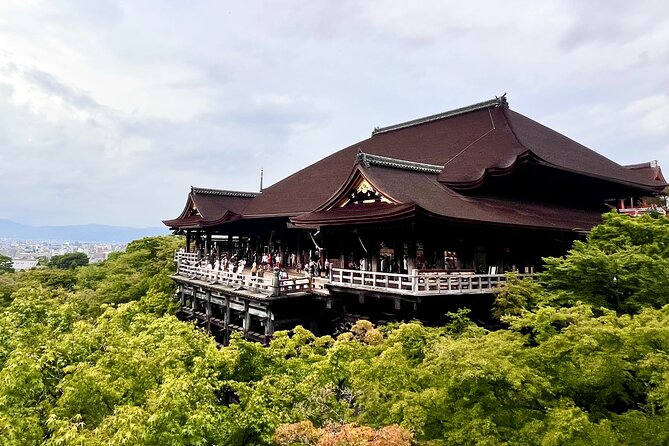
Kiyomizu-dera receives about 45 minutes, the longest stop before Fushimi Inari. Admission is included, which adds practical value to the $50 price.
The temple is famous for its large wooden terrace, supported by a complex structure of timbers and set above the hillside. From the terrace, you get broad views across Kyoto. The grounds also include pagodas, smaller religious buildings, and sacred waterfalls associated with different blessings.
Forty-five minutes gives you enough time to see the main features and listen to an explanation, but it does not allow for every corner of the temple grounds. If Kiyomizu-dera is your top priority, you may later want to return independently with more time.
The guide’s role matters here. Buddhism and Shinto are not simply collections of old buildings, and the meaning of the spaces can be hard to grasp from signs alone. Guides such as Mari explain customs, religious details, and the stories behind the sites in a way that connects the architecture to daily life.
The temple is also a good point to judge the pace of the tour. You will be moving on rather than lingering for an hour at every viewpoint. That is the price of fitting several major places into one afternoon.
Fushimi Inari and the orange torii tunnels
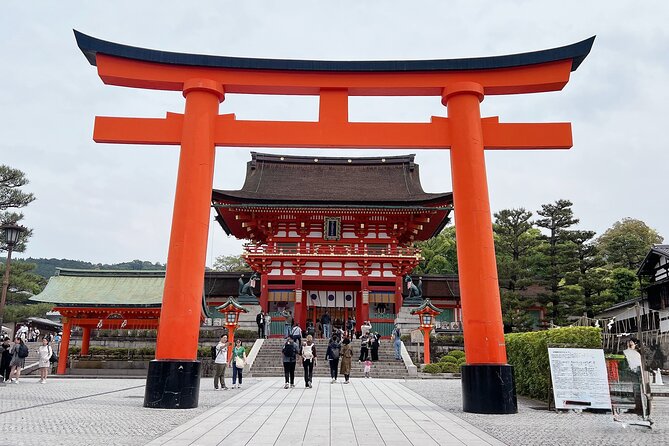
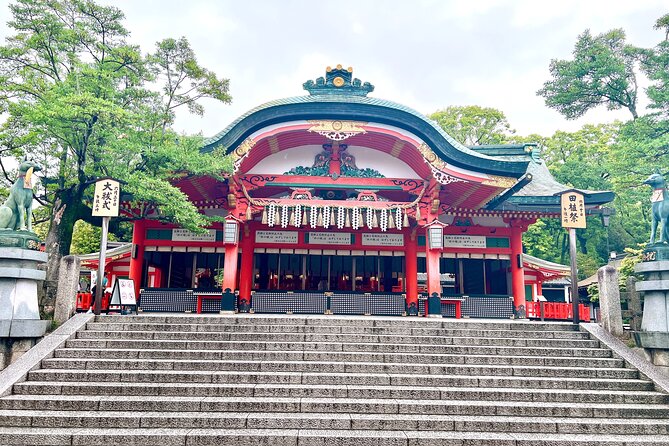
The tour’s final and longest stop is Fushimi Inari-taisha Shrine. You spend about one hour here, with no admission fee, and finish in front of the shrine near Fushimi Inari JR and Keihan stations.
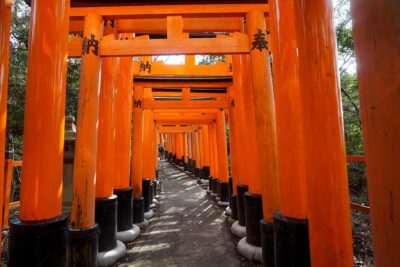
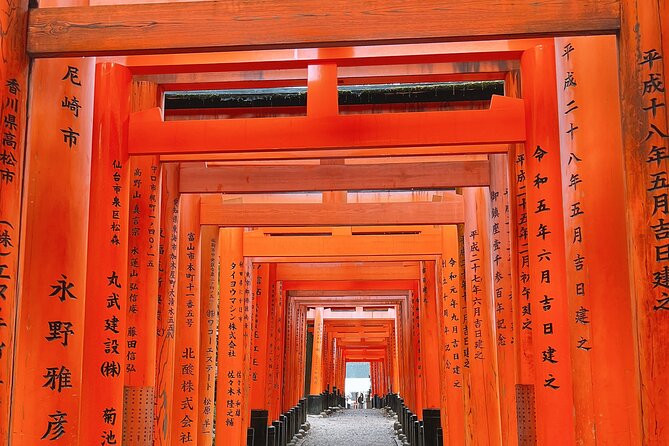
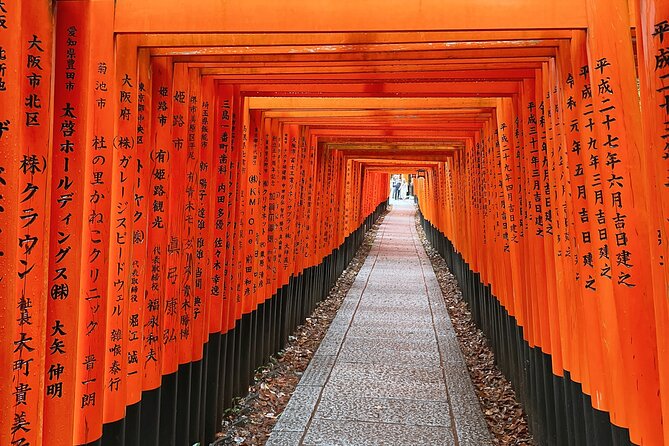
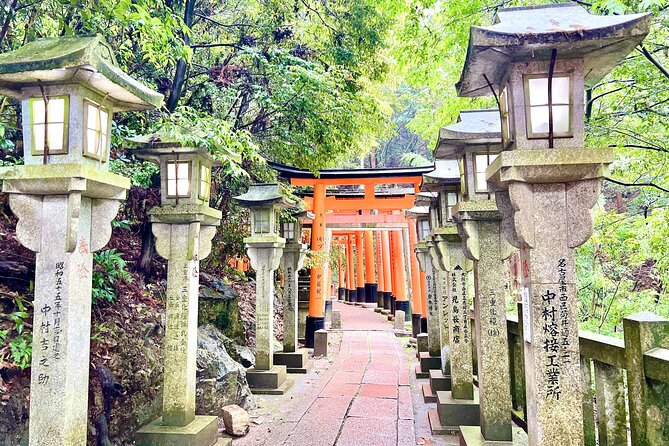
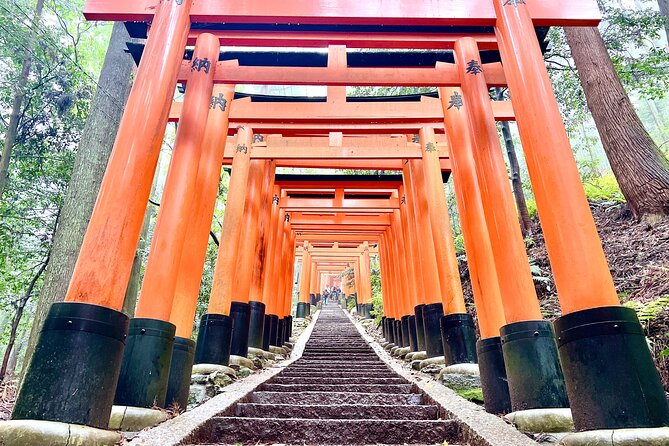
Fushimi Inari is dedicated to the god associated with rice and prosperity. Its most famous feature is the series of orange torii gates that line the paths up the mountain. The gates create tunnels of color and shade, with the route winding uphill through a wooded setting.
The first section is the part most people come to see, and the tour gives you time to walk through it with an explanation of the shrine’s purpose and symbols. The paths continue much farther up the mountain, but a three-and-a-half-hour city tour cannot cover the entire route at a leisurely pace.
This is the most physically demanding part of the afternoon. Even if you do not go far uphill, you will be walking on an incline and may encounter stairs. The orange gates are memorable, but the site is not a quick, flat photo stop.
Ending here makes good sense. You can leave by JR or Keihan train instead of returning to Gion. That gives you a convenient next step for dinner or another Kyoto neighborhood. The extra public transportation cost is listed as ¥220 per person, so budget for that separately.
What the guide adds to the experience
A self-guided walk can show you the same buildings, but it may not explain why they matter. This tour is strongest when the guide connects the places rather than simply naming them.
The guides named in the tour feedback include Mari, Marie, and Maricel. Mari is described as friendly, flexible, funny, and good at explaining local history and customs. One account also describes help after a late arrival caused by travel problems, though you should still aim to arrive on time.
The guide may adjust the pace or route to suit the group. That flexibility is useful, but the published plan still includes a lot of ground. Do not book this expecting a private, slow photo session at every stop.
The most useful subjects covered include geisha culture in Gion, Shinto shrine practices, Buddhist sites, and the meaning behind the major landmarks. You also get the benefit of being shown where to go next, which reduces the small navigation errors that can consume a short Kyoto visit.
A small group of no more than 12 supports this style of guiding. You can hear explanations more easily, ask questions, and avoid the impersonal feel of a large bus group. The group size is not a guarantee that the tour will always be full, but the limit keeps it manageable.
How strenuous is the walk?
The tour requires moderate physical fitness. That phrase matters here. You are not just walking between two nearby attractions. You are covering Gion streets, Higashiyama slopes, temple grounds, and part of the Fushimi Inari mountain route.
Wear comfortable walking shoes. The stone lanes around Ninenzaka and Sannenzaka can be tiring, while Fushimi Inari adds inclines and steps. Kyoto’s humidity can make the same distance feel harder, so water and light clothing are sensible choices.
Snacks are not included. You may find places to buy food along the way, but the tour is organized around sightseeing rather than a planned meal break. Eat beforehand if you need a substantial meal, and do not count on the walking pace leaving much time for a sit-down stop.
The experience requires good weather. If poor weather causes cancellation, you can choose a different date or receive a full refund. For your own comfort, a forecast with heavy rain would also make the stone paths and hillside sections less appealing.
Who will get the most from this tour?
I would choose this tour if you have limited time in Kyoto and want a strong first look at several famous areas. It is also a good fit if you prefer hearing the cultural background rather than reading signs or managing every train and turn yourself.
Solo visitors can benefit from the small group and the guide’s help with photographs. First-time visitors may appreciate the structure, especially because Gion, Kiyomizu-dera, and Fushimi Inari can feel like separate trips when planned alone.
Families with older children may also enjoy it if everyone is comfortable walking. The route is active, and younger children who tire easily may find the hills and temple grounds demanding.
I would hesitate if you need a slow pace, have difficulty with slopes or stairs, or want extensive time inside each temple. I would also skip it if you have already explored Gion and Higashiyama and want a more specialized experience focused on one neighborhood.
Book at least a day ahead if your schedule is fixed. The experience is booked, on average, 54 days ahead, which suggests that popular dates can fill well before arrival. Free cancellation is available until 24 hours before the 3 p.m. start time. Changes or cancellations inside that window are not accepted for a refund.
Should you book the Kyoto Half Day Highlights Tour?
Book it if you want efficient sightseeing with cultural explanation and can handle a brisk afternoon walk. The route covers Kyoto’s most recognizable sights, includes Kiyomizu-dera admission, keeps the group small, and finishes beside useful train stations.
Skip it if your ideal day means lingering, eating slowly, or exploring one temple in depth. At $50, the tour earns its value through time saved, route planning, and guide commentary, not through a long list of included extras.
For a first Kyoto visit with only a short window, this is a sensible way to connect Gion’s old streets, Kiyomizu-dera’s terrace, and Fushimi Inari’s orange gates in one well-paced afternoon.
FAQ
How long does the Kyoto Half Day Highlights Tour last?
The tour lasts approximately 3 hours and 30 minutes. It begins at 3 p.m. and ends near Fushimi Inari Shrine.
Where does the tour start?
The meeting point is Gion-Shijo Station at 1 Chome Miyagawasuji, Higashiyama Ward, Kyoto, 605-0801, Japan.
Where does the tour end?
The tour ends in front of Fushimi Inari Shrine, close to Fushimi Inari JR Line and Keihan Line stations.
Is admission included?
The guide service and the admission fee for Kiyomizu-dera are included. Gion, Yasui-Konpiragu, Hokan-ji, Ninenzaka, Sannenzaka, and Fushimi Inari are visited without a separate admission charge.
How large is the group?
The maximum group size is 12 people.
Can I cancel for a refund?
You can cancel at least 24 hours before the local start time for a full refund. Cancellations or changes made less than 24 hours before the start are not accepted for a refund. If poor weather causes the tour to be canceled, you can receive a full refund or choose another date.
Recently added around Kyoto
- Higashiyama | Kyoto: Sakura Season Private Rickshaw Tour★ 5.0 · 3 reviews
- Kyoto Kimono Rental CHAMATSU|Kimono/Yukata Rental FamilyPlan★ 5.0 · 3 reviews
- Kyoto: Half-Day Private Guided Tour to the Old Town of Gion★ 4.4 · 3 reviews
- Nara Private Customizable Half Day Tour★ 5.0 · 3 reviews
- Kansai Region Hiking Adventure in Nara Kobe Kyoto and More★ 5.0 · 3 reviews
- Full Day Nara Deer, Temple, Shrine, Activities & Tea Ceremony★ 5.0 · 3 reviews
- Nara: Essential Private Tour with Deer Park and Temples★ 5.0 · 3 reviews
- Hiking Tour for Sacred Sites in Kyoto with a Guide★ 5.0 · 3 reviews
Tours, compared.
Fushimi Inari, Kinkakuji, Bamboo Grove 1 Day Bus Tour
Read our review →
Kyoto Geisha Walking Tour: Gion District & Hidden Gems
Read our review →
Gion Magical Night Walking Tour with Geisha Trivia
Read our review →
Gion Geisha District Walking Tour – Stories of Geisha
Read our review →

Kyoto Night Foodie Tour in Gion (9+ dishes + 6 Sake tastings)
Read our review →