
REVIEW · GION GEISHA DISTRICT TOURS
Kyoto Gion Historical Walking Tour
Kyoto’s eastern hills are where the city feels most like the Kyoto you imagined: stone lanes, wooden buildings, temple gates, gardens, and the tall Yasaka Pagoda appearing between rooftops. This tour connects Gion’s geisha district with Higashiyama’s famous temple quarter, giving you a useful story for the places you might otherwise see as a string of pretty photo stops.
I like the route for two reasons. First, it gives you a strong overview in three hours, from theater and geisha culture to Buddhist temples and the Meiji Restoration. Second, guides such as Jay, Ben, and Ayumi are praised for clear English, humor, historical depth, and practical advice for the rest of your Kyoto visit.
The tradeoff is simple: this is a real walking tour, not a gentle stroll. You will cover uneven lanes, slopes, and some stair climbing, with limited time for food or long temple visits. Comfortable shoes, water, and a snack will make a big difference.
In This Review
- Key points to know before you go
- Why this route works so well in Kyoto
- Starting near Gion Shibashi and Tatsumi Bridge
- Chion-in’s great gate and Buddhist setting
- Maruyama Park and Nene-no-Michi
- Yasaka Pagoda and the Higashiyama lanes
- Finishing at Kiyomizu-dera
- What the guides add to the walk
- Is $40 a good value?
- Who should book this Kyoto walking tour?
- Should you book it?
- FAQ
- How long is the Kyoto Gion Historical Walking Tour?
- Where does the tour begin?
- Where does the tour end?
- Which places are visited?
- Is the tour conducted in English?
- Is admission to the temples included?
- How much walking is involved?
- What should I wear?
- How large can the group be?
- Can I cancel for a refund?
Key points to know before you go
- A Gion-to-Higashiyama route: Begin near Shijo and finish at Kiyomizu-dera, passing Kyoto’s best-known eastern sights.
- History with a wider frame: Expect discussion of emperors, samurai, monks, geisha, theater, religion, and the Meiji Restoration.
- A small maximum group: The tour accepts no more than 12 people, which makes questions and guide interaction easier.
- Strong guide feedback: Jay, Ben, Ayumi, Michel, and Tommy are among the guides praised for clear English and engaging explanations.
- Kiyomizu-dera admission costs extra: The walking tour includes the guiding service, but temple admission is not included.
- Good value at $40: You pay for a focused three-hour orientation rather than separate entry tickets or lunch.
Why this route works so well in Kyoto
Kyoto can be confusing on a first visit. One lane leads to a shrine, another to a temple, and a third to a shop selling sweets or ceramics. Without context, the city’s old streets can become a pleasant blur.
This walk gives that blur a storyline. You begin around Gion, one of Kyoto’s most famous historic districts, then move through temple grounds and hillside lanes toward Kiyomizu-dera. The route also lets you see how old Kyoto functions today, with modern shops and daily city life sharing the same streets as centuries-old buildings.
The tour lasts about three hours. That is long enough to cover a lot of ground, but short enough to fit into a morning or afternoon. It is best used near the start of your Kyoto stay, when you want to understand the city before returning later to explore favorite places at your own pace.
The group limit of 12 matters here. Narrow streets and busy temple approaches are easier to manage with a small group than with a large crowd. You can also ask questions without needing to shout across a line of people.
More evenings in Gion:
- Kyoto Geisha Walking Tour: Gion District & Hidden Gems
★ 4.7 · 3,273 reviews - Kyoto: Gion Magical Night Walking Tour with Geisha Trivia
★ 4.9 · 2,393 reviews - Kyoto: Gion Geisha District Walking Tour – Stories of Geisha
★ 4.7 · 2,187 reviews
Starting near Gion Shibashi and Tatsumi Bridge
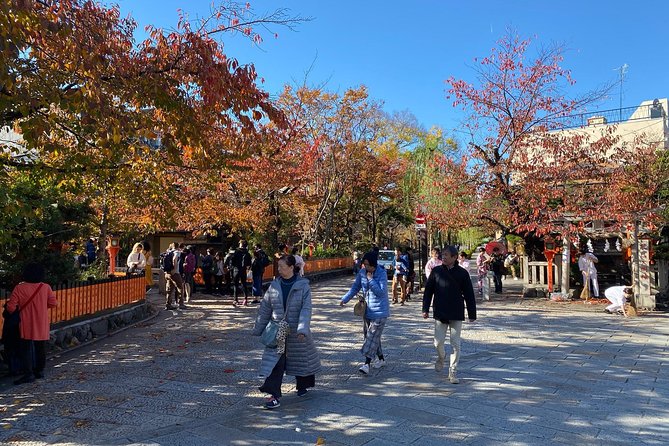
The meeting point is in front of Ben’s Cookies Kyoto at 89 Shinchō in the Shimogyo Ward. From there, the walk reaches the Gion Shibashi area and Tatsumi Bridge.
Tatsumi Bridge is a short stop, listed at about 15 minutes, but it sets the mood quickly. The surrounding lanes are among the most attractive in Gion, with traditional architecture and a quieter feel than the district’s larger streets. Your guide uses this opening to explain the area’s connection with entertainment, theater, and geisha culture.
This is a good place to listen rather than rush for photographs. Gion is often treated as a backdrop, but the guide can help explain how the district developed and how its customs fit into Kyoto life today. You may also hear about local etiquette, which is useful if you plan to return independently.
The route begins in a central area, so public transportation is nearby. Still, confirm the exact meeting details before leaving your hotel. Kyoto’s lanes can be easy to misread, especially if you are following a map while trying to find a particular shop entrance.
Chion-in’s great gate and Buddhist setting
The next major stop is the Sanmon gate at Chion-in Temple. The tour allows about 10 minutes at the gate, followed by roughly 20 minutes inside the temple area.
Chion-in’s Sanmon is enormous, built of wood and designed to make you feel small as you approach. It is not just an entrance for a photograph. It announces the scale and power of the temple complex, and it gives your guide a natural way to explain Buddhist institutions in Kyoto.
Chion-in was founded in the 13th century and is associated with one of Japan’s major Buddhist traditions. You do not need prior knowledge of Japanese religion to follow the explanation. A good guide can point out what you are seeing, explain how temple spaces are used, and separate Buddhist practice from the many simplified images that appear in popular culture.
This is one of the places where a guide adds real value. On your own, you might admire the gate and move on. With a clear explanation, the temple becomes part of Kyoto’s religious and political story.
There is a practical catch. Chion-in is only one stop on a route that keeps moving, so this is not a temple tour with time for every building or quiet corner. If you already know you want a long visit here, mark it for a return trip after the walking tour.
Maruyama Park and Nene-no-Michi
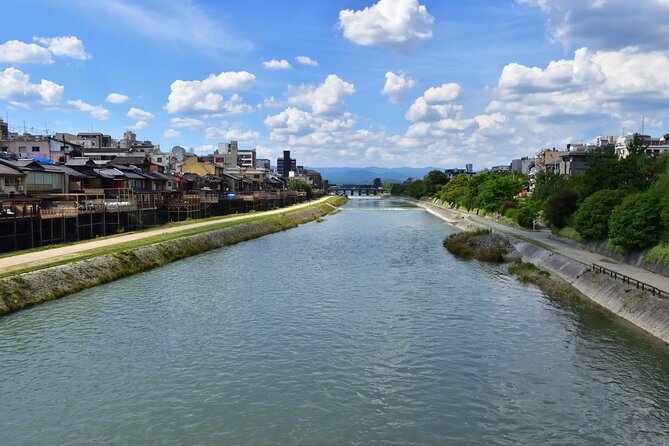
After Chion-in, the route continues through Maruyama Park, with about 10 minutes set aside for the stop. The park provides a welcome change from temple gates and narrow streets. It is an urban green space where you can pause, look around, and see how Kyoto mixes open public areas with historic districts.
The guide may use the park to discuss seasonal customs, city life, and the relationship between nature and religious sites. The stop is not long, so think of it as a breathing space rather than a full park visit.
From there, you walk along Nene-no-Michi, or the Path of Nene. This stone-paved lane takes its name from Nene, the wife of Toyotomi Hideyoshi. Its historical link gives the guide another opening to discuss the people and events that shaped Kyoto.
Nene-no-Michi is also one of the prettiest walking sections. The paving, old-style buildings, and nearby temple grounds create the kind of scene many people hope to find in Kyoto. It can also be busy, so you should expect other people sharing the path and allow space for pedestrians.
The route’s strength is the contrast. You move from a public park to a historic lane, then on toward a tall pagoda and the temple slopes. That variety keeps the three-hour walk from feeling like a repeated sequence of gates.
More history walks in Kyoto:
- World Heritage Kyoto & Nara Uji Authentic Matcha Experience
★ 5.0 · 1,573 reviews - Kyoto Gion: 2-Hour Geisha Culture & History Walking Tour
★ 5.0 · 1,186 reviews - Historical Kyoto E-Bike Tour
★ 5.0 · 181 reviews - Kyoto: Nijo Castle World Heritage Guided Tour with Admission
★ 5.0 · 128 reviews
Yasaka Pagoda and the Higashiyama lanes
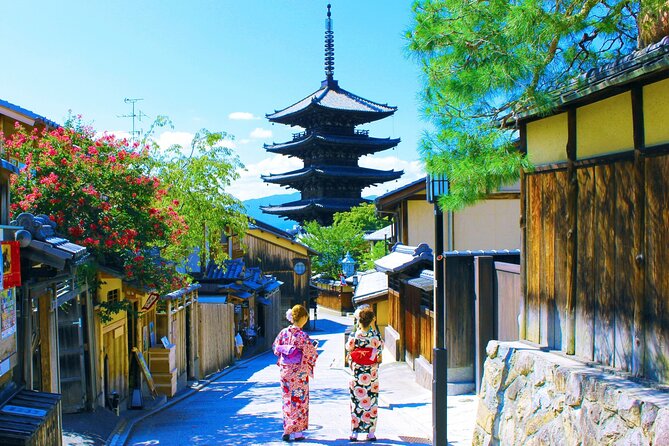
Hōkan-ji Temple, better known as Yasaka Pagoda, is one of the visual anchors of the walk. Its five-story pagoda rises above the Higashiyama District and is especially striking from the surrounding lanes.
The scheduled stop is about 10 minutes. That is enough to appreciate the view and hear the basic story, but not enough for an extended visit inside every part of the temple. Admission is listed as free for this stop, while Kiyomizu-dera later requires a separate fee.
From Yasaka Pagoda, the walk enters the famous Ninen-zaka and Sannen-zaka slopes. These stone-paved paths are lined with traditional buildings, tea houses, and souvenir shops. Ninen-zaka means Two-Year Slope, while Sannen-zaka means Three-Year Slope. The names are easy to remember, and your guide can add the local stories and historical setting behind them.
The lanes are photogenic, but they are not empty museum corridors. You will share them with many other people, particularly at popular times. Watch your footing on the stones, stay aware of the group, and do not expect to browse every shop during the guided portion.
Ninen-zaka receives about five minutes in the schedule, while Sannen-zaka receives about 10 minutes. Those short stops tell you what the tour is designed to do: orient you to the district and its main sights, not provide a leisurely shopping afternoon.
If you see a shop or café you want to revisit, note its location. The guide’s route can help you decide which lanes deserve more time later, when you are free to stop for a snack or browse at your own speed.
Finishing at Kiyomizu-dera
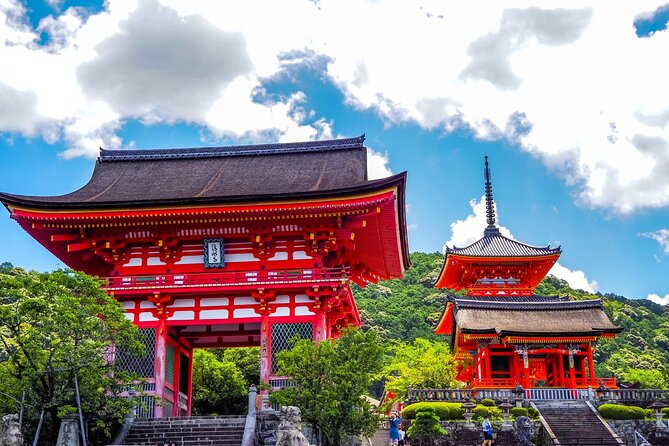
The walk ends at Kiyomizu-dera, one of Kyoto’s best-known temples and a UNESCO World Heritage Site. The temple dates to the 8th century and sits on a hillside above the city.
The listed stop is about 10 minutes, with admission not included. That detail is important. The $40 price covers the walking tour, but you should budget separately if you want to enter Kiyomizu-dera.
Ending here is a smart choice. Kiyomizu-dera is large enough to fill much more than 10 minutes, so the guide can explain the setting and leave you at the entrance for your own visit. You can continue inside after the tour, return to Ninen-zaka, or make your way elsewhere in eastern Kyoto.
The meeting point and end point are different. You start near Ben’s Cookies Kyoto in the Shijo area and finish in front of Kiyomizu-dera at 1-chōme-294 Kiyomizu. That means you should not plan to collect luggage, meet someone at the starting point, or catch an immediate reservation back across town without allowing extra time.
The final approach includes slopes and stairs. If you have knee, hip, or balance concerns, consider how you normally manage three hours on foot before booking. The tour accepts service animals, and a moderate level of physical fitness is required.
What the guides add to the walk
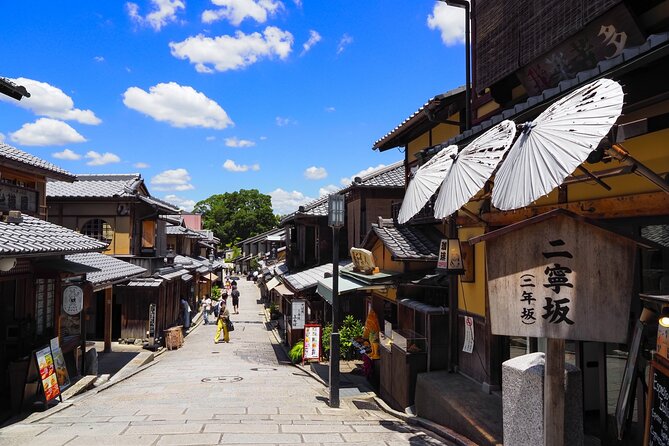
The strongest part of this experience is the guiding. Past departures have been led by Jay, Ben, Ayumi, Michel, and Tommy. The feedback attached to those departures repeatedly points to clear English, lively delivery, good humor, and a strong grasp of Japanese history.
Jay is especially praised for explaining Kyoto within the larger story of Japan, including the relationship between samurai, monks, and emperors. He has also been described as generous with questions, photographs, local shortcuts, and suggestions for the following day.
Ben is noted for memorable stories and useful recommendations for gardens, temples, and shops. Ayumi is praised for energy, enthusiasm, and explanations of geisha and samurai culture. Michel and Tommy are also described as friendly, accommodating, and well prepared.
Of course, the exact guide depends on the date. The consistent pattern is what matters: this is not simply a walk from one landmark to the next. The guide’s role is to connect theater, religion, politics, folklore, and present-day Kyoto.
The tour has a 4.9 rating from 188 reviews, with 98 percent recommending it. Those numbers suggest a reliable experience, but they do not remove the need to match the format to your interests. If you want long periods of silent temple viewing, this may feel too guided. If you want context and a chance to ask questions, it is a strong fit.
Is $40 a good value?

At $40 per person, the price is reasonable for a three-hour guided walk through Kyoto’s most visited historic quarter. You are paying for the guide’s time, route planning, explanations, and local orientation. The tour includes no lunch, gratuity, or admission fee.
The value is greatest if this is your first visit to Kyoto. A good introduction can save you from spending the rest of your trip wondering what you just saw. It also helps you choose which temples, lanes, and shops deserve a second visit.
The price is less attractive if you already know Gion and Higashiyama well, or if you prefer to set your own pace. You can walk through many of these areas independently, but you will not get the same historical framework or easy access to a guide’s recommendations.
Bring money for Kiyomizu-dera admission, plus water and food before the start. The route has bathroom opportunities, but there are not many planned meal stops. One departure ran longer than expected, with the guide warning the group in advance, so avoid booking a tight appointment immediately afterward.
Who should book this Kyoto walking tour?
I would recommend it to first-time visitors, history fans, couples, solo visitors, and adults who want a serious introduction to Gion and Higashiyama. It also suits anyone who wants to ask questions about Japanese culture rather than simply take pictures.
Families can take the tour, but the three-hour length and information-heavy format may test younger children. An eight-year-old managed the route on one departure, yet children may lose interest after several temples and shrines. Bring water and a small snack if you are walking with kids.
You should also think about footwear and weather. The experience requires good weather and may be canceled if conditions are poor. If that happens, you are offered another date or a full refund. You can cancel for a full refund up to 24 hours before the start time, but late cancellations and changes are not accepted.
Should you book it?
Book this tour if you want Kyoto’s famous eastern sights to make sense as part of a larger story. The route is well chosen, the group size is manageable, and the guide can turn Gion, Chion-in, Maruyama Park, Yasaka Pagoda, and Kiyomizu-dera into more than a checklist.
Skip it if you dislike hills, stairs, crowds, or fixed walking schedules. Also skip it if your main goal is a slow temple visit with plenty of time for shopping and photographs.
For most first visits, I would take it early in the trip, wear proper shoes, eat beforehand, and keep the rest of the afternoon flexible. At $40, it is a practical way to get your bearings in one of Kyoto’s most rewarding districts.
FAQ
How long is the Kyoto Gion Historical Walking Tour?
The tour lasts approximately three hours.
Where does the tour begin?
It begins at Ben’s Cookies Kyoto, 89 Shinchō, Shimogyo Ward, Kyoto, 600-8001, Japan.
Where does the tour end?
It ends in front of the entrance to Kiyomizu-dera at 1-chōme-294 Kiyomizu, Higashiyama Ward, Kyoto, 605-0862, Japan.
Which places are visited?
The route includes Tatsumi Bridge, Chion-in Temple Sanmon, Chion-in Temple, Maruyama Park, Nene-no-Michi, Hōkan-ji Temple, Yasaka Pagoda, Ninen-zaka, Sannen-zaka, and Kiyomizu-dera.
Is the tour conducted in English?
Yes. The tour is led by an English-speaking guide.
Is admission to the temples included?
The walking tour includes the guide, but admission fees are not included. Kiyomizu-dera is specifically listed as requiring an additional admission fee.
How much walking is involved?
You walk for about three hours, including slopes, uneven stone paths, and some stair climbing. A moderate level of physical fitness is recommended.
What should I wear?
Wear comfortable walking shoes. The route includes historic stone-paved lanes, slopes, and stairs.
How large can the group be?
The tour has a maximum of 12 participants.
Can I cancel for a refund?
You can cancel at least 24 hours before the start time for a full refund. Cancellations or changes made less than 24 hours before the start time are not accepted, and poor weather or an insufficient number of participants may lead to a rescheduled tour or full refund.
More Walking Tours in Kyoto
- Night Walk in Gion: Kyoto’s Geisha District
★ 4.5 · 2,003 reviews - Kyoto Gion Geisha District Walking Tour – The Stories of Geisha
★ 5.0 · 1,441 reviews - Nishiki Market Brunch Walking Tour (7 Tastings + Brunch)
★ 5.0 · 1,355 reviews - Kyoto Arashiyama Walking Tour: Bamboo, Monkeys, Gardens & Secrets
★ 5.0 · 1,216 reviews
Recently added around Kyoto
- Higashiyama | Kyoto: Sakura Season Private Rickshaw Tour★ 5.0 · 3 reviews
- Kyoto Kimono Rental CHAMATSU|Kimono/Yukata Rental FamilyPlan★ 5.0 · 3 reviews
- Kyoto: Half-Day Private Guided Tour to the Old Town of Gion★ 4.4 · 3 reviews
- Nara Private Customizable Half Day Tour★ 5.0 · 3 reviews
- Kansai Region Hiking Adventure in Nara Kobe Kyoto and More★ 5.0 · 3 reviews
- Full Day Nara Deer, Temple, Shrine, Activities & Tea Ceremony★ 5.0 · 3 reviews
- Nara: Essential Private Tour with Deer Park and Temples★ 5.0 · 3 reviews
- Hiking Tour for Sacred Sites in Kyoto with a Guide★ 5.0 · 3 reviews
Gion Geisha District Tours, compared.

Kyoto Geisha Walking Tour: Gion District & Hidden Gems
Read our review →
Gion Magical Night Walking Tour with Geisha Trivia
Read our review →
Gion Geisha District Walking Tour – Stories of Geisha
Read our review →
Best of Kyoto: Gion, Geisha, Pagodas & Cobblestones
Read our review →

Kyoto Night Foodie Tour in Gion (9+ dishes + 6 Sake tastings)
Read our review →
Kyoto Gion Geisha District Walking Tour – The Stories of Geisha
Read our review →
Kyoto Gion: 2-Hour Geisha Culture & History Walking Tour
Read our review →Browse the lists this tour appears in