
REVIEW · GION GEISHA DISTRICT TOURS
Kyoto: Gion Evening Walk with Hidden Gems, Geisha & Sake
Gion after dark is Kyoto at its most atmospheric. Lanterns glow beside wooden tea houses, the streets quiet down, and a local guide helps you understand the world of Geiko and Maiko without turning the walk into a classroom. The route includes Hanamikoji Street, Yasaka Pagoda, Ninenzaka, and Yasaka Shrine.
I like the small groups of no more than 10, which make it easy to ask questions and keep pace with the guide. I also like the included cup of sake and the photo assistance, two simple touches that make a short evening walk feel more personal. The main drawback is the tight 90-minute schedule. You see the key sights from outside, but you do not have time for long visits or interior tours.
In This Review
- Key points at a glance
- Why Gion works best after sunset
- Starting at Shijo Kiyamachi
- Hanamikoji Street and the world of Geiko
- Yasui Kompira-gū and its unusual power stone
- Yasaka Pagoda and Hōkan-ji Temple
- Ninenzaka’s sloping stone street
- Finishing at Yasaka Shrine
- What the sake adds to the evening
- The small-group format and guide quality
- Is $32 a fair price?
- Who should book this Gion walk?
- Should you book it?
- FAQ
- How long does the Gion evening walk last?
- What language is the tour conducted in?
- How many people can join the group?
- Where is the meeting point?
- What sights are included?
- Is sake included?
- Do I need comfortable shoes?
- Can I cancel the booking?
Key points at a glance
- Gion without the daytime crowds: See its lantern-lit lanes when the mood is quieter and more striking.
- A compact route: Cover Hanamikoji Street, Yasui Kompira-gū, Hōkan-ji Temple, Ninenzaka, and Yasaka Shrine in 70 to 90 minutes.
- A conversational guide: English-speaking guides such as Shumpei and Nick explain local customs in plain language.
- Sake included: Enjoy a cup of local sake during the walk, responsibly and at an easy pace.
- Good for first-time Kyoto visitors: Get cultural context and a useful orientation to one of the city’s most famous districts.
- A prompt start matters: Meet the guide holding an Otatrip Guide sign, and arrive early because the group leaves on time.
Why Gion works best after sunset
Gion can feel very different at night. During the day, its famous streets draw large numbers of people, but the evening brings softer light and a slower pace. Traditional wooden buildings, narrow lanes, and paper lanterns become the focus rather than passing crowds.
That change is the central reason to book this walk. You are not simply ticking off Kyoto sights. You are seeing how the district feels when restaurants and tea houses begin their evening work and the streets take on a more private mood.
You should still keep your voice low. Gion is a living neighborhood, not an open-air stage set. The tour specifically asks you to show care around homes and sacred places, and that is good advice for everyone visiting the area.
The guide adds the context that signs and guidebooks cannot. You learn about Geiko and Maiko, the women who train and work in Kyoto’s traditional entertainment culture, as well as the links between Shinto shrines, Buddhist temples, and daily life in the district.
The format is relaxed rather than formal. Guides including Shumpei and Nick have been singled out for being funny, patient, friendly, and easy to talk with. That matters here because the best questions may be spontaneous: how Geiko differs from Maiko, what happens inside a tea house, or where to go next for food.
More evenings in Gion:
- Kyoto Geisha Walking Tour: Gion District & Hidden Gems
★ 4.7 · 3,273 reviews - Kyoto: Gion Magical Night Walking Tour with Geisha Trivia
★ 4.9 · 2,393 reviews - Kyoto: Gion Geisha District Walking Tour – Stories of Geisha
★ 4.7 · 2,187 reviews
Starting at Shijo Kiyamachi
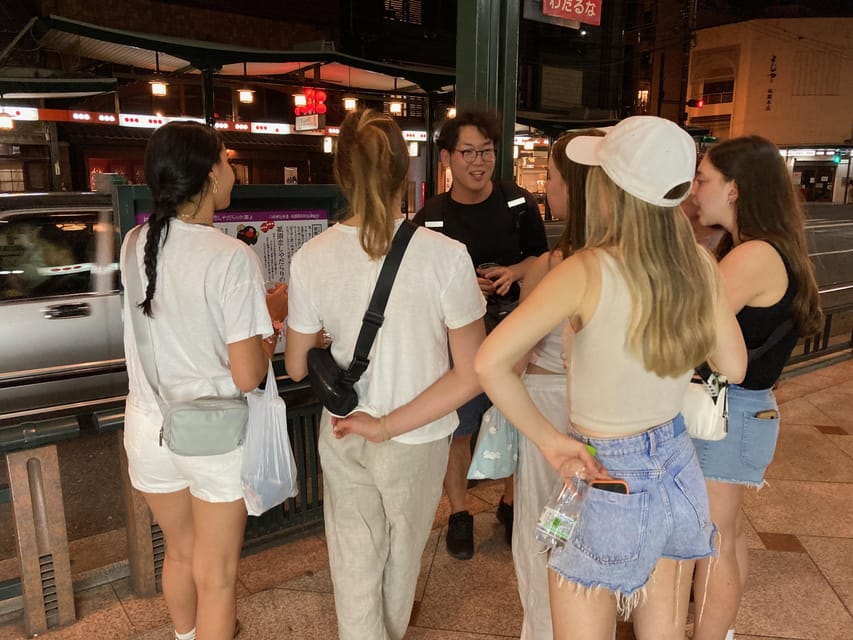
The meeting point is at 90-3 Shinchō, in the Shijo Kiyamachi area. Look along Kiyamachi Street, a little south of the Japanese restaurant Kikunoi Roan and between it and McDonald’s. Your guide should be holding a sign marked Otatrip Guide.
Give yourself extra time to find this spot. The instructions are specific, but busy Kyoto streets can still be confusing, especially after dark. The tour begins promptly, and the group may leave without late arrivals. One past group arrived late but was still welcomed warmly, yet you should not count on that kindness being repeated.
This is a useful starting place because you move from a lively central area toward the more traditional streets of Gion. Wear comfortable shoes. The route includes ordinary pavement, temple approaches, and the sloping cobblestones of Ninenzaka, so dress for walking rather than for a formal night out.
The tour runs for 70 to 90 minutes, with the advertised duration listed as 90 minutes. That makes it easy to fit before dinner, after another Kyoto visit, or into a night when you want a focused activity instead of a long organized excursion.
Hanamikoji Street and the world of Geiko
The first major stop is Gion itself, with about 15 minutes for a guided visit and photographs. Hanamikoji Street is the visual heart of this part of Kyoto, lined with traditional wooden buildings and tea houses.
The value here is not just the architecture. Your guide explains the customs and work connected with Geiko and Maiko, helping you look beyond the popular image of women in elaborate kimono. You gain a better sense of why the district has rules about photography, noise, and personal space.
You may see a Geiko or Maiko during the walk, but this should never be treated as a promise. One participant happened to see two actual Geisha, a memorable moment, but the tour’s main value does not depend on spotting one. The guide can explain the culture whether or not someone in traditional dress passes by.
This is also a good place to use the photo assistance. The guide can help position you at key spots, allowing you to enjoy the setting instead of fumbling with your phone. Expect photo stops rather than a dedicated portrait session.
The guide’s conversational approach suits Hanamikoji well. You can ask about local etiquette, food, the difference between Geiko and Maiko, or what to see after the tour. Several guides have also helped groups feel comfortable asking questions outside the usual sightseeing script, including questions about Japanese pop culture.
Yasui Kompira-gū and its unusual power stone
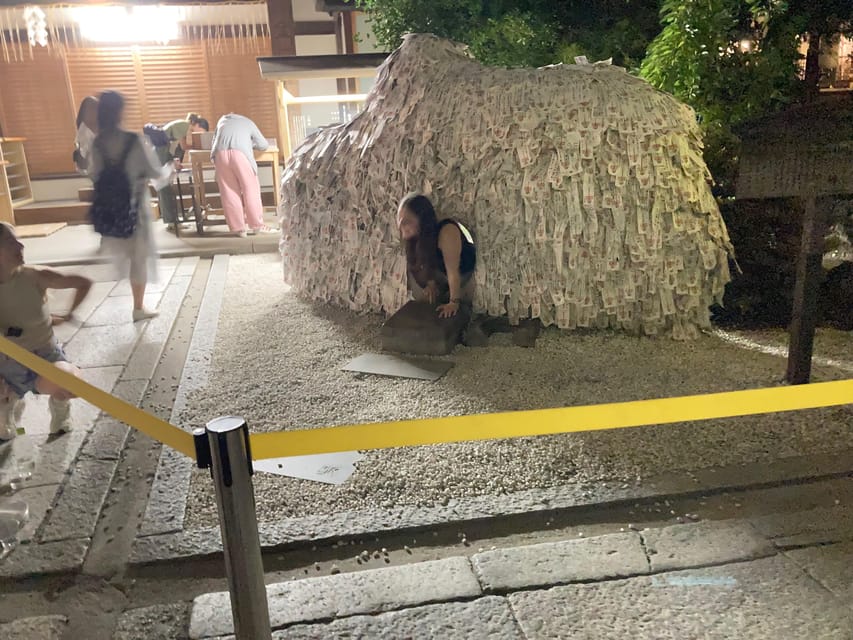
The next stop is Yasui Kompira-gū Shrine, usually given about 10 minutes. It is known for a large power stone covered with paper charms. People pass through the opening in the stone as part of a ritual to cut unwanted ties and build better ones.
The shrine gives the walk a different tone. Hanamikoji introduces the social world of Gion, while Yasui Kompira-gū shows a more personal side of Japanese religious practice. The guide explains the meaning behind the shrine in plain English, which helps you understand what people are doing rather than viewing the stone as a curious photo prop.
You have enough time for a short visit and pictures, but not for a long ritual or quiet period of reflection. That is a fair trade on a 90-minute route. If this shrine interests you, you can note its location and return later at your own pace.
Because it is a sacred site, keep your voice down and follow the guide’s lead. The evening setting can make the shrine feel especially calm, but the tour is still moving through a working religious place.
More bars and sake stops in Kyoto:
- Kyoto Night Foodie Tour in Gion (9+ dishes + 6 Sake tastings)
★ 5.0 · 1,762 reviews - 3-Hour Kyoto Insider Sake Brewery Tour with Tastings & Pairings
★ 5.0 · 917 reviews - Arashiyama Bamboo, Temple, Monkeys, or Secret Sake Brewery
★ 4.8 · 886 reviews - Kyoto: Izakaya Bars Guided Walking Tour
★ 4.9 · 815 reviews
Yasaka Pagoda and Hōkan-ji Temple
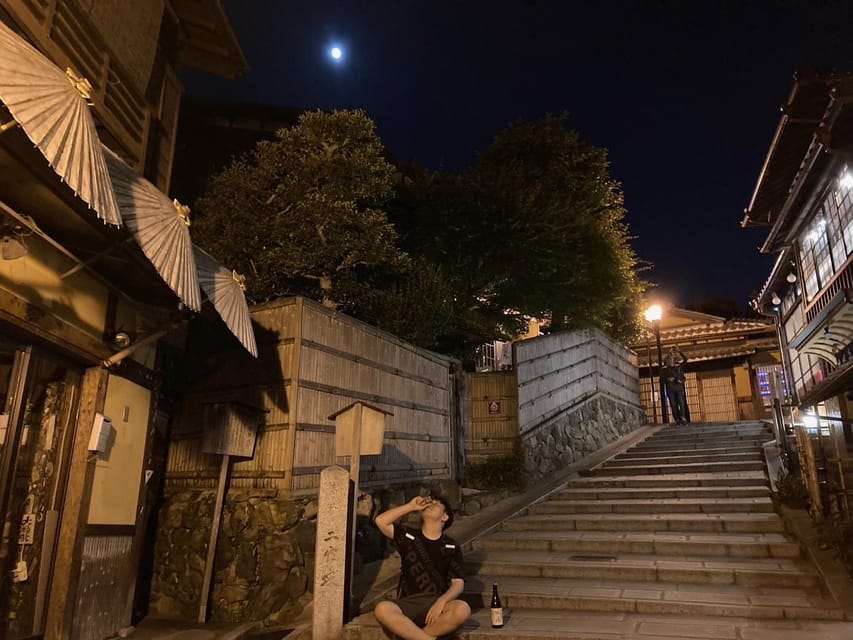
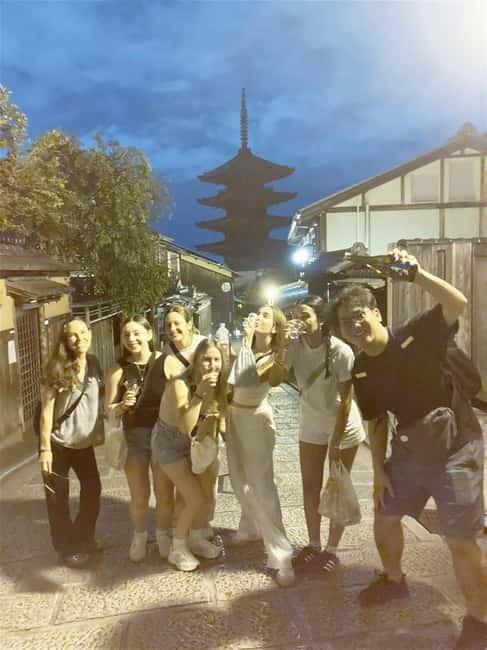
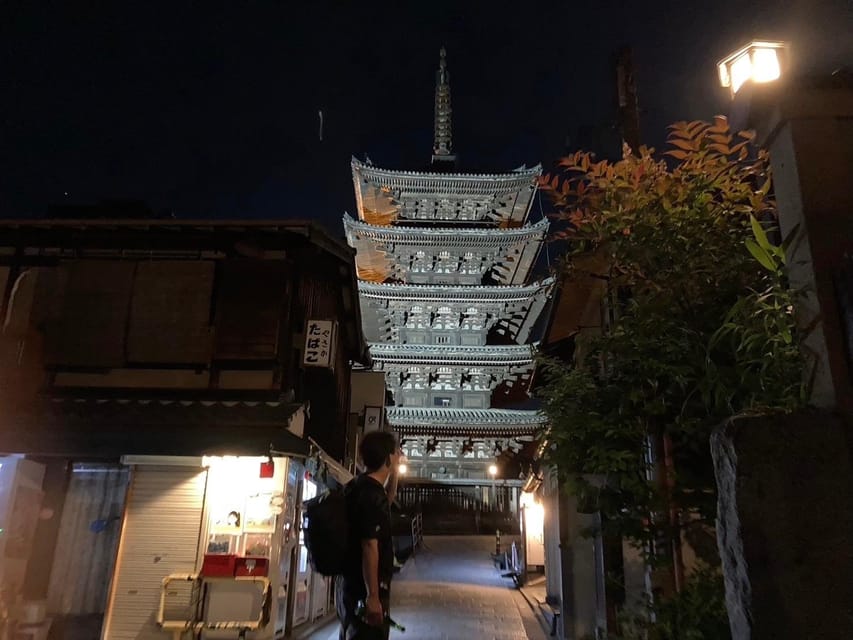
Hōkan-ji Temple, better known for its Yasaka Pagoda, receives roughly 10 minutes. The five-story pagoda is one of Kyoto’s most photographed sights, and its nighttime lighting gives it a clean, dramatic presence against the dark sky.
This is one of the strongest photo stops on the route. At night, the pagoda can feel less crowded than during the day, giving you a better chance to take a picture without a mass of people in front of it. The guide can help with framing and timing.
Keep your expectations clear: this is an exterior visit and photo stop. The experience does not include a long temple tour or a guaranteed entry inside the pagoda. The short stop works well if you want a first look, but visitors seeking detailed Buddhist art or temple interiors will need a separate daytime visit.
The guide’s historical explanation gives the pagoda more meaning than a quick roadside photograph. You hear about the religious setting and Kyoto’s older neighborhoods while standing in a place that is easy to recognize but better appreciated with context.
Ninenzaka’s sloping stone street
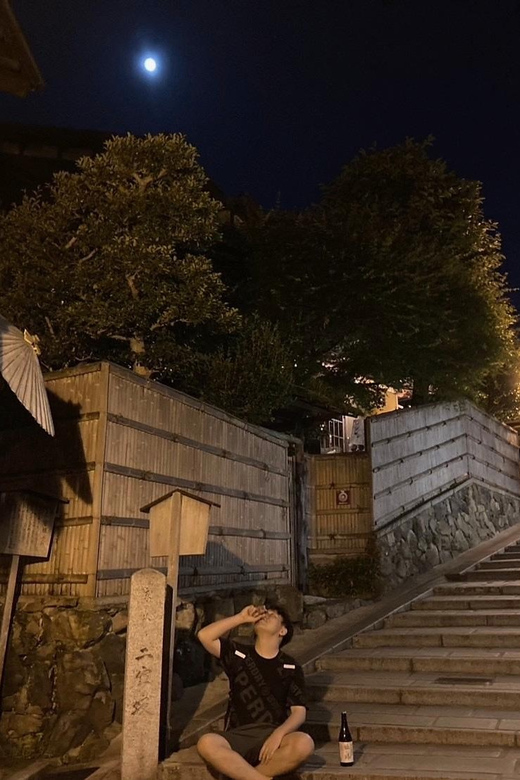
From Hōkan-ji, the walk continues to Ninenzaka, another 10-minute stop. This traditional slope is lined with wooden townhouses and has the sort of old-Kyoto appearance that many people hope to find.
Night changes the experience. Shops may be closed or less active, but the reduced activity lets you focus on the buildings, paving stones, and lantern light. Rain can make the street even quieter and more reflective, though it also makes the slope slippery. Bring suitable shoes and take care on the incline.
Ninenzaka is one of the reasons this tour feels more useful than a simple walk through the main Gion streets. You see a less obvious side of the district and learn how the streets connect. The route is compact, but it is not limited to one famous photo location.
Again, the time is brief. You will not have much opportunity to browse shops or stop for a long snack. Think of this as an evening orientation. You can return during daylight if you want shopping, food, or more photographs.
Finishing at Yasaka Shrine
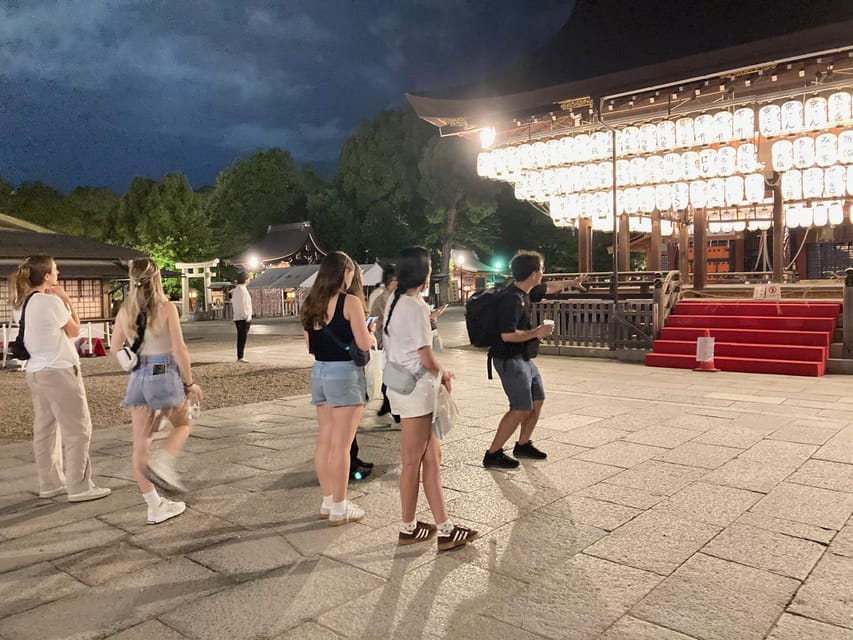
The tour ends at Yasaka Shrine, marked in the details as 八坂神社. This major shrine has watched over Gion for more than 1,300 years and provides a fitting finish to the route.
Ending here gives you a useful choice. You can continue exploring on your own, make your way to dinner, or simply pause at the shrine after the guide departs. Since the walk does not return to the starting point, check your plans before booking and make sure the finish works for your evening.
Yasaka Shrine also ties together the themes of the tour. You have seen the entertainment district, a shrine known for personal wishes, Buddhist architecture, an old shopping street, and one of Kyoto’s major Shinto landmarks. The guide’s explanations help connect these places without requiring a full-day history tour.
What the sake adds to the evening

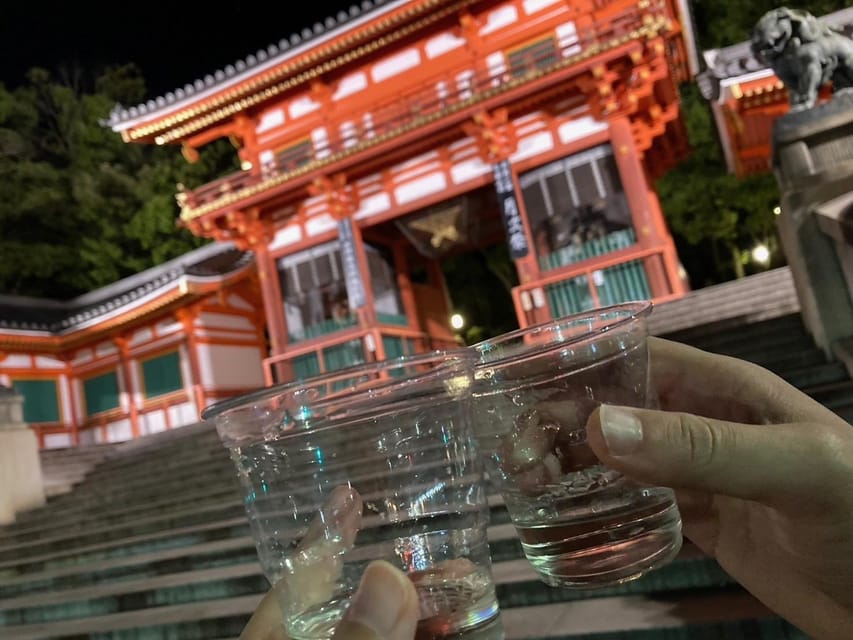
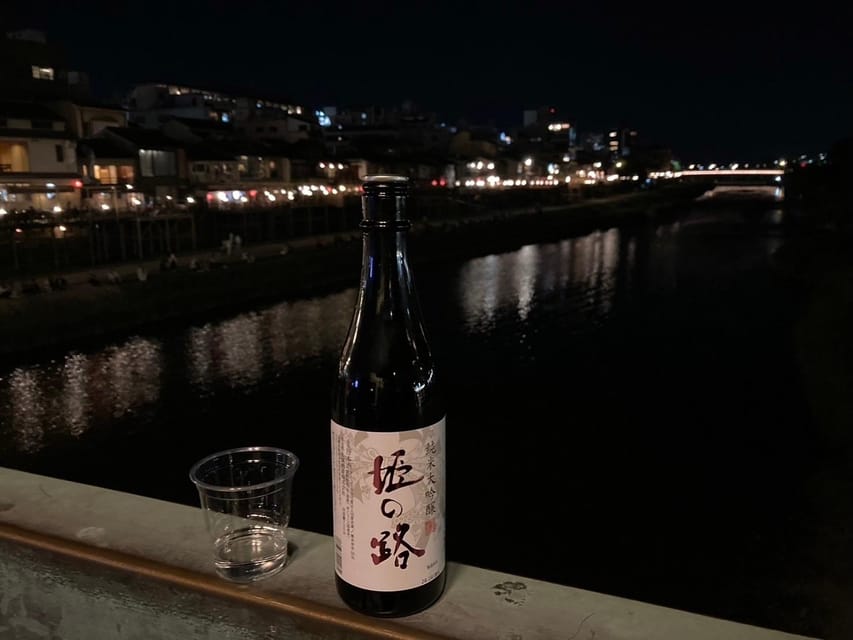
A cup of local sake is included. It is a small feature, but it fits the setting well. You can try a Japanese drink while walking through the historic district, and it gives the group an easy way to begin talking.
The sake is not the reason to book the tour. The route and guide are the main value. Still, it makes the experience feel less like a checklist and more like a social evening. Several people particularly enjoyed the sake, and some stayed for food or another drink after the tour.
Be responsible. You are walking on slopes and cobblestones, and the tour covers sacred and residential areas. The point is to enjoy one drink while taking in Gion, not to turn the walk into a bar crawl. Smoking is not allowed on the activity.
The small-group format and guide quality
The group is limited to 10 people. That is the right size for narrow streets and informal conversation. You can hear the guide, ask follow-up questions, and get occasional help with photos without the stop becoming crowded with your own group.
The size may vary in practice. Some departures have been nearly private because other participants chose an earlier time slot. That can create an unusually personal experience, but you should book for the small-group format rather than expect a private tour.
The guides are a major part of the experience. Shumpei is described as friendly, entertaining, and willing to answer a wide range of questions. Nick is also praised for keeping the walk organized while making it feel easygoing. The activity is conducted in English.
I would choose this tour for a guide who explains culture in ordinary language rather than reciting dates. That style is especially helpful in Gion, where a little etiquette and background can change the way you see the streets.
Is $32 a fair price?
At $32 per person, this is good value if you want a short introduction to Gion with a guide. You receive a 70 to 90-minute walking tour, an English-speaking local guide, photo assistance, and a cup of sake.
The price is less attractive if you already know Gion well or want entry to temples and attractions. There are no listed interior visits, meals, or transportation. You are paying for interpretation, a planned route, company, and the chance to ask questions in a small group.
For a first evening in Kyoto, I think the cost is sensible. The tour combines several places that would be easy to visit independently, but the guide adds the cultural explanation and helps you move between them efficiently. It also leaves the rest of your night free.
Free cancellation up to 24 hours before the activity and reserve-now, pay-later booking make it easier to fit into a changing Kyoto schedule. Check the available starting times before booking, since the late-evening option has been useful for people who wanted to spend the day sightseeing first.
Who should book this Gion walk?
I would recommend it to first-time Kyoto visitors, couples, solo visitors, and small groups who want a friendly introduction to Gion without committing to a long tour. It is also useful if you want a guide’s help with cultural questions and photographs.
This is a good match if you enjoy walking, local stories, traditional neighborhoods, and a relaxed drink. It suits people who want to see several famous places in one evening but do not need to enter every temple.
You may want something else if you have back problems, dislike uneven streets, or want a detailed temple study. The route is short, but it is still a walking tour with slopes and cobbled surfaces. Comfortable shoes are essential.
Should you book it?
Book this tour if you want to see Gion in its quieter evening mood and prefer a local conversation to a formal lecture. The small group, sake, photo help, and well-regarded guides such as Shumpei and Nick give the walk a personal feel for a reasonable price.
Skip it if your priority is extensive temple access, a full Geisha performance, or a long food tour. You might also prefer to explore alone if you already understand Kyoto’s neighborhoods and customs.
For most first-time visitors, I would place it early in a Kyoto stay. The route gives you bearings, cultural context, and ideas for the rest of your trip, while the finish at Yasaka Shrine leaves you free to continue the evening on your own.
FAQ
How long does the Gion evening walk last?
The activity is scheduled for 90 minutes, with the walking portion described as lasting 70 to 90 minutes.
What language is the tour conducted in?
The tour is conducted in English with a live English-speaking guide.
How many people can join the group?
The small group is limited to 10 participants.
Where is the meeting point?
Meet at 90-3 Shinchō in the Shijo Kiyamachi area. The guide waits along Kiyamachi Street between McDonald’s and Kikunoi Roan, a little south of the restaurant, holding an Otatrip Guide sign.
What sights are included?
The route includes Gion and Hanamikoji Street, Yasui Kompira-gū Shrine, Hōkan-ji Temple and Yasaka Pagoda, Ninenzaka, and Yasaka Shrine.
Is sake included?
Yes. A cup of local sake is included as part of the walking experience.
Do I need comfortable shoes?
Yes. Comfortable shoes are recommended because the activity involves walking, slopes, and cobblestone streets.
Can I cancel the booking?
You can cancel up to 24 hours in advance for a full refund. Reserve-now, pay-later booking is also available.
More Walking Tours in Kyoto
- Night Walk in Gion: Kyoto’s Geisha District
★ 4.5 · 2,003 reviews - Kyoto Gion Geisha District Walking Tour – The Stories of Geisha
★ 5.0 · 1,441 reviews - Nishiki Market Brunch Walking Tour (7 Tastings + Brunch)
★ 5.0 · 1,355 reviews - Kyoto Arashiyama Walking Tour: Bamboo, Monkeys, Gardens & Secrets
★ 5.0 · 1,216 reviews
More Food Tours in Kyoto
- Kyoto: Insider Sake Brewery Tour with Sake and Food Pairing
★ 5.0 · 704 reviews - Kyoto Sake Brewery & Tasting Walking Tour
★ 5.0 · 623 reviews - Kyoto Nishiki Market Food and Culture Walking Tour
★ 5.0 · 412 reviews - Kyoto: Gion Food Tour 13 Dishes at 4 Eateries
★ 5.0 · 408 reviews
Recently added around Kyoto
- Higashiyama | Kyoto: Sakura Season Private Rickshaw Tour★ 5.0 · 3 reviews
- Kyoto Kimono Rental CHAMATSU|Kimono/Yukata Rental FamilyPlan★ 5.0 · 3 reviews
- Kyoto: Half-Day Private Guided Tour to the Old Town of Gion★ 4.4 · 3 reviews
- Nara Private Customizable Half Day Tour★ 5.0 · 3 reviews
- Kansai Region Hiking Adventure in Nara Kobe Kyoto and More★ 5.0 · 3 reviews
- Full Day Nara Deer, Temple, Shrine, Activities & Tea Ceremony★ 5.0 · 3 reviews
- Nara: Essential Private Tour with Deer Park and Temples★ 5.0 · 3 reviews
- Photo Shoot with a Private Vacation Photographer in KYOTO, JAPAN★ 5.0 · 3 reviews
Gion Geisha District Tours, compared.

Kyoto Geisha Walking Tour: Gion District & Hidden Gems
Read our review →
Gion Magical Night Walking Tour with Geisha Trivia
Read our review →
Gion Geisha District Walking Tour – Stories of Geisha
Read our review →
Best of Kyoto: Gion, Geisha, Pagodas & Cobblestones
Read our review →

Kyoto Night Foodie Tour in Gion (9+ dishes + 6 Sake tastings)
Read our review →
Kyoto Gion Geisha District Walking Tour – The Stories of Geisha
Read our review →
Kyoto Gion: 2-Hour Geisha Culture & History Walking Tour
Read our review →Browse the lists this tour appears in