REVIEW · TOURS
Explore Hidden Alleyway with a Local Expert (Afternoon Tour)
Kyoto’s best moments often arrive between the famous sights. This three-hour private bike tour threads through narrow lanes, old wooden houses, quiet waterways, and residential corners that buses cannot reach. You begin in the afternoon, when the city has had time to wake up, and finish back at the starting point.
I like two things right away: the small group size, limited to six people per guide, and the route’s useful mix of famous Kyoto and ordinary Kyoto. You get Gion and the Imperial Palace, but also Miyagawacho’s traditional houses and the Kamo River spots locals use to relax. The main consideration is the price, $102.47 per person, which makes the tour best for people who value a private guide and efficient sightseeing rather than simply renting a bicycle.
In This Review
- Key points to know before you book
- Why Kyoto works so well by bicycle
- Miyagawacho and the wooden lanes of old Kyoto
- Gion, where Kyoto’s old entertainment district still feels refined
- Tatsumi Bridge and the waterway beside it
- Kyoto Imperial Palace on gravel paths
- Kashiwayacho and a local pause by the Kamo River
- The guide and the small-group advantage
- E-bikes, road confidence, and family suitability
- Rain planning and what to bring
- Is $102.47 per person good value?
- Booking details that deserve attention
- Who should book this Kyoto bike tour?
- Should you book it?
- FAQ
- Where does the Kyoto bike tour begin?
- What time does the tour start?
- How long does the activity last?
- Where does the tour finish?
- Which places are visited?
- How many people can join one guide?
- Can one person book the tour?
- What happens if it rains?
- What are the age and height rules for children?
- Can I reschedule or cancel the tour?
Key points to know before you book
- Quiet lanes come first: The route uses backstreets and alleyways where Kyoto feels calmer and more residential.
- Five distinct stops: You visit Miyagawacho, Gion, Tatsumi Bridge, Kyoto Imperial Palace, and Kashiwayacho by the Kamo River.
- Small private groups: One guide handles two to six people, so the pace can stay personal and manageable.
- A strong guide can shape the day: Yuichi earned especially warm praise for being funny, personable, and informative.
- Rain does not automatically cancel the ride: You can continue by bicycle with a free poncho or switch to walking with public transportation included.
- Cycling ability matters: Children must be at least 10 years old, 145 centimeters or taller, and able to ride safely on the road without help.
Why Kyoto works so well by bicycle
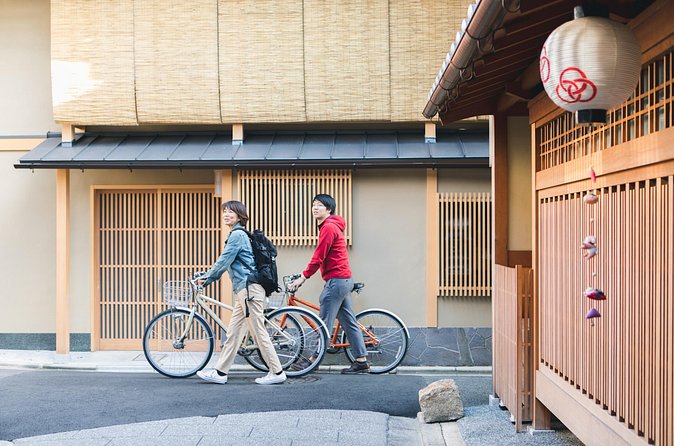
Kyoto is easy to admire from a bus window, but harder to understand that way. The city’s character changes quickly. One street may be lined with shops and traffic, while the next is a narrow lane with wooden facades, a small stream, and almost no noise.
A bicycle gives you that change in scale. You can cover more ground than on foot, yet still slow down for a lane, bridge, or view that would pass unnoticed in a vehicle. The route is designed around those shifts. You pedal through quiet streets, then emerge onto a larger road and recognize the postcard Kyoto you expected.
The guide’s role matters here. The company trains its guides in Kyoto culture, traffic safety, group riding, and local manners. That is useful in a city where road conditions and narrow lanes require attention. You are not simply following someone who knows a shortcut. You have a guide who is expected to help the group ride as one unit and behave respectfully around residents.
The tour takes about three hours and begins at 2 p.m. That timing suits anyone who wants a morning visit to a temple, a leisurely lunch, or a slower start after arriving in Kyoto. It also means you should not expect a full-day city tour. The route offers a well-chosen slice of Kyoto rather than every major sight.
Other Kyoto mornings people book alongside this one:
- PERFECT KYOTO 1-Day Bus Tour
★ 5.0 · 13,518 reviews - Kyoto: Fushimi Inari, Kinkakuji, Bamboo Grove 1 Day Bus Tour
★ 4.8 · 4,316 reviews - Kyoto: Tea Ceremony in a Traditional Tea House in Kiyomizu
★ 4.9 · 3,519 reviews
Miyagawacho and the wooden lanes of old Kyoto
The first stop is Miyagawacho Kaburenjo, part of Miyagawacho, one of Kyoto’s five traditional geisha districts. It is the second largest of those districts, and its appeal comes from the street itself.
Traditional wooden houses line both sides of the alley. The setting is quieter than the better-known parts of Gion, and the close arrangement of the buildings gives you a strong sense of how old Kyoto neighborhoods were formed. You get about 15 minutes here, enough for a look around and an explanation from the guide.
This is a good early stop because it sets the tone for the tour. Instead of starting with a major monument and a crowd, you begin with architecture and atmosphere. I would pay attention to the proportions of the houses, the narrowness of the lane, and the way private homes and cultural businesses share the same street.
You should also keep your expectations sensible. This is not a performance or a geisha encounter. The stop is about seeing the district respectfully from public streets. The free admission keeps things simple, but the value comes from the guide’s context, not from entering a paid attraction.
Gion, where Kyoto’s old entertainment district still feels refined
From Miyagawacho, the tour continues to Gion. This is the Kyoto many people picture first, with its traditional architecture and connection to maiko and geiko culture.
Gion developed as a major geisha district, and some of its old character remains in the streets and buildings. You have roughly 15 minutes here. That is enough to take in the setting, hear background about the district, and continue without getting stuck in one of Kyoto’s most visited areas.
The short stop is also a practical choice. Gion can become crowded, and a bicycle is not always easy to manage on its busiest lanes. A good guide will help you move through carefully and remind you to respect private spaces. Treat the neighborhood as a living district, not a stage set. Avoid blocking doorways, photographing people without permission, or assuming every traditionally dressed person is available for a picture.
I like the contrast between Gion and Miyagawacho. The two districts share a connection to Kyoto’s entertainment culture, but the route lets you see a quieter side first. Gion then feels familiar without being the entire story.
Tatsumi Bridge and the waterway beside it
Tatsumi Bridge offers one of the tour’s gentlest pauses. The path follows a winding stream, with willows moving in the breeze. The stop lasts about 15 minutes.
This is the sort of place where a bicycle tour earns its keep. On a tight schedule, you might otherwise pass through Gion and never notice the water, the trees, or the softer rhythm of the lane. The bridge provides a small reset after the denser streets around the geisha district.
The stop is atmospheric rather than packed with formal sightseeing. If you want a long historical lecture or a major interior visit, this may feel brief. If you enjoy details of light, water, and traditional streets, the short pause should fit the tour well.
Your guide can also make this stop more useful by explaining how the waterways help shape Kyoto’s neighborhoods. The tour description emphasizes the changing scents, light, and sounds of the backstreets. Tatsumi Bridge is where that idea becomes easiest to notice.
A completely different side of Kyoto:
- Kyoto Geisha Walking Tour: Gion District & Hidden Gems
★ 4.7 · 3,273 reviews - Kyoto: Tea Ceremony Ju-An at Jotokuji Temple
★ 4.9 · 3,207 reviews - Kyoto: Gion Magical Night Walking Tour with Geisha Trivia
★ 4.9 · 2,393 reviews - Kyoto: 45-Minute Tea Ceremony Lesson Experience
★ 4.3 · 2,378 reviews
Kyoto Imperial Palace on gravel paths
The route then reaches Kyoto Imperial Palace, once the residence of Japan’s Imperial Family. Today, the palace grounds are open to the public as a national garden, with seasonal flowers and broad paths.
You spend about 20 minutes cycling along gravel paths. That gives you a change of pace and more open space after the tight lanes of Miyagawacho and Gion. The palace grounds are not just another photo stop. They show the scale and order of imperial Kyoto, with a more spacious setting than the surrounding neighborhoods.
The gravel is worth noting. You are cycling on paths rather than smooth city pavement, so your comfort may depend on your bike and riding confidence. The guide’s training in group cycling and safety is especially relevant here. Stay alert, keep a reasonable distance, and follow directions when the surface changes.
This stop is also a good reason to bring water and dress for the weather. The tour operates in rain, and the open garden setting may feel different in wet conditions. Seasonal flowers are part of the appeal, but the exact display will depend on when you visit.
Kashiwayacho and a local pause by the Kamo River
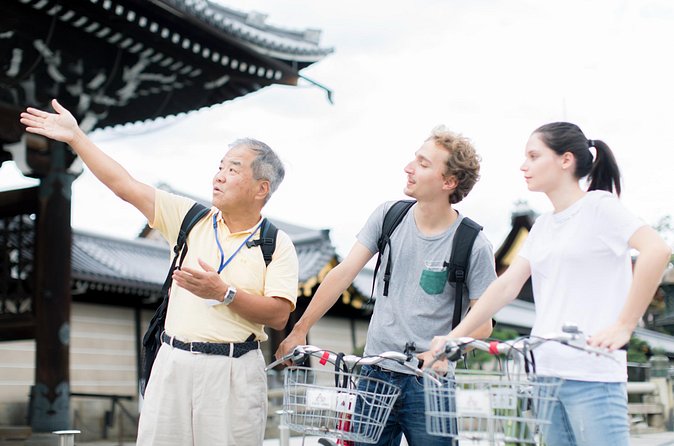
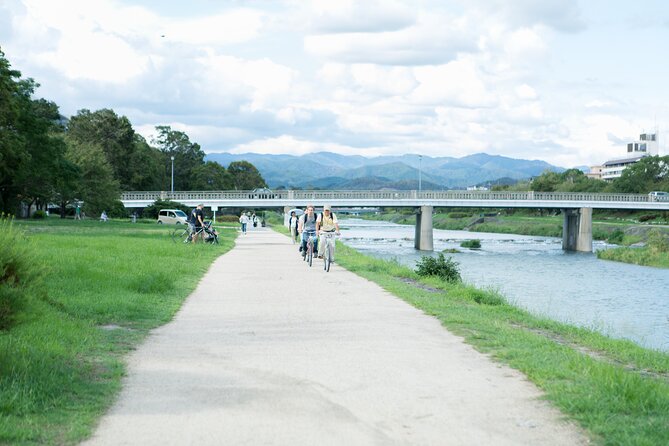
The final sightseeing stop is Kashiwayacho, where you can relax near a section of the Kamo River favored by local residents. You have about 20 minutes here, making it the longest stop on the route.
The river offers a natural ending to the sightseeing portion. After traditional districts, narrow streets, and imperial grounds, you get an open view and a place to slow down. The point is not a grand monument. It is the simple pleasure of seeing how Kyoto residents use their city.
This stop can also help you judge the tour’s overall character. The route is not built around racing from one ticketed attraction to another. It gives you short encounters with several parts of the city, then allows time beside the river. That makes it a good fit if you want local texture and variety.
Admission is included for this stop, while the other listed stops are free to enter. The experience ends back at the original meeting point, so you do not have to arrange a separate pickup from the river.
The guide and the small-group advantage
The tour accepts two to six people per guide. A single-person booking is not accepted, though a larger party of seven to 12 can arrange an extra guide. This is important because cycling tours become less pleasant when the group is too large to stay together.
A private format also gives you more room to ask questions. You can request a slower pace, clarify a cultural detail, or spend a little more time at a stop if conditions allow. The exact flexibility is not guaranteed, since the guide must manage the three-hour route, but a small group is still a real advantage.
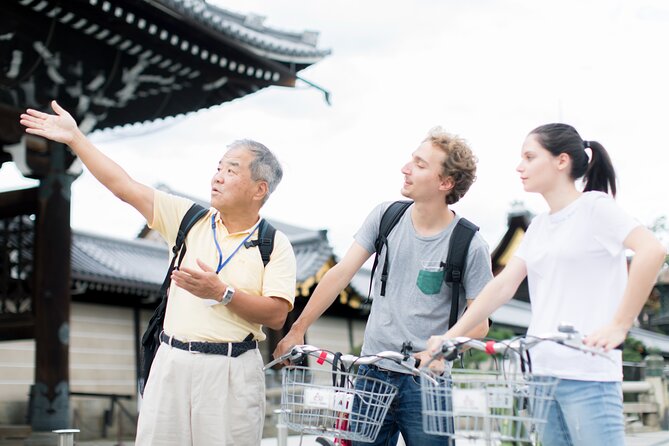
Yuichi is the guide name associated with the strongest praise. He was described as funny, personable, and informative, which is a useful combination for a tour that includes both traffic and cultural explanation. A guide who can keep a family group comfortable while also explaining what you are seeing can make the difference between a pleasant ride and a tiring one.
The company’s training program covers more than local facts. It includes traffic safety, group cycling technique, and local etiquette. That should reassure you if you are comfortable on a bicycle but less familiar with riding in Kyoto.
E-bikes, road confidence, and family suitability
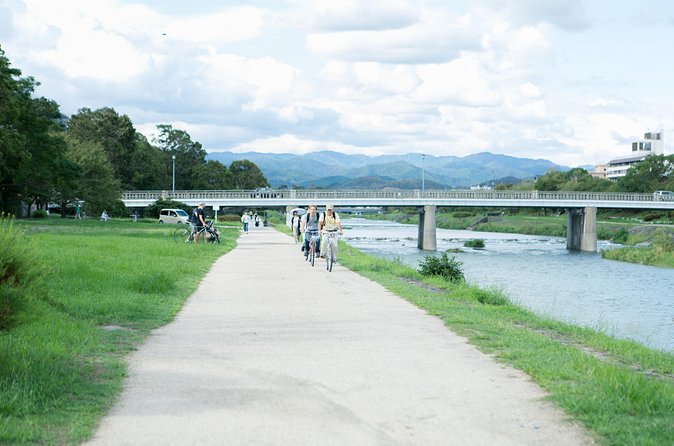
An especially positive detail is the enthusiasm for the e-bikes. Electric assistance can make a three-hour ride easier, especially if you have spent the morning walking or are not used to Kyoto’s distance between districts.
You should confirm the bike type when booking if an e-bike is important to you. The available information includes strong praise for e-bikes, but the general tour description identifies the activity as a bike tour rather than specifying every equipment detail.
This is not a bicycle lesson. You need to ride safely on the road without assistance from another person. Children must be at least 10 years old and 145 centimeters or taller. Those rules make the tour more suitable for older children, teens, and adults with ordinary road-riding confidence.
Most people can participate, but cycling comfort remains the key test. If you are nervous on busy streets, ask about the pace and bike type before committing. A walking tour may be a better choice if controlling a bicycle for three hours sounds stressful.
Rain planning and what to bring
The tour operates in rain, with two choices. You can continue by bicycle using a free rain poncho, or change to a walking tour that uses public transportation. Bus or metro costs are included in the tour fee for that option.
That policy gives you useful flexibility, but rain can still change the feel of the afternoon. Wet lanes, gravel paths, and reduced visibility may make the ride less comfortable. The walking alternative is practical, though it will not provide the same access to quiet side streets.
Wear comfortable clothing suitable for sitting and riding. Bring water, and consider a small bag that stays secure while cycling. Because the route includes old districts and public streets, modest, respectful behavior matters. Your guide can explain local etiquette, but common sense goes a long way.
Is $102.47 per person good value?
At $102.47 per person, this is not the cheapest way to get around Kyoto. You are paying for a private activity, a trained guide, bicycles, a carefully planned route, and three hours of guided access to several districts.
The value improves if you have limited time. One detailed account praised the tour as a good way to see several parts of the city when time is tight. That is exactly where the price can make sense. Instead of working out routes, navigating unfamiliar streets, and deciding which lanes are worth a detour, you have a local person handling the flow.
The cost is harder to justify if you mainly want transportation. Kyoto has other ways to move between neighborhoods, and many of the stops do not charge admission. You should book this for the guided experience, small group, and access to quieter streets, not because it is the cheapest sightseeing option.
For a family or small private group, the price may feel more reasonable because the whole activity is limited to your party. For a solo visitor, it is not available under the stated minimum of two people. Couples, families, and friends are the natural audience.
Booking details that deserve attention
The meeting point is 552-13 Higashiaburanokōjichō, Shimogyo Ward, Kyoto, 600-8235. The tour starts at 2 p.m. and ends back there after about three hours. Since the meeting point is specific, allow enough time to reach it and check the exact location before the day of the ride.
Confirmation is sent within 48 hours of booking, subject to availability. The activity is booked an average of 13 days ahead, so reserving early is sensible if your Kyoto dates are fixed.
There is a conflict in the supplied booking terms. One section says cancellation at least three days before the tour, by 6 p.m. Japan time, allows a refund, while the stated cancellation policy says the experience is non-refundable and cannot be changed. I would confirm the current rule with KCTP before paying, especially if your schedule is uncertain.
The same three-day, 6 p.m. Japan time deadline is given for rescheduling. After that point, you may need to cancel and make a new reservation.
Who should book this Kyoto bike tour?
I would choose this experience if you want a local view of Kyoto but do not want to spend an entire day on a bicycle. It suits couples, families with older children, and small groups who value a private guide and a clear route.
It is also a smart choice for a first afternoon in Kyoto. The itinerary gives you a basic map of the city’s character: traditional entertainment districts, a quiet stream, imperial grounds, and the Kamo River. You can use that orientation to decide where to return on foot later.
I would skip it if you dislike riding near traffic, need a fully flexible schedule, or want extended time inside museums and monuments. The stops are short, and the focus is on streets and atmosphere rather than long admissions.
Should you book it?
Book this tour if you want to see several sides of Kyoto efficiently, especially the quiet lanes most visitors miss. The private format, small group limit, rain alternatives, and strong guide potential give it real practical value.
Before booking, confirm whether e-bikes are supplied and clarify the cancellation terms. If you are comfortable cycling and the $102.47 price fits your budget, this is a well-shaped afternoon that combines famous Kyoto with the everyday streets between the famous places.
FAQ
Where does the Kyoto bike tour begin?
It begins at 552-13 Higashiaburanokōjichō, Shimogyo Ward, Kyoto, 600-8235, Japan.
What time does the tour start?
The tour starts at 2 p.m.
How long does the activity last?
It lasts approximately three hours.
Where does the tour finish?
The activity ends back at the original meeting point.
Which places are visited?
The route includes Miyagawacho Kaburenjo, Gion, Tatsumi Bridge, Kyoto Imperial Palace, and Kashiwayacho by the Kamo River.
How many people can join one guide?
Each guide accepts a minimum of two and a maximum of six people. Groups of seven to 12 can arrange an additional guide.
Can one person book the tour?
No. The stated minimum is two participants.
What happens if it rains?
You can continue by bicycle with a free rain poncho, or switch to a walking tour using buses or the metro. Public transportation is included in the tour fee.
What are the age and height rules for children?
Children must be at least 10 years old, at least 145 centimeters tall, and able to ride a bicycle safely on the road without help.
Can I reschedule or cancel the tour?
The supplied terms say you should request a change by 6 p.m. Japan time at least three days before the tour. They also contain conflicting refund information, with one section allowing a refund before that deadline and another calling the experience non-refundable. Confirm the current policy with KCTP before booking.
Recently added around Kyoto
- Higashiyama | Kyoto: Sakura Season Private Rickshaw Tour★ 5.0 · 3 reviews
- Kyoto Kimono Rental CHAMATSU|Kimono/Yukata Rental FamilyPlan★ 5.0 · 3 reviews
- Nara Private Customizable Half Day Tour★ 5.0 · 3 reviews
- Kyoto: Half-Day Private Guided Tour to the Old Town of Gion★ 4.4 · 3 reviews
- Kansai Region Hiking Adventure in Nara Kobe Kyoto and More★ 5.0 · 3 reviews
- Full Day Nara Deer, Temple, Shrine, Activities & Tea Ceremony★ 5.0 · 3 reviews
- Nara: Essential Private Tour with Deer Park and Temples★ 5.0 · 3 reviews
- Hiking Tour for Sacred Sites in Kyoto with a Guide★ 5.0 · 3 reviews
Tours, compared.
Fushimi Inari, Kinkakuji, Bamboo Grove 1 Day Bus Tour
Read our review →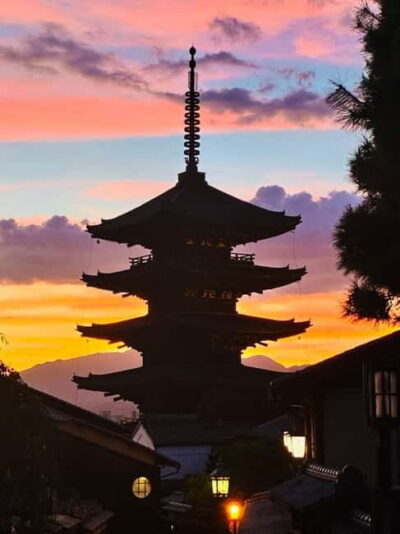
Kyoto Geisha Walking Tour: Gion District & Hidden Gems
Read our review →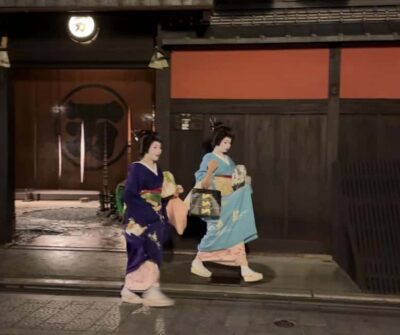
Gion Magical Night Walking Tour with Geisha Trivia
Read our review →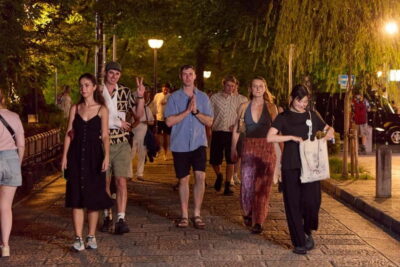
Gion Geisha District Walking Tour – Stories of Geisha
Read our review →

Kyoto Night Foodie Tour in Gion (9+ dishes + 6 Sake tastings)
Read our review →