
REVIEW · GION GEISHA DISTRICT TOURS
Kyoto: Gion Magical Night Walking Tour
Kyoto’s Gion district feels most atmospheric after dark, when lanterns glow, temple grounds grow quiet, and the famous lanes become easier to appreciate without daytime crowds. This roughly 100-minute walk takes you beyond the best-known streets and adds context about geisha life, shrines, pagodas, and local customs.
I especially like the small-group format, which makes it easier to ask questions and keeps the walk less intrusive in residential and geisha areas. I also like the carefully chosen route, which links Gion’s traditional streets with several religious sites and strong nighttime photo stops. The main drawback is the amount of walking on slopes and stairs, so this is not a good match if you want a gentle, seated evening activity.
In This Review
- Key points to know before booking
- Why Gion works better at night
- Gionmachi Minamigawa: the first look at geisha Kyoto
- Yasui-Konpiragu and the meaning of local shrines
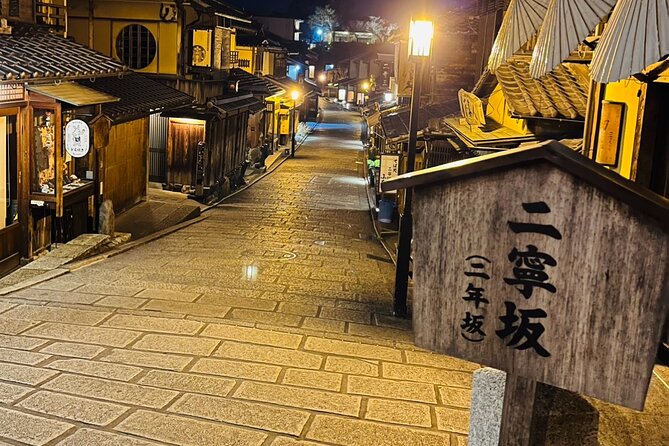
- Ninenzaka and Sannenzaka: Kyoto’s most photogenic climb
- Two quieter religious stops beyond the main lanes
- Yasaka Shrine: a fitting finish
- What the $29.60 price really buys
- Guides, language, and the quality of the explanation
- Walking demands, weather, and practical planning
- Who will enjoy this Kyoto night walk
- Should you book the Gion Magical Night Walking Tour?
- FAQ
- How long does the Gion Magical Night Walking Tour last?
- How much does the tour cost?
- Where does the tour meet?
- Where does the tour finish?
- What places are included?
- Will I definitely see a maiko or geiko?
- How large is the group?
- Is the tour suitable for people with limited mobility?
- Can I cancel for a refund?
Key points to know before booking
- Gion after dark: See illuminated streets, lantern-lit shrines, pagodas, and quieter lanes after many daytime sightseers have gone.
- A compact route with variety: The walk covers Gionmachi Minamigawa, Yasui-Konpiragu, Ninenzaka and Sannenzaka, several temple or memorial sites, and Yasaka Shrine.
- Geisha culture explained: Learn about the difference between maiko and geiko, their place in Kyoto society, and the etiquette to follow if you happen to see one.
- Small groups matter: The tour is promoted for up to eight people, while the additional booking information lists a maximum of 10.
- Good value at $29.60: You pay mainly for interpretation, local context, and an efficient route rather than admission to paid attractions.
- Wear proper shoes: Hills, steps, and a steady pace are part of the experience.
Why Gion works better at night
Gion can be frustrating in the middle of the day. Its narrow lanes attract large crowds, and the area’s quiet architecture can be hard to appreciate when people are stopping for photos at every turn.
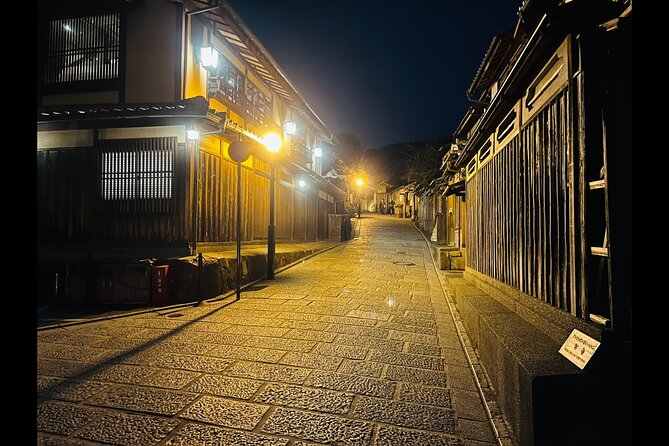
At night, the mood changes. Streetlights and shop lanterns bring out the woodwork and tiled roofs, while the shrines and pagodas take on a calmer character. You still need to act with care, since Gion is a living neighborhood rather than a stage set, but the evening timing helps you look rather than simply pass through.
The tour begins at Minamiza Theater, a well-known landmark near the eastern end of Shijo Bridge, and finishes at 625 Gionmachi Kitagawa. That point-to-point format is useful. You are not simply led back to where you started, and the final location leaves you in Gion with dining and evening plans still possible.
The exact start time can vary, but the experience is described as a night walk. One reported departure was 7:30 p.m., when the streets were quiet and the shrines were lit. If you want the calmest atmosphere, an evening departure is the reason to book this rather than wander Gion during the afternoon.
More evenings in Gion:
- Kyoto Geisha Walking Tour: Gion District & Hidden Gems
★ 4.7 · 3,273 reviews - Kyoto: Gion Magical Night Walking Tour with Geisha Trivia
★ 4.9 · 2,393 reviews - Kyoto: Gion Geisha District Walking Tour – Stories of Geisha
★ 4.7 · 2,187 reviews
Gionmachi Minamigawa: the first look at geisha Kyoto
The walk opens on Gionmachi Minamigawa, one of Kyoto’s most famous streets. This is the kind of place that appears in countless photographs, with traditional façades and an atmosphere tied closely to Kyoto’s geisha districts.
Your guide uses this opening stretch to explain the local geisha tradition. You may hear about maiko, who are apprentice performers, and geiko, the term used in Kyoto for experienced geisha. The emphasis is not just on costumes or photo opportunities. The useful part is learning how these women fit into the social and artistic life of the district, both in the past and today.
You may see a maiko or geiko, but this should never be treated as a promised sighting. If one passes by, the proper response is simple: smile and say Konnichiwa. Do not block the lane, follow her, or take intrusive photographs. A guide who explains this etiquette makes the walk more respectful and more rewarding.
The stop lasts about 10 minutes. That is enough time for an introduction and a few photographs, but not enough for a long pause. If you want to study every façade, you will need to return on your own.
Yasui-Konpiragu and the meaning of local shrines
Next comes Yasui-Konpiragu, a shrine associated with relationships. Its reputation covers both forming a new bond and cutting away harmful or unwanted relationships. For couples, the shrine is also linked with strengthening an existing connection.
This is a useful stop because it shows how Kyoto’s religious sites remain tied to everyday hopes. You are not looking only at old buildings. You are seeing how people use shrines to ask for help with love, luck, beauty, and personal change.
The visit takes about 10 minutes and admission is free. The site adds a clear cultural layer to the walk, though visitors who prefer long temple visits may find the stop brief. The guide’s explanation is the main reason to include it.
The walk between stops is part of the lesson. Gion’s meaning is spread through lanes, entrances, walls, and small details, not just through headline attractions. Walking with someone who can point out what you might otherwise miss gives the district more shape.
Ninenzaka and Sannenzaka: Kyoto’s most photogenic climb
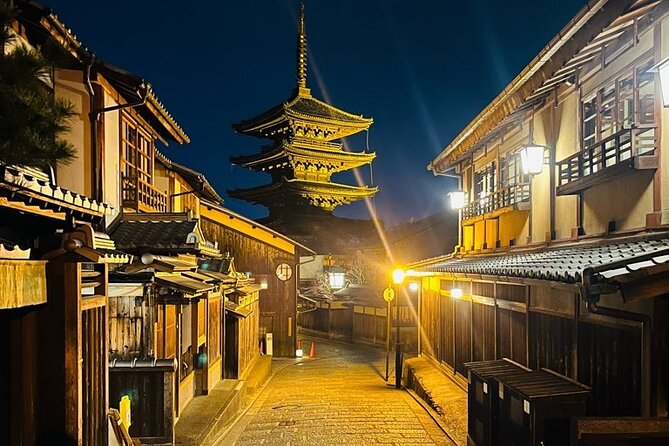
The route then reaches Ninenzaka and Sannenzaka, traditional streets leading toward Kiyomizu-dera Temple. Their preserved townscape is among the most recognizable in Kyoto, with sloping lanes, old-style buildings, and views toward Yasaka Pagoda.
This is one of the strongest parts of the experience for photography. At night, the reduced crowd and warm lighting can make the lanes feel far more graceful than they do during peak daytime hours. You will have time for photographs, but the walk is not designed as a dedicated photography workshop, so keep your camera ready rather than expecting long tripod sessions.
The stop lasts about 20 minutes, making it one of the longer scheduled pauses. Even so, you should expect to walk on an incline and manage steps. Several people have found the route comfortable but physically active, while one person felt that the amount of walking was substantial. That is a fair warning, especially after a full day of sightseeing.
You will not be entering Kiyomizu-dera as part of the described route. The value here is the approach: the old streets, the pagoda view, and the way the guide connects the built setting with Kyoto’s religious and artistic traditions.
More walking tours in Kyoto:
- Night Walk in Gion: Kyoto’s Geisha District
★ 4.5 · 2,003 reviews - Kyoto Gion Geisha District Walking Tour – The Stories of Geisha
★ 5.0 · 1,441 reviews - Nishiki Market Brunch Walking Tour (7 Tastings + Brunch)
★ 5.0 · 1,355 reviews - Kyoto Arashiyama Walking Tour: Bamboo, Monkeys, Gardens & Secrets
★ 5.0 · 1,216 reviews
Two quieter religious stops beyond the main lanes
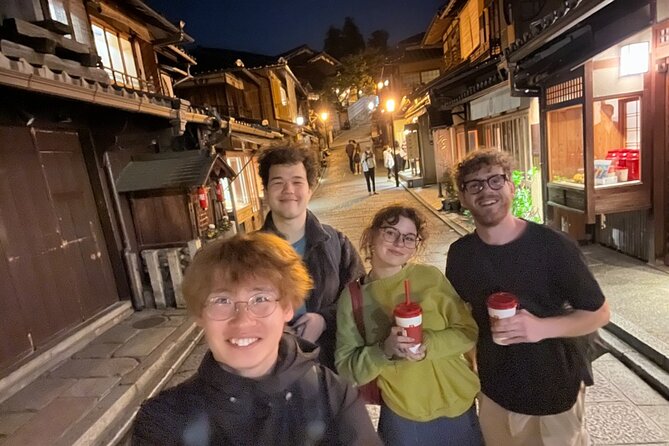
The route also includes two sites described by their purpose and setting rather than by name. One was built in 1955 to pray for the souls of World War II victims and includes a very large Kannon statue. Kannon is a widely revered Buddhist figure associated with compassion, so the stop adds a reflective note to an otherwise scenic evening walk.
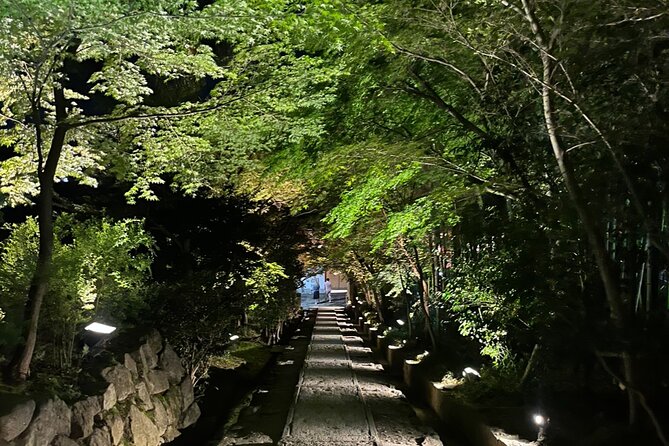
The other site was built about 400 years ago by a shogun’s wife to mourn her husband. It includes a garden, a 400-year-old tea ceremony house, and a bamboo grove. These details give you a sense of why the route is more than a quick circuit of Gion’s famous streets.
The supplied schedule does not clearly identify either place by name or state how long you will spend there. Because of that, I would treat them as guide-led viewing stops rather than plan around full visits to the gardens, tea house, or bamboo grove. The tour may show you the setting and explain its background, but the information provided does not promise admission or an extended exploration.
This is also where a good guide makes a real difference. Guides named in the booking feedback include Karen, Ricky, May, Hina, Pam, and Sho Hamada. Their styles may differ, but the recurring strength of the experience is personal explanation, stories, and willingness to answer questions.
Yasaka Shrine: a fitting finish
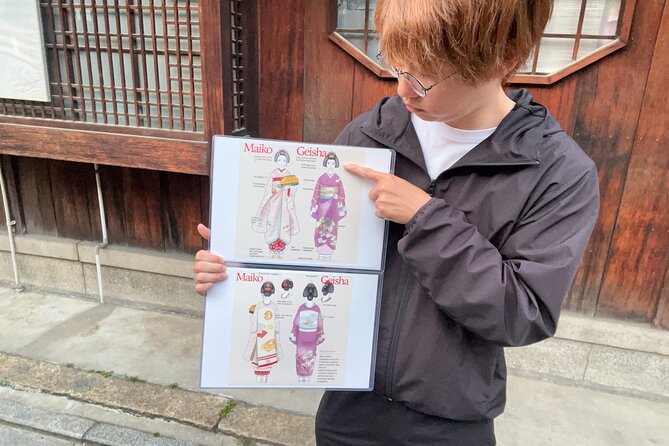
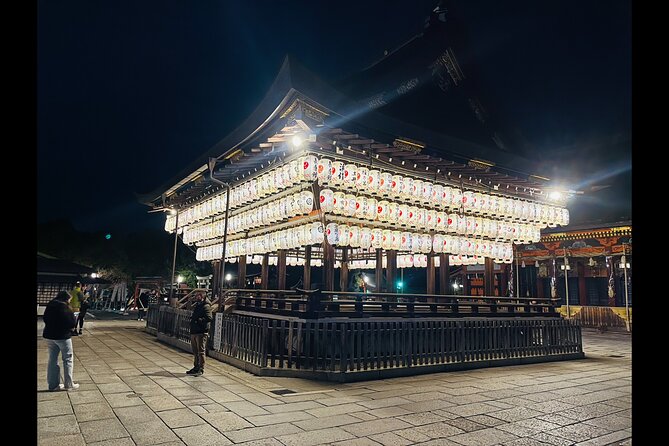
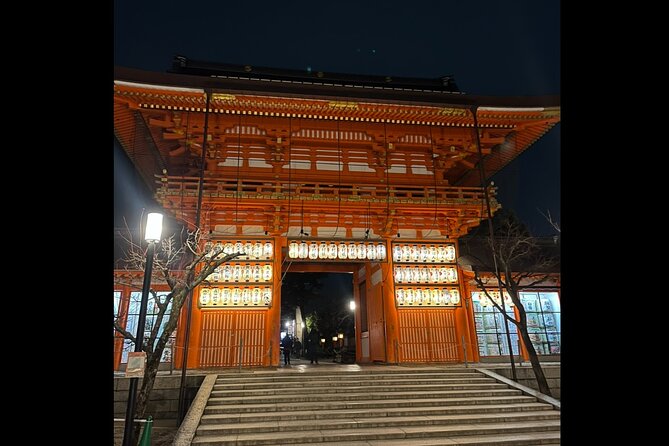
Yasaka Shrine is the final named stop. It is the head shrine of roughly 2,300 related shrines across Japan and is widely known in Kyoto as Gion-san.
The shrine is associated with protection from bad luck, good fortune, and beauty. At night, its lanterns and open spaces provide a strong final scene after the tighter lanes of Gion and the slopes of Ninenzaka and Sannenzaka.
This 10-minute stop is short, but it works well as a conclusion. You get one last explanation of local belief, a chance to take photographs, and a clear endpoint in Gionmachi Kitagawa. Since admission is free, the guide’s interpretation remains the main expense rather than entry fees.
If you want to visit Yasaka Shrine at length, come back independently. Ten minutes is enough for an introduction, not a full shrine visit.
What the $29.60 price really buys
At $29.60 per person, this is an affordable guided walk by Kyoto standards. There are no major admission charges included because the named stops are free, so you are paying for the route, the small group, and the explanations that connect the places.
I think the price is fair if this is your first time in Gion or if you have already walked through the district but felt you were missing the meaning behind it. A guide can help you cover several key areas efficiently and explain geisha culture without requiring you to research each shrine and street beforehand.
The value is weaker if you are comfortable exploring independently, already know Kyoto’s religious traditions, or mainly want a quiet stroll with no scheduled commentary. You can visit many of these streets and shrine exteriors without paying.
The group size is a genuine advantage. The highlights describe a maximum of eight, while the additional details state a maximum of 10. Either way, this is much smaller than a large coach group. A compact group makes it easier to hear the guide, ask questions, and avoid spreading across narrow lanes.
Guides, language, and the quality of the explanation
The strongest guide experiences come from guides who combine local knowledge with an engaging manner. Karen is singled out for answering questions, explaining religious traditions, and handling family questions with patience. Ricky is described as especially strong on Kyoto’s history and on the relationship between maiko, geiko, and wider Kyoto society.
Hina is noted for personal family insights, while Pam is praised for her information about Gion and its nighttime views. May is described as friendly and passionate, and Sho Hamada brings a clear affection for Kyoto to the walk.
English ability can vary by guide. One account notes that Sho was enthusiastic but sometimes needed extra time with questions while still learning English. I would not treat that as a general problem, but if precise, detailed English explanations are essential for you, keep the possibility of variation in mind.
The best questions to ask are specific: how maiko and geiko differ, how to behave if you see one, why a shrine is linked with a certain blessing, or how the religious sites relate to Gion. The walk is short, so thoughtful questions will help you get more from it.
Walking demands, weather, and practical planning
The tour lasts about one hour and 40 minutes, though one person expected an hour and found it closer to two. That is a useful planning point. Leave room around the tour rather than booking a tight dinner reservation immediately afterward.
Comfortable shoes are essential. The route includes slopes and stairs, especially around Ninenzaka and Sannenzaka. Most people can participate, but the experience is not recommended for anyone uncomfortable with this kind of walking.
Rain may affect the schedule because the activity requires good weather. Bring an umbrella if the forecast looks uncertain, but understand that poor weather can lead to a new date or a full refund. The walk has been enjoyed in gentle rain, though wet stone and sloping lanes can make footing less pleasant.
You receive confirmation at booking and can use a mobile ticket. The meeting point is the second-floor west lobby of Minamiza Theater at 198 Nakanocho, near Shijo Bridge. Check the address carefully, since arriving at the wrong side of the river or theater could cost you valuable time.
Free cancellation is available up to 24 hours before the start time. Inside that window, the payment is not refunded, except when the operator cancels because of poor weather or because the minimum number of participants is not reached.
Who will enjoy this Kyoto night walk
I would recommend it most for first-time Kyoto visitors who want a clear introduction to Gion without joining a large group. It also suits families with older children, since the walk is short enough to manage and guides have handled questions from children aged 12 and 14.
It is a good choice if you care about cultural context, night photography, traditional streets, or geisha etiquette. It also works well after a day of temple visits, since the route gives you a different view of Kyoto without taking up an entire evening.
You should think twice if you dislike hills, stairs, or walking for close to two hours. You may also prefer independent sightseeing if you want to linger at one temple, shop, or street rather than follow a set route.
Should you book the Gion Magical Night Walking Tour?
Book it if you want a modestly priced introduction to Gion, especially at night, and value a small group with a guide who can explain what you are seeing. The route combines famous streets with less obvious religious sites, and the strongest part is the connection between scenery, geisha culture, and local belief.
Skip it if you want a full temple admission tour, a dedicated geisha performance, or a slow photography session. This is a walking orientation with cultural interpretation, not a formal show.
For most visitors, I would book it early in a Kyoto stay. You will learn how to read Gion more thoughtfully, then can return later to the streets and shrines that caught your eye.
FAQ
How long does the Gion Magical Night Walking Tour last?
The advertised duration is approximately one hour and 40 minutes. One account described the experience as closer to two hours, so leave some flexibility in your evening schedule.
How much does the tour cost?
The listed price is $29.60 per person.
Where does the tour meet?
The meeting point is the second-floor west lobby of Minamiza Theater, at 198 Nakanocho in Kyoto’s Higashiyama Ward, near Shijo Bridge.
Where does the tour finish?
The tour ends at 625 Gionmachi Kitagawa in Kyoto’s Higashiyama Ward.
What places are included?
The route includes Gionmachi Minamigawa, Yasui-Konpiragu, Ninenzaka and Sannenzaka, two additional religious or memorial sites described in the schedule, and Yasaka Shrine.
Will I definitely see a maiko or geiko?
No. The schedule says you may see one if you are lucky. If you do, greet her with a smile and say Konnichiwa.
How large is the group?
The tour highlights a maximum of eight people, while the additional information gives a maximum of 10 travelers. The group is designed to remain small.
Is the tour suitable for people with limited mobility?
The tour is not recommended for people who are uncomfortable with slopes and stairs. Most participants can take part, but comfortable walking shoes are important.
Can I cancel for a refund?
You can cancel at least 24 hours before the local start time for a full refund. Cancellations or changes made less than 24 hours before the start time are not refunded. If poor weather or an insufficient number of participants causes cancellation, you will be offered another date or a full refund.
More Kyoto Evenings
- Kyoto Night Foodie Tour in Gion (9+ dishes + 6 Sake tastings)
★ 5.0 · 1,762 reviews - Kyoto Gion Night Walk & Geisha District Guided Tour
★ 5.0 · 786 reviews - Kyoto Ghost Tour: Dark Tales, Urban Legends, Bamboo Forest Night
★ 5.0 · 625 reviews - Kyoto Bar Hopping Night Tour
★ 5.0 · 613 reviews
Recently added around Kyoto
- Higashiyama | Kyoto: Sakura Season Private Rickshaw Tour★ 5.0 · 3 reviews
- Kyoto Kimono Rental CHAMATSU|Kimono/Yukata Rental FamilyPlan★ 5.0 · 3 reviews
- Kyoto: Half-Day Private Guided Tour to the Old Town of Gion★ 4.4 · 3 reviews
- Nara Private Customizable Half Day Tour★ 5.0 · 3 reviews
- Kansai Region Hiking Adventure in Nara Kobe Kyoto and More★ 5.0 · 3 reviews
- Full Day Nara Deer, Temple, Shrine, Activities & Tea Ceremony★ 5.0 · 3 reviews
- Nara: Essential Private Tour with Deer Park and Temples★ 5.0 · 3 reviews
- Hiking Tour for Sacred Sites in Kyoto with a Guide★ 5.0 · 3 reviews
Gion Geisha District Tours, compared.

Kyoto Geisha Walking Tour: Gion District & Hidden Gems
Read our review →
Gion Magical Night Walking Tour with Geisha Trivia
Read our review →
Gion Geisha District Walking Tour – Stories of Geisha
Read our review →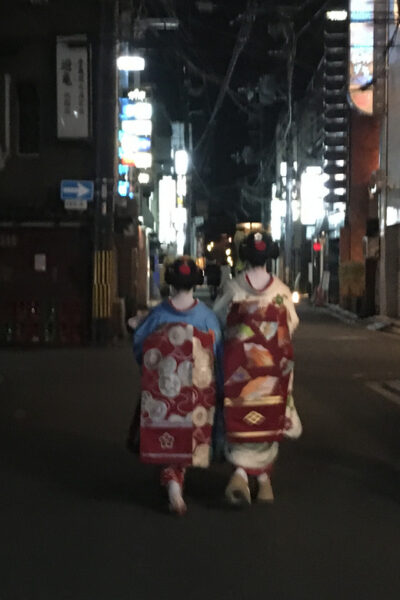
Best of Kyoto: Gion, Geisha, Pagodas & Cobblestones
Read our review →

Kyoto Night Foodie Tour in Gion (9+ dishes + 6 Sake tastings)
Read our review →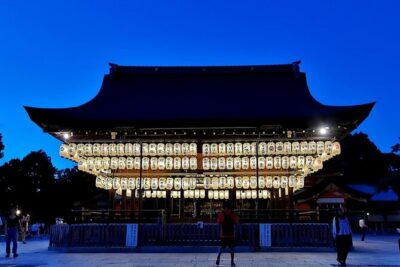
Kyoto Gion Geisha District Walking Tour – The Stories of Geisha
Read our review →
Kyoto Gion: 2-Hour Geisha Culture & History Walking Tour
Read our review →Browse the lists this tour appears in