
REVIEW · KYOTO
Hammer Pattering Experience of Ring
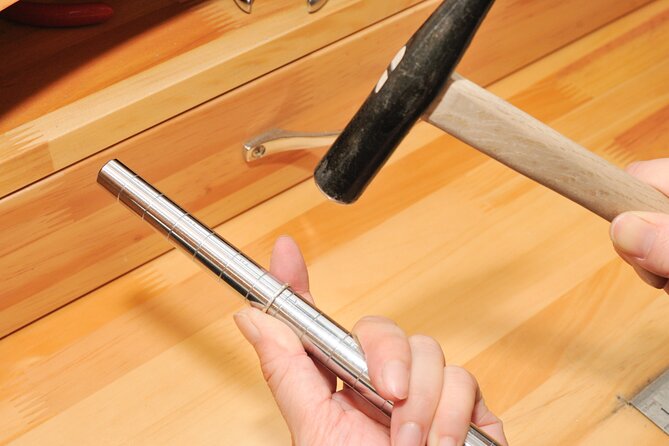
A ring takes shape here through Japanese Tankin hammering, not through cutting, bending, and soldering a strip of metal. You select the material, thickness, shape, and surface pattern, then tap the texture into a ring that has already been formed and finished.
I like two things right away: you take the ring home that day, and the staff guide you closely instead of leaving you alone with unfamiliar tools. The price is also gentle at $21.68 per person, especially when the finished piece can serve as a useful souvenir rather than a shelf ornament.
The main thing to know is that this is a ring-texturing workshop, not a full jewelry-making class. You do not weld the ring or build its basic circle from raw metal, so anyone expecting a traditional soldering lesson may find the work more limited than expected.
In This Review
- Key points to know before booking
- What you are really making at Itoaware Kyoto
- Choosing the material, shape, and texture
- The one-hour hammering session
- The final polish and taking your ring home
- Why the $21.68 price can make sense
- Location in Higashiyama and planning your visit
- Private groups and the feel of the class
- What this workshop does not include
- Who will enjoy making a hammered ring
- Should you book the Hammer Pattering Experience of Ring?
- FAQ
- Where does the ring-making workshop take place?
- How long does the activity last?
- Can I take the ring home on the same day?
- Do I make the entire ring from raw metal?
- What can I customize?
- Is this a private activity?
- Is the workshop near public transportation?
- What is the cancellation policy?
Key points to know before booking
- Hammered Japanese Tankin finish: You create the ring’s pattern by using special hammers and tools.
- Pre-formed rings: The ring has already been welded or polished before you add its texture.
- Same-day keepsake: Skilled staff polish and clean the finished ring, and you take it home that day.
- About one hour: The workshop fits neatly into a Kyoto sightseeing day.
- Private activity: Only your own group participates, which makes the pace more personal.
- Higashiyama location: Meet at Itoaware Kyoto, 91-5 Hoshinocho, near public transportation.
What you are really making at Itoaware Kyoto
The appeal of this workshop is its clear division of labor. The shop prepares the ring’s basic form, then you give it a personal surface. With a hammer in hand, you create small marks and patterns that catch the light and make the ring your own.
That distinction matters. The experience is not a metalsmithing course where you measure a strip, shape it into a circle, solder the join, and polish every stage yourself. Instead, it is a focused finishing class. You work on texture, appearance, and fit while trained staff handle the final polish and cleaning.
For many people, that is the right balance. You get the satisfying part of making something with your hands without spending several hours learning advanced jewelry work. Families, couples, and first-time crafters can finish a wearable souvenir in roughly 60 minutes.
The Japanese Tankin style gives the class a local character. The appeal is not only the finished ring, but also the repeated sound and feel of hammering a pattern into metal. You are making a small object while using a traditional Japanese approach to metalwork.
Other Kyoto mornings people book alongside this one:
- PERFECT KYOTO 1-Day Bus Tour
★ 5.0 · 13,518 reviews - Kyoto: Fushimi Inari, Kinkakuji, Bamboo Grove 1 Day Bus Tour
★ 4.8 · 4,316 reviews - Kyoto: Tea Ceremony in a Traditional Tea House in Kiyomizu
★ 4.9 · 3,519 reviews
Choosing the material, shape, and texture
The workshop begins with choices. You select your preferred material, ring thickness, shape, and texture from the options available at the shop. The supplied information refers to silver or gold rings, so ask the staff what is available for your date and booking before you arrive if the metal matters to you.
Thickness affects the feel of the ring on your finger. A slim ring gives you a lighter, quieter piece, while a thicker band offers more surface for hammer marks. Shape also changes the look. A smooth, simple form may show the pattern clearly, while a different profile can give the ring a more distinct finish.
Texture is where your personal input becomes most visible. You use special hammers and tools to add marks to the prepared ring. The pattern does not need to be perfectly uniform. Small differences are part of the point, since they show that you made the surface yourself.
Staff explain the tools and process before you begin. This is important because a hammer can create a tiny mark or a much stronger impression depending on how you use it. You do not need prior jewelry experience, and the workshop is designed so most people can participate.
If you are making rings as a couple, discuss your choices before the hammering begins. Matching materials with different textures can look coordinated without producing identical rings. You can also choose similar patterns in different thicknesses for a family set.
The one-hour hammering session
Once your ring is selected and the process is explained, the hands-on work begins. You use the provided hammer and tools to build the surface pattern. The work is direct and easy to understand: place the tool, tap the metal, check the mark, and continue around the ring.
The staff remain available to help with technique and sizing. That support is one of the strongest reasons to choose a guided class instead of attempting a similar project alone. If a mark is too heavy or the pattern begins to look uneven, you can ask for help before continuing.
The workshop takes about an hour from start to finish. That includes the explanation, your hammering, and the final cleaning and polishing. The timing makes this a practical choice before dinner, between sightseeing stops, or during a shorter Kyoto visit.
Do not rush the pattern. The ring is small, so it is easy to assume the job will take only a few minutes. In practice, creating a consistent texture around the full band requires care. The class gives you enough time to make decisions, correct your approach, and finish the piece without turning the session into an all-day project.
The work is also suitable for a mixed-age group, based on the family experience described in the supplied details. Two children, two adults, and a couple were all able to take part in the activity. The staff’s patient instruction helps make the workshop approachable for first-time makers.
The final polish and taking your ring home
After you finish adding the texture, skilled craftsmen polish and clean the ring. This final step gives the piece a proper finish and removes the rough feel that can remain after hammering.
The result is not simply a ring you made halfway. The staff complete the final preparation so it is ready to wear or give as a gift. You can take it home on the same day, which is useful if you are buying a souvenir late in your Kyoto stay.
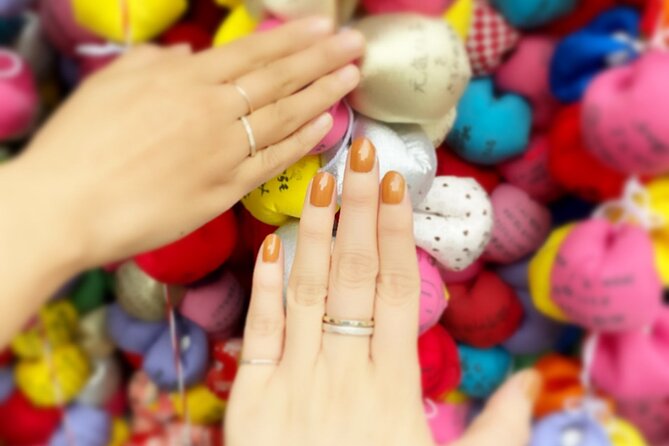
The finished ring also carries more meaning than a standard shop purchase. You chose its material and surface, then put the pattern there yourself. Couples have used the workshop to make matching keepsakes, and one couple added Kyoto engraving to help remember a honeymoon stop. Engraving is not described as a standard part of every booking, so ask the staff directly if you want that option.
If you plan to give the ring as a present, leave enough time to check the fit before you leave the shop. The staff can help with sizing during the class, but the supplied details do not promise unlimited resizing or later alterations.
A completely different side of Kyoto:
- Kyoto Geisha Walking Tour: Gion District & Hidden Gems
★ 4.7 · 3,273 reviews - Kyoto: Tea Ceremony Ju-An at Jotokuji Temple
★ 4.9 · 3,207 reviews - Kyoto: Gion Magical Night Walking Tour with Geisha Trivia
★ 4.9 · 2,393 reviews - Kyoto: 45-Minute Tea Ceremony Lesson Experience
★ 4.3 · 2,378 reviews
Why the $21.68 price can make sense
At $21.68 per person, this is one of the easier Kyoto craft activities to fit into a daily budget. The value comes from three parts: guided instruction, the use of specialist tools, and a finished ring that you can take away.
You are not paying for a long class or a complex piece of jewelry. The workshop lasts about an hour, and the basic ring is prepared before you begin. That keeps the cost low, but it also explains why the activity does not offer the full metal-forming process some people expect.
The price looks especially fair for a couple or family wanting a shared activity rather than another purchase. Each participant makes an individual ring, so everyone leaves with something personal. A family can also compare the different textures afterward, which adds a small social reward to the class.
Material choice may affect what you receive, so confirm the available options when booking. The listed rate is per person, and the booking information specifically asks you to check that the number of participants matches the number of reservations. That is a simple detail, but it is worth checking before you pay.
Location in Higashiyama and planning your visit
The meeting point is Itoaware Kyoto at 91-5 Hoshinocho, Higashiyama Ward, Kyoto, postal code 605-0853. The same address is used for arrival and departure, so you do not need to arrange a separate ending point.
The shop is near public transportation, which makes it easier to place the class into a Kyoto day. Allow enough time to find 91-5 Hoshinocho, especially if you are moving between several Higashiyama sights. The activity itself lasts one hour, but your full schedule needs room for getting there and leaving afterward.
The Higashiyama setting is a natural match for a small Japanese craft activity. You can treat the class as a break from walking and sightseeing, then continue your day with a handmade souvenir in your bag. The address is specific, so use it rather than relying only on the shop name.
The experience ends back at the meeting point. You do not need to collect the ring elsewhere, and the same-day handover keeps your plans simple.
Private groups and the feel of the class
This is a private activity, meaning only your own group participates. That can make a noticeable difference in a hands-on class. You can ask questions without waiting for a large group, and staff can help each person with hammer pressure, texture, and sizing.
A private booking also suits couples who want a shared memory without strangers at the workbench. Families can work at their own speed, while solo participants can receive direct help without feeling watched by a large class.
The class still has a fixed structure. Staff explain the method, you add the texture, and the craftsmen finish the ring. Private does not mean you design every technical detail from scratch, but it does give your group a more personal setting.
The tone described in the supplied details is friendly and patient, with staff helping throughout the activity and taking commemorative photos. If a photograph matters to you, ask during the session so the staff can help capture the finished ring and the making process.
What this workshop does not include
The biggest limitation is also the clearest point to understand. You do not weld the ring yourself. The ring has already been welded or polished, and your job is to add patterns and texture with the hammers.
That makes this a poor match for you if your main goal is to learn traditional jewelry construction from raw metal. You may want a longer metalsmithing class if you hope to cut, bend, solder, and polish a ring through every stage.
For a short Kyoto activity, though, the narrower focus works well. You can concentrate on visible design choices and finish with a real item. The class avoids the steep learning curve of a full jewelry workshop while keeping enough hands-on work to feel genuine.
Think of it as a personal finishing studio rather than a complete ring-construction course. That description will help you book with the right expectations.
Who will enjoy making a hammered ring
I would recommend this activity to couples, families, honeymooners, and anyone who wants a compact souvenir with a personal story. It is especially suitable if you want to make something rather than simply buy it, but you do not want to give up half a day.
It also works for people who like practical souvenirs. A ring takes up almost no space in your luggage and can be worn long after you leave Japan. The Kyoto connection can be made even more specific if engraving is available for your session.
You should think twice if you dislike repetitive handwork or want a highly technical class. The central task is hammering a pattern around a prepared ring. The process is simple to understand, but the final appearance depends on your patience and control.
Most people can participate, and service animals are allowed. Confirmation is sent within 48 hours of booking, subject to availability. You can cancel for a full refund up to 24 hours before the local start time. Changes or cancellations inside that window are not accepted and are not refunded.
Should you book the Hammer Pattering Experience of Ring?
Book it if you want a one-hour Kyoto craft activity, a friendly private setting, and a wearable souvenir finished on the day. The $21.68 price is sensible for a guided class that includes the ring, tool use, staff help, polishing, and cleaning.
Skip it if you expect to forge a ring from a straight strip of metal or learn welding. That is not what happens here. You will texture a prepared ring, and that narrower task is the key to enjoying the class.
For most couples and families, I see the appeal. You leave with two things: a ring and the memory of making its surface together. In Kyoto, that is a better souvenir than another object picked up in a hurry.
FAQ
Where does the ring-making workshop take place?
The workshop takes place at Itoaware Kyoto, 91-5 Hoshinocho, Higashiyama Ward, Kyoto, Japan, postal code 605-0853.
How long does the activity last?
The full workshop takes approximately one hour.
Can I take the ring home on the same day?
Yes. Staff polish and clean the ring during the final stage, and you can take it home that day.
Do I make the entire ring from raw metal?
No. The ring has already been welded or polished. You add the patterns and texture using hammers and special tools.
What can I customize?
You can select your preferred available material, thickness, shape, and texture.
Is this a private activity?
Yes. Only your own group participates in the activity.
Is the workshop near public transportation?
Yes. The meeting point is near public transportation.
What is the cancellation policy?
You can cancel up to 24 hours before the local start time for a full refund. Cancellations or changes made less than 24 hours before the start time are not accepted or refunded.
Recently added around Kyoto
- Higashiyama | Kyoto: Sakura Season Private Rickshaw Tour★ 5.0 · 3 reviews
- Kyoto Kimono Rental CHAMATSU|Kimono/Yukata Rental FamilyPlan★ 5.0 · 3 reviews
- Nara Private Customizable Half Day Tour★ 5.0 · 3 reviews
- Kyoto: Half-Day Private Guided Tour to the Old Town of Gion★ 4.4 · 3 reviews
- Kansai Region Hiking Adventure in Nara Kobe Kyoto and More★ 5.0 · 3 reviews
- Full Day Nara Deer, Temple, Shrine, Activities & Tea Ceremony★ 5.0 · 3 reviews
- Nara: Essential Private Tour with Deer Park and Temples★ 5.0 · 3 reviews
- Hiking Tour for Sacred Sites in Kyoto with a Guide★ 5.0 · 3 reviews