
REVIEW · ARASHIYAMA BAMBOO GROVE TOURS
Arashiyama & Nara Highlights: One-Day Private Tour Adventure
Arashiyama’s bamboo grove and Nara’s giant Buddha make an efficient pair: one day gives you Kyoto’s most photographed natural setting and several of Japan’s most important temples and shrines. The private format lets you adjust the order and pace, which is especially useful with children or older family members.
I like the door-to-door plan from a Kyoto hotel, and I like having a guide who can explain Japanese customs from an outsider’s point of view. Guides named Ahmed, Kingo, Moto, and Miyako have each been praised for clear English, patience, cultural knowledge, and taking family photos.
The main caution is cost. The advertised $490 covers the guiding and management, but the vehicle is paid separately in cash at ¥110,000 for up to five people, and entry fees are extra. Confirm the full amount before booking.
In This Review
- Key points to know before you book
- Two famous places in one Kyoto day
- Arashiyama bamboo and Tenryu-ji before the crowds
- Togetsu Bridge and the Hozu River view
- The long transfer from Arashiyama to Nara
- Nara Park and the famous deer
- Todai-ji and the Great Buddha Hall
- Kasuga Grand Shrine and its lanterns
- A private guide makes the pace more manageable
- What the price really means
- Who should choose this day out
- Should you book Arashiyama and Nara together?
- FAQ
- How long does the private tour last?
- Is transportation included in the $490 price?
- How many people can join the tour?
- Are admission fees included?
- Can the sightseeing order be changed?
- What happens if bad weather cancels the tour?
Key points to know before you book
- Two major day trips in one: See Arashiyama in the morning and Nara in the afternoon without changing hotels.
- A genuinely private outing: Only your own group participates, with space to adjust the order and some sightseeing choices.
- The van is not included: Budget ¥110,000 in cash for vehicle hire for up to five people.
- Admission fees add up: Entry charges are listed at ¥4,800 per person.
- The schedule is tight but workable: You leave Kyoto at 9:00 a.m. and return around 7:00 p.m.
- Best for short stays and families: You cover major sights efficiently, though the long driving day leaves little room for wandering.
Two famous places in one Kyoto day
This tour tackles a common Kyoto problem: there is too much to see and not enough time. Arashiyama lies west of central Kyoto, while Nara is farther south and east. Visiting both independently in one day is possible, but it requires careful train connections, local transport, walking, and time management.
Here, you meet at your Kyoto hotel at 9:00 a.m. and finish back in Kyoto at about 7:00 p.m. The eight-hour vehicle hire gives you a simple framework for the day. You do not need to work out each transfer, and your guide can help decide how long to stay at each stop.
The tradeoff is clear: this is a highlights tour, not a slow cultural day. You will see several important places, but you will not have hours for quiet side streets, long temple visits, or an extended meal. I would choose it for a first visit or a short stay, not for a relaxed return trip to Kyoto.
More of Arashiyama and the bamboo grove:
- Kyoto: Fushimi Inari, Kinkakuji, Bamboo Grove 1 Day Bus Tour
★ 4.8 · 4,316 reviews - Kyoto/Osaka: Nara, Fushimi Inari Taisha, Arashiyama Bus Tour
★ 4.7 · 1,275 reviews - Kyoto Arashiyama Walking Tour: Bamboo, Monkeys, Gardens & Secrets
★ 5.0 · 1,216 reviews
Arashiyama bamboo and Tenryu-ji before the crowds
The morning begins in Arashiyama, usually with the Bamboo Forest Street and the nearby Nonomiya Shrine. Tall bamboo stalks rise on both sides of the path, creating the unusual green corridor that has become one of Kyoto’s best-known sights.
The walk itself is short, listed at about 30 minutes. That is enough to see the famous section and take photographs, but do not expect a long hike through the hills. The path is a public area, so it can feel busy, especially at popular times. A private guide cannot remove the crowds, but can help you move through the area efficiently and explain the connection between the shrine, the forest, and local religious traditions.
Nonomiya Shrine adds a small Shinto stop to the morning. It is less grand than the large temple grounds nearby, but it gives you a chance to see a working place of worship rather than only a photo setting.
Next comes Tenryu-ji Temple Garden, a UNESCO World Heritage site. The Sogenchi Teien garden is the more peaceful part of this visit, with carefully arranged ponds, rocks, trees, and views toward the surrounding hills. The garden’s appeal is not a single monument. It is the way the parts are arranged to guide your eye as you walk.
You have about 30 minutes here according to the planned timing. That is enough for a focused stroll, though some people will want longer. Tenryu-ji charges a separate admission fee, so it is one of the places that contributes to the additional ¥4,800 per person entry cost.
If you enjoy Japanese gardens, I would treat this as one of the morning’s best stops. If you prefer temple interiors or detailed architecture, the visit may feel brief. The guide can customize the order, but the overall distance between Arashiyama and Nara means the morning cannot expand too much.
Togetsu Bridge and the Hozu River view
The next Arashiyama stop is the Togetsu Bridge area and the Hozu-gawa River. The bridge is one of the district’s familiar sights, and the river gives you a change of pace after the narrow bamboo path and temple garden.
The planned time is around 11:00 a.m. This is more of a scenic pause than a major attraction with an extended visit. You can take in the water, bridge, and surrounding hills, then continue toward Nara.
This part is useful because it gives the morning some variety. Arashiyama can otherwise become a quick sequence of bamboo photographs and temple buildings. The river stop helps you understand why this area has long been valued as a place for views and leisure.
It is also a place where expectations matter. You are not promised a boat ride, and none is included in the stated experience. Think of it as a viewpoint and short walk, not a separate river excursion.
The long transfer from Arashiyama to Nara
Around 1:00 p.m., you leave Arashiyama for Nara. The planned arrival is about 2:30 p.m., so the transfer takes a significant part of the day.
This is where the hired vehicle earns its keep. Moving a private group from western Kyoto to Nara is much simpler by car or van than by combining several public transport legs. You can stay together, keep your belongings with you, and avoid navigating stations during a tightly timed day.
Still, the transfer is not free time in the sightseeing sense. You are paying for vehicle hire and using part of an eight-hour booking on the road. For a group of up to five, the stated vehicle charge is ¥110,000 in cash on the tour day. If your group is larger than five, you are asked to arrange the details in advance.
That separate charge is the most important financial point in the entire experience. The $490 group price may look attractive when divided among several people, but the final cost is considerably higher once the vehicle and admissions are added. A group of five can spread the vehicle price more easily than a couple can.
More day trips to Nara:
- World Heritage Kyoto & Nara Uji Authentic Matcha Experience
★ 5.0 · 1,573 reviews - Nara Half Day Trip Walking Tour (Private Option Available)
★ 5.0 · 937 reviews - Nara Early Morning Tour (Kyoto or Osaka Departure Available)
★ 5.0 · 676 reviews - Kyoto and Nara Day Trip from Kyoto
★ 4.5 · 445 reviews
Nara Park and the famous deer
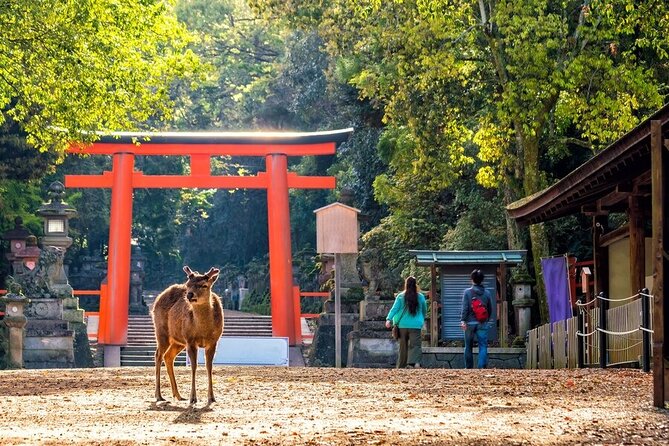
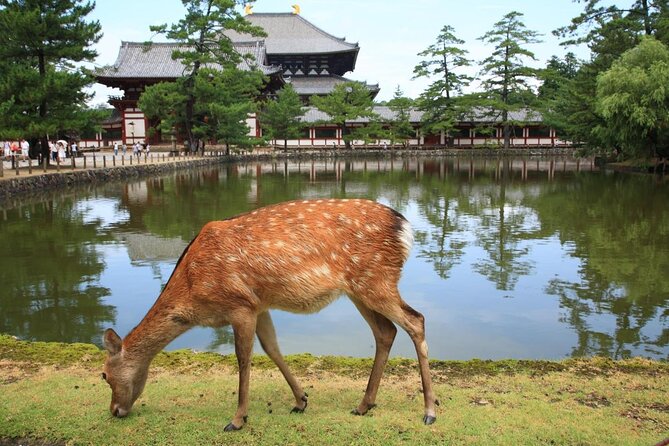
Nara Park is the first Nara stop, with about an hour planned. Deer roam freely through the park, giving this part of the day an experience you cannot duplicate in Kyoto.
The deer are accustomed to people and are known for their calm behavior, but you should still treat them as animals rather than toys. Keep food and paper away from curious mouths, follow local instructions, and give the deer space if one becomes too eager. The park itself has no admission charge, which helps keep this stop simple.
Families often find this the most immediately engaging part of the day. Children have something active to watch, while adults can enjoy the setting around the paths and historic buildings. The guide can also help you understand why the deer hold such a special place in Nara’s culture.
One hour is a reasonable introduction. You can see deer, take photographs, and walk toward Todai-ji. It is not enough for a long exploration of the entire park, and you may need to accept that some pauses will be short.
Todai-ji and the Great Buddha Hall
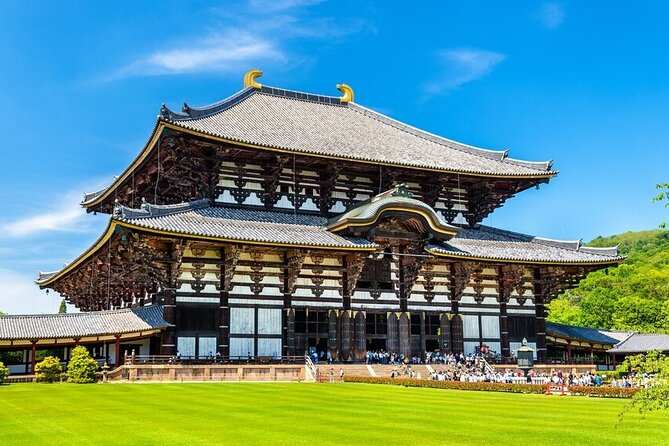
Todai-ji follows at about 3:30 p.m., with one hour planned. This is the heavyweight temple visit of the day.
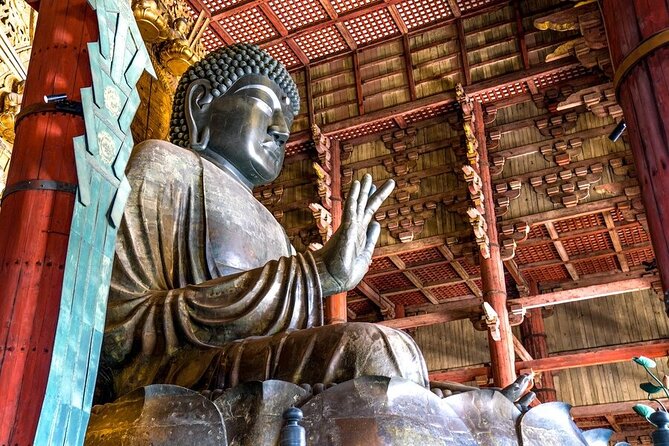
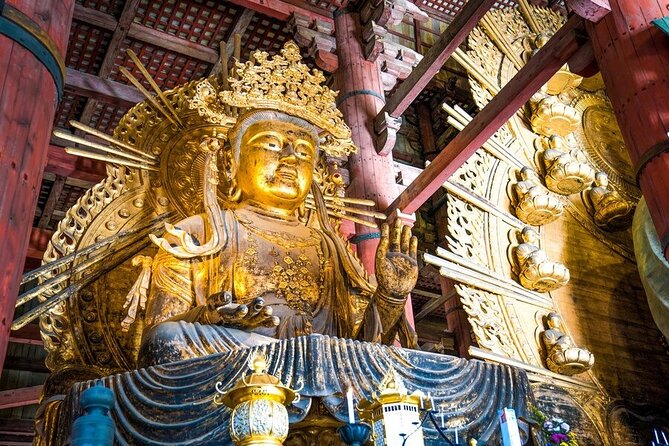
The Great Buddha Hall houses one of the world’s largest bronze Buddha statues. The scale is the point: the hall is enormous, and the statue gives the interior a powerful sense of size even if you have visited many temples before. Todai-ji is also a UNESCO World Heritage site, so this is not simply a quick photo stop. It is one of the central cultural sights in Nara.
Admission is not included. The separate entry charges are listed together as ¥4,800 per person for the experience, so you should ask exactly how the fee is allocated when confirming the booking. The supplied details specifically identify admission as extra.
A guide can make a major difference here. Without context, you may see a large wooden hall and a giant statue, then move on. With explanation, you can better understand the place as a religious center and a landmark in Japanese Buddhist history. The available guide feedback gives particular weight to cultural explanations, English ability, and careful attention to families.
The timing is fairly brisk. One hour allows a focused visit, but not a leisurely examination of every detail. If Todai-ji is your main reason for going to Nara, tell the guide at the start and ask how much time can be protected for it.
Kasuga Grand Shrine and its lanterns
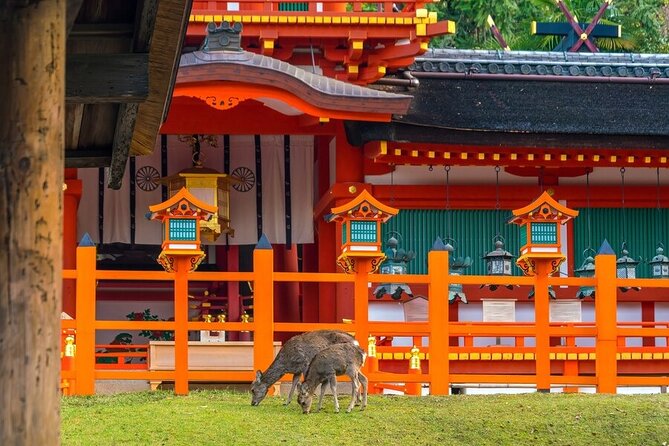
The final major stop is Kasuga Grand Shrine at about 4:30 p.m. The planned visit lasts 30 minutes.
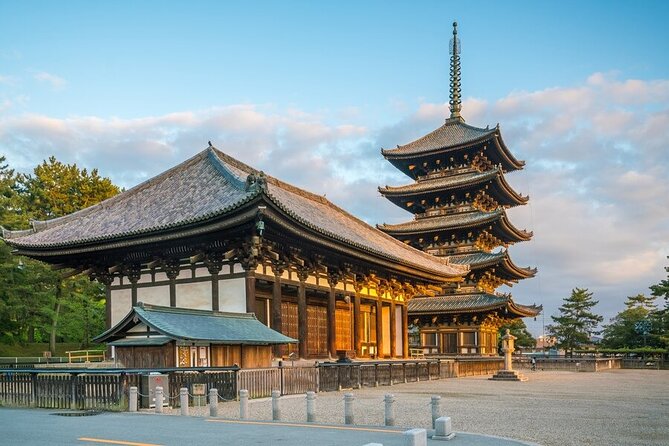
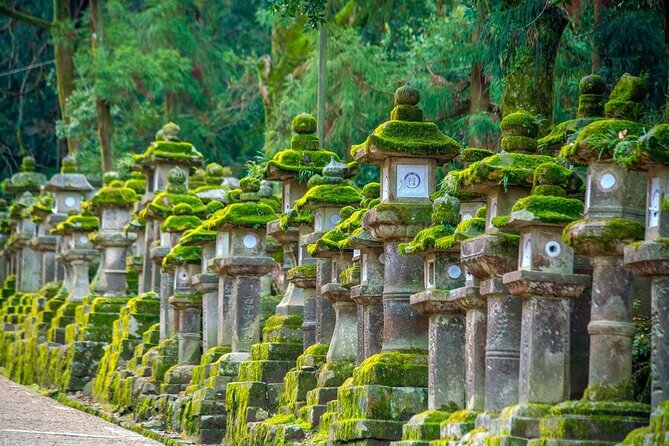
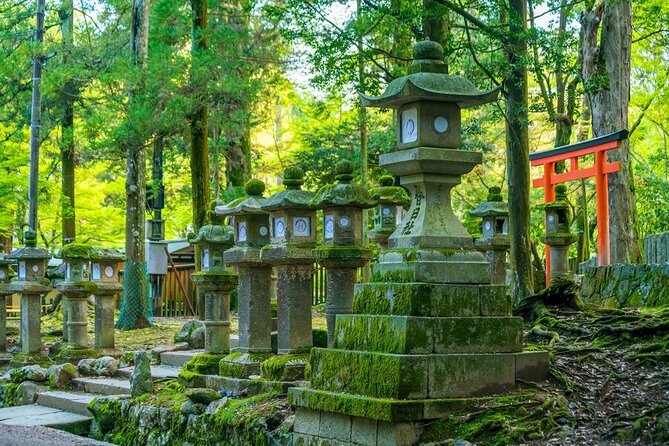
Kasuga is a Shinto shrine known for its bronze and stone lanterns. The lanterns line paths and gather around the shrine buildings, giving the site a distinct visual character. This is a different religious setting from Todai-ji, and the contrast is valuable. In one afternoon, you see a major Buddhist temple and a major Shinto shrine.
Thirty minutes is enough for an introduction and a look at the lantern-filled approach, but it is not a long shrine visit. If you want to explore every path or spend time in the surrounding wooded area, you will probably need a more specialized Nara day.
The short stop does have one advantage: by late afternoon, you are not trying to fit in another large attraction. After Kasuga, you return to Kyoto, with the tour scheduled to finish around 7:00 p.m.
A private guide makes the pace more manageable
The tour is limited to your own group, with a maximum of eight people. That matters most when your party includes children, older relatives, or people with different interests. You can ask to change the order, adjust the pace, or customize parts of the day with the guide.
Several guides are associated with strong service feedback, including Ahmed, Kingo, Moto, and Miyako. Their praised qualities include fluent English, cultural explanations, professionalism, kindness, taking photographs, and staying attentive to family needs. The operator does not guarantee a particular guide in the supplied details, so ask who is assigned if that matters to you.
The private format also gives you a better chance to ask direct questions. The tour is designed to help you understand Japanese culture and daily life from a foreign perspective. That can be useful if you want explanations in accessible English rather than a formal lecture.
There is one practical warning. At least one booking problem involved short-notice guide arrangements and confusion about the separate vehicle cost. The safest approach is to confirm the guide, pickup time, vehicle, group size, and total cash payment well before the day of travel. The experience is normally confirmed at booking, but last-minute arrangements may be less smooth.
What the price really means
The headline price is $490 per group of up to eight. That sounds reasonable for a private eight-hour outing, but it is not the full tour cost.
Transportation is excluded. For up to five people, the stated van hire is ¥110,000 per booking, paid in cash to the driver on the tour day. Groups larger than five must contact the operator in advance. Entry fees are listed at ¥4,800 per person, and tips are appreciated but not required.
For a larger family or group of friends, the vehicle cost can be divided several ways, making the arrangement more appealing. For two people, the separate ¥110,000 transport charge changes the value calculation considerably. You should compare the total against arranging a private taxi or using trains and local transport on your own.
The value is strongest when convenience matters more than keeping the price low. You are paying for a guide, a planned route, private coordination, and a vehicle that links two separated sightseeing areas. If your priority is the lowest possible cost, public transportation will likely deserve a closer look.
Who should choose this day out
I would recommend this tour most strongly for:
- Families who want deer, major temples, and a simple private schedule
- First-time visitors with only a short stay in Kyoto
- Groups of several people who can share the van cost
- Visitors who prefer a guide to explain religious customs and local culture
- Anyone who wants to see both Arashiyama and Nara without planning several transfers
I would hesitate if you dislike long vehicle transfers, want unhurried temple visits, or are traveling as a small group on a tight budget. You may also prefer separate days if bamboo, Todai-ji, or Nara Park is a personal priority.
The tour requires good weather. If poor weather causes cancellation, you are offered another date or a full refund. Free cancellation is available up to 24 hours before the start time. Changes or cancellations inside that window are not refunded.
Should you book Arashiyama and Nara together?
Book it if your main goal is to collect Kyoto and Nara’s major sights efficiently, with a private guide handling the route. The combination of bamboo, a Zen temple garden, free-roaming deer, Todai-ji’s Great Buddha, and Kasuga’s lanterns gives you a broad look at Japan in one long day.
Before paying, get the complete price in writing. Ask for the vehicle cost, admission estimate, guide assignment, and arrangements for groups over five. If the total fits your budget, the private format and hotel pickup can save a great deal of effort.
If you have several days in the region, I would split the destinations. Arashiyama deserves a slower morning, and Nara rewards extra time around its temples and park. But for a short Kyoto stay, this is a practical way to see two major areas in one outing, provided you understand that the advertised group price does not include the van or entry fees.
FAQ
How long does the private tour last?
The experience lasts approximately eight hours. The planned schedule begins with a 9:00 a.m. hotel meeting in Kyoto and finishes back in Kyoto around 7:00 p.m.
Is transportation included in the $490 price?
No. Transportation is excluded. For up to five people, van hire is listed at ¥110,000 per booking, paid in cash to the driver on the tour day. Groups of more than five should contact the operator in advance.
How many people can join the tour?
The private activity is offered for groups of up to eight people. Only your own group participates.
Are admission fees included?
No. Entry fees are listed separately at ¥4,800 per person. Todai-ji and Tenryu-ji both have admission charges noted in the tour details.
Can the sightseeing order be changed?
Yes. The planned route can be customized in arrangement with the guide, including changes to the order of stops.
What happens if bad weather cancels the tour?
The experience requires good weather. If it is canceled because of poor weather, you are offered a different date or a full refund. Cancellations made at least 24 hours before the start time also qualify for a full refund.
Recently added around Kyoto
- Higashiyama | Kyoto: Sakura Season Private Rickshaw Tour★ 5.0 · 3 reviews
- Kyoto Kimono Rental CHAMATSU|Kimono/Yukata Rental FamilyPlan★ 5.0 · 3 reviews
- Kyoto: Half-Day Private Guided Tour to the Old Town of Gion★ 4.4 · 3 reviews
- Nara Private Customizable Half Day Tour★ 5.0 · 3 reviews
- Kansai Region Hiking Adventure in Nara Kobe Kyoto and More★ 5.0 · 3 reviews
- Full Day Nara Deer, Temple, Shrine, Activities & Tea Ceremony★ 5.0 · 3 reviews
- Nara: Essential Private Tour with Deer Park and Temples★ 5.0 · 3 reviews
- Hiking Tour for Sacred Sites in Kyoto with a Guide★ 5.0 · 3 reviews
Arashiyama Bamboo Grove Tours, compared.
Fushimi Inari, Kinkakuji, Bamboo Grove 1 Day Bus Tour
Read our review →
Kyoto/Osaka: Nara, Fushimi Inari Taisha, Arashiyama Bus Tour
Read our review →
Kyoto Arashiyama Walking Tour: Bamboo, Monkeys, Gardens & Secrets
Read our review →
Arashiyama Bamboo, Temple, Monkeys, or Secret Sake Brewery
Read our review →
Arashiyama Bamboo Forest, Monkeys, Matcha & Temple Tour
Read our review →
Nijo, Kinkaku-ji, Arashiyama, Kiyomizu & Fushimi Inari
Read our review →
Kyoto Ghost Tour: Dark Tales, Urban Legends, Bamboo Forest Night
Read our review →
Arashiyama Bamboo Forest & Hidden Gems Bike Tour (Early Bird)
Read our review →Browse the lists this tour appears in