
REVIEW · ARASHIYAMA BAMBOO GROVE TOURS
Arashiyama Hidden Gems: Walking Tour escaping crowds
Arashiyama is famous for its bamboo forest, but the best part of this walk comes after you leave the main tourist path. Local guide Yusuke Tanaka leads you through old temples, a moss garden, an imperial retreat, and Japan’s oldest artificial pond, with time for history, photos, and quiet views.
I like the small group limit of six, which gives Yusuke room to adjust his pace and explain details. I also like the literary option tied to The Tale of Genji, since most stops apart from the bamboo forest connect to the novel. The main drawback is the walking: about 3 kilometers, with a warm-weather route that may feel long if you tire easily.
In This Review
- Key points at a glance
- Why this Arashiyama walk takes a quieter route
- Starting at Nonomiya Shrine and its black torii
- Fifteen minutes in the Arashiyama bamboo forest
- Seiryoji Temple and a 1,200-year story
- Daikakuji, the former imperial residence
- Osawa-no-ike Pond and the final quiet view
- What the $89 price really covers
- The Tale of Genji option for literary-minded visitors
- Pace, heat, and the practical side of walking
- Who will get the most from this experience
- Final call: should you book Yusuke’s Arashiyama walk?
- FAQ
- How long does the Arashiyama Hidden Gems walking tour take?
- How many people can join the tour?
- Who guides the tour?
- Where does the tour start?
- Where does the tour end?
- Are temple admission fees included?
- Do I need to remove my shoes?
- What is included in the tour price?
- What happens if the weather is poor?
Key points at a glance
- A calmer side of Arashiyama: The route moves beyond the busiest bamboo grove to Seiryoji, Daikakuji, and Osawa Pond.
- A personal guide: Yusuke Tanaka designed the walk and leads it himself, drawing on experience with more than 3,000 guests.
- Two storytelling styles: Choose the standard tour or add literary background from The Tale of Genji.
- Useful cultural lessons: You learn how to pray at a shrine and how a shrine differs from a Buddhist temple.
- Photo help included: Yusuke takes photos in the bamboo forest and provides a roughly 15-page tour booklet.
- Plan for extra costs: Temple admissions are not included, and you should bring money for optional Japanese snacks.
Why this Arashiyama walk takes a quieter route
Arashiyama can feel like two different places. The central bamboo forest and main streets draw heavy foot traffic, especially around the middle of the day. Just a short distance away, old temple grounds and garden paths offer a slower look at western Kyoto.
This tour is designed around that contrast. You still see the bamboo forest, but only for about 15 minutes. The larger share of your time goes to Nonomiya Shrine, Seiryoji Temple, Daikakuji Temple, and Osawa-no-ike Pond.
That balance matters. If you only want a quick photograph among bamboo stalks, this is more tour than you need. If you want to understand why Arashiyama mattered to emperors, Buddhist worshippers, poets, and novelists, the route gives you far more to work with.
Yusuke leads the walk himself. He has guided more than 3,000 people and designed the route around local scenery, historical sites, and practical cultural explanation. The group limit is six, so you are not lost in a large crowd or left trying to hear a guide from the back.
The full experience takes about three to four hours. Travel between stops is included, and the walking section totals about 3 kilometers or 55 minutes. You will also spend time inside temple grounds, listening to explanations, taking photos, and pausing at scenic places.
More of Arashiyama and the bamboo grove:
- Kyoto: Fushimi Inari, Kinkakuji, Bamboo Grove 1 Day Bus Tour
★ 4.8 · 4,316 reviews - Kyoto/Osaka: Nara, Fushimi Inari Taisha, Arashiyama Bus Tour
★ 4.7 · 1,275 reviews - Kyoto Arashiyama Walking Tour: Bamboo, Monkeys, Gardens & Secrets
★ 5.0 · 1,216 reviews
Starting at Nonomiya Shrine and its black torii
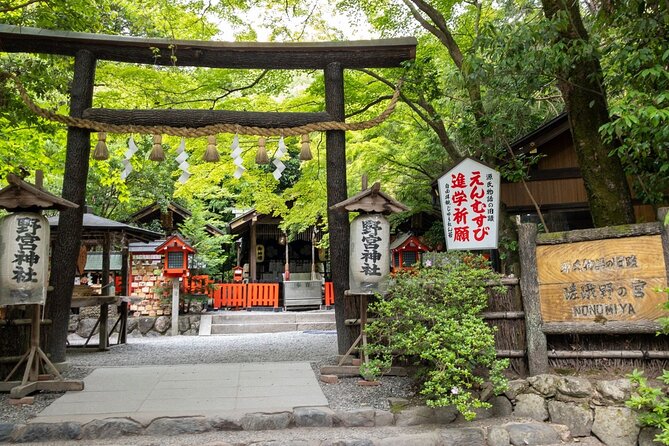
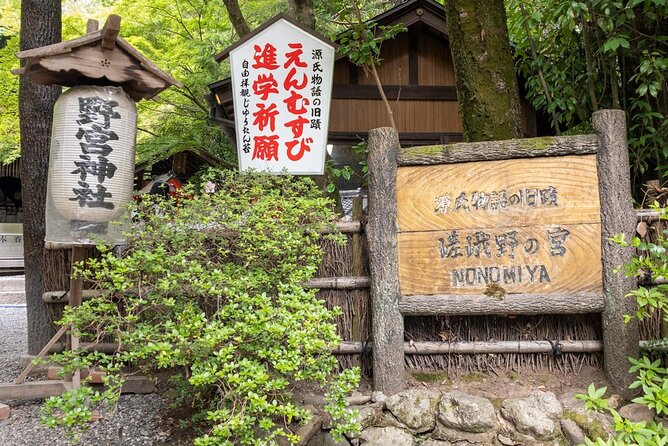
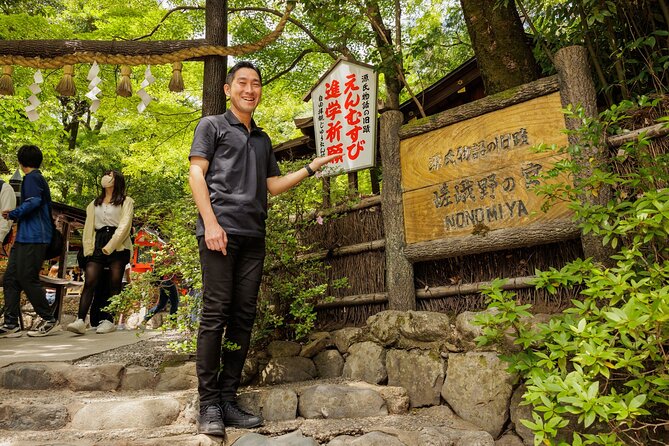
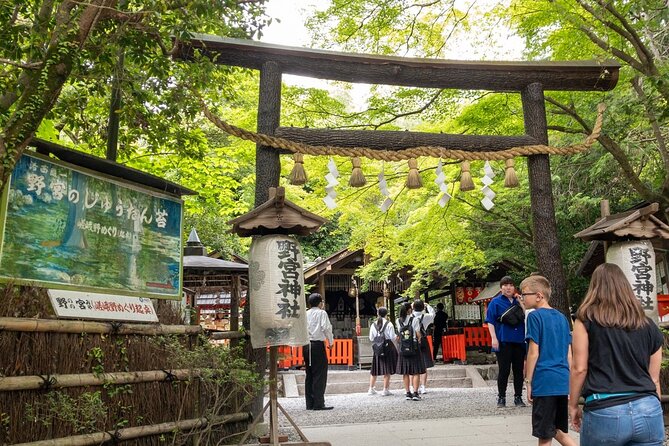
The meeting point is Randen-yaJapan inside the Arashiyama station complex at Randen Arashiyama Station. That is a practical start, since the area is close to public transportation and easy to combine with other Kyoto plans.
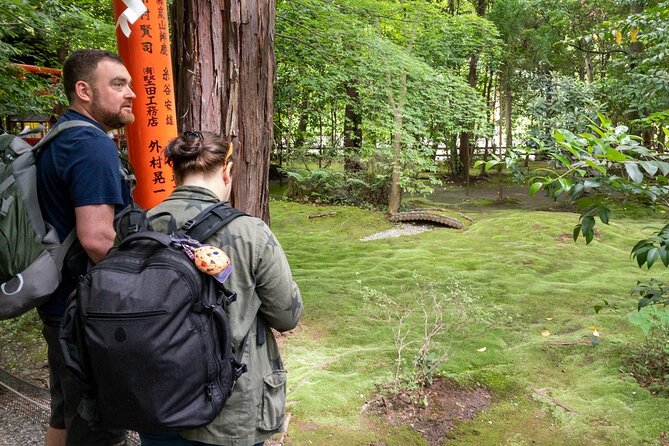
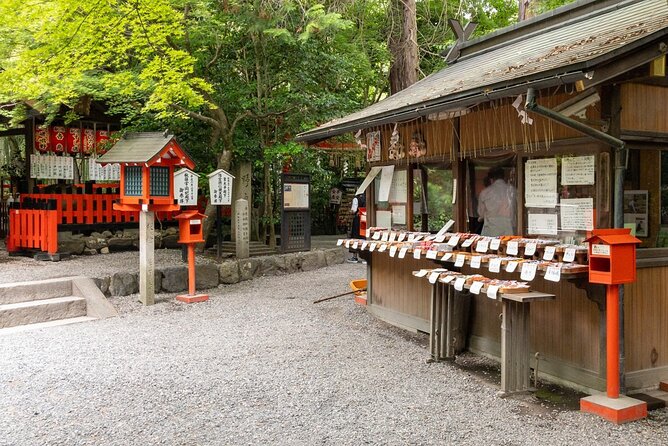
The first stop, Nonomiya Shrine, introduces two themes that continue through the morning: local religious customs and the way Arashiyama’s scenery connects with literature.
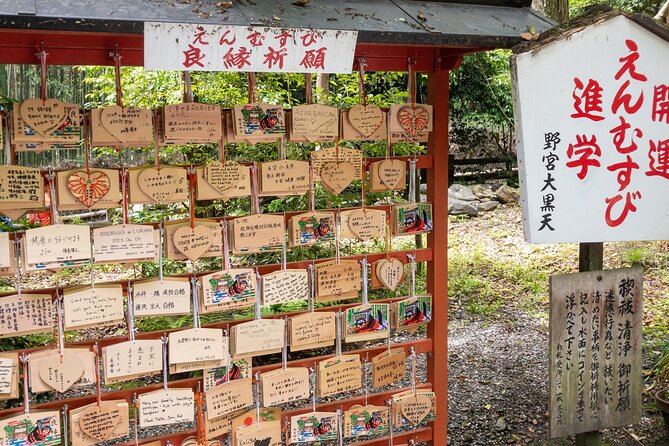
One of the shrine’s notable features is its black wooden torii gate. The tour explains that only two shrines in Japan have black torii gates, making this a detail worth noticing before you rush toward the bamboo.
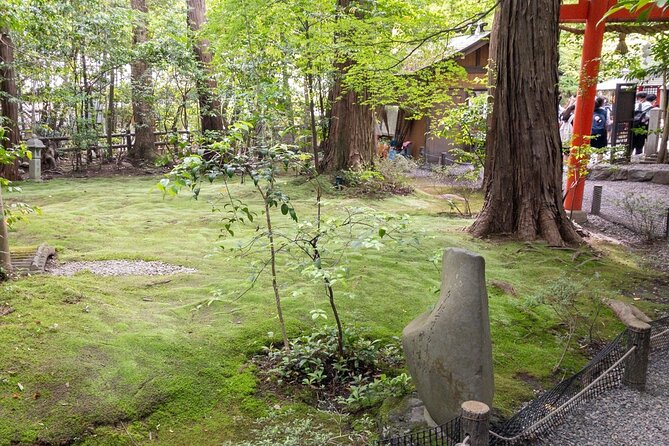
You will also see a moss garden and learn how to visit and pray at a Japanese shrine. Yusuke explains the difference between a shrine and a Buddhist temple, which is useful if you are seeing several religious sites during your Japan trip and want to know what you are looking at.
The stop lasts around 30 minutes. That is enough time for an explanation and a proper look, rather than a quick photo stop. The admission cost is free.
Fifteen minutes in the Arashiyama bamboo forest
The bamboo forest is the tour’s most familiar stop, but it is not treated as the whole event. You spend about 15 minutes among the bamboo, with time to hear the sound of the stalks, take photos, and enjoy the setting without letting one famous path consume the morning.
Yusuke helps take photos, including memorable shots in the bamboo forest. That is useful if you are traveling alone, as a couple, or with a small family group and want more than a hurried selfie.
Still, keep your expectations sensible. Fifteen minutes is enough for a taste, not an extended photography session. The point is to see the bamboo as one part of Arashiyama, then continue to places where the tour can offer more historical and cultural detail.
The bamboo stop has no separate admission charge. Good walking shoes are sensible, and you should be ready to continue on foot soon afterward.
Seiryoji Temple and a 1,200-year story
Seiryoji Temple is where the tour shifts from a popular scenic district to a more substantial temple visit. The original temple was established about 1,200 years ago, while the present buildings date from roughly 300 years ago.
You will see a Japanese national treasure, a statue of Shaka Nyorai, the historical Buddha. The value here is not only the object itself. Yusuke gives you context for the temple, its age, and the role of Buddhist worship in Japanese culture.
The visit lasts about 55 minutes, making it one of the more important stops. You have time to look around rather than being pushed through in a few minutes.
Admission to Seiryoji costs ¥500 per person and is not included in the tour price. You must remove your shoes before entering inside the temple. Wear socks you are comfortable with, and avoid footwear that is difficult to take off and put back on.
For anyone who wants only outdoor scenery, this indoor visit may feel like a pause in the walking rhythm. I see it as one of the tour’s stronger sections, especially if you want more than a succession of gardens and photo points.
More walking tours in Kyoto:
- Kyoto Geisha Walking Tour: Gion District & Hidden Gems
★ 4.7 · 3,273 reviews - Kyoto: Gion Magical Night Walking Tour with Geisha Trivia
★ 4.9 · 2,393 reviews - Kyoto: Gion Geisha District Walking Tour – Stories of Geisha
★ 4.7 · 2,187 reviews - Night Walk in Gion: Kyoto’s Geisha District
★ 4.5 · 2,003 reviews
Daikakuji, the former imperial residence
Daikakuji gives the tour its strongest sense of place. The temple began as Saga Gosho, a former imperial palace built about 1,200 years ago. The buildings you see today allow you to picture an older courtly world in a way that a standard city walk often cannot.
The tour spends about 50 minutes here. Yusuke points out the temple’s unusual features and explains its connection to the imperial past. The setting is also important for the The Tale of Genji option, since most places on the route, apart from the bamboo forest, appear in or connect with the novel’s world.
If you choose the literary option, Yusuke adds more background about the characters, places, and historical setting. The locations do not change. You simply receive more storytelling about the book and its place in Japanese culture.
You must remove your shoes to enter Daikakuji. Admission is listed together with Osawa-no-ike Pond at ¥800 per person, separate from the tour price. Check the exact payment arrangement when booking, since Seiryoji has its own ¥500 admission charge.
Daikakuji is also the end point of the standard walk. There are not many restaurants around the ending point, so bring a snack if you expect to be hungry after several hours outside. An optional Japanese snack during the tour costs about ¥500.
Osawa-no-ike Pond and the final quiet view
Osawa-no-ike is described as Japan’s oldest artificial pond. The stop lasts about 20 minutes, which gives you time to appreciate the water, seasonal scenery, and a quieter bamboo area without needing a long detour.
This is a good final stop because it slows the pace after the temples. You can look across the pond, enjoy the surrounding greenery, and finish with a sense of Arashiyama as a place of gardens and retreat, not only as a famous photo backdrop.
The pond admission is part of the ¥800 Daikakuji and Osawa-no-ike ticket listed for the tour. It is not included in the $89 price.
The standard ending is Daikakuji Temple. If you prefer to return to the starting point, Yusuke offers a free walking return tour. That makes the route easier to fit into a day when your transportation plans bring you back toward central Arashiyama.
What the $89 price really covers
At $89 per person, this is not the cheapest way to see the bamboo forest. But the bamboo forest is only a small part of what you are paying for.
Your fee covers Yusuke’s guiding, the original 15-page tour booklet, and help taking good photos. The small group size also changes the experience. With no more than six people, you have a better chance to ask questions, hear the explanations, and move at a comfortable pace.
You should add the following costs to your budget:
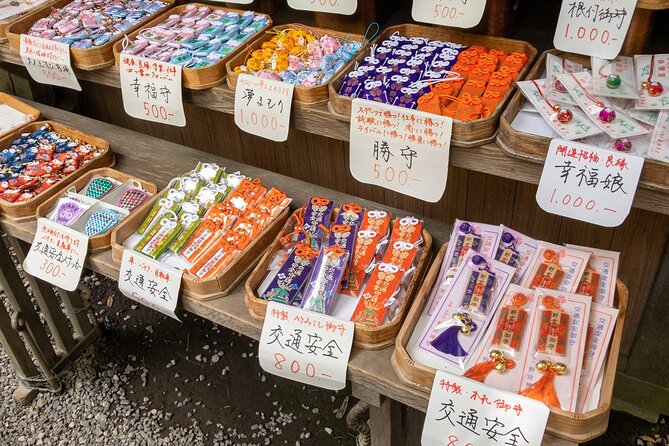
- Seiryoji Temple: ¥500 per person
- Daikakuji Temple and Osawa-no-ike Pond: ¥800 per person
- Optional Japanese snacks: about ¥500
- Personal travel insurance, if you want it
That brings the known admission costs to ¥1,300 per person, before snacks. The price makes the most sense for someone who values a guide’s interpretation, photo help, and a carefully planned route. It makes less sense if you are comfortable navigating temples independently and mainly want a short bamboo-forest visit.
The Tale of Genji option for literary-minded visitors
The literary option is a useful choice rather than a separate route. Both versions visit the same five locations. The difference is the amount of attention given to The Tale of Genji and its historical setting.
Most of the stops, excluding the bamboo forest, appear in the novel. If you have read the book, the extra context can make the walk feel like a visit to places connected with its world. If you have not read it, the option may still add interest, but the standard tour may be enough if your main focus is temples, gardens, and local customs.
One useful point is that the literary choice does not remove the practical parts of the experience. You still learn how to pray, see the same gardens and buildings, and receive the same route. You are choosing a different style of explanation, not a different set of sights.
A guest who had read The Tale of Genji was especially eager to follow its fictional footsteps. That gives you a clear sense of who should choose this version: readers who want history and literature woven into their sightseeing.
Pace, heat, and the practical side of walking
The route covers about 3 kilometers, with approximately 55 minutes of walking time included in the total four-hour schedule. That is not an extreme distance, but the day can feel longer because the walk takes place in warm weather, temple grounds, and streets where you may stand during explanations.
A 68-year-old participant found the route tiring on a hot day, despite enjoying the literary content. I would take that seriously if you have limited stamina or are visiting Kyoto during a hot season. Ask Yusuke to adjust the pace if needed, and plan water and comfortable shoes.
Most people can take part, but this is not a seated sightseeing experience. You will walk between several stops, enter buildings without shoes, and finish away from the starting point unless you take the free return walk.
The weather also matters. The activity requires good weather. If poor conditions lead to cancellation, you are offered another date or a full refund.
Who will get the most from this experience
I would choose this tour if you want a small-group introduction to Arashiyama that goes beyond the standard central route. It suits first-time visitors who want help understanding Japanese religious sites, as well as returning visitors who have already seen the main bamboo path.
It is also a strong fit for readers of The Tale of Genji, photographers who appreciate help with pictures, and visitors who prefer a guide to explain what they are seeing rather than simply point out names.
You may want to skip it if your time in Kyoto is very limited, you want to move at your own pace, or you mainly want the bamboo forest. The 3 to 4 hour schedule takes a good part of a morning or afternoon, and the added temple fees increase the final cost.
The route is also less convenient for a meal at the end. Since there are not many restaurants around Daikakuji, carry a snack or plan food elsewhere.
Final call: should you book Yusuke’s Arashiyama walk?
Book it if you want to see Arashiyama through its temples, imperial connections, local customs, and quieter scenery, not just through the bamboo forest. Yusuke’s personal guiding, photo help, booklet, and group limit of six add real value for visitors who enjoy context.
Choose the The Tale of Genji option if the novel matters to you. Choose the standard version if you want the same places with a broader focus on Kyoto culture and history.
Skip it if you dislike walking, need a low-cost outing, or have only enough time for a quick bamboo-forest stop. For everyone else, this is a thoughtful way to spend several hours in Arashiyama, with the busiest sight treated as an introduction rather than the main event.
FAQ
How long does the Arashiyama Hidden Gems walking tour take?
The tour takes about 3 to 4 hours. Walking time is included, with approximately 3 kilometers or 55 minutes of walking during the experience.
How many people can join the tour?
The group has a maximum of six travelers.
Who guides the tour?
Yusuke Tanaka guides the tour himself. He designed the route and has experience guiding more than 3,000 guests.
Where does the tour start?
The tour starts at Randen-yaJapan, inside the Randen Arashiyama station complex at 202 Sagatenryuji Tsukurimichicho, Ukyo Ward, Kyoto.
Where does the tour end?
The standard tour ends at Daikakuji Temple. If you prefer to return to the starting point, Yusuke offers a free walking return tour.
Are temple admission fees included?
No. Seiryoji Temple costs ¥500 per person. Daikakuji Temple and Osawa-no-ike Pond are listed together at ¥800 per person.
Do I need to remove my shoes?
Yes. You must remove your shoes when entering inside Seiryoji Temple and Daikakuji Temple.
What is included in the tour price?
The price includes guiding, an original tour booklet of about 15 pages, and help taking photos.
What happens if the weather is poor?
The experience requires good weather. If it is canceled because of poor weather, you can choose another date or receive a full refund. Free cancellation is available up to 24 hours before the start time.
Recently added around Kyoto
- Higashiyama | Kyoto: Sakura Season Private Rickshaw Tour★ 5.0 · 3 reviews
- Kyoto Kimono Rental CHAMATSU|Kimono/Yukata Rental FamilyPlan★ 5.0 · 3 reviews
- Kyoto: Half-Day Private Guided Tour to the Old Town of Gion★ 4.4 · 3 reviews
- Nara Private Customizable Half Day Tour★ 5.0 · 3 reviews
- Kansai Region Hiking Adventure in Nara Kobe Kyoto and More★ 5.0 · 3 reviews
- Full Day Nara Deer, Temple, Shrine, Activities & Tea Ceremony★ 5.0 · 3 reviews
- Nara: Essential Private Tour with Deer Park and Temples★ 5.0 · 3 reviews
- Photo Shoot with a Private Vacation Photographer in KYOTO, JAPAN★ 5.0 · 3 reviews
Arashiyama Bamboo Grove Tours, compared.
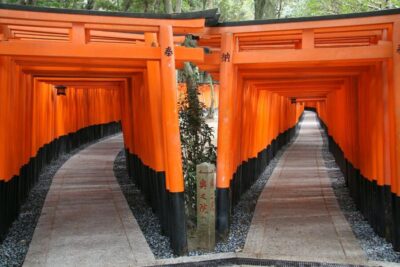
Fushimi Inari, Kinkakuji, Bamboo Grove 1 Day Bus Tour
Read our review →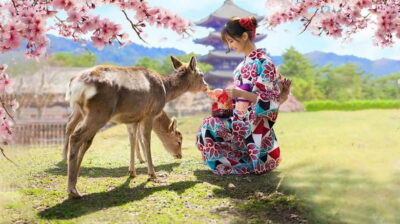
Kyoto/Osaka: Nara, Fushimi Inari Taisha, Arashiyama Bus Tour
Read our review →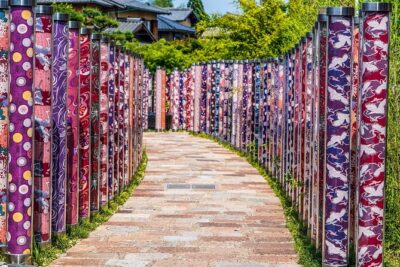
Kyoto Arashiyama Walking Tour: Bamboo, Monkeys, Gardens & Secrets
Read our review →
Arashiyama Bamboo, Temple, Monkeys, or Secret Sake Brewery
Read our review →
Arashiyama Bamboo Forest, Monkeys, Matcha & Temple Tour
Read our review →
Nijo, Kinkaku-ji, Arashiyama, Kiyomizu & Fushimi Inari
Read our review →
Kyoto Ghost Tour: Dark Tales, Urban Legends, Bamboo Forest Night
Read our review →
Arashiyama Bamboo Forest & Hidden Gems Bike Tour (Early Bird)
Read our review →Browse the lists this tour appears in